Winchester Cathedral
England's oldest cathedral city, where medieval pilgrimage still begins
Understand sacred places, explore living traditions, and learn how to engage respectfully with Pilgrim Map.
Access has not been verified. Check current local guidance before planning a visit.
Winchester, England, United Kingdom
Read the sources
Visit essentials
A quick read before you go
- Duration
- Allow 2–3 hours for a thorough visit: nave, Norman transepts, crypt (if accessible),…
- Access
- Winchester Cathedral is in the city centre within a pedestrianised close.
Overview
The Old Minster was raised around 648 CE by Cynegils, the first Christian king of Wessex, making Winchester one of southern England's earliest Christian centers. It became the burial ground of Saxon kings and the home of Saint Swithun's bones, which drew pilgrims from across the medieval world.
Swithun, Bishop of Winchester, died in 862 asking to be buried outside, where passers-by would walk over him and heaven's rain fall on his grave. Monks moved his remains inside in 971, followed, legend says, by forty days of rain. That translation made Winchester one of medieval England's great pilgrimage destinations, rivaled in the country only by Canterbury.
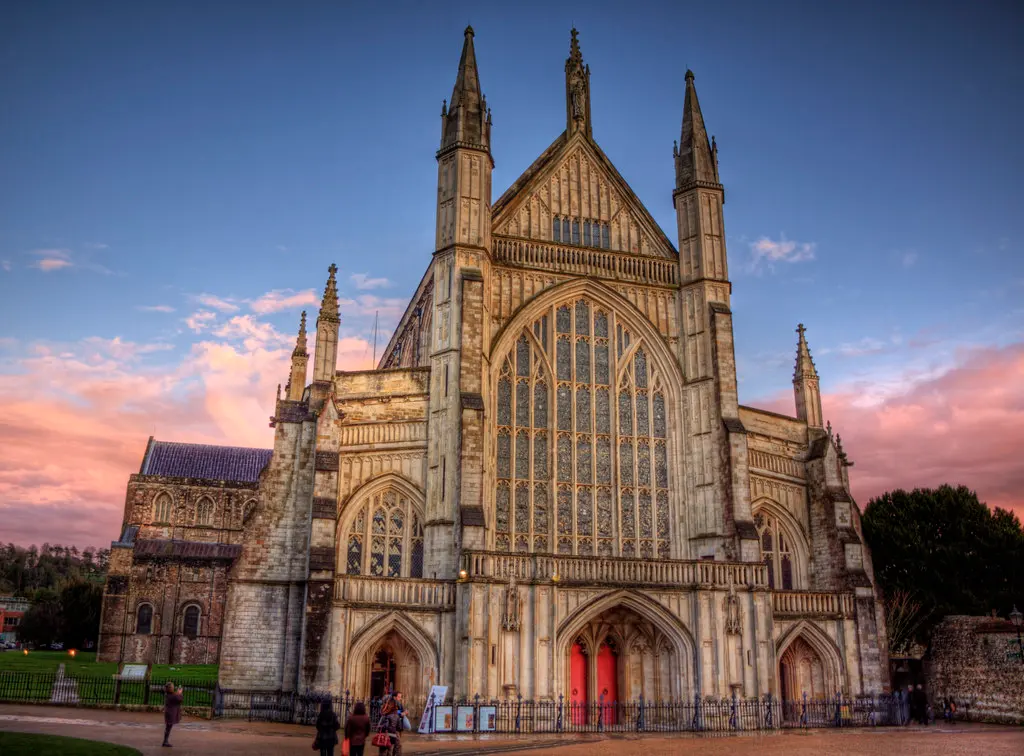
Today's cathedral was begun in 1079 by Bishop Walkelin, William the Conqueror's cousin, who reportedly demolished the Saxon church so hastily that William complained. Four centuries produced the world's longest medieval cathedral nave, 170 meters, joining Norman, Early English, and Perpendicular Gothic. From 1906 to 1911, diver William Walker saved foundations eroded by boggy ground, working underwater in complete darkness for six years.
The cathedral remains a beginning for the Pilgrim's Way to Canterbury. Pilgrims depart with a blessing and the echo of half a million footsteps across ten centuries.
Why this place is sacred
What makes Winchester Cathedral unusual among England's great churches is not any single feature but the density of its sacred layering. The same ground has been held as holy since the earliest years of English Christianity — before the Normans, before the Vikings raided the coast, before Bede wrote his history.
Standing in the Norman transepts, built from stone quarried on the Isle of Wight and shipped up the River Itchen, one stands inside an interior that was already 400 years old when Chaucer wrote the Canterbury Tales.
The crypt, which still floods in winter, is among the oldest and most atmospherically charged spaces in the building. Its rounded Romanesque arches and rough stone columns predate all the Gothic grandeur above by several centuries. During winter months, water rises to the ankles of Antony Gormley's cast-iron figure Sound II, which stands at the crypt's centre gazing into cupped hands — a contemporary image of contemplation set inside one of England's oldest sacred vaults.
Many visitors describe the experience of descending into this space as a genuine encounter with something they cannot easily name.
The commemorative shrine of St Swithun, which marks the original location of his medieval reliquary (destroyed in 1538 during the Dissolution), draws quiet attention from pilgrims and visitors who know the story. What was once among the most elaborately adorned shrines in England — adorned with gold, silver, and jewels, drawing sick pilgrims seeking miraculous healing — is now a plain stone marker. The absence is itself meaningful: a reminder of what was lost and what, in some form, persists.
For the Pilgrim's Way walker, the cathedral carries a particular quality of threshold. The route to Canterbury is 138 miles of chalk track and ancient path. Standing in the nave before departure, or receiving a pilgrim blessing at the start of the journey, connects the modern walker to the medieval tradition in a way that feels direct rather than merely historical.
Founded as a royal Saxon church and episcopal seat of the kingdom of Wessex, the site became a pilgrimage destination following the translation of St Swithun's relics in 971. The medieval cathedral functioned simultaneously as a place of daily monastic worship (Benedictine Priory of St Swithun until 1539), a pilgrimage shrine, a royal mausoleum, and the ecclesiastical centre of one of the most powerful dioceses in England.
The site has moved through at least five distinct phases: a 7th-century Saxon minster and royal burial place; a major Anglo-Saxon pilgrimage centre following the translation of Swithun's relics; a Norman cathedral replacing the Saxon structures from 1079; a medieval Catholic cathedral and Benedictine priory until the Dissolution in 1539; and since the Reformation, a functioning Anglican cathedral and mother church of the Diocese of Winchester. The physical building reflects all these phases.
The ancient shrine was destroyed but never forgotten — it was commemorated anew in the 20th century and remains a focus of pilgrimage today.
Experience and orientation
The nave arrives as a physical fact: the longest in the world for a medieval cathedral, 170 metres from west door to high altar. The scale is not immediately comprehensible. The eye moves upward to the fan-vaulted ceiling, a product of the late 14th-century Perpendicular remodelling, and then outward toward the Norman transepts, where the architecture becomes heavier, more elemental, the arches rounded instead of pointed.
These two structural registers — the soaring Gothic of the nave and the compressed Romanesque of the transepts — coexist without contradiction. The building teaches its own history through the weight and proportion of its stone.
In the north aisle, a plain black ledger slab marks the grave of Jane Austen, who died in Winchester in 1817. She asked to be buried facing the altar; she was. The response of visitors to this grave is often unexpectedly emotional — something about the spareness of the inscription, the stone worn smooth by time.
The crypt lies below the choir and is accessible via a narrow stair. When not flooded, it opens to visitors and reveals its Romanesque bones — low round arches, massive piers, and the quality of underground silence that belongs to spaces built for the dead rather than the living. At its centre, Antony Gormley's Sound II stands in contemplation.
The figure is not religious in any specific sense, but its placement in this space — motionless, inward-facing, surrounded by water when the Thames-linked aquifer rises — gives it an authority that seems earned rather than imposed.
The commemorative shrine of St Swithun stands near the site of the original medieval reliquary, destroyed in 1538. Pilgrims who arrive at Winchester as the starting point of the Pilgrim's Way often pause here first, making some form of acknowledgement before they begin — a moment of orientation that connects the present walk to a tradition reaching back to the 10th century.
Enter through the west doors to encounter the full length of the nave immediately. The Norman transepts are to the north and south as you approach the crossing. The crypt entrance is near the south transept. The commemorative shrine of St Swithun is in the retrochoir behind the high altar. Jane Austen's grave is in the north aisle near the west end. The Kings and Scribes exhibition, including the Winchester Bible, is housed in the library.
Pilgrim blessings, when available, can be arranged through the cathedral's welcome team. The Cathedral Close and surrounding precinct are pedestrianised and worth walking in full before or after entering the building.
Context and lineage
The story of Winchester Cathedral begins with Cynegils, the first Christian king of Wessex, who founded a church on this site around 648 CE. This Old Minster became the ecclesiastical heart of a kingdom that would eventually become England. It was here that Alfred the Great, who ruled from Winchester, chose his capital. The city was England's effective capital through the Saxon and early Norman periods.
Saint Swithun served as Bishop of Winchester from around 852 until his death in 862. His request for a humble outdoor grave was overruled by his successors, and when his remains were formally translated inside the church on 15 July 971, the forty days of rain that followed became fixed in English folk memory as the St Swithun's Day weather omen.
The translation established his shrine as a pilgrimage destination and Winchester as the western anchor of the great medieval pilgrimage road to Canterbury.
In 1079, Bishop Walkelin — appointed by and related to William the Conqueror — began construction of the present Norman cathedral. According to tradition, he demolished the Saxon buildings with such speed that his uncle William complained the whole of Winchester had been destroyed. The Norman structure took decades to complete; its transepts survive largely intact, some of the finest Romanesque church interiors in England.
By the 14th century, the nave was being remodelled in the Perpendicular Gothic style under Bishops William of Wykeham and William of Waynflete — a project that transformed the interior into the grand Gothic space visitors see today while preserving the Norman structure beneath. The medieval shrine of St Swithun, by then one of the wealthiest in England, was stripped of its treasures and destroyed in 1538 during Henry VIII's dissolution of the monasteries.
The Benedictine Priory of St Swithun, which had sustained continuous monastic worship at the cathedral since the 10th century, was dissolved in 1539.
In the early 20th century, the building faced catastrophe: the foundations, saturated by Winchester's high water table, had been undermined over centuries. Between 1906 and 1911, a diver named William Walker — working alone, in complete darkness, six hours a day — replaced 25,000 bags of concrete, 115,000 concrete blocks, and 900,000 bricks beneath the waterlogged foundations, effectively saving the cathedral from collapse. A monument to Walker stands in the nave.
The Diocese of Winchester, established with the Old Minster in the 7th century, was at the height of its power in the medieval period one of the wealthiest and most politically influential in England, its territorial reach extending at times from the Thames to the Channel Islands. The cathedral passed from Anglo-Saxon to Norman to Plantagenet to Tudor hands — each phase leaving architectural and institutional traces.
Since the Reformation it has been the mother church of the Church of England's Diocese of Winchester. The Benedictine monastic tradition that sustained worship here from the 10th to 16th centuries left its mark in the choral tradition, which continues in a modified form through the Cathedral Choir.
Saint Swithun
Bishop of Winchester, patron saint and dedicatee
Cynegils
Founder of the original church
Bishop Walkelin
Builder of the Norman cathedral
William of Wykeham
Bishop of Winchester, architect of the Perpendicular nave
William Walker
Diver who saved the cathedral foundations
Jane Austen
Author, buried in the north aisle
Traditions and practice
The Benedictine monks of the Priory of St Swithun maintained the Hours — the cycle of daily prayer from Matins to Compline — for approximately five centuries before the Dissolution. The choral tradition rooted in this monastic office continues, in Anglican form, through the Cathedral Choir, which sings Choral Evensong throughout the year. The St Swithun's Day observance on 15 July commemorates the translation of the saint's relics and has been marked continuously, in varying forms, since 971 CE.
Before the Reformation, veneration of Swithun's shrine drew pilgrims from across England and beyond who came seeking miraculous healing and the spiritual merit associated with pilgrimage.
The cathedral holds daily services: Holy Communion each morning, Morning Prayer, and Evening Prayer. Choral Evensong is sung by the Cathedral Choir on most days of the year. On selected Sundays, a Taizé-style meditative Evening Prayer provides a contemplative service accessible to those outside formal Anglican practice. All public services are open to visitors free of charge. The annual St Swithun's Day service on 15 July includes a commemorative element honouring the saint's pilgrimage tradition.
Pilgrim blessings for walkers beginning the Pilgrim's Way can be arranged through the cathedral's welcome team.
For those arriving as the start of the Pilgrim's Way, attending Choral Evensong on the evening before departure — or Morning Prayer on the morning of departure — provides a genuine liturgical framing for the journey. The retrochoir, where the commemorative shrine of St Swithun stands, is worth extended time: approach it after the main nave, allow the space to settle. The crypt, if accessible, is best visited in silence and without rush.
The Winchester Bible, housed in the cathedral library as part of the Kings and Scribes exhibition, is one of the finest illuminated manuscripts in the world — allow an hour if this matters to you.
Anglican Christianity / Church of England
ActiveWinchester Cathedral is the mother church of the Diocese of Winchester and seat of the Bishop of Winchester. Daily worship has been maintained on this site, in varying liturgical forms, since the 7th century. The cathedral is one of the oldest continuously active places of Christian worship in England.
Daily Holy Communion, Morning Prayer, and Evening Prayer throughout the year. Choral Evensong sung by the Cathedral Choir on most days. Annual St Swithun's Day service on 15 July. Pilgrim blessings for walkers beginning the Pilgrim's Way to Canterbury. Taizé-style meditative Evening Prayer on selected Sundays.
Medieval Catholic Pilgrimage
HistoricalBefore the Reformation, the shrine of St Swithun at Winchester was one of the most important pilgrimage destinations in England, drawing pilgrims seeking miraculous healing and the spiritual merit of venerating a major saint. Winchester formed one anchor of the great pilgrimage axis linking it to Canterbury's shrine of Thomas Becket. The shrine was destroyed in 1538 during the Dissolution of the Monasteries.
Veneration of St Swithun's relics, seeking miraculous healing, departure point for pilgrimage to Canterbury. A commemorative shrine now marks the location of the destroyed medieval reliquary and draws quiet attention from visitors and pilgrims.
Benedictine Monasticism
HistoricalThe Benedictine Priory of St Swithun occupied the cathedral from around the 10th century until the Dissolution of the Monasteries in 1539. For approximately five centuries, monks sustained the Hours — the full cycle of daily prayer from Matins to Compline — in this building. The choral tradition they developed shaped the cathedral's liturgical identity in ways that persist in the Anglican choir today.
The full Benedictine Divine Office; monastic care of the shrine of St Swithun; scriptoria producing manuscripts including the Winchester Bible.
Perspectives and open questions
Winchester Cathedral holds an unusual place in English religious history: it is both a cathedral of immense architectural and institutional significance and a site whose meanings have been actively contested, transformed, and renewed across more than thirteen centuries. Different traditions — scholarly, liturgical, pilgrimage, and esoteric — draw on different aspects of this long record without obvious contradiction.
Scholarly perspective
Historians and architectural scholars regard Winchester Cathedral as one of the most important medieval buildings in northern Europe. Its Norman transepts (begun 1079) are among the best-preserved examples of 11th-century Romanesque ecclesiastical architecture in England. The Perpendicular Gothic nave, completed over several decades in the 14th and 15th centuries, represents the mature English expression of late medieval Gothic.
The Winchester Bible, produced at the cathedral scriptorium between approximately 1160 and 1175, is one of the finest surviving examples of 12th-century Romanesque manuscript illumination in the world. Scholars of medieval religion regard the shrine of St Swithun as a significant case study in the social and economic role of saints' cults in medieval England — the massive pilgrimage traffic it generated helped fund both the cathedral's physical development and the broader ecclesiastical infrastructure of the diocese.
Living and traditional perspectives
Within the Church of England, Winchester Cathedral holds a position of exceptional antiquity and authority. The Diocese of Winchester, which claims apostolic succession through a continuous line of bishops from the 7th century, regards the cathedral as the mother church of a tradition older than the English nation itself. The choral tradition maintained by the Cathedral Choir is seen as a living continuation of the Benedictine monastic office, adapted for Anglican worship after the Reformation.
St Swithun remains the cathedral's patron: his feast day on 15 July is observed annually, and pilgrims who come to begin the Pilgrim's Way are received as participants in a tradition the church actively honours.
Alternative interpretations
Some pilgrims and those drawn to Britain's pre-Christian sacred geography read Winchester as more than a Christian site. The trackway that underlies parts of the Pilgrim's Way — the Harroway, one of Britain's oldest roads — predates Christianity and suggests that the chalk ridge between Winchester and Canterbury was already understood as a significant route before any church stood here.
This perspective holds that the Norman cathedral and the medieval pilgrimage tradition were layered onto an older pattern of sacred movement through the landscape. The connection between Winchester and Alfred the Great carries its own quasi-mythological weight: for some, the city remains a symbolic seat of English identity bound up with founding narratives that blend history and legend.
Open questions
The precise fate of St Swithun's original relics after the destruction of his shrine in 1538 remains unresolved. Some fragments are believed to have been preserved, possibly dispersed to European reliquaries or held in private hands, but no confirmed fragment has been authenticated. The exact form of the 7th-century Old Minster has not been fully established through excavation; archaeological work has revealed its general footprint, but details of its original appearance remain speculative.
The pre-Christian significance, if any, of the chalk ridge trackway underlying parts of the Pilgrim's Way continues to be debated among archaeologists and historians.
Plan your visit
Access and arrival
Winchester Cathedral is in the city centre within a pedestrianised close. No parking within the Cathedral Close; city centre car parks are nearby. Winchester railway station is approximately 10 minutes' walk. The Pilgrim's Way begins from the cathedral, heading east through the city before joining the South Downs Way and ancient chalk trackways. The first stage (Winchester to Ropley) is approximately 12 miles. Admission charges apply for non-worshippers visiting as tourists; attendance at services is always free.
Winchester has a range of accommodation within walking distance of the cathedral, from city-centre hotels to B&Bs in the surrounding streets. For pilgrims beginning the Pilgrim's Way, the city offers a convenient base the night before departure. The cathedral does not operate pilgrim accommodation; for organised Pilgrim's Way walks, the British Pilgrimage Trust website lists relevant resources and route guidance.
Respectful visit
Modest, respectful dress appropriate to a working church. No specific dress code is enforced at the door, but visitors are expected to dress in a manner consistent with entering a sacred space.
Photography for personal use is generally permitted throughout the cathedral. Flash photography and the use of tripods are restricted. Photography during services is not appropriate. Commercial photography requires prior permission from the cathedral.
Candles may be lit in designated areas. Donations are welcomed at the entrance and throughout the building. Collections are taken at services.
Dogs are not permitted inside the cathedral, with the exception of registered assistance animals. Visitors are asked to remain quiet during services. Some areas may be inaccessible during worship.
The crypt floods periodically in winter and access is seasonal; check in advance. Services take precedence over visitor access to certain areas of the building — there are periods each day when the nave or choir is partially closed. Guided tours and tower climbs must be booked in advance and are not available at all hours.
Location
Map loads as you approach this section.
Pilgrim reflections
A portrait of encounter, not a score
Pilgrims describe what they felt, how present they could become, and whether the place would shape a journey. There are no stars and no ranking of traditions.
No reviewed reflections yet
The first pilgrims can help describe the character of being here.
Share a reflection
Available after an account-backed “Been there.” Every reflection is reviewed before publication.
Nearby sacred places
Explore other sacred places in the region. Proximity does not establish access or travel time; check each place’s guidance.



References
Sources consulted for this page. Source categories describe the publication, not a guarantee that every claim is verified. Traditional accounts and outside interpretations may differ.
- 01Winchester Cathedral — Wikipedia — Wikipedia contributorsacademicComprehensive overview of history, architecture, notable burials, and records
- 02Winchester Cathedral | History & Facts — Britannica — Encyclopaedia Britannica editorsacademicConfirms founding date 1079, Norman construction by Bishop Walkelin, and St Swithun patronage
- 03Winchester Cathedral — Official Website — Winchester Cathedral ChapterofficialPrimary official source for current worship, visitor information, exhibitions, and opening hours
- 04The Pilgrims' Way — Winchester to Canterbury — British Pilgrimage Trust — British Pilgrimage TrustofficialConfirms Winchester Cathedral as start of the Pilgrim's Way, connection between St Swithun shrine and Canterbury
- 05Swithun — Wikipedia — Wikipedia contributorsacademicDetails on St Swithun's life, death 862 AD, translation of relics 971, and the cathedral dedication
- 06Shrine of St Swithun — Hampshire History — Hampshire HistoryofficialDetails on the shrine of St Swithun and its role as pilgrimage destination
- 07Winchester Cathedral — Britain Express — Britain ExpressSource contextOverview of history, architecture, notable features, and visitor information
- 08Winchester Cathedral — History Hit — History HitSource contextContextual history and architectural development
Share a photo
Help visitors recognize Winchester Cathedral. Every submission is reviewed before publication.