Vinquoy Chambered Cairn
A Neolithic hilltop tomb of rough red sandstone, overlooking Eday's waters from the island's highest point
Understand sacred places, explore living traditions, and learn how to engage respectfully with Pilgrim Map.
Access has not been verified. Check current local guidance before planning a visit.
Eday, Scotland, United Kingdom
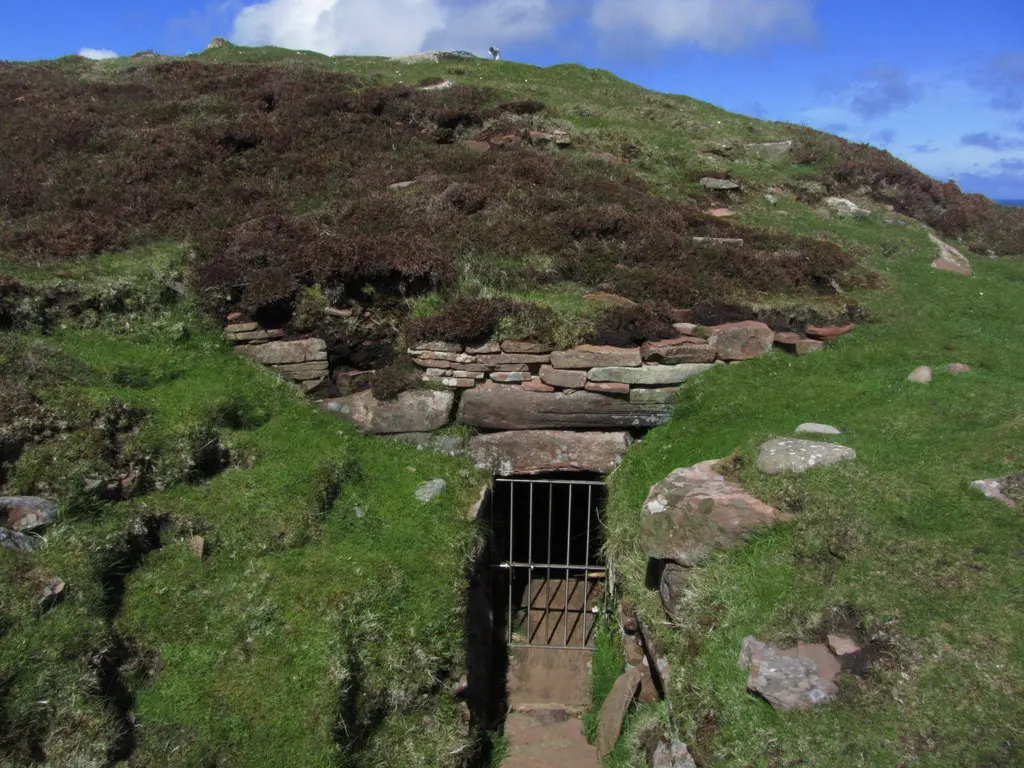
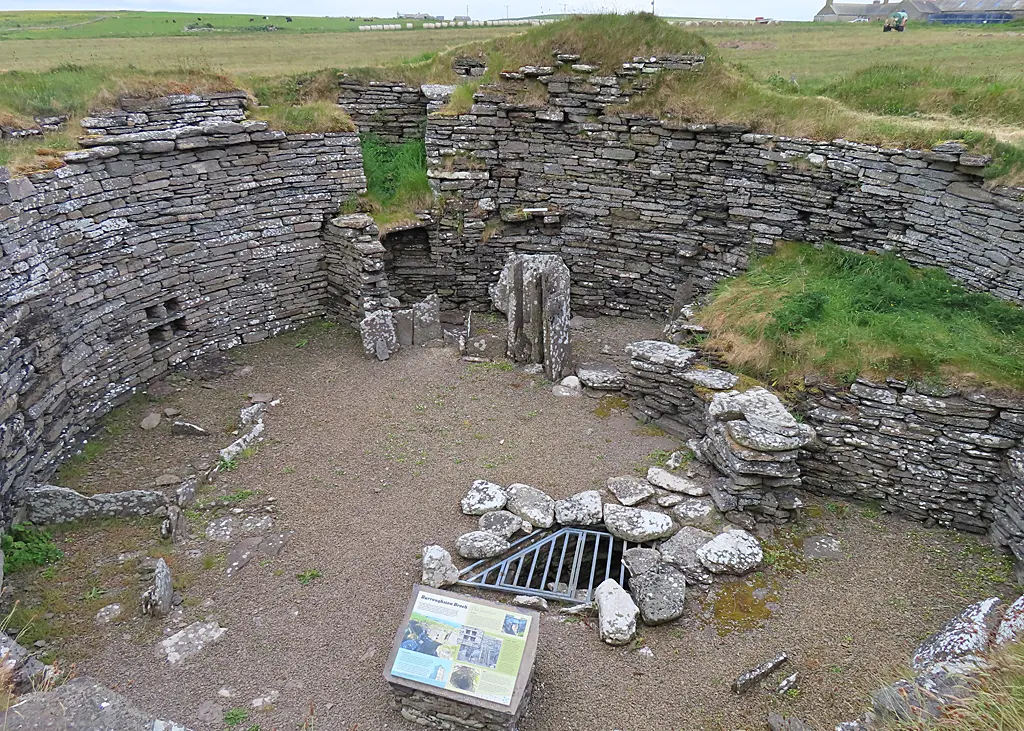
Image of Vinquoy Chambered Cairn. Image source · CC-BY-SA-2.0
Visit essentials
A quick read before you go
- Duration
- One hour to explore the cairn, enter the chamber, and appreciate the hilltop views.
- Access
- Eday is reached by Orkney Ferries from Kirkwall, approximately seventy-five minutes.
Overview
Vinquoy Hill rises gently from Eday's northern landscape, treeless moorland opening in all directions. The chambered cairn sits at the summit, a restored grass-covered mound with a modern concrete lintel protecting the entrance.
The tomb belongs to the Maeshowe type, a classification defined by a long entrance passage leading to a central rectangular chamber with side cells opening off it. This architectural form is distinctive to Orkney and represents one of the most sophisticated Neolithic building traditions in the British Isles.
Vinquoy shares its basic plan with Maeshowe itself, though it is smaller and less precisely constructed, reflecting the difference between Eday's coarse red sandstone and the easily split flagstone available on the Orkney Mainland.
The entrance passage is low, requiring visitors to crouch or crawl. This is original design, not later collapse. The Neolithic builders intended that those entering should bend, should make themselves smaller, should experience the transition from open sky to enclosed darkness as a physical event. The central chamber, roughly rectangular, admits faint light through the passage. Four small side cells open off the main space, each large enough to hold human remains.
James Farrer and Robert Fraser Hebden first excavated the tomb in 1857, breaking in through the top of the mound rather than clearing the entrance passage. Their methods, typical of the era, meant that any stratified deposits were disrupted. What they found, and what subsequent visitors have found, is the architecture itself: a space designed five thousand years ago to house the dead on the highest point of this island.
From the cairn's entrance, the view across Calf Sound to the Calf of Eday is expansive. On clear days, other Orkney islands are visible on the horizon. The dead were placed here not in hidden darkness but at the summit of their world, surrounded by sea and sky.
Why this place is sacred
The walk up Vinquoy Hill is itself a preparation. The ground rises gradually, the views expanding with each step. By the time you reach the summit, the island spreads below you, the sea visible in multiple directions. You stand at the boundary between earth and sky.
Then you crouch, and enter the passage. The world contracts. Stone walls close in. Light diminishes. The passage is low enough to require hands on the ground. This physical humbling is the architecture's intention. The builders designed a transition from the world of the living to the world of the dead, and they encoded that transition in stone.
The central chamber opens around you, darker than the passage but not entirely lightless. The four side cells are small, intimate, spaces that once held human remains. Standing in this space, you occupy a room designed for the dead, built five thousand years ago, still intact.
The return to daylight reverses the transition. Emerging from the passage, the sky and the view across Calf Sound arrive with renewed force. The contrast between the chamber's enclosure and the summit's exposure creates a perceptual shift, a recalibration of scale and awareness.
This oscillation between openness and enclosure, height and depth, light and darkness, may approximate something of the original experience the builders intended. Certainly it creates a liminal quality that modern visitors consistently notice.
Vinquoy functioned as a communal burial monument, a place where the dead were interred in the central chamber and side cells. The Maeshowe-type design allowed repeated access through the passage, suggesting ongoing relationship with the dead rather than single deposition. The hilltop location, commanding views across the island and the sea, suggests that placement of the dead was a significant act of landscape inscription.
The tomb was built around 3000 BCE and remained in use for an unknown period. It was first excavated in 1857 by James Farrer and Robert Fraser Hebden, who entered through the top of the mound. The cairn has been partially restored and the entrance passage cleared to allow visitor access. A modern concrete lintel protects the entrance. The site is managed by Historic Environment Scotland.
Experience and orientation
The walk to Vinquoy follows the Eday Heritage Trail from the road, crossing moorland and ascending the gentle slopes of Vinquoy Hill. The terrain is open, treeless, exposed to the wind. As you climb, the views open: Calf Sound below, the Calf of Eday across the water, and on clear days the profiles of other islands on the horizon.
The cairn appears at the summit as a grass-covered mound, modest in scale but commanding in position. A modern entrance with a concrete lintel marks the passage opening. A torch is useful but not essential; some light penetrates the passage.
Entering the passage requires crouching. The roughly hewn red sandstone walls are close, the ceiling low. The passage runs for several metres before opening into the central chamber. The rougher texture of Eday's sandstone, compared to the smooth flagstone of Maeshowe or Quoyness, gives the interior a more organic, less refined character. This is not a failing of construction but a consequence of material. The builders worked with what Eday offered.
The four side cells open off the central chamber, each a small alcove that once held human remains. The atmosphere is still and contained, insulated from the wind that scours the hilltop above.
Emerging from the passage, the panoramic view of Calf Sound and the surrounding sea arrives with particular force after the chamber's enclosure. This contrast is, arguably, the core of the experience Vinquoy offers.
Vinquoy Chambered Cairn is part of the Eday Heritage Walk, a five-mile circular route. It lies approximately 800 metres northwest of the Stone of Setter and can be combined with visits to the Huntersquoy and Braeside cairns nearby. The Heritage Walk begins at the Eday Community Enterprises Shop. Allow three to four hours for the full route.
Context and lineage
No origin narrative survives. The tomb was built by Neolithic farming communities on Eday as part of the broader Orcadian tradition of chambered cairn construction. The choice of the island's highest point for a burial monument suggests the dead held a position of prominence in the landscape and, presumably, in the community's cosmology.
No continuous tradition connects present-day visitors to the Neolithic builders. The tomb passed through subsequent millennia without recorded use or veneration. Its modern significance is archaeological and contemplative.
James Farrer
Robert Fraser Hebden
Traditions and practice
The original practices are unknown in their specifics. Archaeological evidence from comparable Orcadian tombs suggests communal burial with ongoing access to the dead, implying rituals of deposition, rearrangement, and possibly consultation with ancestors. Whether ceremonies took place in the chamber, at the entrance, or on the hilltop around the cairn cannot be determined.
No organised ceremonies take place. The site is visited by walkers on the Eday Heritage Trail and by those with archaeological or spiritual interests.
Enter the tomb with awareness of its original purpose. The passage demands a physical transition; allow this to register. In the chamber, spend time in stillness. The darkness and silence of the interior, the knowledge that this space was built for the dead, create conditions for reflection that require no formal practice to be meaningful.
Neolithic Orcadian Burial Tradition
HistoricalVinquoy represents the Maeshowe type of Neolithic passage tomb, the most architecturally sophisticated burial tradition in Orkney. These tombs, characterised by long entrance passages, central chambers, and side cells, were built by farming communities between approximately 3500 and 2500 BCE. They served as communal burial monuments where the dead were accessible to the living through the passage design.
The tombs were designed for repeated entry, suggesting ongoing rituals involving the dead. Evidence from comparable Orcadian cairns indicates both inhumation and cremation were practiced. The side cells may have held individual burials or groups of remains. Whether ceremonies took place inside the chamber, at the entrance, or around the cairn exterior is unknown.
Perspectives and open questions
Vinquoy Chambered Cairn offers a window into Neolithic funerary practice in Orkney, though the glass is opaque in places. The architecture survives; the beliefs it served do not.
Scholarly perspective
Vinquoy is classified as a Maeshowe-type chambered cairn, the most architecturally sophisticated form of Neolithic tomb in Orkney. A 2017 re-analysis of radiocarbon and luminescence dates from comparable sites suggests that Maeshowe-type cairns were first built in the middle of the fourth millennium BCE, with Vinquoy likely raised around 3000 BCE. The use of Eday's coarse red sandstone, rather than the easily split flagstone available on the Orkney Mainland, gives the tomb a rougher character than its counterparts.
The hilltop location is unusual among Maeshowe-type cairns, most of which occupy lower ground. The 1857 excavation by Farrer and Hebden was conducted using methods now considered destructive.
Living and traditional perspectives
No oral tradition survives from the Neolithic builders. Comparative study of Orcadian chambered cairns suggests a shared cosmology centred on ancestor veneration, with the dead maintained in accessible monuments rather than permanently sealed away. The specific contours of this worldview are lost.
Alternative interpretations
Some visitors experience the hilltop location and the tomb's darkness as complementary aspects of a deliberate design, an architecture that orchestrated the transition between the world of the living and the realm of the dead. Contemporary spiritual practitioners may engage with the site as a place of ancestor connection or earth-based practice.
Open questions
Whether the hilltop placement was chosen for cosmological reasons, for visibility, for territorial assertion, or for some other purpose is unknown. What ceremonies accompanied burials, whether the chamber was used for purposes beyond interment, and how long the tomb remained in active use are all unanswered questions.
Plan your visit
Access and arrival
Eday is reached by Orkney Ferries from Kirkwall, approximately seventy-five minutes. The cairn is on Vinquoy Hill, accessed via the signposted Heritage Trail. The walk to the summit involves a moderate hillside ascent across open moorland. Not wheelchair accessible.
Very limited accommodation on Eday. Book well in advance. More extensive options in Kirkwall on the Orkney Mainland.
Respectful visit
No specific requirements. Practical outdoor clothing and sturdy walking boots essential. Windproof and waterproof layers recommended.
Unrestricted. Interior photography requires a light source. The hilltop views provide dramatic backdrops.
Not traditional or expected. Do not leave objects inside the tomb or at the entrance.
Do not damage, disturb, or excavate any part of the monument. Do not climb on the cairn mound.
The passage is low and narrow; those with claustrophobia may find entry uncomfortable. A torch is recommended. The interior floor may be uneven. The hilltop is exposed to wind and weather; prepare accordingly.
Current practical details
Address
66GG+VX, Calfsound, Orkney KW17 2AB, UK
Hours, fees, and access can change — verify on the official source before you travel. Practical details last checked Jun 2026.
Location
Map loads as you approach this section.
Pilgrim reflections
A portrait of encounter, not a score
Pilgrims describe what they felt, how present they could become, and whether the place would shape a journey. There are no stars and no ranking of traditions.
No reviewed reflections yet
The first pilgrims can help describe the character of being here.
Share a reflection
Available after an account-backed “Been there.” Every reflection is reviewed before publication.
Nearby sacred places
Explore other sacred places in the region. Proximity does not establish access or travel time; check each place’s guidance.
Share a photo
Help visitors recognize Vinquoy Chambered Cairn. Every submission is reviewed before publication.