Marae Taputapuātea
The navel of Polynesia, where voyaging canoes still come home
Understand sacred places, explore living traditions, and learn how to engage respectfully with Pilgrim Map.
Access has not been verified. Check current local guidance before planning a visit.
Opoa, Raiatea, Society Islands, Leeward Islands, French Polynesia
Read the sources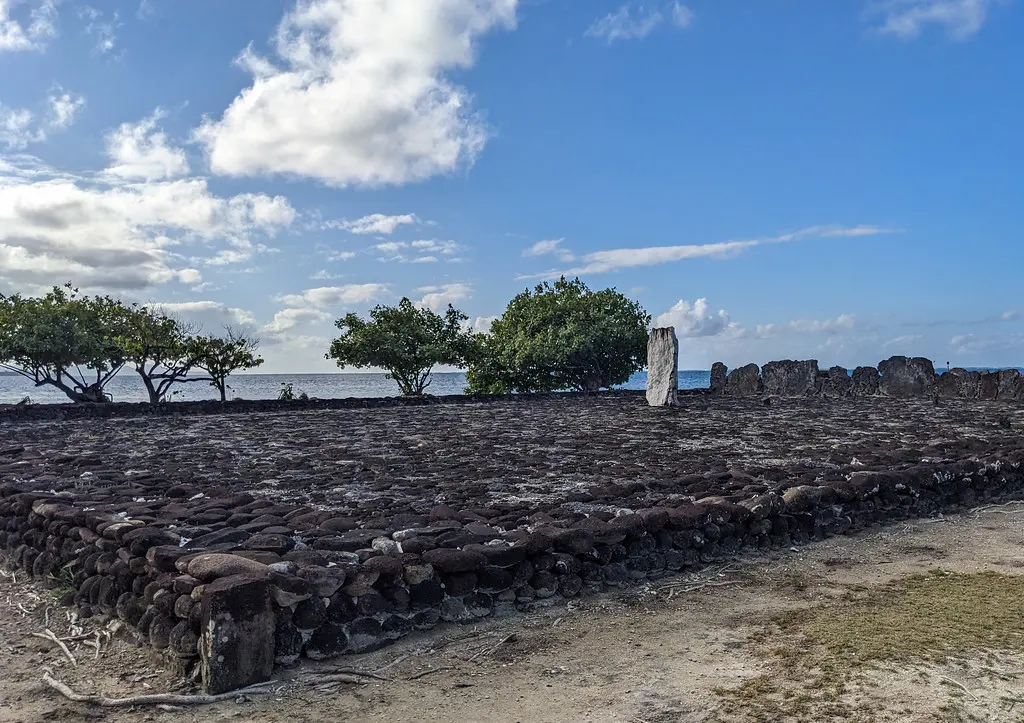
Image of Marae Taputapuātea. Image source
Visit essentials
A quick read before you go
- Duration
- One to two hours is generally sufficient to walk the marae complex and the adjoining Hauviri…
- Access
- Located at Opoa on the eastern coast of Raiatea, Society Islands, reachable by road from Uturoa…
Overview
On an ordinary afternoon, Taputapuātea reads as a hushed archaeological reserve: a broad paved tahua, a single upright ahu stone, and forest and lagoon pressed around a narrow peninsula at Opoa on Raiatea's eastern coast. Yet its tenders describe it as the piko—the navel—of the Polynesian Triangle. Mā'ohi and wider Polynesian tradition names it as the point from which voyaging, genealogy, and sacred authority radiated to Hawai'i, Aotearoa, and Rapa Nui, and to which those lines lead back.
In June 2025, the voyaging canoes Hōkūleʻa, Hikianalia, and Fa'afaite made landfall during a four-year Pacific-wide voyage. An acting high priest met them on the beach and put the ceremonial kapu to sleep before crew and canoes proceeded inland. In December 2023, more than 250 delegates from Hawai'i, the Marquesas, New Caledonia, and Rapa Nui gathered under the Taputapuātea name for prayer, chant, and offering.
UNESCO inscribed the site in 2017 for its testimony to roughly a thousand years of Mā'ohi civilization. These are meanings of the same ground.
Why this place is sacred
What made this particular stretch of reef and forest into the preeminent marae of the Society Islands, rather than any of the hundreds of others scattered across Polynesia, is a question the record answers only partway.
Mā'ohi tradition holds that the god 'Oro was born in the bay of Opoa and that his cult, once ascendant here, sent consecrated stones out to found sister marae across the Pacific — a physical, portable extension of this one site's spiritual authority into new ground. Priests and navigators are said to have converged at Taputapuātea to exchange genealogical knowledge, settle questions of cosmological origin, and negotiate alliance and war; the marae functioned simultaneously as temple, parliament, and archive.
That combination of functions is what UNESCO's Outstanding Universal Value language and Mā'ohi oral tradition converge on: not a shrine to a single power but a hub where the deepest kinds of knowledge — how the world began, how to find your way across open ocean, who is kin to whom — were held and transmitted.
The marae's name is often glossed as relating to sacrifices or offerings gathered from distant places, a etymology that itself gestures at the site's gravitational pull: this was where tribute, pilgrims, and knowledge from far-flung islands were drawn.
As the primary cult center of 'Oro — a status tradition attributes to his birth at Opoa — Taputapuātea functioned as the political-religious capital of the Society Islands: the venue for chiefly investiture at the adjoining Hauviri marae, for priestly assemblies exchanging cosmological and navigational knowledge, and for rites, including offerings and by some historical accounts sacrifice, addressed to 'Oro.
Before 'Oro's ascendancy, tradition holds the marae was linked to Ta'aroa, the supreme creator in Mā'ohi cosmology — though the exact sequence and timing of that religious transition is not settled across sources.
Bora Bora warriors raided and damaged the marae in 1763; Cook, Banks, and Solander visited in 1769 and left documentary record of a site already central to regional politics. Missionization in the nineteenth century ended organized 'Oro worship.
The stone complex was restored in 1994 and inscribed as a UNESCO World Heritage property in 2017 — a conservation-and-archive layer that today sits alongside, not in place of, a distinct and separate reactivation: since at least the early twenty-first century, the site has become the recognized ceremonial landfall point for Pacific voyaging culture, hosting welcome protocols for arriving canoes and multi-day pan-Polynesian festivals under the stewardship of the Opoa community association Na Papa E Va'u Raiatea.
Experience and orientation
The marae sits low and open against the water, the tahua courtyard wider than its single remaining ahu stone would suggest is necessary — as if built for gatherings much larger than any one family or clan. Reef and lagoon lie close on one side, forested valley rising behind on the other; the peninsula setting gives the whole complex a sense of being poised between land and open ocean, which is not incidental to what the place is for.
Travel accounts consistently note that this does not feel like a typical ruins visit: guidance asks for hushed, contemplative conduct, not because a sign demands it but because the site retains an active ceremonial status that a casual tourist stop does not. For Polynesian and Pacific Islander visitors especially, accounts describe something closer to homecoming than sightseeing — a genealogical and cultural reconnection to a site colonial history worked to sever.
Non-Polynesian visitors report a comparable sense of historical weight, though by their own account it registers differently: awe at standing inside the nexus of a thousand-year civilization, rather than the return described by those who trace their line to it.
The marae complex includes the main Taputapuātea platform and the adjoining Hauviri marae, historically used for chiefly investiture and, in 2025, part of the ceremonial procession route for arriving voyaging canoes.
Most visits take one to two hours on foot across the compact, largely unshaded grounds; the wider UNESCO-inscribed property extends beyond the stones themselves to two forested valleys, a stretch of lagoon and reef, and a strip of open ocean, underscoring that the protected zone was never just the courtyard.
Context and lineage
Mā'ohi oral tradition holds that the god 'Oro was born in the bay of Opoa and that the marae was established by Hiro, his descendant, to house and extend his cult. The site's name is popularly understood to reference offerings or sacrifices drawn from distant places — a description of its pull on pilgrims and tribute from across the Pacific rather than a claim about any single rite.
Sources disagree on chronology: some place the earliest structures as far back as roughly AD 1000, while the surviving architecture reflects building and rebuilding across the fourteenth through eighteenth centuries: academic and UNESCO framing treats the complex as a palimpsest of Mā'ohi civilization rather than the product of one founding act.
Earlier still, tradition links the site to Ta'aroa, the supreme creator, with 'Oro's cult later rising to dominance there — though which came first, and how the transition unfolded, is not resolved across the sources consulted.
Historically the complex was expanded across generations by the Tamatoa dynasty and successive Raiatean chiefs. Today its living lineage runs through the Opoa community and Association Na Papa E Va'u Raiatea locally, and through the wider network of Pacific voyaging organizations — including the Hawai'i-based Polynesian Voyaging Society and the Ka'iwakīloumoku Hawaiian Cultural Center — who treat Taputapuātea as the shared ancestral reference point of the Moananuiākea, the wider Pacific.
Hiro
Founding figure (traditional)
A descendant of the god 'Oro credited in oral tradition with establishing the marae at Opoa; his role sits within a body of tradition rather than a documentary record.
Andre Maramatoa
Acting High Priest
Presided over the June 2025 landfall ceremony for the voyaging canoes Hōkūleʻa, Hikianalia, and Fa'afaite, performing the traditional welcome protocol including putting the kapu to sleep and leading the procession to Hauviri and Taputapuātea marae.
James Cook
European documentarian of the site
Visited Taputapuātea in 1769 with Joseph Banks and Daniel Solander; their accounts form part of the documentary record UNESCO cites alongside oral tradition and archaeology in assessing the site's authenticity.
Association Na Papa E Va'u Raiatea
Community steward and advocate for UNESCO listing
A cultural association of Opoa community members credited with driving the successful campaign for the marae's 2017 UNESCO World Heritage inscription and with ongoing stewardship of the site.
Traditions and practice
Historically, the marae hosted the investiture of chiefs with ceremonial regalia (the maro 'ura) at the adjoining Hauviri marae, communal offerings and, per historical accounts including early European testimony, sacrifice directed to 'Oro accompanied by the sacred drum Ta'imoana, and the transport of consecrated stones from Taputapuātea to newly founded marae elsewhere in Polynesia — a practice that physically extended the site's religious authority outward across the ocean it faces.
Contemporary ceremonial use centers on the formal welcome of arriving voyaging canoes. The June 2025 landfall of Hōkūleʻa, Hikianalia, and Fa'afaite — vessels of the Polynesian Voyaging Society's four-year Moananuiākea Voyage — was met by an acting high priest who sounded the ritual kapu to sleep, followed by conch-shell sounding, chanting, a procession between Hauviri and Taputapuātea marae, gift presentation, and an 'awa ceremony.
Separately, the site's name and tradition anchor larger multi-day gatherings such as the December 2023 Taputapuātea Festival, which brought over 250 delegates from Hawai'i, Rapa Nui, New Caledonia, and the Marquesas together for prayer, chant, and offering — that particular festival was held on Rapa Nui rather than at the Raiatea marae itself, organized under the Taputapuātea cultural-revival banner. Neither event follows a fixed annual calendar; both are tied to the irregular rhythm of voyaging expeditions and cultural-exchange planning.
A visitor arriving on an ordinary day should expect a place for quiet attention rather than participation: walk the tahua slowly, stay off the stones, and hold silence as the operative courtesy rather than the exception. Those specifically drawn to the site's living ceremonial dimension should check current announcements from Tahiti Tourisme and the Polynesian Voyaging Society rather than assume a set schedule, since the significant gatherings are tied to voyaging cycles measured in years, not seasons.
Ancient Mā'ohi religion (Ta'aroa and 'Oro worship)
HistoricalTaputapuātea was originally associated with Ta'aroa before the cult of 'Oro, born at Opoa according to tradition, came to dominate and spread across the Society Islands and beyond via the 'Arioi society.
Ceremonial offerings and, per early European testimony and popular-history accounts, sacrifice; investiture of chiefs at the adjoining Hauviri marae; gathering of priests and navigators to exchange genealogical and cosmological knowledge; transport of consecrated stones to found sister marae elsewhere in Polynesia.
Contemporary pan-Polynesian voyaging and cultural revival
ActiveSince the late twentieth century, Taputapuātea has been reactivated as the symbolic center of Pacific voyaging heritage, the point of origin and return for the wider Polynesian Triangle.
Formal welcome ceremonies for arriving voyaging canoes, including the June 2025 landfall of Hōkūleʻa, Hikianalia, and Fa'afaite; multi-day pan-Pacific festivals such as the December 2023 Taputapuātea Festival.
UNESCO heritage conservation and scholarly archaeology
ActiveSince 2017, Taputapuātea has been formally recognized as testimony to roughly a thousand years of Mā'ohi civilization, anchoring ongoing conservation of its fragile stone structures.
Site conservation, archaeological documentation, and heritage-tourism interpretation under the World Heritage framework.
Perspectives and open questions
Taputapuātea is read differently depending on who is doing the reading — as a political-navigational hub by scholars, as a living ancestral homeland by Mā'ohi and Pacific voyaging communities, and, in a marginal and contested strand of popular writing, through a lens of ritual violence that official and indigenous sources alike decline to center.
Scholarly perspective
Academic and UNESCO framing treats Taputapuātea as the paramount ceremonial, political, and funerary complex of Eastern Polynesia, its Outstanding Universal Value resting on the convergence of archaeological evidence, Mā'ohi oral tradition, and early European documentary sources including Cook's 1769 visit. Scholars emphasize its role as a hub for navigational knowledge transmission and inter-island political alliance over a purely religious reading.
Living and traditional perspectives
Mā'ohi and broader Polynesian voices — represented by the Association Na Papa E Va'u Raiatea and the Ka'iwakīloumoku Hawaiian Cultural Center — describe Taputapuātea as a living ancestral homeland: the piko of a shared Polynesian family whose language, cosmology, and voyaging heritage span the entire Triangle. This perspective foregrounds continuity and reactivation over preservation, locating the site's significance in its ongoing capacity to host acts of ancestral reconnection.
Alternative interpretations
Some popular and alternative-history writing frames the site primarily through dramatic or esoteric emphasis on historical human sacrifice — a marginal, contested strand not corroborated as the site's primary meaning by official, academic, or indigenous-affiliated sources, which instead foreground its navigational, political, and ancestral functions.
Open questions
The precise chronology of the religious transition from Ta'aroa to 'Oro worship, the exact founding date of the earliest structures, and the full historical operation of the Fa'auta Aroha alliance network remain unresolved in the documentary and archaeological record, relying substantially on oral tradition whose details vary by source and community.
Plan your visit
Access and arrival
Located at Opoa on the eastern coast of Raiatea, Society Islands, reachable by road from Uturoa or by boat across the lagoon; Raiatea itself is accessible by air or inter-island ferry from Tahiti.
No specific on-site or Opoa-area accommodations were documented in research; travelers typically base in Uturoa, Raiatea's main town, and visit Taputapuātea as a day trip.
Respectful visit
No standardized dress code is specified for general visitors; modest, unshowy clothing is implied by the site's contemplative character. Ceremonial dress — such as the red wraps worn by voyaging crew during the 2025 landfall — belongs to invited participants, not visitors.
Personal photography is permitted but should never involve climbing on structures for a better shot or otherwise treating the marae as a backdrop rather than a sacred space.
No visitor offering protocol exists for casual tourists; offerings and gifts made during ceremonies (such as canoe-welcome protocols) are conducted by recognized cultural and religious authorities as part of formal rite, not by independent visitors.
Fires, alcohol, picnics, pets, graffiti, and climbing on or touching the stone structures are all prohibited. Stay on the designated paths, keep silence, and leave no trace. Visitor movement may be further restricted during active ceremonies or festivals at the discretion of the cultural authorities present.
Ceremonial participation — in canoe welcomes or pan-Polynesian festivals — is generally reserved for invited delegations, cultural practitioners, and community members; unaffiliated visitors should not expect or seek to join. Access and visitor movement may be further restricted at the discretion of cultural or religious authorities during active rites.
Location
Map loads as you approach this section.
Pilgrim reflections
A portrait of encounter, not a score
Pilgrims describe what they felt, how present they could become, and whether the place would shape a journey. There are no stars and no ranking of traditions.
No reviewed reflections yet
The first pilgrims can help describe the character of being here.
Share a reflection
Available after an account-backed “Been there.” Every reflection is reviewed before publication.
Nearby sacred places
Explore other sacred places in the region. Proximity does not establish access or travel time; check each place’s guidance.

Maeva Archaeological Site
Maeva, Huahine, Society Islands, Leeward Islands, French Polynesia
42.5 km away

Opunohu Marae Complex
Papetoai / Opunohu Valley, Moorea, Society Islands, Windward Islands, French Polynesia
180.6 km away
Marae Arahurahu
Paea, Tahiti, Society Islands, Windward Islands, French Polynesia
219.2 km away

Arai-Te-Tonga Marae
Avarua / Ngatangiia, Rarotonga, Rarotonga, Cook Islands
1005.2 km away
References
Sources consulted for this page. Source categories describe the publication, not a guarantee that every claim is verified. Traditional accounts and outside interpretations may differ.
- 01Taputapuātea — UNESCO World Heritage Centre — UNESCO World Heritage CentreofficialOfficial inscription record (2017); describes property boundaries, Outstanding Universal Value, authenticity/integrity assessment based on convergence of oral Mā'ohi tradition and documentary sources.
- 02Taputapuatea marae — Wikipedia — Wikipedia contributorsacademicDetailed history including 1763 Bora Bora raid, 1769 Cook/Banks/Solander visit, 1994 restoration, 2017 UNESCO listing, and Fa'auta Aroha regional alliance network.
- 03Hōkūleʻa and Hikianalia make Landfall at French Polynesia's Taputapuātea — Polynesian Voyaging SocietySource contextPrimary account from the Polynesian Voyaging Society (indigenous-led Hawaiian voyaging organization) of the June 2025 Moananuiākea Voyage landfall ceremony, including named High Priest Andre Maramatoa and ceremonial protocol details (Teawamoʻa pass, kapu, procession to Hauviri and Taputapuātea marae).
- 04TAPUTAPUĀTEA: Sacred Gathering Place of Navigators and Chiefs — Ka'iwakīloumoku Hawaiian Cultural Center, Kamehameha SchoolsSource contextIndigenous Hawaiian cultural institution perspective; emphasizes ongoing stewardship, transmission of navigation knowledge across the Moananuiākea (Pacific) region, and living-tradition framing.
- 05Exploring Taputapuatea — Tahiti Tourisme (Islands of Tahiti official tourism board)officialOfficial French Polynesian tourism board page with specific visitor etiquette guidance (no fires/alcohol/picnics/pets, stay on paths, no climbing on structures, maintain respectful silence, leave no trace).
- 06ʻOro — Wikipedia — Wikipedia contributorsacademicBackground on 'Oro as the Tahitian god of war and fertility, his cult's rise centered on Taputapuatea, and spread throughout the Society Islands via the 'Arioi society.
- 07Hōkūleʻa, Hikianalia arrive at center of Pacific voyaging heritage, Taputapuātea — Big Island NowSource contextHawai'i news outlet coverage corroborating the June 2025 Moananuiākea Voyage arrival ceremony at Taputapuātea.
- 08Return to Taputapuatea, sacred site for Pacific voyaging heritage — Spectrum Local News HawaiiSource contextNews coverage describing Taputapuātea as the 'piko' (center) of Pacific voyaging heritage and contemporary reconnection voyages.
- 09Rapa Nui: center of Polynesian cultural heritage at the Taputapuātea Festival 2023 — AnakenaSource contextDescribes the December 2023 Taputapuātea Festival held on Rapa Nui (Easter Island), bringing together delegations from Hawai'i, Raiatea, Tumara'a, Rapa Iti, New Caledonia, and the Marquesas; documents ongoing pan-Polynesian ceremonial/cultural exchange associated with the Taputapuātea name and tradition beyond the physical Raiatea site itself.
- 10Taputapuātea listed as UNESCO World Heritage — Welcome TahitiSource contextLocal Tahiti travel/news source; corroborates Association Na Papa E Va'u Raiatea's role in achieving UNESCO listing and cross-Pacific relationship-building.
- 11Taputapuatea Marae in Raiatea: The Origins of Polynesia — Polynesia ParadiseSource contextRegional travel publication; used for corroborating legend of 'Oro's birth at Opoa and the Ta'aroa-to-'Oro religious narrative.
- 12Taputapuātea Day: What to See and How to Time It in Raiatea — Far and Away AdventuresSource contextIndependent travel blog; used only for supplementary practical logistics context, not as primary factual authority.
- 13Taputapuatea Marae, An Ancient Site of Human Sacrifice and Communing with the Gods — Ancient OriginsSource contextPopular/alternative-history outlet; sensationalized framing around human sacrifice not used as primary source, flagged in conflicts_noted rather than treated as settled fact.
Share a photo
Help visitors recognize Marae Taputapuātea. Every submission is reviewed before publication.