Arai-Te-Tonga Marae
Where Rarotonga's chiefs were raised into their office
Understand sacred places, explore living traditions, and learn how to engage respectfully with Pilgrim Map.
Access has not been verified. Check current local guidance before planning a visit.
Avarua / Ngatangiia, Rarotonga, Rarotonga, Cook Islands
Read the sources
Visit essentials
A quick read before you go
- Duration
- Roughly 15 to 30 minutes; the visible remains are compact and are best understood with…
- Access
- Located beside the Ara Metua, the ancient inland coral road, approximately two miles (three…
Overview
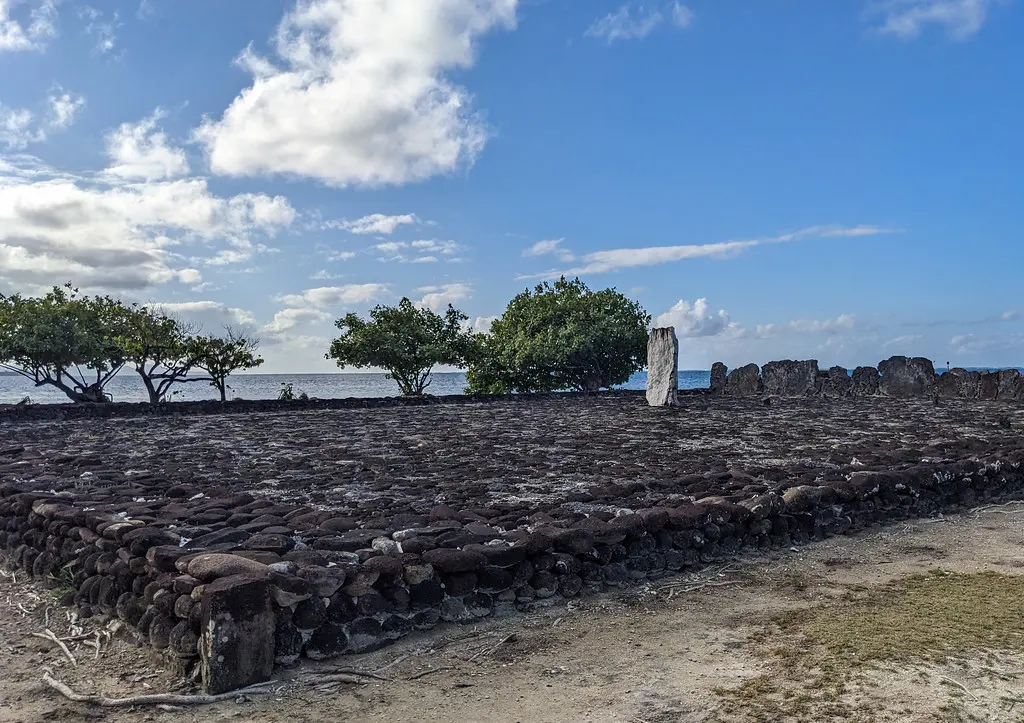
Beside the Ara Metua, Rarotonga's old coral ring-road, Arai-Te-Tonga lies roughly two miles east of Avarua as a low platform, standing pillar, and low walls of a former chiefly courtyard. For the Makea tribe of Te-Au-o-Tonga, it is the koutu, the founding seat of island chiefly authority since voyaging chief Tangiia Nui claimed the ground. For roughly seven hundred years, ariki-elect were stripped of ordinary standing, reclothed, anointed, and hoisted onto the Taumakeva pillar on crossed spears before the tribe.
Its sacredness is genealogical and procedural: mana was conferred on this ground. A protracted dispute over the Makea Nui Ariki title has moved recent investitures elsewhere, while a court injunction restricts parts of the site to the kopu lineage holding customary authority. In Rarotongan understanding Arai-Te-Tonga remains the proper ground, though its present role is unsettled rather than resolved.
Why this place is sacred
What makes a koutu like this one sacred is not visible in the stones themselves. It is sacred because of what was staged there: the transformation of an individual into an ariki, enacted as a physical event rather than a legal formality. The chief-elect was undressed of ordinary clothing, then reclothed and anointed in a sequence — akamaroanga, akatainuanga — before being presented with the tokotoko, the chiefly staff, crowned, and addressed with chants of instruction.
The culminating act was physical elevation: seven mataiapo, sub-chiefs, raised the ariki-elect onto the Taumakeva pillar on a lattice of crossed spears, the tribe calling out around him. The maro kura, a crimson feathered girdle, marked the moment the chief took the whole tribe under his shelter. None of this required grandeur of setting.
It required precision of place — the same ground, generation after generation, so that the authority conferred there could be traced back through an unbroken line to Tangiia Nui himself. That continuity, more than any single feature of the stonework, is the source of the site's thinness: a place where lineage, land, and title were made to meet in a single ceremonial act, repeated across roughly seven centuries.
Arai-Te-Tonga was established as a koutu — a chiefly court — by Tangiia Nui upon his arrival at Rarotonga, reserved for himself among the first koutu he founded on the island. It functioned as the residence and burial ground of the Makea ariki lineage, the site of ariki investiture, and the venue for annual first-fruits presentation and tribal feasting.
The site's ceremonial use has narrowed over time from an active residential and burial koutu to a specifically investiture-associated ground, tended and prepared ahead of anticipated ceremonies even when, as in 2025, the actual investiture is held elsewhere.
Its standing as the customary 'proper' site persists independently of where a given ceremony is physically performed, and the site has taken on an additional, unwelcome dimension in recent years as a locus of legal contest over the Makea Nui Ariki title itself.
Experience and orientation
There is little at Arai-Te-Tonga to detain the eye on its own terms. The Taumakeva platform and its standing pillar sit close to the road, flanked by the low stone traces of Pure-ora, Muri-vai, and Marae-Koroa, the smaller clan marae that once extended the koutu's reach. A visitor arriving without context might walk the site in ten minutes and leave with the impression of a modest historical curiosity.
That impression inverts almost entirely once the ceremonial history is known: the same stones become the exact point where seven mataiapo lifted a chief-elect on crossed spears, where a girdle of red feathers marked a change of status witnessed by an entire tribe. The site rewards stillness more than movement — standing at the pillar, tracing where the platform's edges would have framed the ceremony, rather than searching for something to photograph.
Given the site's current entanglement in a live legal dispute, visitors should also expect a place in flux: parts of it may be restricted to kopu members, and the ordinary visitor experience here is now inseparable from an unresolved question about who has standing to gather here at all.
The marae sits directly beside the Ara Metua on Rarotonga's northern coastal plain, near the boundary of the Avarua and Ngatangiia districts — a flat, open roadside setting rather than a secluded or elevated one, making the site easy to pass without noticing.
Context and lineage
According to Takitumu and Rarotongan tradition, the voyaging chief Tangiia Nui arrived at Rarotonga — fleeing his elder brother Tutapu, in the same general period that Karika arrived from Samoa — and established several koutu on the island, reserving Arai-Te-Tonga for himself.
Sources vary as to whether this was one of the first three or first four koutu he built, and the date of his arrival is placed anywhere between roughly 1250 and 1350 AD; a 2018 archaeological excavation of the adjacent Ara Metua road suggests site development in the range of 1300 to 1400 AD, without settling the question further. Karika Ariki is said to have been the first ariki invested here, as an ariki-putokotoko, a supporting chief, to Tangiia Nui.
A traditional saying recorded in 1903 by the ethnographer S. Percy Smith — 'E kirikiri teatea no Arai-te-tonga,' a white pebble from Arai-te-tonga — is associated with the site, though its fuller meaning is not explained in the sources available.
Arai-Te-Tonga is the koutu of the Makea tribe of Te-Au-o-Tonga, one of Rarotonga's principal ariki lineages descending from Tangiia Nui. The three Makea Ariki titles of Te-Au-o-Tonga are customarily invested here, though a contested succession has, as of 2025, moved actual ceremonies to other sites — Para O Tane Palace for Susan Love's investiture as Makea Nui Ariki, and Marae Kaukura Ia Papa in Pokoinu for the subsequent investiture of Makea Arera Ariki in November 2025.
Tangiia Nui
Founding voyaging chief
Arrived at Rarotonga around the 13th to 14th century and established Arai-Te-Tonga as his own koutu, founding the chiefly line from which the Makea ariki title descends.
Karika Ariki
First ariki invested at the site
Traditionally the first chief invested at Arai-Te-Tonga, installed as an ariki-putokotoko, a supporting chief, alongside Tangiia Nui.
S. Percy Smith
Ethnographer and early recorder
Visited the site in 1897 and published the earliest substantive account of Arai-Te-Tonga in 1903, recording the Taumakeva pillar, the chants used in elevating an ariki, and a traditional saying tied to the marae.
Susan Love
Recently invested Makea Nui Ariki
Invested as Makea Nui Ariki on May 31, 2025, though the ceremony was moved from Arai-Te-Tonga to Para O Tane Palace due to an ongoing legal dispute over the title and a court injunction affecting site access.
Traditions and practice
The akamarokura, also rendered akauruuruanga or aka'uru'uru'anga, unfolds in stages: the chief-elect is ceremonially undressed of ordinary clothing (part of the akamaroanga sequence), then ritually reclothed and anointed (akatainuanga), presented with the tokotoko chiefly staff, crowned (akapareanga), and addressed with karakia, chants of instruction.
The ceremony culminates in physical elevation — seven mataiapo raise the ariki-elect onto the Taumakeva pillar using crossed spears, accompanied by ritual calls, while the maro kura, a crimson feathered girdle, symbolizes the chief drawing the tribe under his protection. Historically the koutu also hosted annual first-fruits presentation and tribal feasting and dancing, and served as burial ground for ariki and other high-ranking members of the lineage.
The site continues to be customarily tidied and prepared ahead of an anticipated Makea investiture, a maintained readiness that reflects its retained status even when not used. The 2025 investitures connected to the disputed Makea Nui Ariki title, however, were conducted at Para O Tane Palace and at Marae Kaukura Ia Papa in Pokoinu rather than at Arai-Te-Tonga, reflecting the site's currently contested and restricted status rather than any diminishment of its customary standing.
There is no visitor-facing ceremony to take part in here; the akamarokura is a kopu affair, not a public rite. A visit is best approached as quiet observation from the perimeter — pausing at the Taumakeva platform to consider what the physical elevation of a chief-elect would have looked like on this exact ground, rather than seeking anything to participate in.
Cook Islands Māori (Rarotongan) traditional chiefly religion and governance
ActiveArai-Te-Tonga is the principal koutu and marae of the Makea tribe of Te-Au-o-Tonga, traditionally the site where ariki were invested, where ariki families resided and were buried, and where annual first-fruits and tribal feasts were held.
The akamarokura investiture ceremony — ceremonial undressing and reclothing, anointing, presentation of the tokotoko staff, crowning, ritual chanting, and elevation of the ariki-elect onto the Taumakeva pillar by seven mataiapo using crossed spears.
Perspectives and open questions
Arai-Te-Tonga is read differently depending on who is doing the reading — as an archaeological puzzle with an unsettled date, as living ancestral ground currently caught in legal contest, or, for outside esoteric traditions, largely not read at all.
Scholarly perspective
Historians and archaeologists, from S. Percy Smith's 1903 ethnographic account through the 2018 University of the Highlands and Islands excavation of the adjacent Ara Metua road, treat Arai-Te-Tonga as the paramount koutu of the Makea tribe, founded by Tangiia Nui in the 13th or 14th century and historically the primary site for ariki investiture on Rarotonga. Neither the exact founding date nor the number of koutu Tangiia Nui originally established is settled between sources.
Living and traditional perspectives
Within Cook Islands Māori tradition and House of Ariki custom, Arai-Te-Tonga is the proper ancestral ground where mana, land, and chiefly title are bound together through the akamarokura ritual; the House of Ariki describes the maro kura girdle as symbolizing the chief's role in gathering the tribe under his protection.
Descendant families maintain the site's tapu status, and the ongoing dispute over the Makea Nui Ariki title — including litigation over access to the site itself — demonstrates that the marae remains a living locus of customary authority rather than a settled historical relic.
Open questions
The full original extent and layout of the marae complex beyond the Taumakeva platform is not fully reconstructed. The founding date remains genuinely uncertain across a roughly century-wide range, and it is not known how the current Makea Nui Ariki title dispute will resolve, or whether Arai-Te-Tonga will resume its role as the actual, rather than customary, investiture site for future Makea installations.
Plan your visit
Access and arrival
Located beside the Ara Metua, the ancient inland coral road, approximately two miles (three kilometers) east of Avarua on Rarotonga, near the boundary of the Avarua and Ngatangiia districts. Reachable by rental car, scooter, or the round-island bus service; historically viewable from the roadside without formal entry, though some areas may currently be subject to legal access restriction under the 2025 injunction.
No specific on-site or immediately adjacent accommodation is documented in available sources; Avarua, roughly two miles west, is Rarotonga's main town and the standard base for visitors touring the island's marae and coastal sites.
Respectful visit
No specific dress code is documented for casual visitors; modest, respectful attire in keeping with general Polynesian marae protocol is appropriate.
Photography is not explicitly restricted, but visitors should exercise discretion given the site's tapu status and its entanglement in an active title dispute — this is not a backdrop to treat casually.
There is no documented visitor offering practice today. Historically the koutu received first-fruits offerings as part of tribal ceremony, but this is not something a visitor should attempt to replicate.
Do not remove stones or disturb any rock formations. As of 2025, a court injunction connected to the Makea Nui Ariki title dispute restricts access to parts of the site for individuals outside the kopu; visitors should confirm current access conditions locally rather than assuming the entire site is open, and should not treat the site as an unowned historical curiosity.
As of 2025, access to portions of the site by non-kopu individuals may be legally restricted under a court injunction tied to the Makea Nui Ariki title dispute. Visitors should check current local guidance before assuming the whole site is open, and should not treat any restriction as an invitation to bypass it.
Location
Map loads as you approach this section.
Pilgrim reflections
A portrait of encounter, not a score
Pilgrims describe what they felt, how present they could become, and whether the place would shape a journey. There are no stars and no ranking of traditions.
No reviewed reflections yet
The first pilgrims can help describe the character of being here.
Share a reflection
Available after an account-backed “Been there.” Every reflection is reviewed before publication.
Nearby sacred places
Explore other sacred places in the region. Proximity does not establish access or travel time; check each place’s guidance.

Tuoro
Avarua / Nikao, Rarotonga, Rarotonga, Cook Islands
6.7 km away
Marae Taputapuātea
Opoa, Raiatea, Society Islands, Leeward Islands, French Polynesia
1005.2 km away

Maeva Archaeological Site
Maeva, Huahine, Society Islands, Leeward Islands, French Polynesia
1046.7 km away

Matapa Chasm
Hikutavake, Niue, Hikutavake, Niue
1082.8 km away
References
Sources consulted for this page. Source categories describe the publication, not a guarantee that every claim is verified. Traditional accounts and outside interpretations may differ.
- 01Arai-te-tonga, The Ancient Marae At Rarotonga — S. Percy Smithacademic1903 Journal of the Polynesian Society article; earliest substantive published ethnographic/historical account, based on Smith's 1897 visit; records the Taumakeva pillar, chants used during elevation of the ariki, and a traditional saying associated with the site
- 02Arai-te-Tonga: the ancient marae at Rarotonga — S. Percy SmithSource contextNational Library of New Zealand catalogue record for Smith's published work; corroborates academic provenance of the primary early source
- 03Arai-Te-Tonga — Cook Islands Tourism CorporationofficialOfficial Cook Islands tourism authority page; describes history, the Taumakeva platform/pillar, Pu'era rock, tapu status, and visitor conduct expectations
- 04Susan Love invested as Makea Nui Ariki amid ongoing dispute — Cook Islands NewsofficialNational newspaper of record reporting on the May 31, 2025 aka'uru'uru'anga investiture of Susan Love as Makea Nui Ariki; states the ceremony was moved from its traditional site at Arai-Te-Tonga to Para O Tane Palace due to an ongoing legal/title dispute and to accommodate guests; also references a court injunction restricting non-kopu access to Arai-Te-Tonga sections
- 05Makea Arera Ariki invested — Cook Islands NewsofficialReports on the November 2025 akamarokura'anga of Makea Arera Ariki, held at Marae Kaukura Ia Papa in Pokoinu (not Arai-Te-Tonga), illustrating that current Makea-title investitures are occurring at alternate sites amid the ongoing title dispute
- 06Excavation of the Ara Metua (Ara Nui o Toi) at Arai te Tonga — University of the Highlands and Islands Archaeology Instituteacademic2018 archaeological excavation report on the adjacent Ara Metua (ancient coral road) at Arai te Tonga, conducted with Cook Islands Museum and Te Ipukarea Society; dates site development sequence to approximately 1300-1400 AD, informing (but not definitively settling) the marae's founding period
- 07Akamarokura | The Significance of the Ancient Rarotongan Investiture — Mouria Ngati AuSource contextCommunity/tribal-history blog authored by a contributor identifying with Ngati Au tribal lineage; closest indigenous-community-affiliated source found; details the six-part akamarokura investiture ritual sequence (akamaroanga, akatainuanga, tokotoko presentation, akapareanga, karakia, akauruuruanga) and the symbolism of the maro kura girdle, citing House of Ariki statements
- 08Arai Te Tonga - the most sacred marae in Rarotonga — WondermondoSource contextTravel/heritage-focused site; describes Arai-Te-Tonga as the most sacred marae in Rarotonga with details on the Taumakeva platform and pillar
- 09Arai-Te-Tonga Marae — Lonely PlanetSource contextGuidebook publisher entry; confirms location (~2 miles east of Avarua, on the Ara Metua/main road), Taumakeva feature, and general visitor framing
- 10Arai-Te-Tonga Marae — Cook Islands Pocket GuideSource contextIndependent Cook Islands travel guide; corroborates the establishment narrative, koutu function, and burial/feasting roles
- 11"...if it fails to follow custom" — peumaori.comSource contextCommunity commentary on the Makea Nui Ariki title dispute and custom/protocol concerns surrounding the 2025 investiture controversy
Share a photo
Help visitors recognize Arai-Te-Tonga Marae. Every submission is reviewed before publication.