The Street of the Dead
The last road walked by Scotland's dead kings, from the sea to the sacred ground of Iona
Understand sacred places, explore living traditions, and learn how to engage respectfully with Pilgrim Map.
Access has not been verified. Check current local guidance before planning a visit.
Iona, Scotland, United Kingdom
Read the sources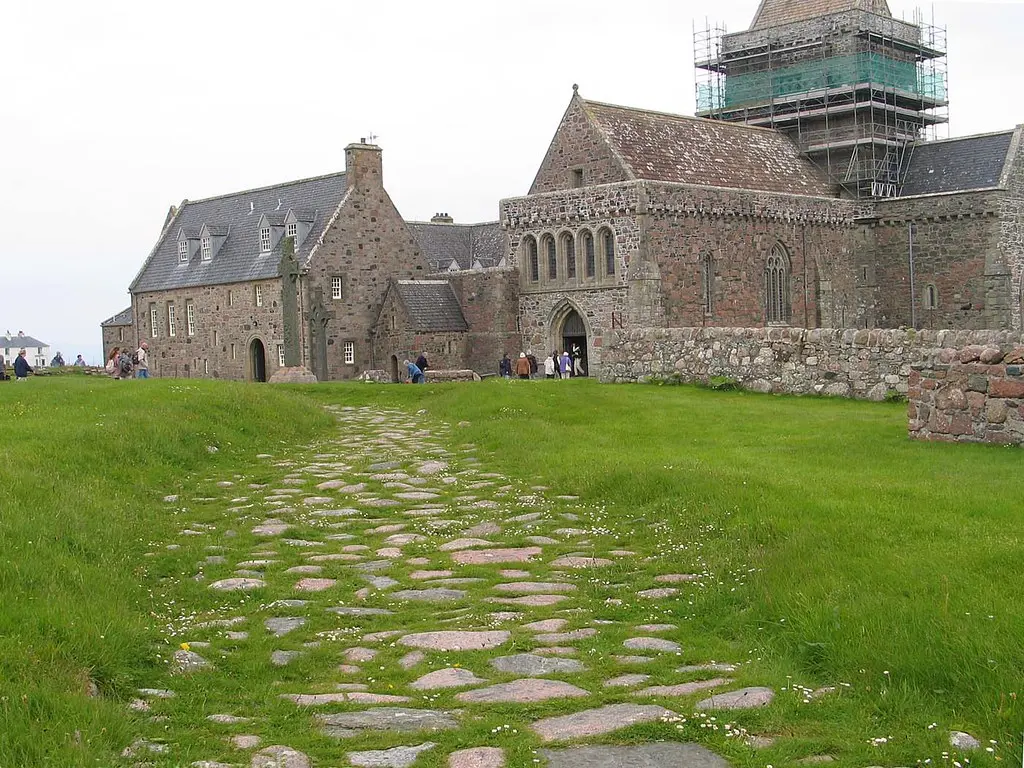
Image of The Street of the Dead. Image source
Visit essentials
A quick read before you go
- Duration
- Walking the Street of the Dead from Martyrs Bay to the abbey takes 15 to 30 minutes at a…
- Access
- The Street of the Dead is accessible at all times with no admission charge.
Overview
The path is short. From Martyrs Bay to the burial ground is a walk of only a few hundred metres. But this road carried more kings to their graves than any other in Scotland.
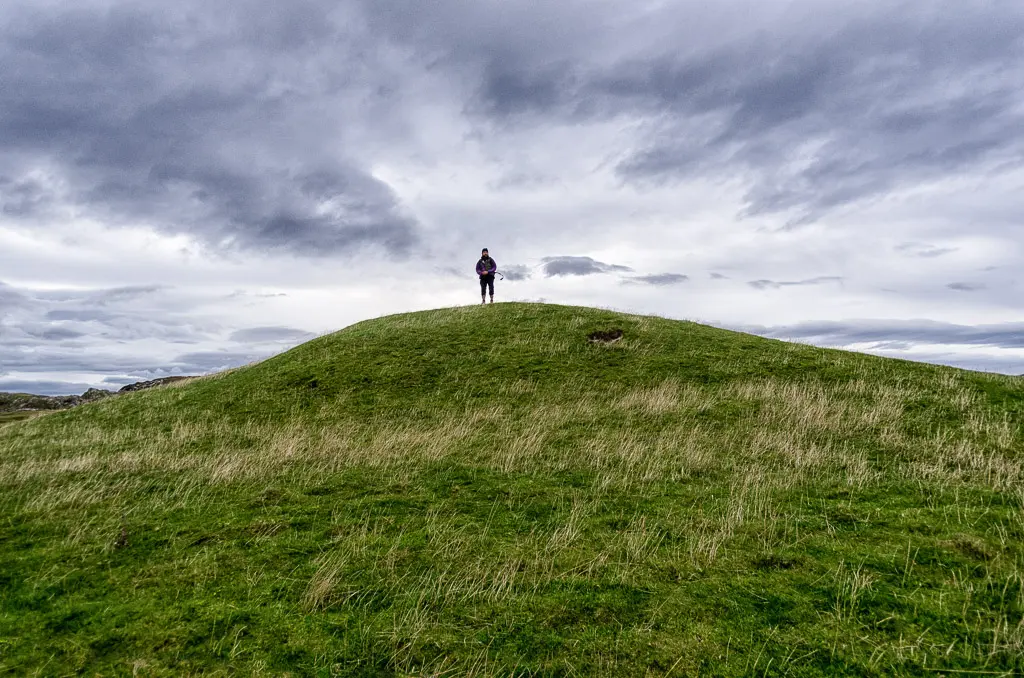
The Street of the Dead, Sràid nan Marbh in Gaelic, was the processional route along which the bodies of the dead were borne from the sea to the sacred ground. Coffins arrived by boat at Martyrs Bay, were rested on the Ealadh, a small mound at the back of the bay where the funeral procession was arranged. The bearers circled the mound three times in the sunwise direction, the deisiol, before setting out along the cobbled road.
At its end lay Reilig Odhrain, the burial ground named for St Oran, companion of Columba, where an inventory of 1549 recorded forty-eight Scottish kings, eight Norwegian kings, and four Irish kings among the dead.
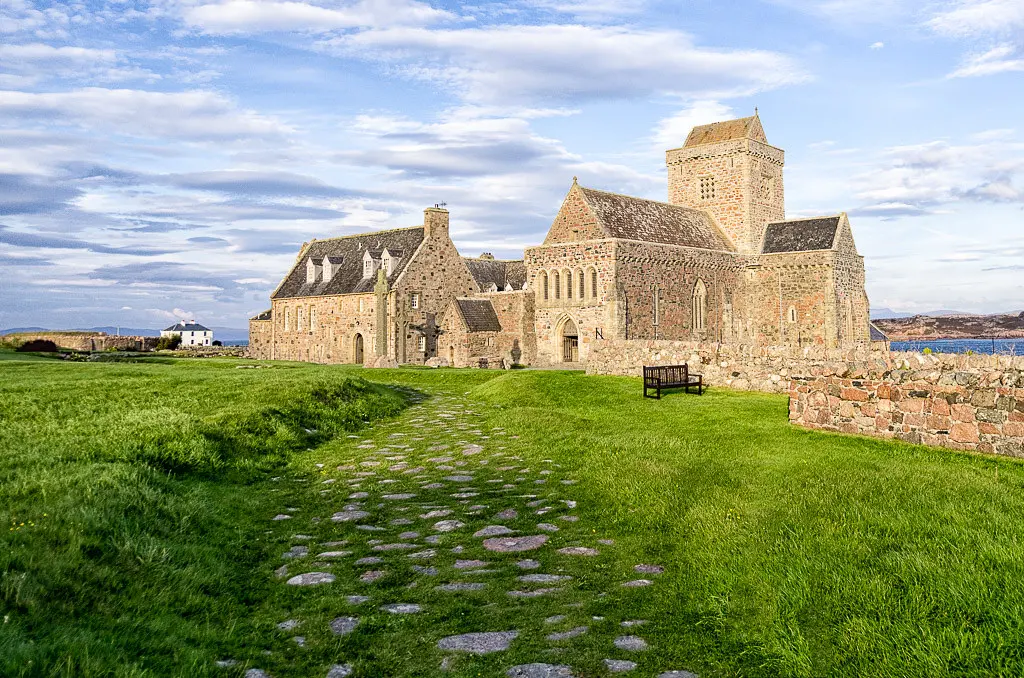
The cobbled surface dates from approximately 1000 AD. It is about two metres wide, composed of boulders of red Mull granite with kerbs of flat schist slabs. Archaeologists regard it as one of the finest medieval paved roads in Europe. The visible section runs between St Martin's Cross and the graveyard wall, though the original route extended the full distance from the bay.
For the medieval monks of Iona, this was their Via Dolorosa. Columba's shrine stood in place of the Holy Sepulchre. The abbey church was their Temple. Every funeral procession along these stones re-enacted the sacred geography of Jerusalem on a small Hebridean island. High crosses, including the surviving St Martin's Cross carved between 750 and 800 AD, served as stations of prayer along the route.
Today the road still connects the living to the dead. Visitors walking from the ferry to the abbey follow the same ground that bore the bodies of Kenneth MacAlpin and Duncan and Macbeth. The stones do not distinguish between pilgrim and tourist, between those who come seeking and those who come curious. The road simply leads where it has always led: from the water to the grave.
Why this place is sacred
What makes the Street of the Dead thin is not what stands along it but what has passed along it. A thousand years of funeral processions have worn this path into a groove between worlds. The living carried the dead, step by careful step, over cobblestones that were laid for precisely this purpose. The road exists because the dead needed to travel it.
The thinness begins at the water. Martyrs Bay, where the coffins were unloaded from boats, takes its name from the sixty-eight monks killed during Viking raids in 806 AD. The bay where monks died became the bay where all subsequent dead arrived. Death saturates the geography from the first step.
At the Ealadh, the small mound where the coffin was rested, the processional ritual began. The threefold circling, the deisiol, was an act of transition. It marked the moment when the dead left the world of travel and entered the world of ceremony. The road that followed was not merely a path but a passage, a movement between states.
The high crosses that once lined the route served as thresholds within the threshold. At each cross, the procession paused for prayer. The crosses marked stages of the journey, each one a deeper step into sacred space. St Martin's Cross, still standing in its original position after twelve centuries, continues to mark this transition.
And then the road ends at the graves. Reilig Odhrain, where the bodies were received by the earth, is the terminus of all movement. From water to stone to earth. From the living world across the Sound to the sacred ground of Iona. The Street of the Dead is the seam between these worlds, and walking it means walking in that seam.
The street was built as a processional road for funeral processions, connecting the landing place at Martyrs Bay with the burial ground of Reilig Odhrain beside Iona Abbey. It served as the monks' Via Dolorosa, a liturgical journey re-enacting the sacred geography of Jerusalem. Coffins were carried along this road as part of an elaborate ritual that included the deisiol circling at the Ealadh and prayers at the high cross stations.
The processional route likely predates the surviving cobbled surface by several centuries, originating with the establishment of Columba's monastery in 563 AD. The cobbled road was laid around 1000 AD during the period when Iona served as the principal burial ground for Scottish kings. With the decline of royal burials after the 11th century and the establishment of the Benedictine abbey in the early 13th century, the road continued to serve monastic and local funerary processions.
After the Reformation, the abbey fell into ruin and the processional function largely ceased, though local burials continued in Reilig Odhrain. In the 20th century, George MacLeod's Iona Community restored the abbey and re-established pilgrimage on the island. The Street of the Dead is now walked by pilgrims and visitors as a contemplative path rather than a funerary road, though its original purpose shapes the quality of the experience.
Experience and orientation
The experience begins at Martyrs Bay, a short walk from the ferry pier. The bay is small and quiet, its pebbly beach curving toward a grassy bank. At the back of the bay, a slight rise marks the Ealadh, the mound where coffins were rested when they came ashore. There is no marker, no sign. The mound simply is, as it has been for a thousand years.
From the bay, the route follows the path toward the abbey. The modern road overlies much of the original cobbled surface, but the route is the same. The ground rises gently. To the right, the ruins of the Iona Nunnery appear, one of the best-preserved medieval nunneries in Scotland. Ahead, the tower of the abbey comes into view.
The visible cobbled section of the street emerges between St Martin's Cross and the wall of Reilig Odhrain. Here the red granite boulders and flat schist kerbs are exposed, and you walk on the same surface that bore the weight of royal coffins. The roughness of the cobbles is striking. This was never a comfortable road. It was a road for a burden.
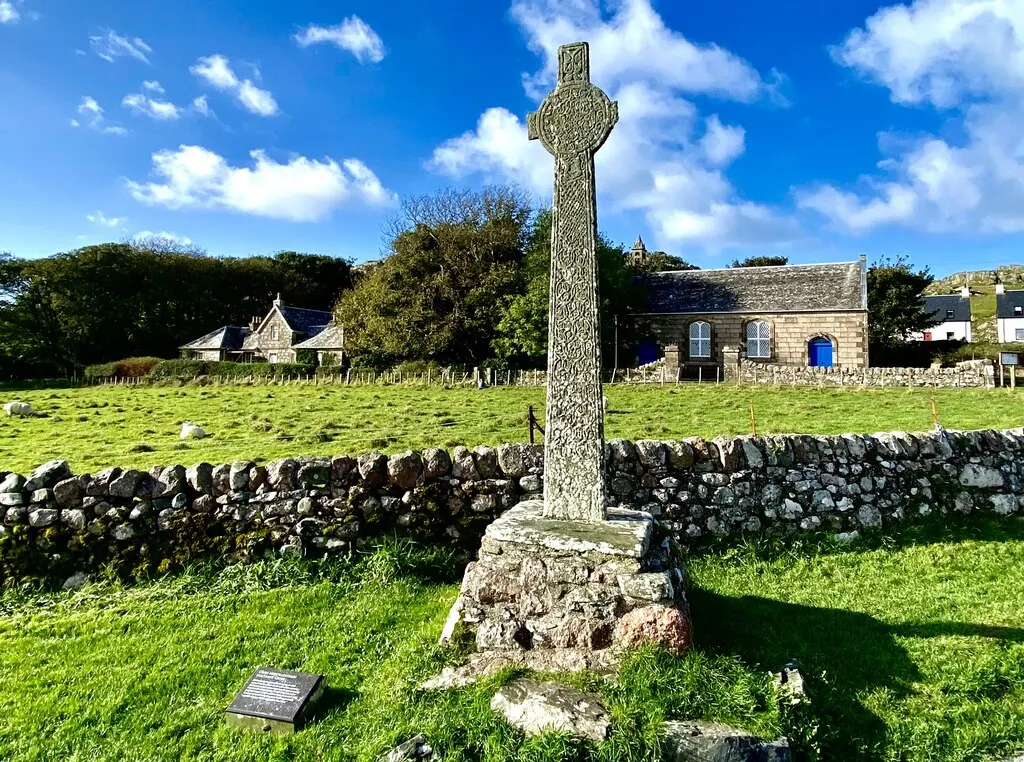
St Martin's Cross stands at the junction of the street and the abbey entrance. Carved between 750 and 800 AD, it is one of the finest Celtic high crosses in existence. The west face shows the Virgin and Child, Daniel in the Lions' Den, David and Goliath. The east face is covered in interlaced serpents and bosses. For twelve centuries, this cross has marked the moment when the processional route enters the sacred precinct.
Beyond the cross lies Reilig Odhrain, the oldest Christian burial ground in Scotland. Weathered medieval gravestones stand among more recent markers. St Oran's Chapel, a small Romanesque building from the 12th century, stands at its centre. This is where the road ends. This is where the dead were set down.
The abbey itself rises behind the graveyard, restored in the 20th century from medieval ruins. Services are held in the church. The cloisters have been rebuilt. But the Street of the Dead belongs to the space between the sea and the graves, to the journey rather than the destination.
Begin at Martyrs Bay rather than at the abbey. Walking from the sea toward the burial ground follows the direction of the funeral procession and allows the experience to develop as it was meant to. Pause at the Ealadh. Walk slowly along the road. Stop at St Martin's Cross. Enter Reilig Odhrain. Then, if you wish, continue into the abbey.
Walking the route in reverse, from abbey to bay, reverses the procession and carries a different quality, a return to the world of the living.
Context and lineage
In 563 AD, the Irish monk Columba crossed to Iona with twelve companions and established a monastery that would become the most important centre of Celtic Christianity in Scotland. The island's holiness drew pilgrims, and before long, kings sought burial near Columba's shrine. The route from the landing place to the burial ground became formalised into a processional road, the Street of the Dead.
The graveyard at its terminus, Reilig Odhrain, carries its own origin story. According to tradition, Oran was one of Columba's companions who volunteered to be buried alive to consecrate the ground for the monastery. When Columba opened the grave after three days, Oran spoke, saying he had seen heaven and hell. Alarmed, Columba ordered the grave resealed, declaring 'Earth, earth on Oran's eye, lest he blab more.'
Whether the story preserves a memory of pre-Christian sacrifice or is a later creation, it connects the burial ground and its processional approach to the deepest layers of the island's sacred history.
Martyrs Bay, where the Street begins, takes its name from the sixty-eight monks slaughtered by Vikings in 806 AD. The monks' blood consecrated the landing place, and every subsequent funeral arrival at the bay walked over ground already hallowed by martyrdom.
The spiritual lineage of the Street of the Dead runs from Celtic Christianity through Benedictine monasticism to modern ecumenical practice. Columba's 6th-century foundation established the island's sanctity. The Benedictine order, arriving in the early 13th century, maintained the processional traditions and built the abbey whose ruins and restorations frame the route today. The Iona Community, founded in 1938, restored both the buildings and the spiritual practice of pilgrimage, creating a living lineage that continues to walk the ancient road.
St Columba
founder
The Irish monk who founded the monastery on Iona in 563 AD, establishing the island as the cradle of Christianity in Scotland. His shrine at the abbey was the sacred centre toward which the Street of the Dead was oriented. Columba's presence on Iona transformed the island into holy ground, and the desire of kings to be buried near his shrine gave the processional route its purpose.
St Oran
legendary / traditional
Columba's companion whose legendary burial consecrated the ground of the cemetery that bears his name, Reilig Odhrain. The tradition that he was buried alive and spoke from the grave connects the burial ground to pre-Christian layers of belief. His chapel, a 12th-century Romanesque building, stands at the centre of the graveyard where the Street of the Dead terminates.
Kenneth MacAlpin
historical
Generally regarded as the founder of medieval Scotland, Kenneth MacAlpin died in 858 AD and was buried at Reilig Odhrain. He was among the earliest Scottish kings to make the final journey along the processional route, establishing a tradition of royal burial that continued for two centuries.
George MacLeod
modern founder
The Church of Scotland minister who founded the Iona Community in 1938 and led the restoration of the medieval abbey. MacLeod's vision re-established Iona as a centre of pilgrimage and worship, giving the Street of the Dead a renewed function as a path for the living rather than the dead.
Traditions and practice
The funeral procession followed a prescribed ritual sequence. The coffin arrived by boat at Martyrs Bay, having crossed the Sound of Iona from the mainland or from the Isle of Mull. It was carried to the Ealadh, a small mound at the head of the bay, where it was set down while the procession was organised. The bearers then circled the mound three times in the deisiol, the sunwise direction that in Gaelic tradition blessed and protected.
The procession moved along the cobbled road toward the abbey, pausing at the high crosses for prayer. Each cross served as a station, marking a deeper entry into sacred space. At Reilig Odhrain, the coffin was received by the burial ground, and the dead took their place among the kings and saints.
For the monks, the daily offices of prayer in the abbey church gave the processional route a second function. The path between the working areas of the monastery and the church was a liturgical journey in miniature, walked several times each day, each transit a small procession of the living toward the place of worship.
The Iona Community offers residential pilgrimage programmes throughout the year, and the nine-mile pilgrimage walk around the island includes the Street of the Dead as a significant waypoint. Pilgrims walk together in silence or in prayer, following a route that takes in the island's sacred sites over the course of a day.
Many visitors walk the Street of the Dead independently as part of a visit to the abbey. The path from the ferry pier to the abbey passes close to the original route, and the visible cobbled section between St Martin's Cross and the graveyard wall can be walked contemplatively. Some pilgrims begin at Martyrs Bay and follow the full processional route in the direction of the ancient funeral processions.
The restored abbey church holds regular worship services, and the ecumenical Iona Community welcomes guests from all faith backgrounds and none. The island has become a destination for those seeking retreat, reflection, and encounter with a landscape that has carried human prayer for fifteen centuries.
Walk the route from Martyrs Bay toward the abbey, following the direction of the ancient processions. Pause at the Ealadh. Walk slowly along the path, feeling the transition from the open bay to the enclosed precinct of the abbey. Stand at St Martin's Cross and study its carvings. Enter Reilig Odhrain quietly. Read the stones. Then sit, if you wish, and let the accumulated weight of the place settle.
If you have a full day on Iona, combine the Street of the Dead with the longer pilgrimage walk around the island. The contrast between the intimate processional route and the wild coastline of the island's western shore creates a powerful experience of containment and release.
If you seek solitude, arrive on the first ferry and walk the route before the day visitors come. Or stay overnight on the island and walk the street at dusk, when the light comes low across the Sound and the abbey stands silhouetted against the western sky.
Gaelic Funeral Procession and Royal Burial
HistoricalFrom the 9th to 11th centuries, Iona was the chosen burial place of Scottish kings. An inventory of 1549 recorded forty-eight Scottish kings among those interred at Reilig Odhrain, alongside rulers from Norway, Ireland, and France. The Street of the Dead was the last road these rulers travelled, borne from the boats at Martyrs Bay along the cobbled processional way to the sacred ground near Columba's shrine. The tradition gave the road its name and its purpose.
Coffins arrived by boat and were rested on the Ealadh at the head of Martyrs Bay. Bearers performed a threefold deisiol, a sunwise circling of the resting mound. The procession then moved along the cobbled road, pausing at the high cross stations for prayer, before entering Reilig Odhrain for burial. The ritual sequence marked a graduated transition from the world of the living to the world of the dead.
Celtic and Medieval Monasticism
HistoricalColumba's monastery, founded in 563 AD, established Iona as the most important centre of Celtic Christianity in Scotland. The Benedictine abbey that succeeded it in the early 13th century continued the traditions of worship, scholarship, and hospitality to pilgrims. The Street of the Dead served both communities as a processional route, connecting the secular shore to the sacred precinct. The high crosses carved by the island's monks marked the route as a liturgical journey.
The monks observed the daily offices of prayer, walking between their living quarters and the abbey church multiple times each day. The processional route was incorporated into the liturgical calendar, with special processions on feast days and during funeral rites. The high crosses served as stations for prayer and as markers guiding pilgrims toward Columba's shrine.
Contemporary Ecumenical Pilgrimage
ActiveThe Iona Community, founded by George MacLeod in 1938, restored the medieval abbey and re-established Iona as a living centre of Christian worship and pilgrimage. The community's ecumenical vision welcomes people from all backgrounds. The nine-mile pilgrimage walk around the island, which includes the Street of the Dead, has become a central practice. The Slí Cholmcille (St Columba Way) pilgrimage trail incorporates the processional route into a broader network of pilgrimage paths.
Pilgrims walk the island route together, stopping at sacred sites for reflection and prayer. The Street of the Dead is walked as a contemplative path, often in silence. Worship services in the restored abbey church draw from multiple Christian traditions. Residential guests participate in the community's daily rhythm of prayer, work, and fellowship.
Perspectives and open questions
The Street of the Dead sits at the intersection of archaeology, history, and living faith. Scholarly analysis examines its construction, dating, and physical characteristics. Historical accounts document its use as a royal funeral route. And contemporary pilgrims continue to walk it as a path of spiritual encounter. These perspectives do not conflict so much as they attend to different dimensions of the same stones.
Scholarly perspective
Canmore, the National Record of the Historic Environment, classifies the Street of the Dead as a processional way dating from approximately 1000 AD. The cobbled surface, composed of red Mull granite boulders with flat schist kerbs, is recorded as running from NM 2845 2385 to NM 2858 2453. Archaeologists regard it as one of the finest medieval paved roads in Europe.
The University of Glasgow's Iona Namescape project has analysed the place-name evidence, identifying the Ealadh as derived from the Gaelic word for tomb or sepulchre and confirming its function as a resting place for coffins during funeral processions.
The 1549 inventory recording 48 Scottish, 8 Norwegian, and 4 Irish kings is treated as a historical document, though the precise number cannot be independently verified and some historians suggest the figures may be inflated. The royal burial tradition is securely dated to the 9th through 11th centuries, the period of Pictish-Gaelic-Norse conflict that saw the formation of the Kingdom of Scotland.
Living and traditional perspectives
For the medieval monks of Iona, the Street of the Dead was their Via Dolorosa. The processional route from Martyrs Bay to the abbey re-enacted the sacred geography of Jerusalem, with Columba's shrine taking the place of the Holy Sepulchre. Every funeral procession was simultaneously a local ceremony and a participation in the universal Christian story of death and resurrection.
The Gaelic funeral traditions that shaped the procession, particularly the deisiol circling at the Ealadh, belong to a layer of practice that may predate Christianity. The sunwise circuit was a blessing and protection, a way of marking the transition from the world of the living to the world of the dead. These traditions were absorbed into Christian practice on Iona rather than suppressed by it.
For the Iona Community today, the Street of the Dead is part of a living landscape of prayer. The pilgrimage walks that include the processional route are acts of worship as much as acts of walking. The community holds that the island's sanctity is not a historical artefact but a continuing reality, renewed by each generation of those who come to pray.
Alternative interpretations
Iona's reputation as a thin place, where the boundary between material and spiritual worlds is especially permeable, draws visitors from spiritual traditions beyond Christianity. Some understand the Street of the Dead as a path aligned with earth energies, its orientation and the positioning of the high crosses reflecting a sensitivity to the landscape's spiritual currents. The island's remoteness and beauty contribute to experiences of altered consciousness that visitors interpret according to their own frameworks.
The Gaelic concept of the deisiol and the ritual use of the Ealadh connect to broader traditions of sacred movement and threshold ritual found in cultures worldwide. For some, the Street of the Dead resonates with the universal archetype of the path between worlds, the road that the dead must walk and the living may follow.
Open questions
Whether the processional route was in use from Columba's time in the 6th century or only formalised with the cobbled surface around 1000 AD remains uncertain. The full extent of the original cobbled road beneath the modern turf has not been comprehensively surveyed. The ritual details of the medieval funeral procession, beyond the circling at the Ealadh and the pauses at the cross stations, are incompletely recorded.
The identity of many of those buried in Reilig Odhrain, particularly the claimed Norwegian and Irish royal burials, cannot be verified. And the reason why Iona, among all the islands of the Hebrides, was chosen by Columba as his foundation continues to be debated.
Plan your visit
Access and arrival
The Street of the Dead is accessible at all times with no admission charge. Iona Abbey hours: April to September, daily 9:30am to 5:30pm (Sundays from 12:30pm); October to March, daily except Sundays 10am to 4pm. Abbey admission: Adults £10, Concessions £8, Children (7-15) £6. Audio guide included.
Iona has limited accommodation: the St Columba Hotel, the Argyll Hotel, several B&Bs, and the Iona Hostel. The Iona Community offers residential accommodation at the Abbey and the MacLeod Centre for those participating in their programmes. Booking well in advance is essential, particularly in summer. Day visits from Mull are common but overnight stays are recommended.
Respectful visit
No specific dress code. Weather-appropriate outdoor clothing is essential: waterproofs, warm layers, and sturdy footwear suitable for uneven cobbled surfaces and island paths.
Photography is welcome along the Street of the Dead and at the high crosses. Photograph the graveyard with discretion, particularly near recent burials. Photography inside the abbey church is permitted.
No formal offerings are expected. Some visitors leave small stones at graves in Reilig Odhrain. The Iona Community shop and abbey admission support the preservation of the site.
The cobbled road surface is a scheduled ancient monument and must not be disturbed. Do not remove cobblestones or any materials from the site. Reilig Odhrain is a protected graveyard; gravestones must not be touched or moved. Visitors' vehicles are not permitted on Iona.
The cobbled surface is uneven and can be slippery when wet. Sturdy footwear is recommended. Reilig Odhrain contains both ancient and recent graves; treat the cemetery with the respect due any active burial ground. Weather on Iona can change quickly, and waterproof clothing is advisable at all seasons. Ferry services may be cancelled in poor weather; check CalMac schedules before travelling, especially in winter.
Current practical details
Address
Isle of Iona PA76 6SW, UK
Hours, fees, and access can change — verify on the official source before you travel. Practical details last checked Jun 2026.
Location
Map loads as you approach this section.
Pilgrim reflections
A portrait of encounter, not a score
Pilgrims describe what they felt, how present they could become, and whether the place would shape a journey. There are no stars and no ranking of traditions.
No reviewed reflections yet
The first pilgrims can help describe the character of being here.
Share a reflection
Available after an account-backed “Been there.” Every reflection is reviewed before publication.
Nearby sacred places
Explore other sacred places in the region. Proximity does not establish access or travel time; check each place’s guidance.
References
Sources consulted for this page. Source categories describe the publication, not a guarantee that every claim is verified. Traditional accounts and outside interpretations may differ.
- 01Iona, Sraid Nam Marbh -- Canmore (Historic Environment Scotland) — Historic Environment ScotlandofficialNational archaeological database record with construction details and archaeological references
- 02Iona Abbey and Nunnery -- Historic Environment Scotland — Historic Environment ScotlandofficialOfficial visitor information and historical overview for the abbey complex
- 03Iona Abbey: History -- Historic Environment Scotland — Historic Environment ScotlandofficialDetailed historical account including Columban and medieval periods
- 04Iona, Sraid Nam Marbh -- trove.scot — trove.scot (Heritage database)officialScottish heritage database record with archaeological details
- 05Pilgrimage on Iona -- Iona Community — The Iona CommunityspiritualOfficial Iona Community pilgrimage information
- 06For a spiritual pilgrimage, head to the tiny Scottish Isle of Iona — National GeographicSource contextNational Geographic feature on Iona pilgrimage
- 07Excavations on Iona, 1979 -- Proceedings of the Society of Antiquaries of Scotland — Society of Antiquaries of ScotlandacademicAcademic excavation report with archaeological findings
- 08Reilig Odhrain -- Iona Royal Burial Ground — Thin Places TourspiritualSpiritual and cultural perspective on the burial ground and thin place traditions
- 09Six Iona Burials That Tell the Story of the British Isles — Wild About ArgyllSource contextHistorical overview of notable burials and the Street of the Dead
- 10St Orans Chapel -- Isle of Iona — isle-of-iona.netSource contextLocal information on St Orans Chapel and the burial ground
- 11Reilig Odhrain -- Visit Mull and Iona — Visit Mull and IonaSource contextTourism information on the burial ground
- 12Visiting Iona Abbey -- A Complete Visitors Guide — Scotlands StoriesSource contextPractical visitor information including ferry and access details
- 13Iona Abbey -- Scotland — English MonarchsSource contextHistorical reference for royal burial traditions
Share a photo
Help visitors recognize The Street of the Dead. Every submission is reviewed before publication.