MacLean's Cross
A carved stone cross that outlasted the destruction of 357 others on Scotland's most sacred island
Understand sacred places, explore living traditions, and learn how to engage respectfully with Pilgrim Map.
Access has not been verified. Check current local guidance before planning a visit.
Iona, Scotland, United Kingdom
Read the sources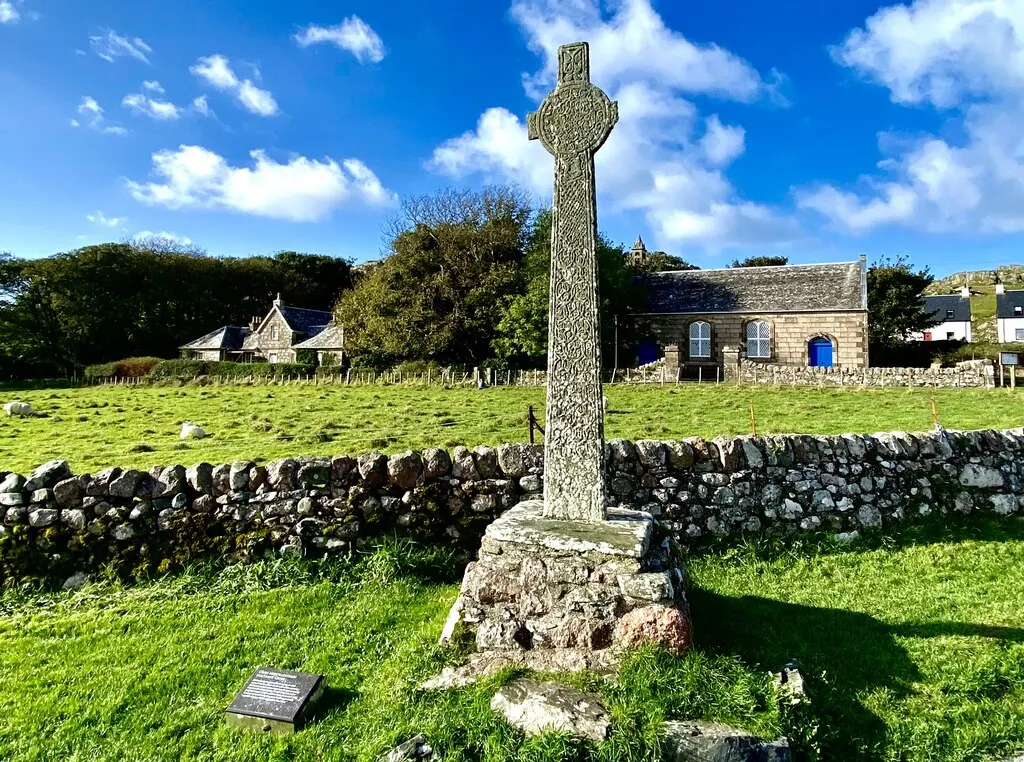
Image of MacLean's Cross. Image source · CC-BY-SA-2.0
Visit essentials
A quick read before you go
- Duration
- 10-20 minutes at the cross itself.
- Access
- Iona is reached by CalMac ferry from Fionnphort on the Isle of Mull (approximately 10-minute…
Overview
Three hundred and sixty stone crosses once filled Iona's pilgrim landscape, marking prayers, patrons, and devotion on the route to St Columba's shrine. Reformation reformers destroyed 357. Three survived, including MacLean's Cross.
Carved from one slab by Iona-school craftsmen in the last quarter of the 15th century, it stands 3.15 metres high. Its west face shows Christ in a long robe within a multi-cusped crucifixion niche, with a lily above symbolising the Virgin Mary. The east has plaitwork, foliage, two animals near the top, and an armed horseman at the shaft's base who may be the MacLean chief who paid for it.
Disc head, interlacing, Christian imagery, and Celtic ornament preserve generations of island craft.
The cross marks three medieval routes. Sraid nan Marbh, the Street of the Dead, carried coffins to Reilig Odhrain's royal burial ground; another route climbed from boat landings at Port Ronain. Pilgrims from shore stopped here, faced the crucifixion, and prayed before continuing to the abbey—the threshold where arrival became pilgrimage.
Remarkably, the cross still stands in its original socket slab on its first ground. It offers no explanation for its near-miraculous survival; it endures.
Why this place is sacred
Iona has been called a thin place since long before the term became common. Columba himself is said to have spoken of places where the distance between earth and heaven narrows. The island has absorbed centuries of prayer, pilgrimage, and royal burial. Forty-eight Scottish kings lie in Reilig Odhrain. The monastery Columba founded in 563 AD became the seedbed of Christianity in Scotland. The Book of Kells may have been begun here.
MacLean's Cross participates in this accumulated sanctity, but it also carries its own particular charge. Consider what it means to stand before one of three survivors from a population of 360. The absence of the other crosses is as powerful as the presence of this one. Every other junction, every other path, every other point of prayer on the island once had its cross. Now they are gone. This one is not.
The cross was carved to be encountered, not admired from a distance. The crucifixion faces west, toward the arriving pilgrims. The lily of the Virgin rises above Christ's head. The carving was meant to stop you, to turn your walk into a pause, your pause into a prayer. Five centuries later, it still performs this function.
The pilgrims who walk past on their way to the abbey today follow the same route as those who came in the 1400s, and the cross meets them at the same threshold.
There is something in the encounter with survival that opens a space in the mind. The cross does not celebrate its own endurance. It simply stands, as it has stood, while everything around it changed.
MacLean's Cross was erected as a devotional waypoint on the pilgrimage route to Iona Abbey and St Columba's shrine. Commissioned by a MacLean chief, it served both as an act of piety and a statement of clan prestige. Pilgrims paused here to pray before the crucifixion scene, orienting themselves spiritually before continuing to the abbey.
The cross also stood at the junction of the Street of the Dead, linking it to the funeral processions of kings and nobles bound for Reilig Odhrain.
The cross was carved in the last quarter of the 15th century as part of a tradition of cross-erection on Iona that had continued for centuries. Following the Reformation of 1560, the vast majority of Iona's crosses were destroyed. MacLean's Cross survived, though the reasons are unknown. It became a scheduled ancient monument and the oldest monument in state guardianship on the island.
Today it functions as a heritage site within a living pilgrimage landscape, encountered by visitors walking the ancient route from the ferry to the abbey.
Experience and orientation
The ferry from Fionnphort takes ten minutes across the Sound of Iona. You land on Iona and begin walking. The island is car-free for visitors, so the approach is on foot, as it was for medieval pilgrims, though they arrived at a different landing place. The road leads past the nunnery, past scattered cottages, and there, at the junction where paths once converged from three directions, stands MacLean's Cross.
It is taller than you expect. Three metres of carved stone rising from its original socket slab, the disc head silhouetted against Iona's wide sky. If you approach from the south, the east face meets you first: plaitwork and plant-stem ornament, a pair of carved animals near the top, and at the shaft's base the armed horseman, riding into whatever future the stone would give him.
Walk around to the west face and the crucifixion appears. Christ wears a long robe reaching to his ankles, contained within a cusped niche. Above his head, the lily of the Virgin Mary. This is the face the pilgrims saw. They came up from the boats and stood here, looking at what you are looking at. The carving has weathered five centuries of Hebridean wind and rain, but the figure remains legible, the ornament still intricate.
The cross stands in open air, on a grassy roadside with the nunnery ruins nearby and the abbey a few minutes further along the road. There is no visitor centre, no admission booth, no interpretive panel demanding your attention. The cross is simply there, as it has been since the 1400s, offering itself to whoever pauses.
Most visitors walk past on their way to the abbey, glancing at the cross but not stopping. Those who do stop find themselves in the position of every pilgrim who ever stood here: at a junction, between what has been left behind and what lies ahead, with a carved Christ looking back at them.
MacLean's Cross stands on the road between the ferry jetty and Iona Abbey, near the ruined nunnery. You will pass it walking to the abbey. The west face (crucifixion) faces the direction of approach from the ferry. The east face (plaitwork and horseman) faces the abbey. Take time to walk around the cross and view both faces. The carved detail rewards close looking.
Context and lineage
In the last quarter of the 15th century, a chief of the Clan MacLean commissioned a stone cross for the Isle of Iona. The MacLeans of Duart and Lochbuie were the most powerful families in the district. Their chief wanted a cross that would stand on the pilgrimage route, marking both devotion and status. He turned to the Iona school of carvers, craftsmen who had maintained the tradition of stone carving on the island for generations.
They carved it from a single block of stone. On the west face, a crucifixion for the pilgrims to pray before. On the east face, the intricate plaitwork and foliage ornament that was the school's signature. At the base of the shaft, an armed horseman, perhaps the patron himself, riding across the stone.
They set it in a socket slab at the junction where three paths met: the Street of the Dead, the route from the port, and the way to the nunnery.
The cross joined hundreds of others. Iona was dense with carved stone. Then the Reformation came. After 1560, reformers moved across the island, breaking crosses. Three hundred and fifty-seven fell. Three survived. MacLean's Cross was one. No one recorded why it was spared.
The cross belongs to the tradition of high cross erection that spans the entire history of Christianity on Iona, from the early medieval crosses of the Columban monastery (such as St Martin's Cross, 8th century) through to the late medieval products of the Iona school. It represents the final flowering of this tradition before the Reformation ended it. The pilgrimage route it marks stretches back to the 7th century, when Columba's fame first drew pilgrims to the island.
Columba (Colum Cille)
historical
Irish monk who founded the monastery on Iona in 563 AD with twelve companions. His foundation became the cradle of Christianity in Scotland and one of the most important monastic centres in early medieval Europe. The pilgrimage tradition that MacLean's Cross served originated with Columba's legacy.
The MacLean Patron
historical
An unidentified chief of the MacLeans of Duart or Lochbuie who commissioned the cross in the late 15th century. The armed horseman carved at the base of the shaft may be his portrait. The MacLeans were the most influential clan in the district and maintained close connections with Iona's ecclesiastical community.
The Iona School Carvers
historical
Anonymous craftsmen who maintained a tradition of stone carving on Iona throughout the 15th century. Their work is characterised by disc-headed crosses, intricate plaitwork, foliaceous ornament, and the integration of Christian imagery with Celtic decorative traditions. MacLean's Cross is among the finest surviving examples of their work.
George MacLeod
historical
Founder of the Iona Community in 1938, who led the restoration of Iona Abbey and revived the island's tradition of pilgrimage, worship, and community. His work ensured that the landscape through which MacLean's Cross stands remains a living pilgrimage route.
Traditions and practice
Medieval pilgrims arriving by boat at Port Ronain walked up the track toward the abbey, passing MacLean's Cross at the junction of three paths. They would have stood before the west face, facing the carved crucifixion, and prayed. The lily above Christ's head directed devotion toward the Virgin Mary. This was one station among many on an island thick with crosses, each offering a point of pause and prayer.
The Street of the Dead, which passed the cross, was also the route along which the bodies of kings and nobles were carried to burial at Reilig Odhrain. The cross witnessed both the living pilgrims going up and the dead being carried to their rest.
Iona remains a place of pilgrimage. The Iona Community, founded in 1938, offers pilgrimage weeks and maintains the abbey as a place of worship and retreat. Visitors walking from the ferry to the abbey pass MacLean's Cross on the road, as medieval pilgrims did. Some pause to examine the carving. Others offer a quiet prayer.
The cross is not the focus of organised devotion, but its position on the route ensures that it is encountered by nearly everyone who visits the island's sacred sites.
Walk the route from the ferry as the pilgrims walked it. When you reach MacLean's Cross, stop. Stand on the west side and face the crucifixion, as arriving pilgrims were meant to. Notice the lily above Christ's head, the worn detail of the carving, the socket slab that has held this stone for five centuries. Then walk around to the east face and find the horseman at the base, the animals near the top, the plaitwork that covers the shaft.
Let the pause be a pause. The abbey will wait.
Celtic Christianity / Columban Monasticism
ActiveMacLean's Cross stands within the sacred landscape of Iona, the island where Columba founded his monastery in 563 AD. The pilgrimage tradition the cross served originated with Columba's legacy and has continued, with interruptions, for over fourteen hundred years. Today the Iona Community maintains a living tradition of worship, pilgrimage, and community on the island.
Medieval pilgrims followed set routes across Iona, pausing at crosses and holy sites before reaching the abbey and Columba's shrine. The Iona Community today offers pilgrimage weeks that include walking the island's sacred routes. Daily worship continues at the restored abbey. The pilgrimage tradition that MacLean's Cross marked has evolved but has not ended.
Clan MacLean Patronage
HistoricalThe cross was commissioned by a MacLean chief in the late 15th century, when the MacLeans of Duart and Lochbuie were the most powerful families in the region. The armed horseman carved at the base of the shaft may be the patron's portrait. The commission represented both religious devotion and clan prestige, marking the MacLean presence on an island of immense spiritual significance.
Highland and Island chiefs commissioned high crosses, tomb slabs, and other carved monuments as acts of piety that simultaneously displayed wealth and status. The Iona school of carvers served this dual purpose, producing works that combined Christian imagery with symbols of secular power.
Perspectives and open questions
MacLean's Cross can be understood through multiple lenses: as a work of art, as a historical survival, as a devotional object, and as part of Iona's broader sacred landscape. Each perspective illuminates something the others do not.
Scholarly perspective
Art historians classify MacLean's Cross as a product of the Iona school of stone carving, active throughout the 15th century. Its closest stylistic parallel is the cross erected by Duncan MacMillan at Kilmory, Knapdale, which dates to the same period. The Royal Commission on the Ancient and Historical Monuments of Scotland has recorded the cross in detail: 3.15 metres high, 0.42 metres wide at the base, 0.27 metres at the neck, with a solid disc-head 0.53 metres in diameter.
The iconographic programme, combining crucifixion, Marian symbolism, clan patronage, and decorative tradition, places the cross within a well-documented tradition of late medieval Hebridean stone carving. Scholars note that the cross's survival through the Reformation, when 357 others were destroyed, was likely accidental rather than deliberate. The cross is the oldest monument in state guardianship on Iona.
Living and traditional perspectives
For Christians who come to Iona on pilgrimage, MacLean's Cross is part of a sacred landscape that has been continuously venerated for over fourteen hundred years. Columba's foundation in 563 AD established Iona as one of the holiest places in the Celtic Christian world. The cross participates in this holiness. It was carved as an act of faith, a devotional object intended to bring pilgrims into the presence of Christ through the carved crucifixion.
The lily above the cross speaks of Mary. The survival of the cross through centuries of destruction and neglect can be understood as providential, a sign that what was consecrated to God is not easily erased.
Alternative interpretations
Iona has long been described as a thin place in the Celtic spiritual tradition, a location where the boundary between the physical and spiritual worlds becomes permeable. Visitors who come with this understanding often experience MacLean's Cross as charged with the prayers of centuries, a stone that has absorbed the devotion of everyone who has ever paused before it.
The cross's position at the junction of three paths adds to this perception: crossroads have been considered liminal spaces in many traditions, places where worlds meet.
Open questions
Why MacLean's Cross survived when 357 other crosses on Iona did not remains unexplained. Whether it was deliberately spared, overlooked, or simply too difficult to destroy is not recorded. The precise identity of the patron, the carver, and the circumstances of the commission are lost. The meaning of the paired animals on the east face is uncertain.
Whether the cross has always stood in its current position or was moved at some point cannot be determined with certainty, though the original socket slab suggests continuity of location.
Plan your visit
Access and arrival
Iona is reached by CalMac ferry from Fionnphort on the Isle of Mull (approximately 10-minute crossing). Fionnphort is reached by road from Craignure, Mull's main ferry terminal (approximately 1 hour drive). Craignure is connected by CalMac ferry to Oban on the Scottish mainland. From the Iona ferry terminal, MacLean's Cross is approximately a 5-10 minute walk along the road toward the abbey. No visitor vehicles are permitted on Iona.
Iona has limited accommodation: the St Columba Hotel, the Argyll Hotel, several B&Bs, a hostel, and the Iona Community's accommodation at the abbey (for those participating in their programmes). Booking well in advance is essential, particularly in summer. Day visits from Mull are also possible.
Respectful visit
No specific dress code. Comfortable walking shoes and weather-appropriate layers are recommended. Iona's weather is changeable; waterproofs are advisable at any time of year.
Photography is permitted and encouraged. The carved detail is best captured in raking light, which brings out the relief of the plaitwork and figures.
Do not leave offerings on or near the scheduled monument.
Do not touch or climb on the cross. Do not attempt rubbings. The cross is a scheduled ancient monument (SM90173); any disturbance is a criminal offence.
The cross is a scheduled ancient monument. Do not touch or lean against it. Do not attempt to make rubbings of the carving. The stone has survived five centuries of Hebridean weather; it should not have to survive careless contact.
Current practical details
Address
Unnamed Road,, Isle of Iona PA76 6SW, UK
Hours, fees, and access can change — verify on the official source before you travel. Practical details last checked Jun 2026.
Location
Map loads as you approach this section.
Pilgrim reflections
A portrait of encounter, not a score
Pilgrims describe what they felt, how present they could become, and whether the place would shape a journey. There are no stars and no ranking of traditions.
No reviewed reflections yet
The first pilgrims can help describe the character of being here.
Share a reflection
Available after an account-backed “Been there.” Every reflection is reviewed before publication.
Nearby sacred places
Explore other sacred places in the region. Proximity does not establish access or travel time; check each place’s guidance.
References
Sources consulted for this page. Source categories describe the publication, not a guarantee that every claim is verified. Traditional accounts and outside interpretations may differ.
- 01MacLean's Cross | Historic Environment Scotland — Historic Environment ScotlandofficialOfficial heritage body responsible for the monument's care and designation
- 02MacLean's Cross: History | Historic Environment Scotland — Historic Environment ScotlandofficialDetailed historical overview from the managing heritage body
- 03Iona, Maclean's Cross | Canmore — National Record of the Historic EnvironmentofficialScotland's national inventory of the historic environment with detailed measured descriptions and bibliographic references
- 04Iona Abbey and Nunnery | Historic Environment Scotland — Historic Environment ScotlandofficialContextual information on the wider Iona sacred landscape and abbey complex
- 05Maclean's Cross, Iona | History & Photos — Britain ExpressSource contextAccessible overview with visitor-oriented details
- 06Iona: MacLean's Cross — Heritage Futures blogSource contextContextual discussion of the cross within Iona's heritage landscape
- 07MacLean's Cross from The Gazetteer for Scotland — The Gazetteer for ScotlandSource contextScottish geographic reference
- 08Iona Cross [Relig Odhrain] Ancient Cross | The Megalithic Portal — The Megalithic PortalSource contextCommunity heritage database with visitor perspectives on Iona's crosses
Share a photo
Help visitors recognize MacLean's Cross. Every submission is reviewed before publication.