The Sainte-Foy abbey church in Conques
Where a child martyr's golden reliquary has drawn pilgrims for a thousand years
Understand sacred places, explore living traditions, and learn how to engage respectfully with Pilgrim Map.
Access has not been verified. Check current local guidance before planning a visit.
Conques-en-Rouergue, Aveyron, France
Read the sources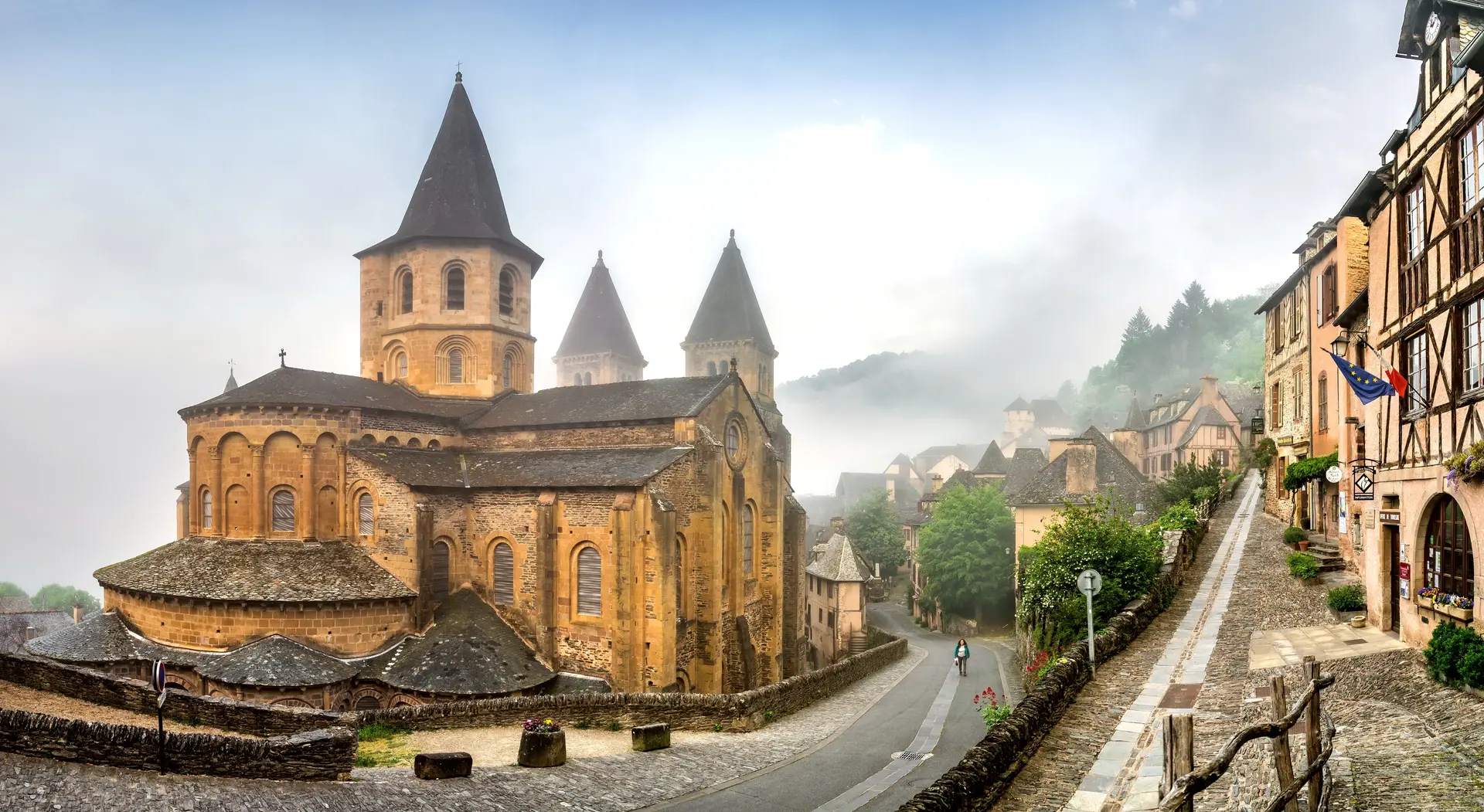
Visit essentials
A quick read before you go
- Duration
- 1-2 hours for church and treasury; longer for full appreciation.
- Etiquette
- The church is an active place of worship; approach with appropriate reverence.
Overview
In a remote Aveyron valley, the Romanesque Abbey Church of Sainte-Foy has received Via Podiensis pilgrims bound for Santiago de Compostela for over a millennium. They come to venerate a golden statue-reliquary containing the bones of Faith, a twelve-year-old martyr.
Sainte Foy was killed around 303 during the Diocletian persecution. Legend says she survived a red-hot brazier before being beheaded. Her relics remained in Agen until the ninth century, when Conques monks allegedly stole them through years-long deception, transforming an impoverished monastery into a spiritual power.
By 1172, Benedictines had documented 126 miraculous interventions attributed to Sainte Foy. Pilgrims sought healing, deliverance, and release from captivity. Her reliquary remains at Conques: a seated figure with a child's face, possibly a reused Roman-era portrait, covered in precious stones, gold, and enamel. It is the only surviving medieval statue-reliquary of a type once found across Europe.
Above the west entrance, a Last Judgment tympanum presents 124 carved figures. Christ judges as angels and devils sort humanity, the saved process serenely, and the damned tumble into hell's jaws. Medieval pilgrims passed beneath this Romanesque masterpiece into the dark nave where Sainte Foy waited.
Why this place is sacred
The thin quality at Conques emerges from accumulated intensity. Consider what has gathered here: the bones of a child who chose death over betrayal of her faith; a golden statue that may incorporate an ancient Roman portrait; a thousand years of pilgrims' prayers; the medieval world's vision of salvation and damnation carved above the entrance.
Sainte Foy's story grounds the site's power. She was twelve when she was martyred—a child whose faith proved stronger than torture. The reliquary that contains her bones presents her as a seated figure, childlike in scale but invested with the authority of miracle-working. The Benedictines documented 126 miracles; pilgrims came seeking what she had to give.
The reliquary itself is uncanny. The oldest surviving statue-reliquary in Western Christianity, it incorporates a Roman-era bronze head that may predate Christianity entirely. Medieval craftsmen covered the ancient face with gold leaf and surrounded it with precious stones donated by the grateful healed. The figure's eyes, inlaid with enamel, seem to hold whoever looks at them.
The Last Judgment tympanum performs a different function. Medieval pilgrims could not read; the Church taught through images. This image teaches the ultimate lesson: life leads to judgment, and judgment leads to heaven or hell. The carving is specific—one man has coins hanging from his neck; a drunk vomits from a barrel. The message is personal, intended for each viewer.
To enter Conques today is to enter the same space those medieval pilgrims entered, to pass beneath the same warning, to stand before the same golden child who somehow survived fire. The stones have absorbed a millennium of prayer. Something persists.
The abbey was founded in the ninth century. The current church was built 1031-1065, completed in the early twelfth century to accommodate the pilgrimage traffic generated by Sainte Foy's miracles.
The abbey remained wealthy and influential through the medieval period. After the Revolution, the monastic community dispersed but the church survived. It now serves as a parish church and major pilgrimage destination, inscribed as part of the UNESCO World Heritage Routes of Santiago de Compostela.
Experience and orientation
Conques is a village of perhaps three hundred souls in a remote valley of the Aveyron. Arrival by car involves narrow mountain roads; arrival on foot as a Camino pilgrim involves days of walking. Either way, the first view of the abbey's towers rising above slate roofs is a reward.
Approach the church through the medieval streets—preserved, not reconstructed. The tympanum above the western entrance demands attention before you enter. Take time with it. Christ sits in judgment at the center; to his right (your left), the saved process serenely toward paradise; to his left, chaos and torment as the damned are weighed, condemned, and swallowed. The detail is extraordinary: specific sins depicted, specific consequences illustrated.
Enter the church proper. The Romanesque nave rises in proportions designed to elevate without overwhelming. Light enters through the clerestory; the space is clear and ordered after the medieval complexity outside. This is a pilgrimage church, designed to move crowds past the relics efficiently while maintaining appropriate awe.
The treasury is housed separately and requires admission. Here you will find Sainte Foy. The golden reliquary sits in a darkened room, illuminated to show its details: the child's face, the covering of gems and gold, the hands open to receive offerings. Medieval pilgrims touched this figure, kissed its feet, begged for healing. You cannot touch, but you can look. The eyes look back.
After the treasury, return to the church. Sit. Let the Romanesque proportions do their work. You have seen what pilgrims came to see. You have passed beneath what pilgrims feared. The rest is contemplation.
Conques is a small village in the Aveyron department. The church is at the village center. The treasury has separate hours and admission. Allow 1-2 hours for church and treasury together.
Context and lineage
The abbey of Conques was founded in the early ninth century but remained poor and obscure. Seeking relics that could attract pilgrims and their offerings, the monks executed a remarkable theft. Around 866, a monk named Arinisdus traveled to Agen, where Sainte Foy's relics were kept. He lived among the canons there for ten years, gaining their trust, until finally he had opportunity to steal the relics and flee to Conques.
The holy theft transformed the abbey's fortunes. Miracles began immediately. The cult of Sainte Foy specialized in healing the blind and liberating captives; by 1172, the Benedictines had documented 126 miraculous interventions. Pilgrims streamed to the remote valley. The wealth they brought funded the construction of the current church, begun under Abbot Odolric in 1031 and completed in the early twelfth century.
The church was designed as a pilgrimage church, architecturally related to Saint-Sernin in Toulouse and the cathedral of Santiago de Compostela itself. The Last Judgment tympanum was carved around 1107-1125, presenting the medieval world's understanding of what awaited all souls.
The abbey was Benedictine until the Revolution. The church now serves as a parish within the Diocese of Rodez. It is inscribed as part of the UNESCO World Heritage Routes of Santiago de Compostela in France.
Sainte Foy (Saint Faith)
Martyr
Arinisdus
Relic thief
Traditions and practice
Medieval pilgrims came to touch the reliquary, seek healing, and receive blessings for their journey to Santiago. The Benedictines maintained the cult of miracles and documented interventions.
Regular masses continue. Camino pilgrims receive credential stamps and sometimes special pilgrim blessings. The treasury allows visitors to encounter the reliquary. Art historians and architecture enthusiasts study the tympanum.
Begin at the tympanum and take time with its details. Enter the church and sit before proceeding to the treasury. In the treasury, let the reliquary hold your attention as it has held pilgrims' attention for a millennium. Return to the church to sit with what you have seen.
Roman Catholicism / Santiago Pilgrimage
ActiveConques has been a major pilgrimage station on the Camino de Santiago for over a thousand years. The cult of Sainte Foy represents the medieval devotion to saints' relics as sources of miraculous power.
Veneration of the reliquary, contemplation of the Last Judgment, pilgrim masses, credential stamping.
Perspectives and open questions
Conques can be understood as a masterpiece of Romanesque architecture, as a treasury of medieval devotional art, as a milestone on the Camino de Santiago, or as evidence of the power medieval Europeans attributed to saints' relics.
Scholarly perspective
Art historians recognize the tympanum as one of the finest Romanesque sculptural programs. The reliquary is uniquely important as the only surviving example of medieval statue-reliquaries. The church demonstrates pilgrimage church architecture.
Living and traditional perspectives
Within Catholic tradition, Sainte Foy is venerated as a courageous virgin martyr whose intercession continues to work miracles. The pilgrimage to Conques is part of the living tradition of the Camino.
Alternative interpretations
The ancient Roman head incorporated into the reliquary has attracted interest from those exploring the continuity between pagan and Christian sacred objects.
Open questions
The exact circumstances of the holy theft. The identity of the ancient Roman head. The full range of miracles attributed to Sainte Foy.
Plan your visit
Access and arrival
Small village with limited but adequate accommodations including a pilgrim gîte.
Respectful visit
Modest dress appropriate for a church.
Generally permitted in the church; may be restricted in the treasury. Never use flash.
Candles available in the church.
Do not touch the reliquary or artwork.
The treasury has specific hours and admission fees. Check current schedules.
Current practical details
Address
Prieuré Ste Foy de Conques, 12320 Conques-en-Rouergue, France
Phone
Hours
Hours, fees, and access can change — verify on the official source before you travel. Practical details last checked Jun 2026.
Location
Map loads as you approach this section.
Pilgrim reflections
A portrait of encounter, not a score
Pilgrims describe what they felt, how present they could become, and whether the place would shape a journey. There are no stars and no ranking of traditions.
No reviewed reflections yet
The first pilgrims can help describe the character of being here.
Share a reflection
Available after an account-backed “Been there.” Every reflection is reviewed before publication.
Nearby sacred places
Explore other sacred places in the region. Proximity does not establish access or travel time; check each place’s guidance.


References
Sources consulted for this page. Source categories describe the publication, not a guarantee that every claim is verified. Traditional accounts and outside interpretations may differ.
- 01St Foy Abbey Church - Office de tourisme Conques-Marcillac — Conques TourismofficialOfficial tourism site
- 02Church and Reliquary of Sainte-Foy - Smarthistory — SmarthistoryacademicAcademic art history resource
- 03Abbey Church of Sainte-Foy - Wikipedia — Wikipedia contributorsencyclopediaComprehensive overview
- 04The Reliquary of Sainte Foy - The Pilgrim's Guide — The Pilgrim's GuideacademicPilgrimage specialist
Photo gallery
3 curated photos
Share a photo
Help visitors recognize The Sainte-Foy abbey church in Conques. Every submission is reviewed before publication.