Temple of Khnum, Esna
Nine meters below modern streets, the divine potter's temple still holds the last hieroglyphs ever carved
Understand sacred places, explore living traditions, and learn how to engage respectfully with Pilgrim Map.
Access has not been verified. Check current local guidance before planning a visit.
Esna, Luxor, Egypt
Read the sources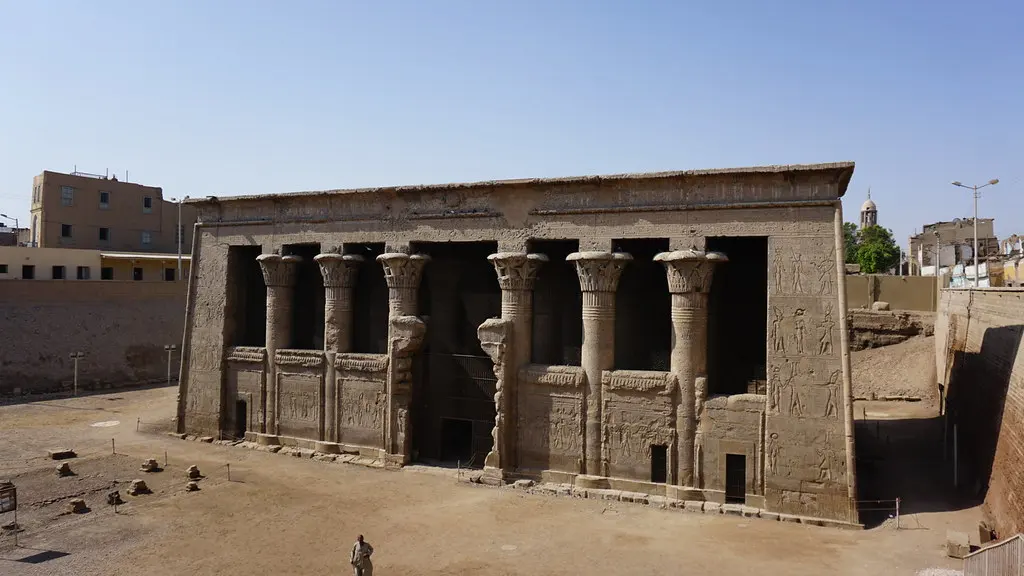
Image of Temple of Khnum, Esna. Image source
Visit essentials
A quick read before you go
- Duration
- 45 minutes to 1.5 hours depending on interest.
- Access
- Esna is 55 km south of Luxor.
Overview
Entering the Temple of Khnum means descending nine metres from the modern street through centuries of accumulated habitation. At the floor, the hypostyle hall's twenty-four columns rise with varied floral capitals, displaying an exuberance restrained in more formal Egyptian architecture.
The temple honoured Khnum, the ram-headed creator who fashioned all living beings on his potter's wheel. From fertile black Nile silt he shaped physical bodies and the ka, or life force, placing them in mothers' wombs. Astronomical ceiling imagery records that creative power.
A joint Egyptian-German restoration removed centuries of soot and grime, revealing colours researchers had not expected: vivid blues, reds, yellows, and golds depicting zodiac signs, constellations, and deities. This is recovery rather than reconstruction; the temple now approaches the appearance it had when its last priests performed rituals nearly two thousand years ago.
Why this place is sacred
The descent to the Temple of Khnum is more than practical necessity. Walking down those steps, you leave the modern city behind and enter a space where creation was the primary subject. Khnum fashioned humanity here, according to those who worshipped him. The fertile black silt of the Nile became clay on his potter's wheel, shaped into bodies that would house the ka. Every human being, in this understanding, was Khnum's handiwork.
The temple's location on the Nile amplified this theology. The annual inundation deposited the very clay Khnum was believed to use. The river's fertility and the god's creativity were aspects of the same force. To worship Khnum at Esna was to honor creation where creation's materials were perpetually renewed.
Neith added a second creative principle. This primordial goddess, called 'mother of mothers,' emerged from the waters before creation and spoke the world into being. All that she conceived in her heart came into existence. Where Khnum shaped with hands, Neith created with words. Together, they represented the completeness of creative power, physical and verbal, masculine and feminine.
The recently restored ceiling transforms what was already significant. For decades, visitors saw soot-blackened surfaces that hinted at decoration. Now they see what the priests saw: a complete zodiac, Egyptian constellations, and deities in colors that seem impossible for two-thousand-year-old pigments. This is not reconstruction. These are the original colors, cleaned rather than repainted. The effect is of time collapsing.
The temple also holds the end of something. The last hieroglyphic inscription, carved in 250 CE, marks the conclusion of a three-thousand-year tradition. The priests at Esna were among the last to read and write the sacred script. Their inscriptions preserve knowledge that would soon be lost until modern decipherment. Standing before these walls, you witness both the persistence of tradition and its final expression.
The Temple of Khnum served as the cult center for Khnum, Neith, and associated deities. Daily rituals awakened the gods, presented offerings, and maintained the cosmic order that Egyptian religion understood as dependent on correct observance. The temple's extensive inscriptions document approximately ninety festival days per year, creating a sacred calendar that structured community life. The New Year celebration was particularly important, as the hymns inscribed alongside the doors describe.
The temple also functioned as an economic center, controlling significant agricultural lands and requiring substantial staff for its ongoing operations.
The site's sacred history extends back to the 18th Dynasty, when Thutmose III established initial structures around 1479-1425 BCE. The Ptolemaic period saw major temple construction beginning under Ptolemy VI Philometor (180-145 BCE). The surviving hypostyle hall was commissioned by Emperor Claudius (41-54 CE) and decorated through the reigns of Trajan, Hadrian, Marcus Aurelius, and Decius (until 250 CE). The last hieroglyphic inscription, carved under Decius, marks the effective end of the pharaonic writing tradition.
By the late 3rd or early 4th century, the temple closed. Residents dismantled the main sanctuary for building materials. The hypostyle hall survived, eventually used as a cotton warehouse and ammunition storage in the 19th century. Modern restoration began in 2018 under a joint Egyptian-German project that has revealed the ceiling's original colors.
Experience and orientation
The walk from the Nile to the temple passes through Esna's souk, a market street whose commerce has continued for centuries. Shops sell everything from spices to plastic goods. The everyday noise of Egyptian commercial life accompanies your approach. Then the street opens onto the excavation pit, and the temple appears below.
The descent is gradual but definite. Each step takes you deeper into the past, down through the debris that generations accumulated over the abandoned temple. By the time you reach the temple floor, the modern street is nearly ten meters above. The transition feels complete. You have entered a different order of space.
The hypostyle hall opens around you. Twenty-four columns rise to a ceiling that, until recently, showed only blackened hints of decoration. The restoration has transformed this. The astronomical ceiling now displays its zodiac in vivid color: the twelve signs, Egyptian constellations, and deities arranged in careful patterns. Blues that seemed impossible, reds that appear freshly applied, golds that catch the light. The original colors have survived beneath centuries of soot.
Each column capital differs from the others. Where most Egyptian temples standardize such elements, Esna's columns display varied floral designs that demonstrate virtuosic stone carving. Palm fronds, lotus flowers, papyrus plants, and composite arrangements create a forest of organic forms. The Ptolemaic and Roman periods encouraged such elaboration.
The walls carry inscriptions in quantities that scholars are still processing. Festival calendars, hymns to Khnum and Neith, ritual instructions, and the cartouches of Roman emperors depicted in pharaonic style cover every surface. Claudius, Trajan, Hadrian, Marcus Aurelius, and Decius appear making offerings to Egyptian gods, a visual demonstration of imperial accommodation to local religion.
The temple's incomplete state is itself evocative. Only the hypostyle hall survives. The sanctuary, the inner chambers, the auxiliary structures all disappeared, their stones repurposed for irrigation canals and other construction. What remains is what was spared: this hall, these columns, this ceiling. The rest must be imagined from inscriptions that describe what no longer exists.
The Temple of Khnum sits in an excavation pit in central Esna, approximately 55 km south of Luxor. The surviving structure is the hypostyle hall (pronaos) of what was once a larger temple complex. It faces east toward the Nile. Twenty-four columns with varied floral capitals support a ceiling decorated with astronomical imagery including a complete zodiac. The walls carry extensive hieroglyphic inscriptions from the Ptolemaic and Roman periods. The temple floor lies approximately 9 meters below modern street level.
Only the hypostyle hall survives; the sanctuary and other chambers were dismantled for building materials in antiquity.
Context and lineage
The mythological foundation of the temple rested on Khnum's role as creator. According to Egyptian belief, Khnum fashioned the bodies of gods and humans on his potter's wheel using the fertile black silt of the Nile. He created not only physical form but the ka, the life force, placing both within mothers' wombs. The annual inundation provided the clay for this perpetual creation.
As one hymn inscribed on the temple walls proclaims, Khnum is 'the lord of the wheel,' 'the one who fashioned gods and men.'
Neith added another dimension to the temple's creative theology. This primordial goddess, one of Egypt's oldest deities, emerged from the waters of chaos and created the world by speaking it into existence. All that she conceived in her heart came into being, including all thirty deities of the Egyptian pantheon. She gave birth to Ra and the other gods by speaking their names.
The combination of Khnum (physical creation) and Neith (creation through speech) made Esna a comprehensive meditation on how existence came to be.
The sacred Nile perch, Lates niloticus, connected the site to the primeval waters. This fish was so revered at Esna that the city was known in Greek as Latopolis, the City of the Nile Perch. Specimens received sacred burials in a cemetery west of the town.
The Temple of Khnum at Esna represents the culmination of Egyptian temple building, incorporating Ptolemaic Greek architectural techniques while maintaining pharaonic religious content. It stands in lineage with other Greco-Roman temples such as Dendera, Edfu, and Kom Ombo. The astronomical ceiling connects to the tradition of temple ceilings representing the heavens, most famously at Dendera. The extensive inscriptions participate in a practice of documentary thoroughness that characterizes late Egyptian temples, providing evidence for practices that earlier temples left implicit.
Khnum
Neith
Ptolemy VI Philometor
Emperor Claudius
Traditions and practice
The temple inscriptions document the most complete festival calendar surviving from ancient Egypt. Approximately ninety days per year were marked by special observances. New Year's Day was the principal celebration, when priests performed extensive rites celebrating rebirth and cosmic renewal. The festival calendar inscribed alongside the southeastern and northeastern doors describes the ritual year in detail.
Daily rituals followed patterns established over millennia. Priests performed the morning service to awaken Khnum in his shrine, presenting offerings of food, drink, and incense. Hymns of creation praised 'the lord of the wheel,' 'the one who fashioned gods and men.' The potter's wheel was symbolically spun to remake the cosmos each morning.
The Festival of the Potter's Wheel celebrated Khnum's specific creative function. Hymns described his fashioning of gods and humans, his role in placing the ka within bodies, his connection to the life-giving Nile. The festival integrated cosmic mythology with agricultural reality, as the same inundation that brought fertile silt enabled Egyptian civilization.
Priests adhered to strict codes of ritual purity. The temple's economic resources, drawn from extensive agricultural lands, supported a substantial staff dedicated to maintaining these observances. The last priests to serve here were among the final practitioners of a tradition stretching back three thousand years.
No active religious practices occur at the Temple of Khnum. The site functions as a heritage attraction and subject of ongoing archaeological research. The joint Egyptian-German restoration project has transformed understanding of the temple's original appearance and continues to reveal new details.
Take time with the ceiling. The restored astronomical imagery rewards extended attention. Identify the zodiac signs, trace the Egyptian constellations, notice the deities integrated into the celestial design. This is what the ancient priests saw when they looked up.
Examine the column capitals. Unlike standardized Egyptian architecture, each capital here displays unique floral designs. The virtuosity of the carving deserves appreciation as craft as well as religious artifact.
Read the atmosphere of the excavation pit itself. The descent nine meters below modern street level creates a physical transition into the past. The market street above continues its commerce; down here, another order of time prevails. The contrast is part of the experience.
Ancient Egyptian Religion
HistoricalThe Temple of Khnum was a major cult center for Khnum, the ram-headed creator god believed to fashion humanity on his potter's wheel. At Esna he was venerated as Khnum-Ra, combining creative power with solar divinity. The temple also honored Neith, the primordial creator goddess who spoke the world into existence. Together they represented the ultimate creative forces.
Daily temple rituals performed by priests. Festival calendar with approximately 90 days of celebrations per year. Morning hymns to awaken Khnum in his shrine. Hymns of creation celebrating Khnum as divine potter. Offerings to Khnum, Neith, Menhit, Nebtu, and Heka. New Year's Day celebrations as the principal festival.
Ptolemaic-Roman Syncretic Cult
HistoricalDuring the Ptolemaic and Roman periods, the cult at Esna evolved to integrate Greek and Roman influences while maintaining Egyptian traditions. Roman emperors including Claudius, Trajan, Hadrian, and Decius were depicted in pharaonic style making offerings to Egyptian gods. The temple served as a bridge between cultures.
Roman emperors participating in traditional Egyptian temple rituals. Integration of zodiac symbolism with Egyptian astronomy. Continued decoration and expansion of the temple through the 3rd century CE.
Perspectives and open questions
The Temple of Khnum invites multiple readings: as witness to the end of pharaonic tradition, as meditation on creation, as evidence for the persistence of Egyptian religion under foreign rule, as case study in archaeological revelation.
Scholarly perspective
The Temple of Khnum at Esna is recognized as one of the most important surviving Greco-Roman temples in Egypt and a crucial site for understanding late Egyptian religion. Scholars emphasize its unique status as containing the last hieroglyphic inscription (250 CE), marking the end of three millennia of pharaonic writing tradition.
The recent restoration by the University of Tubingen has revealed the temple's astronomical ceiling to be among the best preserved in Egypt, comparable only to Dendera. The joint Egyptian-German project has transformed scholarly understanding of Egyptian temple decoration, demonstrating that the vivid colors visible at Esna were likely standard throughout pharaonic architecture.
The temple's inscriptions provide invaluable documentation of religious practices, festival calendars, and the evolution of Egyptian mythology under Ptolemaic and Roman rule. The Esna priests invented new hieroglyphic signs for their inscriptions, demonstrating that the tradition remained creative even in its final centuries. These innovations are subjects of ongoing scholarly analysis.
Living and traditional perspectives
In ancient Egyptian understanding, Esna was a place of primordial creation where Khnum continuously fashioned all living beings on his wheel. The temple was not merely commemorative but operational. The rituals performed here actually sustained the creative processes that maintained existence. The festival of the potter's wheel remade the cosmos.
Neith's presence added the dimension of creation through divine speech. Together, Khnum and Neith represented the completeness of creative power. Physical shaping and verbal speaking brought existence into being. The temple honored both principles.
The sacred Nile perch connected the site to the primeval waters from which all existence emerged. The fish's veneration reflected the deep connection between the Nile, creation, and the sustenance of life.
Alternative interpretations
Some contemporary spiritual seekers view the Temple of Khnum as embodying ancient wisdom about the creative process and humanity's divine origin. The potter's wheel symbolism resonates with teachings about souls being shaped by divine hands. The astronomical ceiling is sometimes interpreted as evidence of advanced ancient understanding of cosmic cycles.
The site's position below modern street level is occasionally interpreted as representing hidden or buried spiritual knowledge awaiting rediscovery. The recent revelation of the ceiling's true colors supports narratives of sacred knowledge obscured and now revealed.
Open questions
Several mysteries persist around the Temple of Khnum. The full extent of the original temple complex buried beneath modern Esna remains unexcavated. The exact nature and timing of the ninety festivals celebrated annually are imperfectly understood. How the Esna theological system combining Khnum and Neith evolved and influenced other cults remains debated.
The identity and fate of the last priests who served at the temple before its closure are unknown. Whether the newly invented hieroglyphic signs created by Esna priests carried esoteric meanings beyond their phonetic values is uncertain. What the temple looked like when complete, before the sanctuary was dismantled, can only be inferred from inscriptions and parallel structures.
Plan your visit
Access and arrival
Esna is 55 km south of Luxor. Most visitors arrive by Nile cruise ship; the temple is about 200 meters from the riverbank. From the landing, walk through the atmospheric souq to reach the temple. From Luxor, the drive takes approximately 1 hour. The temple lies in a 9-meter-deep excavation pit requiring stair descent. Entry fees vary by source but are generally modest.
Most visitors experience Esna as a stop on Nile cruises between Luxor and Aswan. Esna has limited tourist accommodations compared to Luxor or Aswan. Day trips from Luxor are common.
Respectful visit
Modest, comfortable clothing appropriate for both the sacred heritage and Egyptian cultural context. Sun protection for the approach; the temple interior is shaded but the walk from the river is exposed.
Photography is generally permitted. Some sources report no additional camera fee. Be respectful of the ancient surfaces and avoid flash if photographing areas with sensitive pigments. The restored ceiling is particularly photogenic.
Not applicable. This is an archaeological site with no active religious practice.
Do not touch walls, columns, or reliefs. The ancient surfaces are delicate and irreplaceable. Do not climb on any structures. Follow site staff instructions. Stay hydrated. The excavation pit requires descending stairs.
The excavation pit means stairs are required for entry. Those with mobility limitations should assess accessibility before visiting. The enclosed nature of the hall means less airflow than open sites. Lighting can be dim in some areas. There are no facilities at the temple itself; use those in the town before descending.
Current practical details
Address
Esna City, Esna, Luxor Governorate 1315537, Egypt
Hours
Hours, fees, and access can change — verify on the official source before you travel. Practical details last checked Jun 2026.
Location
Map loads as you approach this section.
Pilgrim reflections
A portrait of encounter, not a score
Pilgrims describe what they felt, how present they could become, and whether the place would shape a journey. There are no stars and no ranking of traditions.
No reviewed reflections yet
The first pilgrims can help describe the character of being here.
Share a reflection
Available after an account-backed “Been there.” Every reflection is reviewed before publication.
Nearby sacred places
Explore other sacred places in the region. Proximity does not establish access or travel time; check each place’s guidance.



References
Sources consulted for this page. Source categories describe the publication, not a guarantee that every claim is verified. Traditional accounts and outside interpretations may differ.
- 01An Egyptian Temple Reborn - Archaeology Magazine — Archaeology MagazineacademicDetailed scholarly article on temple history and restoration
- 02Khnum | Ram-Headed, Creator, Nile River | Britannica — BritannicaacademicAuthoritative reference on Khnum mythology
- 03Vivid colors of ancient art uncovered in Egypt's Temple of Esna — National GeographicacademicCoverage of restoration project discoveries
- 04Conservation of the Temple of Esna — American Research Center in EgyptacademicOfficial conservation project documentation
- 05Temple of Khnum at Esna: a Pleiades place resource — Pleiades Ancient World GazetteeracademicScholarly geographic database with precise coordinates
- 06Esna Temple | Ancient Egypt Online — Ancient Egypt OnlineacademicComprehensive overview of temple and deities
- 07Complete zodiac found on Temple of Esna ceiling — The History BlogacademicCoverage of zodiac ceiling discovery
- 08Esna Temple: Sacred Zodiac Shrine of Khnum in Ancient Egypt — Egypt Tours PortalguideVisitor information and historical overview
- 09Temple of Esna, Egypt - History, Architecture & Facts — Memphis ToursguideGeneral visitor guide and history
- 10Temple of Khnum - Explore Luxor — Explore LuxorguideLocal tourism resource with practical information
- 11Khnum - Wikipedia — Wikipedia contributorsacademicComprehensive overview of Khnum mythology and worship
- 12Neith - Wikipedia — Wikipedia contributorsacademicInformation on goddess Neith's role at Esna
- 13Temple of Khnum (Esna) - Madain Project — Madain ProjectacademicArchaeological and historical documentation
Share a photo
Help visitors recognize Temple of Khnum, Esna. Every submission is reviewed before publication.