Temple of Ptah
Part ofTemple of Karnak
Where the god who spoke reality into being keeps a quiet chapel—and his lioness consort still watches from the dark
Understand sacred places, explore living traditions, and learn how to engage respectfully with Pilgrim Map.
Access has not been verified. Check current local guidance before planning a visit.
Luxor, Luxor, Egypt
Visit essentials
A quick read before you go
- Duration
- The Temple of Ptah itself rewards 30-60 minutes, depending on how long you spend in the…
- Access
- The temple lies within the Karnak Temple Complex on the northern perimeter of the Amun-Re…
Overview
Karnak's hypostyle hall, forest of columns, and accumulated ambitions of thirty pharaohs create awe through magnitude. At the complex's northern edge, away from main tourist circuits, the small Temple of Ptah offers encounter rather than spectacle.
In Memphite theology, Ptah conceived the universe in his heart and spoke it into existence through his tongue. Before Atum rose from the primordial waters, Ptah's words had imagined him into being. The temple brought this power of thought made real into Thebes's religious heart.
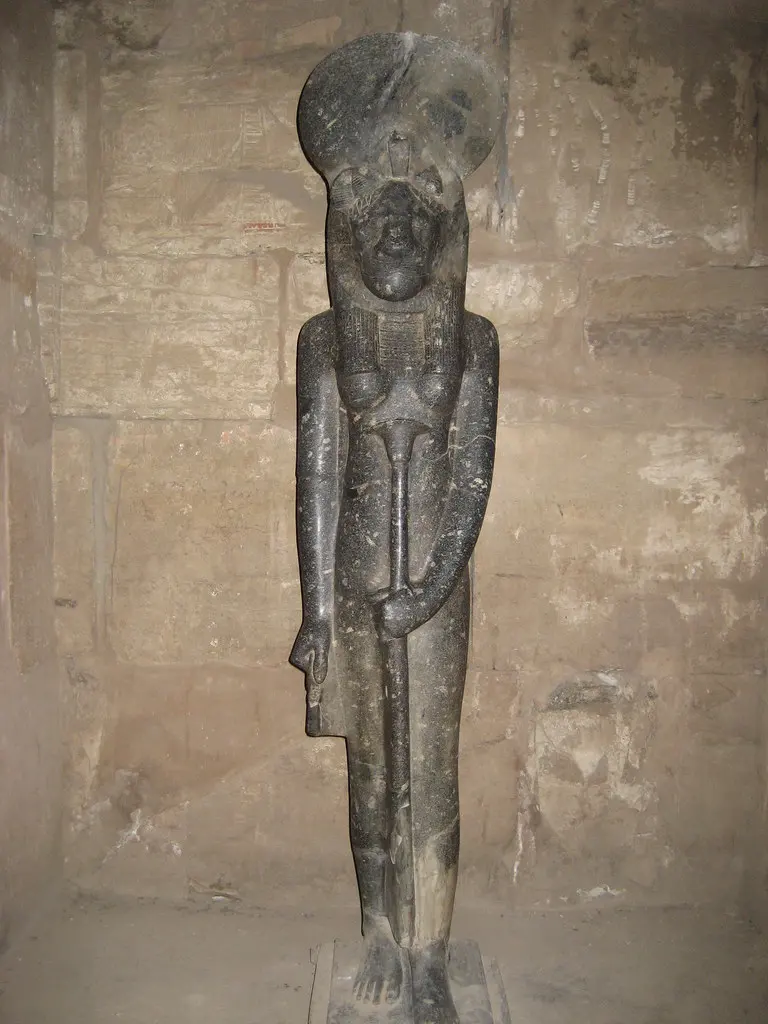
Most visitors are drawn beyond Ptah's empty sanctuary to Sekhmet's side chapel. The black-granite lioness goddess could send or cure plague and embodied both destructive solar heat and the physician's healing art. Unlike hundreds of museum statues, this is an original cult image in its original location. Roof-aperture light illuminates her face; visitors consistently report that she seems to see them and require something. The goddess of transformation, it appears, still demands honest confrontation.
Why this place is sacred
The thinness here operates differently than in Karnak's grand halls. The main temple complex invokes the sublime—human smallness before divine magnitude. The Temple of Ptah invokes something closer to encounter. The scale is human. The darkness is intimate. And in that darkness, presences persist.
Ptah's theology offers one dimension of this thinness. Here was a god who created not through physical action but through conception and speech—through the same faculties humans use for thought and communication. To enter his temple is to enter a space dedicated to the proposition that reality responds to articulated intention. The boundary between thought and manifestation, the theology suggests, is thinner than we assume.
Sekhmet offers another dimension. The hundreds of her statues scattered through museums worldwide rarely provoke the responses that visitors report in her chapel here. Something about encountering her in situ—in the darkness, under the aperture's filtered light, alone—creates conditions for confrontation. Visitors describe feeling seen, evaluated, sometimes challenged. The goddess who could destroy and heal was not safe. Her transformative power required something from those who sought it.
The temple's hidden location contributes to this quality. Finding it requires intention—walking past the tourist crowds, continuing north when others turn back. By the time visitors arrive, they have already separated themselves from casual sightseeing. They have sought something. And in that seeking, they become more available to being found.
The temple served to establish the presence of Memphis's creator god within the religious capital of Thebes. This was both theological and political—demonstrating that Ptah's creative power, originating from Memphis, was honored in Amun-Ra's domain. The temple housed the divine presence through cult statues that priests awakened, fed, clothed, and tended daily. Sekhmet's chapel served to maintain the goddess's appeasement through offerings, as her destructive potential required constant attention. The temple was a working machine for maintaining divine-human relationships.
The temple's form evolved over approximately 1,500 years. Middle Kingdom mud-brick structures gave way to Thutmose III's sandstone construction in the 15th century BCE. Shabaka restored it in the 8th century BCE, the Ptolemies modified it in the last centuries BCE, and Tiberius contributed Roman-era restorations. Through each phase, the essential purpose remained: housing divine presence. When ancient Egyptian religion faded, the temple fell silent but remained intact—neither converted to church use nor systematically dismantled.
In the modern era, it transitioned to archaeological site and, for some visitors, to place of contemplative encounter with presences that persist beyond the traditions that named them.
Experience and orientation
The approach matters. From the Great Hypostyle Hall, you turn left where most visitors turn right. The crowds thin. The path leads north, past sections of Karnak that tour buses never reach, toward the enclosure wall and the gate leading to the Montu Precinct. Before that gate, almost hidden, the Temple of Ptah waits.
The architecture creates a gradual transition. Six small gateways, built close together across different eras, form a compressed processional path. Ptolemaic constructions give way to earlier work. The effect is of passing through time as well as space. A small portico with four columns opens onto the sanctuaries.
Three chambers stand side by side. In the central sanctuary, Ptah's cult image—now headless—receives whatever light filters through the roof aperture. The effect remains striking: a shaft of illumination falling on ancient stone in surrounding darkness. But most visitors are drawn to the southern chamber.
Sekhmet's chapel is darker. The black granite statue emerges from shadow—slender body, massive leonine head crowned with a sun disk, the wadj scepter with flowering lotus in one hand, the ankh of life in the other. Light descends through an aperture directly above, falling on her face. She was broken to pieces and reassembled by archaeologist Georges Legrain in 1900. Local people had feared her—feared she might harm their children. Something of that reputation persists.
Visitors describe the experience in remarkably consistent terms: feeling watched, evaluated, sometimes confronted. Some spend minutes here. Others stay longer. The chamber's darkness and silence, combined with the statue's uncanny presence, create conditions that photographs cannot capture. This is one of the few places in Egypt where an original cult image remains in its original location. The museums hold hundreds of Sekhmet statues. None of them produce what this one produces.
The return walk through Karnak feels different. The vast columns, the tourist groups, the sheer scale of the main complex—these now exist in relationship to what was encountered in that hidden chapel. Something has been added that changes how the rest is seen.
The Temple of Ptah occupies Karnak's northern perimeter, just inside the enclosure wall near the gate to the Montu Precinct. Access is easiest through the Great Hypostyle Hall, exiting left (north) midway through and continuing toward the enclosure wall. The temple faces east-west, aligned with the main Amun-Ra temple to its south. After passing through the small gateways, the central sanctuary of Ptah lies directly ahead, with Sekhmet's chapel to the right (south).
The third sanctuary, dedicated to Nefertum, lies to the left (north). Total time from the Hypostyle Hall: 10-15 minutes walking. The return can loop through the Open Air Museum for variety.
Context and lineage
According to the Memphite Theology recorded on the Shabaka Stone, Ptah existed before existence itself. In the watery chaos of Nun, before anything was, Ptah conceived all things in his heart—which Egyptians understood as the seat of intelligence—and brought them into being through his tongue. His words did not describe reality; they created it.
Even Atum, the sun god of Heliopolis who physically emerged from the primordial waters, was conceived first in Ptah's thought and called into being by Ptah's speech.
This theology positioned Memphis as the source of universal creation—a claim that competed with Heliopolis's solar cosmology. The Temple of Ptah at Karnak extended this creative power into Thebes, where Amun-Ra reigned as king of the gods. The temple represented not rivalry but completion: the creator god honored in the king's domain, Memphis's theology integrated into Theban practice.
The Temple of Ptah's lineage stretches across Egypt's religious history. Recent excavations have confirmed Middle Kingdom origins (c. 18th century BCE), making the site's sacred use contemporary with or older than many of Karnak's major structures. A mud-brick building dating to the late 17th or early 18th Dynasty underlies Thutmose III's sandstone construction. Shabaka of the 25th Dynasty (c. 8th century BCE) restored the temple—the same pharaoh who commissioned the Shabaka Stone recording the Memphite Theology.
The Ptolemies made their own modifications, notably preserving earlier royal cartouches rather than replacing them with their own names. Tiberius contributed Roman-era restorations in the 1st century CE. This 1,500-year construction history represents continuous attention to maintaining Ptah's presence in Thebes—a theological necessity that transcended individual dynasties.
Ptah
Sekhmet
Thutmose III
Georges Legrain
Traditions and practice
Daily priestly rituals followed patterns common to Egyptian temples but adapted to these specific deities. Priests awakened the cult statues at dawn, reciting hymns and making offerings of food, incense, and linen. They anointed the statues with sacred oils and clothed them in fresh garments. For Ptah, the emphasis likely fell on the creative power of speech—priests may have recited creation texts that honored his role as the god who spoke reality into being.
Sekhmet required particular attention. Her destructive potential demanded constant appeasement through offerings meant to pacify her fierce nature. The Egyptians did not worship Sekhmet despite her danger but because of it—her power to send plague was balanced by her power to cure. Physicians served as her priests. Her rituals walked a careful line between invoking her protection and avoiding her wrath.
The 2015 discovery of a favissa (sacred pit) containing 38 religious objects arranged around a seated Ptah statue suggests ritual deposits during the 25th Dynasty—objects deliberately buried as part of cultic practice. The full meaning of this burial remains under investigation.
No official religious practices occur at the temple today. It functions as an archaeological site within the larger Karnak complex. However, some visitors bring personal practices to the space. Meditation in the Sekhmet chapel is common. Some visitors bring intentions or prayers, engaging the space through frameworks from various contemporary traditions. Others simply sit in silence, allowing the atmosphere to work without interpretation.
The temple attracts those drawn to Egyptian spirituality, goddess traditions, and personal transformation work. Sekhmet's dual nature—destroyer and healer—resonates with contemporary interest in shadow integration and transformational practice. Whether these modern approaches connect to anything the ancient Egyptians would recognize is a matter of interpretation.
The temple rewards presence over performance. Rather than attempting to reconstruct ancient rituals, visitors might simply sit in the sanctuaries and attend to what arises. The Sekhmet chapel in particular creates conditions for introspection—the darkness, the filtered light, the uncanny presence of the statue. Some visitors report that formulating a clear intention before entering the chapel intensifies the experience. Others prefer to arrive without agenda and see what emerges.
If you seek more structured engagement, consider: arriving early when the space is empty; spending time in the central sanctuary with Ptah before approaching Sekhmet; sitting rather than standing in the chapels; allowing longer than planned.
Ancient Egyptian Religion
HistoricalThe Temple of Ptah represented the presence of the Memphite creator god within the religious complex of Thebes. This established a connection between Egypt's two most important religious centers—Memphis, where Ptah's cult originated, and Thebes, where Amun-Ra reigned as king of the gods. The temple honored the Memphite Triad: Ptah (creator god and patron of craftsmen), Sekhmet (lioness-headed goddess of war, destruction, and healing), and Nefertum (god of the lotus and rebirth). Daily priestly rituals included awakening the deity statues through offerings of food, incense, and linen. The temple's position within Karnak's sacred enclosure demonstrated Ptah's importance to the unified Egyptian state.
Daily offerings and rituals to Ptah and Sekhmet, maintenance of cult statues, priestly ceremonies, likely participation in major Theban festivals. Sekhmet required particular attention through appeasement offerings meant to control her destructive potential. Physicians served as her priests.
Memphite Theology
HistoricalPtah occupied a unique position in Egyptian theology as a creator god who brought the world into being through thought and speech rather than physical action. According to the Memphite Theology recorded on the Shabaka Stone (25th Dynasty), Ptah conceived the world in his heart (the seat of intelligence in Egyptian thought) and spoke it into existence through his tongue. This intellectual creation myth positioned Ptah as the source of all other gods, including Atum of Heliopolis. The Temple of Ptah at Karnak extended this theological tradition into the religious heart of Thebes.
Veneration of Ptah as supreme creator, likely recitation of creation texts that honored his role as the god who spoke reality into being, offerings to honor the creative power of divine speech.
Perspectives and open questions
The Temple of Ptah invites multiple readings—archaeological, theological, experiential. Scholars study its construction history and cultic function. Practitioners of contemporary spirituality seek encounter with energies that persist beyond the traditions that named them. And visitors simply responding to what they find in the Sekhmet chapel contribute their own interpretations to what this space means.
Scholarly perspective
Egyptologists understand the Temple of Ptah as an extension of Memphite religious influence into the Theban religious center. The temple's presence demonstrates the political and theological importance of maintaining connections between Egypt's great religious centers—Memphis, where Ptah's cult originated, and Thebes, where Amun-Ra reigned supreme. This was not competition but synthesis: the creator god honored in the king's domain.
Archaeological work since 2008 by the Centre franco-égyptien d'étude des temples de Karnak has confirmed Middle Kingdom origins and documented successive phases of construction and restoration spanning approximately 1,500 years. The 2015 discovery of a favissa containing 38 objects from the 25th Dynasty provides evidence of ongoing cultic activity through the late period.
Scholars note that the dramatic lighting effects on the statues may be partially due to missing roof slabs rather than entirely intentional ancient design. Whether the aperture above Sekhmet was created for ritual effect or results from structural damage remains uncertain. This ambiguity does not diminish the space's power but contextualizes claims about ancient intentionality.
Living and traditional perspectives
In ancient Egyptian understanding, Ptah was not merely a god to be worshipped but the creative intelligence that brought reality itself into being. His temple did not represent him symbolically—it housed his actual presence in the form of the cult statue. Daily rituals were not commemorative but operational: they maintained the god's presence and his favor toward Egypt.
Sekhmet's presence added the dimension of dangerous power that required management. The goddess who could send plague or cure it, who embodied the sun's destructive heat, was not safe. Her worship walked a careful line between invocation and appeasement. Physicians served as her priests because her power over disease was literal, not metaphorical. The rituals performed in her chapel were working interventions in the forces that governed health and sickness, war and peace.
The temple, in this understanding, was a machine for maintaining cosmic order. Its function was as practical as it was spiritual—which is to say, the Egyptians did not distinguish between these categories as moderns do.
Alternative interpretations
Modern spiritual practitioners are drawn particularly to the Sekhmet chapel, viewing the goddess as an archetype of fierce feminine power and transformational energy. Contemporary goddess spirituality often frames Sekhmet as representing the aspect of the feminine that destroys in order to heal—the fire that burns away what no longer serves.
Some interpret Ptah's association with creative speech as evidence of ancient understanding of manifestation through intention—a concept that resonates with contemporary law-of-attraction and magical thinking traditions. The temple becomes a site for practicing intentional creation.
The temple's small scale and hidden location support practices of meditation and personal ritual that visitors bring from various contemporary traditions. Whether these approaches connect to anything the ancient Egyptians would recognize is debatable. What is less debatable is that visitors consistently report powerful experiences here—whatever framework they use to interpret them.
Open questions
Several mysteries persist around the Temple of Ptah. The precise ceremonial calendar and rituals specific to this temple remain largely undocumented—we know Egyptian temple practice in general but not the particular observances here. Whether the roof apertures were intentionally designed for light effects or are the result of structural damage remains uncertain.
The full contents and arrangement of the 2015 favissa discovery—38 objects buried around a seated Ptah statue—await complete publication. What ritual prompted this burial? What does the arrangement signify?
The relationship between the Ptah temple and the massive Sekhmet statue program at the nearby Mut Precinct remains incompletely understood. Why hundreds of Sekhmet statues there, and only one here? What different functions did these installations serve?
Most puzzling, perhaps: why do visitors report such powerful experiences specifically in this Sekhmet chapel when hundreds of Sekhmet statues exist in museums worldwide? Something about the combination of location, lighting, and context creates conditions that isolated statues do not. Whether this has explanations in psychology, architecture, or something else remains an open question.
Plan your visit
Access and arrival
The temple lies within the Karnak Temple Complex on the northern perimeter of the Amun-Re Precinct, near the gate leading to the Montu Precinct. From the Great Hypostyle Hall, exit through the doorway on the left (north) side midway through the hall and continue north toward the enclosure wall. The temple is included in general Karnak admission (approximately 600 EGP / $15-20 USD as of early 2025—verify current prices, as fees change frequently).
The complex opens at 6:00 AM and closes at 5:30 PM in winter, 6:00 PM in summer. Last entry is typically one hour before closing.
Luxor offers accommodations ranging from budget hostels to five-star hotels on both the East Bank (near Karnak and Luxor Temple) and West Bank (near the Valley of the Kings). The East Bank provides easier access to Karnak. A taxi from most East Bank hotels to Karnak takes 5-15 minutes; walking from hotels near Luxor Temple is possible but hot in summer.
Respectful visit
No specific dress code is enforced at the Temple of Ptah. Standard Egyptian site recommendations apply: shoulders and knees covered is respectful, practical for sun protection, and will avoid any issues if you visit mosques or more conservative areas afterward. The temple's interior is shaded and cooler than Karnak's open courts.
Photography is generally permitted in the temple exterior and some interior spaces. Flash photography may be restricted or prohibited in the sanctuary areas to protect the reliefs and statues. The guards can clarify current rules. The Sekhmet chapel's low light makes photography challenging without flash; the atmospheric darkness is part of what makes the space powerful. Consider whether you want to photograph or simply experience.
Offerings are not expected or traditional at this archaeological site. Some visitors bring flowers, stones, or other items as personal practice. If you do, remove them when you leave rather than adding to accumulation that site managers must clear.
Do not touch the statues or reliefs. The Sekhmet statue in particular shows wear from centuries of contact—resist adding to it. Do not climb on any structures. Maintain relative quiet in the sanctuaries. Follow directions from site guards regarding any closed areas.
The temple's atmosphere can be intense, particularly in the Sekhmet chapel. Visitors who are emotionally vulnerable or processing difficult material may find the experience confrontational. The goddess's traditional nature—she who could destroy or heal—seems to persist in how visitors experience the space. This is not a gentle encounter. Those seeking comfort may find challenge instead. This is neither good nor bad, but worth knowing in advance.
Current practical details
Address
Unnamed Road, PM95+VQM، الكرنك، الأقصر، محافظة الأقصر، Egypt
Hours, fees, and access can change — verify on the official source before you travel. Practical details last checked Jun 2026.
Location
Map loads as you approach this section.
Pilgrim reflections
A portrait of encounter, not a score
Pilgrims describe what they felt, how present they could become, and whether the place would shape a journey. There are no stars and no ranking of traditions.
No reviewed reflections yet
The first pilgrims can help describe the character of being here.
Share a reflection
Available after an account-backed “Been there.” Every reflection is reviewed before publication.
Nearby sacred places
Explore other sacred places in the region. Proximity does not establish access or travel time; check each place’s guidance.




Share a photo
Help visitors recognize Temple of Ptah. Every submission is reviewed before publication.