Tempio di Ercole
Part ofValle dei Templi
The oldest temple on the ridge, where devotees once kissed a bronze hero's lips smooth with reverence
Understand sacred places, explore living traditions, and learn how to engage respectfully with Pilgrim Map.
Access has not been verified. Check current local guidance before planning a visit.
Agrigento, Agrigento, Italy
Read the sources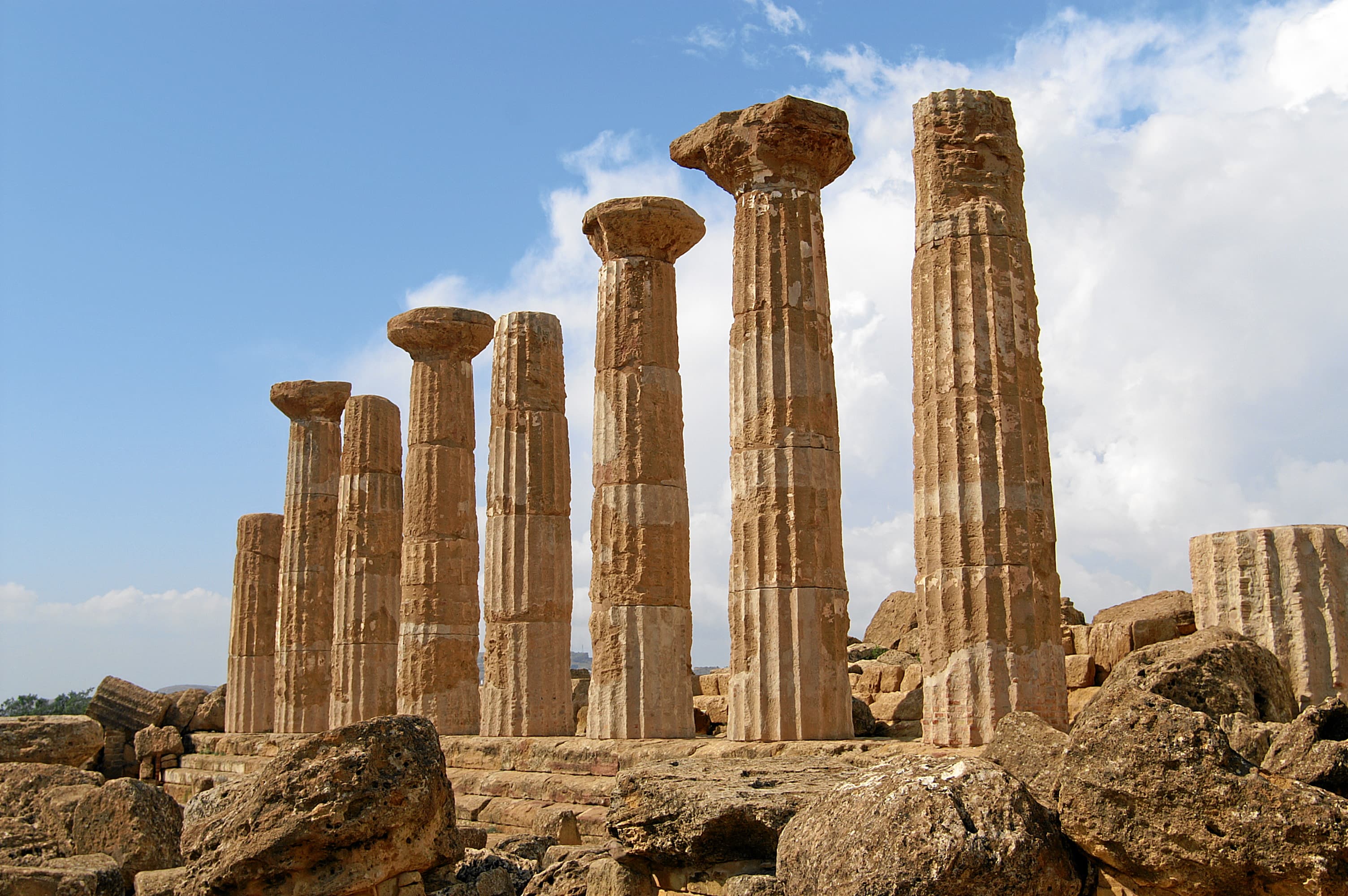
Image of Tempio di Ercole. Image source · CC-BY-SA-4.0
Visit essentials
A quick read before you go
- Duration
- 15-20 minutes at the temple; part of the 2-4 hour Valle dei Templi visit
- Access
- Central section of the Valle dei Templi, near Villa Aurea.
Overview
Near the center of the Valle dei Templi ridge, eight columns stand where thirty-eight once enclosed Akragas's oldest temple. Built around 510 BC in archaic Doric style, the Temple of Heracles predates the other ridge temples by decades and established their sacred ground.
Its attribution rests on Cicero's description of a temple “not far from the agora” containing a bronze Heracles attributed to Myron. Devotees' kisses and caresses had worn the statue's lips and chin smooth. Cicero recorded this tactile devotion while prosecuting the corrupt Roman governor Gaius Verres, who stole the fiercely protected image during his 73–71 BC Sicilian administration. It disappeared into private Roman collections, and its fate is unknown.
British Agrigento benefactor Sir Alexander Hardcastle restored the eight standing columns in 1924. They preserve part of a peristyle with six columns on each short side and fifteen on each long side. Two pillars flanking the naos doorway contained a service staircase to the roof, the earliest known example of a feature that became characteristic of Akragantine temple architecture.
Why this place is sacred
The Temple of Heracles is thin through its age and through its story. As the oldest sacred structure on the ridge, it established the sanctity of the landscape that the later temples would elaborate. But its deepest thinness comes from Cicero's account of the bronze statue — the record of worship as a tactile, bodily act.
The worn lips of the Heracles statue testify to a form of devotion that was not abstract or distant but intimate, physical, repeated across generations until it reshaped the object of veneration itself. The statue is gone, stolen by Verres and lost to history.
But the story remains, and standing before the eight columns, one can imagine the long line of worshippers approaching the bronze, bending to press their lips to the cool metal, each kiss infinitesimally wearing the surface toward the smoothness that Cicero would later note.
Oldest Doric temple at Akragas, dedicated to Heracles — the hero who achieved divinity through labor and suffering. Housed a famous bronze statue attributed to Myron.
Built c. 510 BC. The bronze Heracles statue stolen by governor Verres (73-71 BC). Temple destroyed by war and earthquake. Eight columns restored in 1924 by Sir Alexander Hardcastle. UNESCO World Heritage inscription as part of the Valle dei Templi, 1997.
Experience and orientation
The Temple of Heracles stands near Villa Aurea in the central section of the ridge, between the Temple of Concordia above and the Sanctuary of the Chthonic Deities below. Its eight restored columns, rising from a platform of original stone, create a partial colonnade that suggests the full structure without attempting to reproduce it.
Approaching the temple, the archaic proportions are perceptible: the columns are slightly more robust than those of the later temples, with a wider spacing that gives the colonnade a quality of directness absent from the more refined classical buildings. This is the earliest expression of Greek sacred architecture at Akragas — a building from the generation that first established the ridge as sacred ground.
Standing within the footprint of the temple, the space where the naos once held the bronze Heracles is identifiable. This is where the statue stood — the image with its kissed-smooth lips, its chin polished by the hands of devotees. The absence of the statue is itself a presence: Verres's theft, recorded by Cicero with prosecutorial outrage, left an emptiness that has persisted for over two millennia.
The flanking pillars of the naos doorway, which contained the earliest known service staircase in Akragantine temple architecture, mark a technical innovation as well as a sacred threshold. This practical element — access to the roof for maintenance and rituals — became a defining characteristic of subsequent temples at the site.
The Temple of Heracles is in the central section of the Valle dei Templi, near Villa Aurea. Walking the ridge from east to west, it is encountered after the Temple of Concordia. The eight restored columns are on the southern side, facing the Mediterranean. Walk the full perimeter to appreciate the archaic proportions.
Context and lineage
When the colonists of Akragas began to mark their ridge with temples, the Temple of Heracles was their first major construction — built around 510 BC, within a generation of the city's founding. Heracles was a particularly appropriate patron for a colonial community: he was the hero who achieved divine status through labor, endurance, and service — qualities that defined the colonial experience.
The bronze statue attributed to Myron became the focus of deep popular devotion, with worshippers expressing their reverence through physical contact that gradually reshaped the bronze itself.
The Temple of Heracles introduced the Doric peripteral form to Akragas and established architectural conventions — including the service staircase to the roof — that would characterize all subsequent temples at the site.
Cicero
Roman orator who documented the temple and its statue in the Verrine Orations
Gaius Verres
Corrupt Roman governor who stole the bronze Heracles statue
Sir Alexander Hardcastle
British benefactor who funded the restoration of eight columns
Traditions and practice
The cult of Heracles at Akragas centered on the bronze statue attributed to Myron. Worship included standard Greek practices — animal sacrifice, libation, and prayer — but the physical veneration of the statue was distinctive. Cicero's account of lips and chin worn smooth by devotees' kisses suggests a practice more intimate than typical Greek temple worship, closer to the tactile devotion found in some later religious traditions.
The temple is part of the Valle dei Templi UNESCO World Heritage Site. The eight restored columns serve as a visible marker of the site's earliest sacred phase.
Stand where the naos once held the bronze statue and consider the gesture of kissing a bronze image — the temperature of the metal, the accumulated patina of devotion. The statue is gone, but the gesture it received can still be imagined. Walk the perimeter and notice the archaic proportions — the wider column spacing, the sturdier drums — that distinguish this as the ridge's oldest building.
Ancient Greek Religion - Cult of Heracles
HistoricalAs both hero and god, Heracles embodied the possibility of mortal transcendence. His cult at Akragas was among the most intimate in the Greek world, with physical veneration of the cult statue that gradually reshaped the bronze itself.
Worship through sacrifice, libation, prayer, and physical veneration of the bronze cult statue. The tactile devotion — kissing and caressing the image — distinguished this cult from more formal Greek temple worship.
Perspectives and open questions
The Temple of Heracles connects the founding moment of Akragas's sacred landscape to one of the most vivid accounts of ancient devotion in all of classical literature.
Scholarly perspective
The temple holds significant value for scholars of archaic Doric architecture, representing the earliest known Doric temple at Akragas with the canonical 6x15 column arrangement. The service staircase within the naos doorway pillars is the earliest example of what became a characteristic feature of Akragantine temple architecture. The Cicero account provides rare literary evidence for the nature of popular devotion in the ancient Greek world.
Living and traditional perspectives
Heracles occupied a unique position in Greek religion: he was both mortal and divine, a hero who achieved godhood through suffering and labor. His cult offered worshippers an image of transformation — the possibility that mortality could be transcended through endurance. For a colonial community, facing the challenges of building a new city far from the homeland, Heracles was an especially resonant patron.
Alternative interpretations
The Heracles archetype — the mortal becoming divine through labor — has been interpreted in various spiritual traditions as representing the human path of transformation and self-transcendence.
Open questions
The fate of the bronze Heracles statue after Verres stole it is unknown. Whether additional cult objects or votive deposits remain beneath the site is being investigated. The exact appearance of the statue — which Cicero described with evident admiration — can only be imagined.
Plan your visit
Access and arrival
Central section of the Valle dei Templi, near Villa Aurea. Standard park admission.
Agrigento city center
Respectful visit
Comfortable walking shoes; sun protection
Permitted throughout
Not applicable
Do not touch or climb the columns | Stay on designated paths | Respect cordoned areas
Standard precautions for the Valle dei Templi: sun protection, water, comfortable shoes.
Current practical details
Address
92100 Agrigento, AG, Italy
Phone
Hours
Hours, fees, and access can change — verify on the official source before you travel. Practical details last checked Jun 2026.
Location
Map loads as you approach this section.
Pilgrim reflections
A portrait of encounter, not a score
Pilgrims describe what they felt, how present they could become, and whether the place would shape a journey. There are no stars and no ranking of traditions.
No reviewed reflections yet
The first pilgrims can help describe the character of being here.
Share a reflection
Available after an account-backed “Been there.” Every reflection is reviewed before publication.
Nearby sacred places
Explore other sacred places in the region. Proximity does not establish access or travel time; check each place’s guidance.


References
Sources consulted for this page. Source categories describe the publication, not a guarantee that every claim is verified. Traditional accounts and outside interpretations may differ.
- 01The Temple of Heracles - Smart Education UNESCO Sicilia — Smart Education UNESCO SiciliaSource contextUNESCO-affiliated educational content
- 02Temple of Heracles, Agrigento - Wikipedia — Wikipedia contributorsencyclopediaComprehensive overview with architectural and historical details
- 03Temple of Heracles - The World of Sicily — The World of SicilyspiritualCultural context and visitor information
- 04Temple of Heracles, Agrigento - Archaeolist — ArchaeolistacademicArchaeological site database
- 05Temple of Heracles in Akragas - Ancient History Sites — Ancient History SitesacademicDetailed archaeological analysis
Share a photo
Help visitors recognize Tempio di Ercole. Every submission is reviewed before publication.