Santuario delle Divinità Ctonie
Part ofValle dei Templi
Where the ancient Greeks poured their offerings into the earth, seeking the goddesses who govern death and return
Understand sacred places, explore living traditions, and learn how to engage respectfully with Pilgrim Map.
Access has not been verified. Check current local guidance before planning a visit.
Agrigento, Agrigento, Italy
Read the sources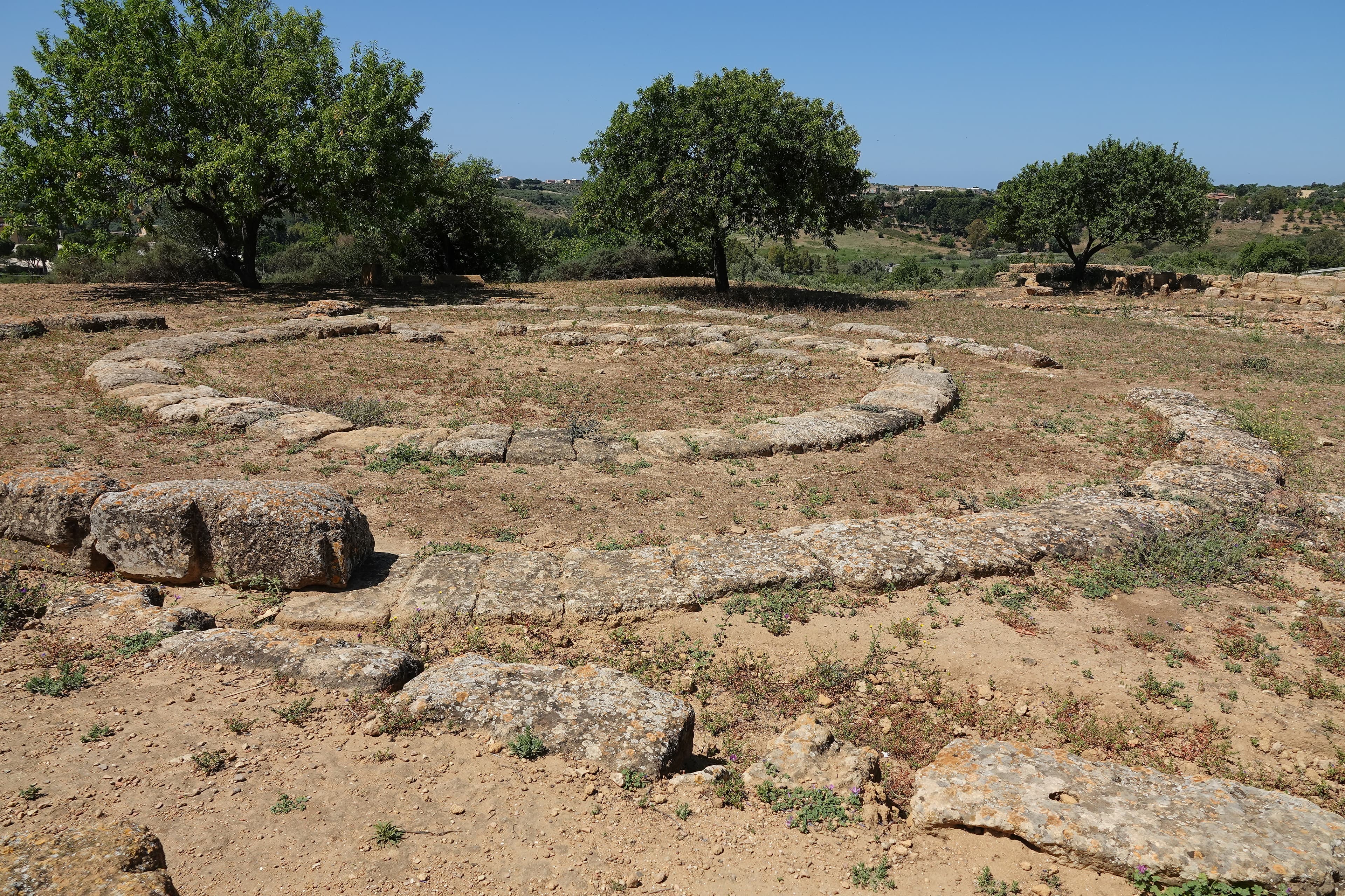
Image of Santuario delle Divinità Ctonie. Image source · CC-BY-SA-4.0
Visit essentials
A quick read before you go
- Duration
- 30-45 minutes for the sanctuary; part of the 2-4 hour Valle dei Templi visit
- Access
- Western section of the Valle dei Templi, near the four columns of the Tempio dei Dioscuri.
Overview
At the Valle dei Templi ridge's western end, monumental Doric temples give way to an intimate, ground-level sanctuary directed into the earth. Small temples, sacred enclosures, and altars honor Demeter and Persephone, goddesses governing soil fertility and souls' passage between living and dead worlds.
The complex crosses three terraces near the ancient Porta V gate. Its oldest 7th- and 6th-century BC structures predate many ridge temples, making this one of Akragas's earliest sacred areas. Archaic temenoi held rectangular and circular altars; later centuries added small temples with pronaoi and naoi.
Circular altars distinguish the sanctuary. While rectangular Olympian altars sent burnt offerings skyward as smoke, these directed offerings below: libations into earth, grain and oil in pits, and prayers to underworld powers. Archaeologists recovered kernoi—multi-cupped vessels associated with Persephone—and oil-lamp remains from ritual processions.
Pindar called Akragas 'the dwelling place of Persephone.' Here that identity was maintained through rites enacting her descent into the underworld and seasonal return, with offerings following the goddess's downward path.
Why this place is sacred
If the monumental temples of the ridge represent the Greek aspiration to reach the sky gods, the Sanctuary of the Chthonic Deities represents the complementary orientation: the descent into earth, the acknowledgment that the powers below are as essential as those above. The sanctuary is thin in the most literal sense of the term — it occupies the boundary between two worlds, the place where the living communicated with the dead through the medium of the soil itself.
The circular altars, designed to channel offerings downward rather than upward, create physical thresholds in the ground. The multi-cupped kernoi vessels, each cup holding a different offering, suggest a ritual practice of remarkable specificity and care. The accumulation of seven centuries of votive deposits — terracotta figurines, vessels, and organic offerings — has created an archaeological record of sustained human attention to the invisible powers beneath the surface.
Primary sanctuary of chthonic (earth-deity) worship at Akragas, dedicated to Demeter and Persephone. The oldest sacred precinct in the city, predating the major ridge temples.
7th-6th century BC: establishment of first archaic temenoi with circular and rectangular altars. 6th-5th century BC: addition of small temples. 406 BC: damaged during Carthaginian siege. 19th century: archaeological rediscovery. Present: ongoing scientific re-investigation of structures and votive deposits.
Experience and orientation
Approaching the sanctuary from the main ridge path, the change in scale is immediately perceptible. After the towering columns of the Temple of Concordia and the Temple of Heracles, the chthonic precinct presents a lower horizon. The structures here are smaller, more numerous, and closer to the ground. The eye, trained upward by the colonnade temples, must readjust to a sacred landscape that spreads horizontally rather than reaching vertically.
The three terraces of the sanctuary descend toward Porta V, the ancient city gate. The second terrace is the best preserved, retaining several small temple foundations, enclosed sacred spaces, and the characteristic circular altars. These altars, round stones set into the earth, are the architectural embodiment of chthonic theology: they directed offerings downward, into the soil, toward the underworld deities.
Standing beside one, the difference from an Olympian altar is palpable — there is no upward reach here, only a downward gravity.
The four columns of the Tempio dei Dioscuri rise from the sanctuary's edge, providing a vertical counterpoint to the otherwise horizontal landscape. But even these columns, as a 19th-century reconstruction, participate in the sanctuary's theme of uncertain boundaries — between ancient and modern, between what was and what we have made of it.
The sanctuary is less visited than the main ridge temples, which gives it a quality of relative solitude. The ground-level remains require closer attention: small foundations, low walls, altar surfaces worn by twenty-five centuries of weather. This is archaeology that asks the visitor to look down rather than up — an appropriate posture for a place dedicated to the powers beneath the earth.
Reach the sanctuary from the western section of the Valle dei Templi, beyond the Temple of Olympian Zeus. The area around the four columns of the Tempio dei Dioscuri serves as the most visible landmark. Walk the three terraces, giving particular attention to the circular altars on the second terrace.
Context and lineage
The cult of Demeter and Persephone was central to Sicilian Greek identity. The myth held that Persephone was abducted by Hades near Enna in central Sicily, making the entire island sacred ground for the grain goddess. Akragas, praised by Pindar as 'the dwelling place of Persephone,' maintained this sanctuary as the city's primary connection to the underworld deities.
The sanctuary predates many of the ridge temples, suggesting that chthonic worship was among the earliest religious acts of the colony — that before the Greeks of Akragas built their sky-reaching columns, they first addressed themselves to the earth.
The cult of Demeter and Persephone in Sicily drew on the Eleusinian Mysteries of mainland Greece but developed distinctive Sicilian characteristics. The localization of the Persephone myth in Sicily gave the island's Greek communities a particular relationship with chthonic worship that distinguished them from other colonies.
Pindar
Greek poet who called Akragas 'the dwelling place of Persephone'
Traditions and practice
Worshippers at the sanctuary directed their offerings downward: libations poured through circular altars into the earth, grain and oil deposited in pits, prayers and invocations addressed to the underworld deities. Kernoi — multi-cupped ritual vessels associated with Persephone's cult — held multiple offerings simultaneously. Oil lamps were used in ritual processions, creating lines of light through the sanctuary in what may have been reenactments of Demeter's search for her abducted daughter.
Terracotta figurines were dedicated as votive offerings, their forms providing evidence of how the devotees imagined and addressed their goddesses.
The sanctuary is part of the Valle dei Templi UNESCO World Heritage Site. Ongoing archaeological research focuses on votive deposits and terracotta figurines, providing new understanding of the social and cultural dimensions of chthonic worship. Recent academic publications on the site's coroplastics (terracotta figurines) are expanding knowledge of archaic religious practice.
Walk among the altars slowly, attending to their forms — the distinction between rectangular Olympian altars and circular chthonic ones. Notice how the sanctuary's orientation is horizontal rather than vertical: where the ridge temples reach for the sky, this precinct addresses the earth. Stand beside a circular altar and consider the gesture of pouring an offering into the ground — the trust that something valuable, given to the invisible, would be received.
Cult of Demeter and Persephone
HistoricalThe primary chthonic cult of Akragas, connecting the city to the Persephone myth and the Eleusinian Mystery tradition. Pindar's identification of Akragas as 'the dwelling place of Persephone' placed this worship at the center of civic identity.
Libations poured into the earth, grain and oil offerings, ritual use of kernoi vessels, oil lamp processions, and terracotta votive figurine dedication.
Perspectives and open questions
The Sanctuary of the Chthonic Deities reveals the dimension of Greek religion that the monumental temples above can obscure: the worship of the earth and the dead.
Scholarly perspective
The sanctuary represents one of the most important chthonic cult sites in Magna Graecia. Recent work on terracotta figurines and votive deposits is providing new understanding of the social, economic, and cultural dimensions of worship. The three-terrace structure preserves evidence of evolving ritual practice from the 7th through 5th centuries BC. The sanctuary's early date — predating many of the ridge temples — challenges the assumption that Olympian worship was primary.
Living and traditional perspectives
The Eleusinian Mysteries, centered on the myth of Demeter and Persephone, were among the most important religious experiences in the ancient Greek world. In Sicily, where the Persephone myth was localized, these mysteries took on particular intensity. The sanctuary at Akragas was where the city's identity as 'the dwelling place of Persephone' was ritually enacted and renewed.
Alternative interpretations
The chthonic orientation of the sanctuary has attracted interpretation in terms of earth-energy, telluric forces, and the concept of sacred geography. The circular altars have been read as devices for channeling subterranean energies, though these interpretations remain outside mainstream archaeology.
Open questions
The exact nature of the mystery rites performed here remains only partially understood. The relationship between the various structures and their chronological sequence is still being clarified. The content of many votive deposits has yet to be fully analyzed.
Plan your visit
Access and arrival
Western section of the Valle dei Templi, near the four columns of the Tempio dei Dioscuri. Standard park admission.
Agrigento city center
Respectful visit
Comfortable walking shoes; sun protection
Permitted throughout
Not applicable
Watch for ground-level archaeological remains | Stay on designated paths | Do not touch altar surfaces | Do not remove any stones or artifacts
Ground-level remains can be easy to overlook or accidentally step on. Walk carefully and stay on designated paths.
Current practical details
Address
92100 Agrigento, AG, Italy
Hours
Hours, fees, and access can change — verify on the official source before you travel. Practical details last checked Jun 2026.
Location
Map loads as you approach this section.
Pilgrim reflections
A portrait of encounter, not a score
Pilgrims describe what they felt, how present they could become, and whether the place would shape a journey. There are no stars and no ranking of traditions.
No reviewed reflections yet
The first pilgrims can help describe the character of being here.
Share a reflection
Available after an account-backed “Been there.” Every reflection is reviewed before publication.
Nearby sacred places
Explore other sacred places in the region. Proximity does not establish access or travel time; check each place’s guidance.


References
Sources consulted for this page. Source categories describe the publication, not a guarantee that every claim is verified. Traditional accounts and outside interpretations may differ.
- 01The sanctuary of the chthonic deities - Smart Education UNESCO Sicilia — Smart Education UNESCO SiciliaSource contextUNESCO-affiliated educational content with detailed description
- 02Santuario delle divinità Ctonie e Tempio dei Dioscuri - Parco Valle dei Templi — Parco Valle dei Templi AgrigentoofficialOfficial park archaeological description
- 03La coroplastica dal santuario delle Divinità Ctonie ad Agrigento — HAL Open ScienceacademicAcademic paper on terracotta figurines from the sanctuary
- 04Santuario delle Divinità Ctonie - The World of Sicily — The World of SicilyspiritualCultural site with archaeological context
- 05Sanctuary of the chthonic divinities - Sicilia in Rete — Sicilia in ReteSource contextRegional cultural tourism resource
Share a photo
Help visitors recognize Santuario delle Divinità Ctonie. Every submission is reviewed before publication.