Swinside Stone Circle
A near-perfect circle of ancient stones where the veil between worlds thins at midwinter dawn
Understand sacred places, explore living traditions, and learn how to engage respectfully with Pilgrim Map.
Access has not been verified. Check current local guidance before planning a visit.
Cumberland, England, United Kingdom
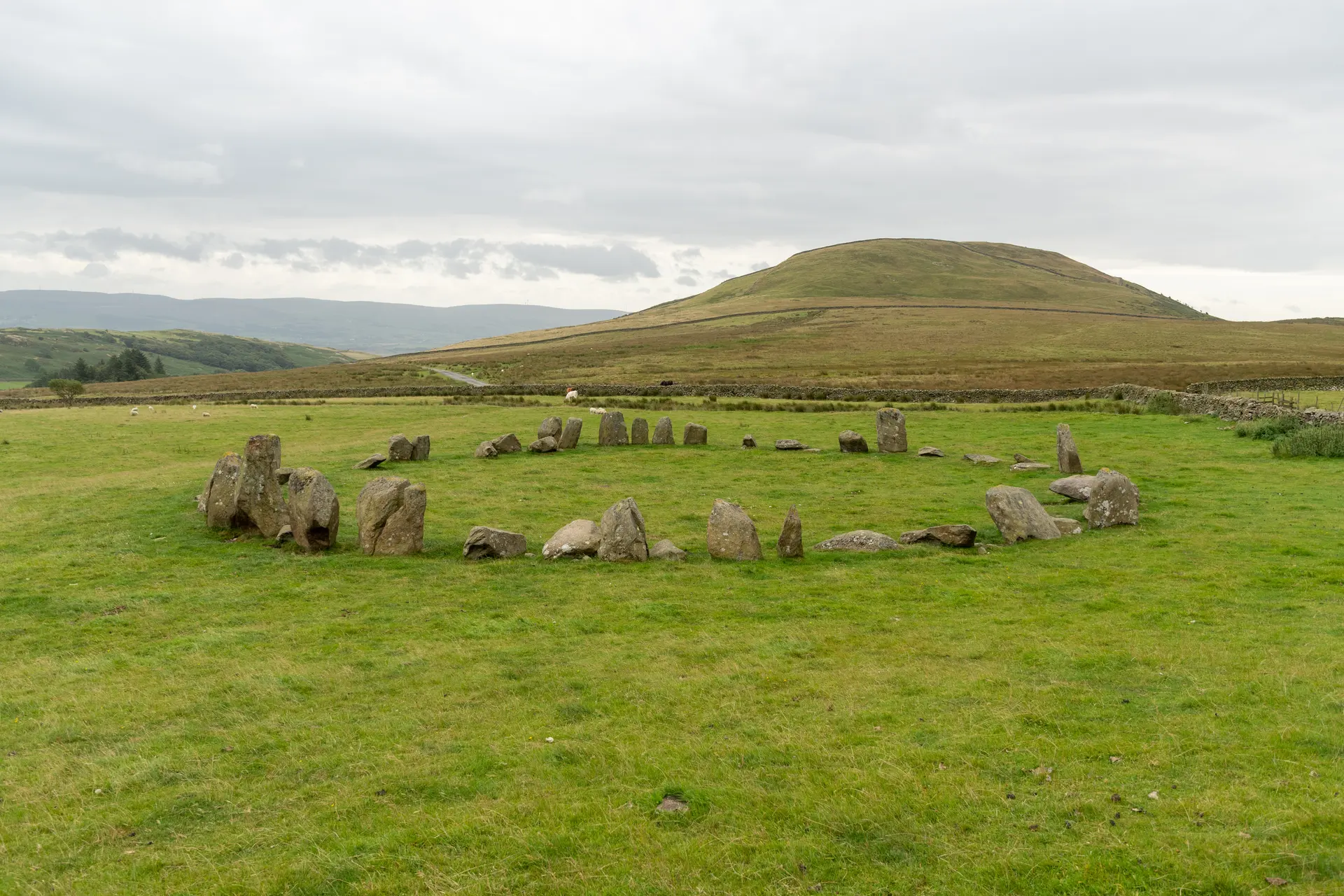
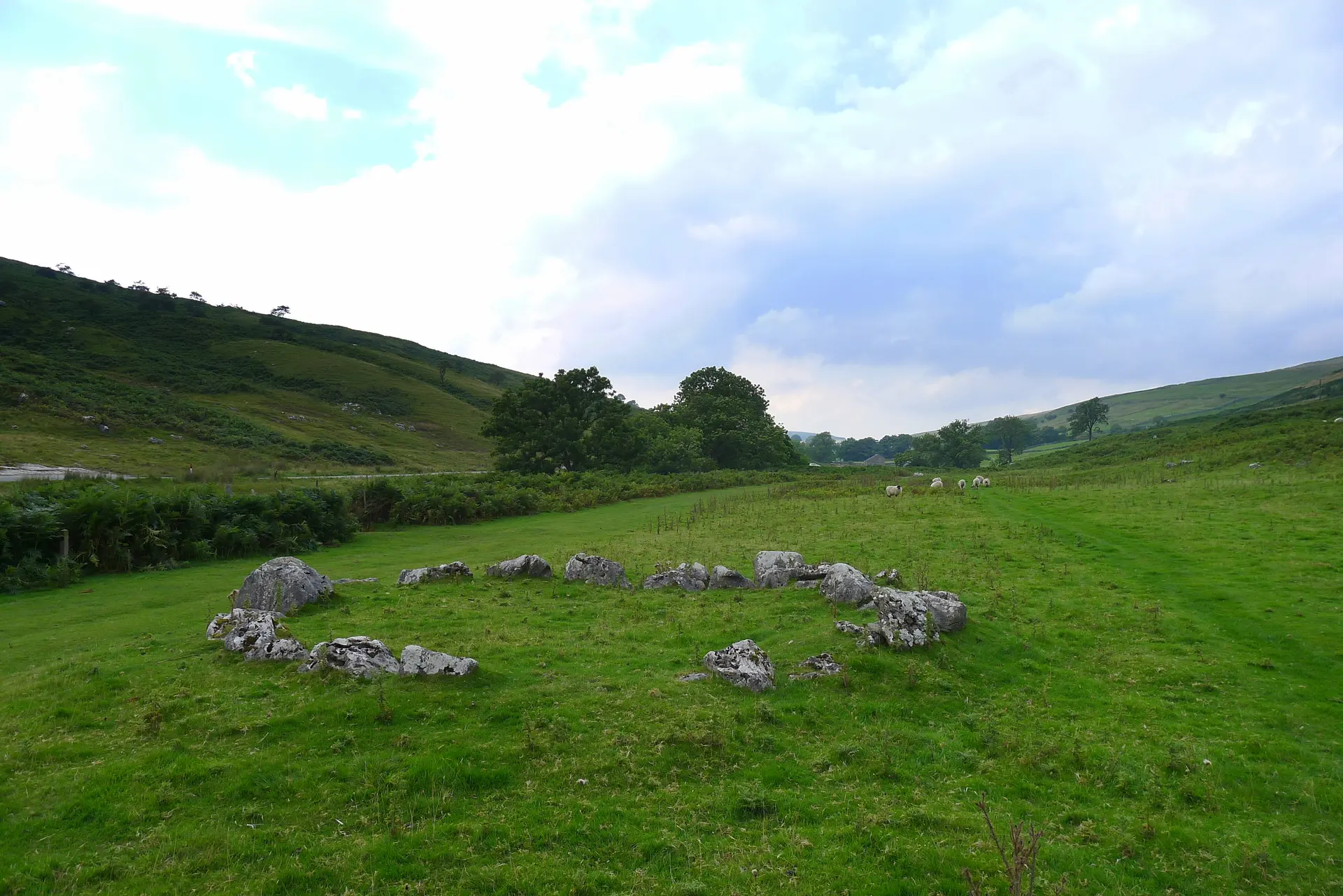
Image of Swinside Stone Circle. Image source · CC-BY-SA-4.0
Visit essentials
A quick read before you go
- Duration
- Allow two to three hours minimum: thirty to forty minutes each way for the walk, plus at least…
- Etiquette
- Swinside requires respect appropriate to both an archaeological treasure and private farmland.
Overview
The walk uphill from Crag Hall takes you away from everything. By the time Swinside Stone Circle appears on the fellside, the modern world has receded—no visitor centre, no interpretive panels, no one else. Just stones rising from grass at nearly eight hundred feet, with Black Combe falling away toward the Irish Sea.
This is what makes Swinside distinctive. Not its size, though at nearly ninety feet across it is substantial. Not its age, though it stands among Britain's oldest monuments. What sets it apart is its survival—fifty-five stones still present, roughly half still standing, arranged in a circle so nearly perfect that archaeologist Aubrey Burl called it 'the loveliest of all the circles' in north-western Europe.
The builders understood something about this place. They set their stones on packed pebbles, filled gaps with cobbles, and positioned their entrance to capture the midwinter sunrise—that moment when the sun reaches its lowest point and begins its return. Whatever ceremonies marked that hinge between darkness and light, they were performed here, in this ring that creates an almost palisade-like enclosure.
No one performs those ceremonies now. The tradition that built Swinside passed into silence perhaps three thousand years ago. Yet the circle remains—and so does the quality of attention it commands. In a landscape largely emptied of monuments to comparison, Swinside holds its ground, inviting contemplation of those who raised these stones and the cosmos they inhabited.
Why this place is sacred
The builders of stone circles knew something about place. They did not scatter their monuments randomly across the landscape but chose locations where sight lines, water, mountains, and sky converged in particular ways. Swinside sits on a terrace of Swinside Fell, sheltered from the north by higher ground, open to the south and southeast where Black Combe sweeps down toward the sea.
The entrance tells us what mattered most. Two large portal stones stand outside the circle's circumference, marking a formal threshold aligned with the midwinter sunrise. On the shortest day, light would have entered through this gateway—a celestial event made architectural. Archaeologist Aubrey Burl argued that the transition from building enclosed burial tombs to constructing open-air circles represented a fundamental shift in religious understanding: 'from darkness to light, from the dead to the living, from the grave to the sky.'
The circle itself creates a sense of enclosed space unusual among stone monuments. The stones stand close together, forming an almost continuous wall. Inside, the diameter provides room for gatherings—ceremony, perhaps, or observation. The 1901 excavation found charcoal and bone fragments, traces of activity whose nature we cannot know but whose presence confirms this was a place of purposeful use.
Archaeologist Colin Richards proposed that such circles may have represented the axis mundi—the center of the world—for their builders. A place where cosmic forces could be accessed, where the boundary between ordinary existence and something larger grew thin. Whether or not we share their cosmology, something of that intention persists in the space these stones define.
Evidence suggests Swinside served as a ceremonial gathering place, likely associated with astronomical observation and seasonal ritual. The midwinter sunrise alignment indicates calendar-keeping significance, while the scale of the interior and formality of the entrance suggest communal use. The shift from tomb-building to circle-building that characterizes this period may reflect new beliefs about where sacred encounters occurred—not in the darkness of burial chambers but under open sky, among the living.
For perhaps two thousand years, communities used this circle for purposes we can only imagine. Then the tradition faded. Unlike some monuments, Swinside appears not to have been repurposed by later cultures—no Roman activity, no medieval church foundations, none of the layering that marks other sacred sites. The circle slept.
Local folklore eventually filled the silence. The name 'Sunkenkirk' (Sunken Church) emerged from a legend that villagers tried to build a church here, only to have the Devil pull down their work each night until they abandoned the effort. The story suggests unease with a place whose original meaning had been lost—something clearly sacred, yet outside Christian understanding.
Today Swinside remains largely unvisited compared to more accessible circles like Castlerigg. Its remoteness means 'the stones are left to themselves,' as one observer noted. For seekers willing to make the walk, this isolation is precisely the point.
Experience and orientation
The approach matters. Unlike circles you can drive to and photograph from a car park, Swinside requires walking—thirty to forty minutes uphill from Crag Hall, following farm tracks through land where sheep outnumber people. By the time the stones appear, you have earned them.
What strikes visitors first is the completeness. Other circles have lost most of their stones to farmers, road builders, or time itself. Swinside keeps fifty-five of an estimated sixty original stones, arranged in a ring so nearly perfect that it seems almost deliberate—which, of course, it was.
The near-continuous line creates an effect somewhere between enclosure and invitation: you are clearly entering a defined space, yet the low height of most stones (the tallest reaches seven and a half feet) does not block the view of mountains and sky.
Many describe a quality of peace that differs from ordinary quiet. The isolation contributes, but there is something more—a sense of the site's aliveness despite its long silence. People find themselves speaking in lowered voices, reluctant to disturb what feels like a listening presence. Whether this reflects psychology, accumulated human attention, or something the builders understood and encoded, the effect is consistent.
Visitors who come seeking transformation may find it in unexpected form: not dramatic experience but subtle shift, a recalibration of perspective that comes from standing where people stood four thousand years ago, performing activities lost to time yet somehow still present in the space these stones define.
Approach Swinside as encounter rather than observation. Leave interpretive frameworks aside—there will be no signage to tell you what to think. The site asks only presence.
If possible, arrive early. Dawn light on the stones has a particular quality, and the midwinter sunrise alignment that guided the builders can be approximated at other times of year. Evening visits, when long shadows transform the circle, offer different but equally compelling atmosphere.
Consider sitting within the circle rather than photographing from outside. The interior space was designed for inhabiting, not viewing. Let the stones mark the horizon. Notice what arises in the stillness. The farmers who walked this land for centuries after the traditions ended called these 'countless stones'—impossible to number accurately no matter how many times you tried. There is something worth attending to in that folklore, a suggestion that the ordinary rules of reckoning do not quite apply here.
Context and lineage
No founding narrative survives from the people who built Swinside—their culture left no written records, and whatever oral traditions once explained the circle's meaning died with them. What remains is stone and landscape.
Later folklore, however, grew to fill the silence. The most persistent legend explains the name 'Sunkenkirk': villagers once attempted to build a church on this spot, but each night the Devil himself rose from the ground and pulled down their work, causing the stones to sink into the earth. After repeated failures, the builders abandoned their effort, leaving the stone circle we see today.
This story, recorded in various forms, reveals how later communities understood the site—clearly sacred, clearly powerful, but not Christian, and therefore requiring a cautionary explanation. The Devil's intervention makes sense of why such an obviously significant place should have been left alone rather than Christianized.
Another fragment of folklore holds that the stones cannot be accurately counted. No matter how many times you try, you will get a different number each time. This 'countless stones' motif appears at megalithic sites throughout Britain, suggesting a deep intuition that these places operate outside ordinary rules.
The communities who built Swinside left no descendants in the sense of continuous tradition. The circle outlasted its builders by millennia, standing through the Bronze Age, Iron Age, Roman occupation, Anglo-Saxon settlement, Norman conquest, and everything that followed—yet no culture claimed it as their own until antiquarians arrived in the modern era.
What we can say is that Swinside belongs to a tradition that stretched from Orkney to Brittany, spanning perhaps two thousand years. Across this geography and time, communities built stone circles for purposes that appear related: astronomical observation, seasonal ceremony, community gathering. The specifics varied, but the impulse seems constant—to mark particular places on the earth as meeting points between human and cosmic orders.
Scheduled as an Ancient Monument in 1933, Swinside now falls under the protection of Historic England. Its future is more secure than its past is knowable.
Charles W. Dymond
historical
Victorian antiquarian who conducted the first archaeological excavation at Swinside in 1901, alongside W. G. Collingwood. Their work, sponsored by the Cumberland and Westmorland Antiquarian and Archaeological Society, documented the circle's dimensions and construction methods, finding charcoal and bone fragments that confirmed ritual use.
Aubrey Burl
scholarly
The leading late-twentieth-century authority on British stone circles, whose work placed Swinside within the broader context of megalithic tradition. He described it as 'the loveliest of all the circles' and argued that the transition from tomb-building to circle-building marked a fundamental shift in prehistoric religious understanding.
Traditions and practice
Archaeological and architectural evidence suggests the circle was designed for midwinter sunrise observation, when light would enter through the portal entrance at the solstice. This astronomical alignment points to ceremonies marking the sun's return—what one observer described as 'the death and rebirth of the sun.'
The interior space could have held gatherings of significant size. The 1901 excavation found charcoal and bone fragments, evidence of activities that might have included fire, offerings, or ritual meals. Beyond this, we cannot say. No contemporary accounts survive; no later traditions preserve even distorted memory of what occurred here.
Comparison with other stone circles and general Bronze Age practices suggests possibilities: offerings to ensure agricultural fertility, ceremonies marking seasonal transitions, rites of passage for individuals or communities. But these remain inference, not knowledge.
Unlike some Lake District stone circles—Castlerigg and Long Meg in particular—Swinside sees minimal modern neo-pagan or druid activity. Its remote location, requiring a significant walk and offering no nearby facilities, means 'the stones are left to themselves.'
This absence of organized contemporary practice creates space for individual encounter. Visitors are not fitting into an existing ceremonial framework but meeting the site on their own terms. For some, this is precisely what they seek: a place where spiritual engagement is self-directed rather than structured.
If you come seeking more than scenery, consider these invitations:
Arrive in silence. The walk from Crag Hall offers time to transition from ordinary mind to something more attentive. Let the approach be preparation rather than prelude.
Enter through the portal. The southeast entrance was designed as threshold. Whether or not you believe in its original significance, approaching the circle formally rather than casually shifts your relationship to the space.
Sit within the ring. Find a stone that calls to you and settle against it—not touching the monument itself, but using the space as its builders intended: as interior, not exterior. Notice what arises in the enclosure.
If timing allows, come at dawn or dusk. The changing light transforms the stones, and solitude is more likely at these hours. A midwinter visit, when the sun rises through the portal entrance, offers the closest approach to original experience.
Neolithic/Bronze Age Megalithic Tradition
HistoricalSwinside represents the apex of a tradition of monument-building that swept across the British Isles and Brittany from approximately 3300 to 900 BCE. The shift from constructing enclosed burial tombs to open-air stone circles marked what archaeologist Aubrey Burl called a religious revolution: 'from darkness to light, from the dead to the living, from the grave to the sky.' This circle, with its near-perfect form and careful solar alignment, embodies the new cosmology—a gathering place for the living under open sky, oriented to celestial movements that governed agricultural life and spiritual understanding.
Practices at Swinside would likely have included ceremonial gatherings at the winter solstice, when sunrise light entered through the portal entrance. The interior space suggests community assembly. Charcoal and bone fragments found during excavation point to fire use and possibly offerings or ritual meals. Beyond these inferences, specific practices remain unknown—the tradition left no written or surviving oral record.
Perspectives and open questions
Swinside invites contemplation more than explanation. What we know is limited; what we feel may be truer than what we can document. Scholarly consensus provides framework, but the circle exceeds any single interpretation.
Scholarly perspective
Archaeological consensus places Swinside's construction in the Late Neolithic or Early Bronze Age, broadly 3300-900 BCE, with most estimates favoring the earlier end of this range for fully developed stone circles. The site belongs to a tradition of monument-building that swept across the British Isles and Brittany, producing hundreds of stone circles varying in size, form, and presumably function.
Aubrey Burl, the leading authority on British stone circles, argued that the transition from building enclosed burial tombs to open-air circles marked a religious revolution—a shift 'from darkness to light, from the dead to the living, from the grave to the sky.' If so, Swinside represents the new cosmology: a space for the living to gather under open sky, oriented to the sun's movements.
The construction shows sophisticated building technique. Stones were set on packed pebbles (called 'pinnel') with cobble packing to stabilize them. The near-perfect circularity suggests careful planning, possibly using a central stake and rope. The entrance alignment with midwinter sunrise points to calendrical function—whether practical (agricultural timing), ceremonial (solstice celebration), or both.
The 1901 excavation found charcoal and bone fragments but no artifacts. This paucity of finds is common at stone circles and suggests ceremonial rather than domestic use. Whatever happened here left traces in the earth but not the objects we would need to reconstruct it.
Alternative interpretations
Some interpret stone circles as nodes on 'ley lines'—hypothetical alignments of ancient sites that some believe mark lines of earth energy. Swinside appears in various alternative maps of Britain's sacred landscape, connected to other monuments in patterns that may or may not reflect original intent.
Archaeologist Colin Richards proposed that circles like Swinside may have represented the axis mundi—the center of the world—for their builders. This interpretation, while speculative, draws on comparative religious studies and suggests that stone circles were not merely calendars or gathering places but cosmological statements, marking points where earth met sky and ordinary existence touched the sacred.
Neither ley line theory nor axis mundi interpretation can be confirmed by archaeological evidence. However, the consistent reports of unusual experience at stone circles—Swinside included—suggest that something about these places produces effects beyond what their simple arrangement of stones would seem to explain.
Open questions
More remains unknown than known about Swinside. The most fundamental questions resist answer: Why this particular location? What specific rituals occurred within the circle? Who were the people who built it—their social organization, their beliefs, their relationship to other communities in the region? How long was the circle actively used, and why did use cease?
The relationship between Swinside and other nearby monuments—the Burnmoor circles six miles north, the scattered cairns and standing stones of the Lake District fells—remains unclear. Were these sites connected in a larger ceremonial landscape, or did each community maintain its own traditions?
Perhaps most tantalizingly: why the midwinter alignment rather than midsummer? Both solstices mark turning points; other circles align with the summer sunrise. The choice to mark midwinter—the return from darkness, the sun's rebirth—suggests something about the builders' priorities, but what exactly remains open to interpretation.
These mysteries are worth preserving. They keep the site alive to questioning rather than closed by false certainty.
Plan your visit
Access and arrival
No accommodation at the site. The nearest options are in Broughton-in-Furness (2.5 miles) or Millom (3 miles), with a greater range available in the central Lake District towns of Coniston, Ambleside, and Keswick. For those combining Swinside with other sacred sites, the Lake District offers numerous walking-focused accommodations and B&Bs.
Respectful visit
No formal requirements, but practical outdoor clothing is essential. The walk is uphill, the ground uneven, and Lake District weather is famously changeable. Waterproof boots with good grip, layers for temperature changes, and rain gear regardless of forecast.
Permitted throughout the site. No special permits required for personal use. The usual courtesies apply: be aware of others' experience, do not monopolize the space for extended shoots, and consider whether your need for images is interfering with your actual presence at the site.
Not appropriate. Swinside is a protected Scheduled Monument and any modification or disturbance is illegal under UK law. Objects left at the site—crystals, coins, flowers, food—are removed as litter. If ceremony is important to you, make offerings internal: attention, gratitude, intention.
The circle is on private land. Access is permitted via the adjacent public footpath. No digging or metal detecting under any circumstances—this is a criminal offense at a Scheduled Monument. No camping at or near the site. Dogs should be kept on leads due to livestock in the surrounding fields.
Do not leave physical offerings. Swinside is a Scheduled Monument; any disturbance is illegal, and objects left behind are removed as litter. If you wish to offer something, make it internal—a moment of attention, a silent acknowledgment of those who built and used this place.
Do not touch or climb the stones. Erosion from human contact threatens monuments that have survived for millennia. The temptation to feel ancient stone under your palm is understandable; resist it.
Respect the private land surrounding the circle. Close gates behind you. Do not approach livestock. Keep dogs under control.
Current practical details
Address
Millom LA18 5LD, UK
Hours
Hours, fees, and access can change — verify on the official source before you travel. Practical details last checked Jun 2026.
Location
Map loads as you approach this section.
Pilgrim reflections
A portrait of encounter, not a score
Pilgrims describe what they felt, how present they could become, and whether the place would shape a journey. There are no stars and no ranking of traditions.
No reviewed reflections yet
The first pilgrims can help describe the character of being here.
Share a reflection
Available after an account-backed “Been there.” Every reflection is reviewed before publication.
Nearby sacred places
Explore other sacred places in the region. Proximity does not establish access or travel time; check each place’s guidance.
Share a photo
Help visitors recognize Swinside Stone Circle. Every submission is reviewed before publication.