Swayambhunath, Kathmandu
Where the primordial light of awakening settled on a hilltop above Kathmandu
Understand sacred places, explore living traditions, and learn how to engage respectfully with Pilgrim Map.
Access has not been verified. Check current local guidance before planning a visit.
Kathmandu, Bagmati Province, Nepal
Read the sources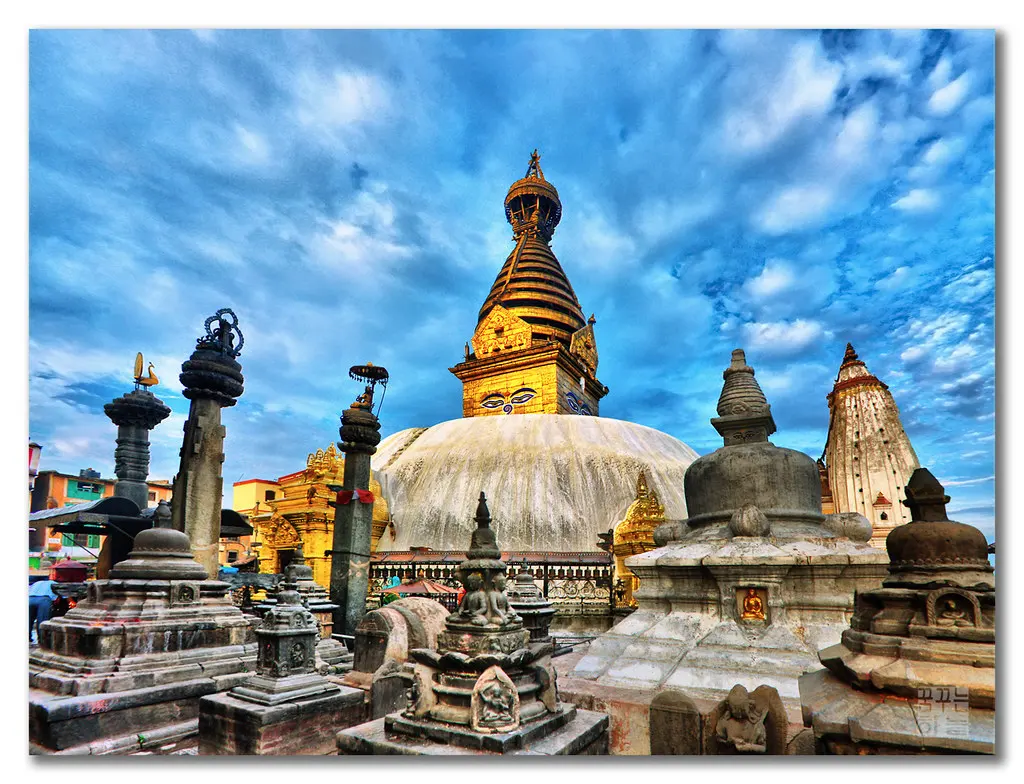
Image of Swayambhunath, Kathmandu. Image source
Visit essentials
A quick read before you go
- Duration
- Two to three hours for a thorough visit including the climb, circumambulation, and exploration…
- Access
- Located four kilometers west of Thamel, central Kathmandu.
Overview
Swayambhunath is approached by 365 stone steps whose ascent shifts the body's rhythm before the Kathmandu Valley opens below. Religious activity on the hill reaches at least to the third century BCE, when Emperor Ashoka is said to have visited; the present stupa most likely dates to the fifth century CE, making it one of the valley's oldest Buddhist monuments.
Vajrayana tradition reads Swayambhu as `self-arisen` or `self-created`: the stupa marks and protects a primordial flame of wisdom understood to have manifested here before any structure, teaching that awareness can arise naturally when conditions allow. The living complex holds multiple traditions without forcing them into a single practice. Newar Buddhists, whose Vajrayana lineage predates Tibetan Buddhism in Nepal, circumambulate counterclockwise; Tibetan Buddhists move clockwise; Hindu devotees worship Harati Devi, Ganesh, and Bhairava.
Their coexistence expresses Nepal's permeable sacred landscape while preserving each community's own authority.
Why this place is sacred
Several dimensions converge to make Swayambhunath a place of extraordinary density. The most fundamental is cosmological. In Vajrayana Buddhism, this hilltop is where the primordial Adi-Buddha, the source from which all Buddhas emanate, chose to manifest as a self-arisen flame of light. The Swayambhu Purana teaches that this light appeared before the valley was habitable, when a great lake still covered the land.
According to this account, multiple Buddhas across successive cosmic ages visited the light, each consecrating the site anew.
Beneath the stupa lies Shantipur, a temple containing underground chambers that the public may not enter. According to tradition, the tantric master Shantikar Acharya has remained in meditation within these chambers since sometime between the fifth and seventh centuries. Only the senior Buddhacharya priest enters, twice monthly, to perform ceremonial activities. The nature of Shantikar Acharya's continued existence, whether literal, symbolic, or as a sustained spiritual presence, is a matter of faith.
What is verifiable is that the Buddhacharya lineage has maintained this practice for centuries, treating the underground chambers as a site of living, not historical, significance.
The convergence of esoteric Buddhist lineages adds another layer. Padmasambhava, the founder of Tibetan Buddhism, practiced here. Nagarjuna, among the most important philosophers in Mahayana Buddhist history, is associated with the site. Vasubandhu and Shantarakshita, foundational figures in Buddhist thought, also maintained connections to Swayambhunath. These are not casual associations. They suggest that across centuries, practitioners recognized something about this location that drew them back.
Then there is the sheer weight of continuous devotion. The steps are worn smooth not by weather but by feet. The prayer wheels are polished by hands. The butter lamps have been lit here daily for longer than anyone can trace. This accumulation is not metaphorical. A site where thousands of people have focused intention for over a millennium carries something that newcomers consistently notice, even when they arrive without expectation or framework.
The stupa marks and protects what Vajrayana tradition identifies as a self-arisen manifestation of primordial wisdom, the Adi-Buddha. Its purpose is to make accessible a place where enlightened awareness is understood to have emerged spontaneously.
The site evolved from a primordial place of veneration, through Ashoka-era Buddhist significance, to a Licchavi-period stupa complex, to a multi-tradition pilgrimage center incorporating Newar Vajrayana, Tibetan Buddhist, Theravada Buddhist, and Hindu worship. The 2015 earthquake caused significant damage; restoration demonstrated the site's importance to a global Buddhist community. The 2010 re-gilding, funded by the Tibetan Nyingma Meditation Center of California using twenty kilograms of gold, reflected the site's living connection to practitioners worldwide.
Experience and orientation
The approach matters. From the base of the hill, the 365 steps rise steeply through forest. Monkeys inhabit the trees, swinging between branches, sitting on railings, occasionally descending to investigate a visitor's bag. They are not tame, exactly, but neither are they wild. According to tradition, they are sacred descendants of Manjushri himself, born from lice that fell from his hair when he cut the gorge at Chobar to drain the primordial lake.
Whether or not one accepts this origin, the macaques are undeniably part of the place. Their presence disrupts any tendency toward excessive solemnity.
The climb itself serves as preparation. By the time the hilltop opens before a visitor, the body has shifted registers. The noise and dust of Kathmandu, loud just minutes ago, recede. The air at the summit carries incense and the faint sound of bells. Prayer flags stretch between every available anchor point, their colors faded by sun and rain, their mantras released by wind.
The stupa dominates the hilltop but does not monopolize it. The great white dome, crowned by its gilded spire and the painted eyes of the Buddha, sits at the center of a complex that includes dozens of shrines, temples, and monasteries. The eyes face north, south, east, and west. Between them, at the position of a nose, is the Nepali numeral for one, a symbol of the single path to enlightenment.
Above, the thirteen golden rings of the spire represent the stages from ignorance to awakening.
Circumambulation draws the visitor into the site's rhythm. The path around the stupa is lined with prayer wheels, each inscribed with mantras. Spinning them as you walk, moving in the direction you choose, the body enters a cadence that quiets the mind without effort. The devotees around you, many of whom have walked this path thousands of times, move with an ease that reveals long practice.
The surrounding shrines reward exploration. The Harati Devi temple, dedicated to the Hindu goddess of epidemics who was converted to Buddhism's protector of children, draws both Hindu and Buddhist worshippers. The Vajra, a massive bronze thunderbolt symbol at the top of the eastern stairway, marks the entrance King Pratap Malla built in the seventeenth century. Small shrines to Ganesh, Bhairava, and various bodhisattvas appear in alcoves and courtyards throughout the complex.
Early morning visits carry particular power. Before dawn, devotees climb the steps in the dark, their flashlights bobbing upward through the trees. At the summit, the first light catches the golden spire before it reaches the valley floor. The circumambulation at this hour is dense with intention, the mantras audible, the butter lamps glowing in the half-dark.
Visitors who arrive at this hour often describe a quality of concentration in the air that differs from the daytime atmosphere, when tourist traffic dilutes the devotional density.
Sunset offers a different gift. The Kathmandu Valley spreads below in every direction, its haze turning amber and rose as the light drops. The stupa's white dome takes on warm tones. The transition from day to night, observed from this elevation, carries its own contemplative weight.
The main stupa occupies the hilltop center, surrounded by temples, shrines, and monasteries. The primary approach is the 365-step eastern stairway, with an alternative road entrance from the south that avoids most steps. The circumambulation path circles the main stupa. Prayer wheels line the base. The Harati Devi temple, Shantipur, Anandakuti Vihar, and the great Vajra thunderbolt are among the most significant structures.
Context and lineage
The Swayambhu Purana tells of a time when the Kathmandu Valley was a great lake. The Buddha Vipassi sowed a lotus seed in its waters, and the seed grew into a thousand-petaled flower that emitted a brilliant, eternal light. The Five Dhyani Buddhas appeared in the rays of this light. Far away in China, at Wu Tai Shan, the Bodhisattva Manjushri was meditating when he had a vision of the luminous lotus.
He flew across the Himalayas on his blue lion to see it for himself.
Manjushri recognized that the light should be accessible to human pilgrims, not hidden beneath a lake. With his sword Chandrahasa, he cut a gorge at Chobar, and the waters drained away. The lotus settled on a hilltop and its light became the Swayambhunath stupa.
The story does not end with drainage. The displaced Naga serpent deities needed a home, so Manjushri established Taudaha lake as a haven for the Naga King Karkotaka and his family. He then founded the first city in the valley, Manjupattana, and installed Dharmakara as its first king, establishing civilization grounded in dharma.
Geologists confirm that the Kathmandu Valley was indeed once a lake, its waters draining through a natural gorge at Chobar. This convergence between geological reality and sacred narrative raises questions about how ancient communities preserved and transmitted memory of landscape transformation through story. Whether the Swayambhu Purana encodes genuine geological observation or arrived at the same conclusion through other means remains an open question.
Swayambhunath holds significance across multiple Buddhist lineages and Hindu tradition. The Newar Buddhacharya priesthood maintains exclusive esoteric authority at Shantipur, preserving a Vajrayana lineage that may predate Tibetan Buddhism's arrival in Nepal. The Nyingma, Gelug, Kagyu, and Sakya schools of Tibetan Buddhism all maintain connections to the site. Theravada Buddhist communities venerate it as one of the oldest stupas in the Buddhist world.
Hindu worship, particularly at the Harati Devi temple and shrines to Ganesh and Bhairava, reflects the deep religious syncretism characteristic of Nepalese sacred sites.
Manjushri
Bodhisattva of wisdom who, according to the founding narrative, drained the primordial lake to make the sacred light accessible to humanity
Shantikar Acharya
Tantric master who, according to tradition, established the Vajrayana presence at Swayambhunath and remains in perpetual meditation within the Shantipur underground chambers
King Manadeva / King Vrsadeva
Licchavi-period rulers (fifth century CE) to whom the construction of the original stupa is attributed, though sources differ on which king was responsible
Padmasambhava
Founder of Tibetan Buddhism who practiced at Swayambhunath, deepening its significance for Tibetan Buddhist lineages
King Pratap Malla
Seventeenth-century ruler who constructed the eastern stairway, the primary approach to the stupa used today
Yogin Sangye Gyaltsen
Added the wheel and spire to the stupa in 1505, giving it much of its present appearance
Traditions and practice
Circumambulation is the central practice at Swayambhunath, but its direction reveals a distinction most visitors overlook. Newar Buddhists, whose Vajrayana lineage predates the Tibetan presence in Nepal, traditionally circle the stupa counterclockwise. Tibetan Buddhists, who form the majority of circumambulators today, move clockwise. Both directions carry doctrinal significance within their respective traditions. That both practices occur simultaneously, around the same stupa, without conflict, says something about the nature of the place.
Butter lamp offerings illuminate the complex throughout the day and into the night. Devotees purchase butter and wicks near the entrance and add their flames to the arrays that surround the stupa and fill the shrine interiors. Each flame symbolizes the light of wisdom dispelling ignorance.
Prostrations deepen the physical dimension of practice. At the four cardinal directions, devotees lower their bodies fully to the ground, rise, and repeat. Some complete hundreds of prostrations in a single visit, a practice that combines physical exertion with meditative focus.
The most esoteric practice remains hidden from public view. Twice each month, the senior Buddhacharya priest descends into the underground chambers of Shantipur to perform ceremonial activities whose specific nature is not disclosed. This practice connects to a tradition that may extend back to Shantikar Acharya's original establishment of the shrine, a continuity measured in centuries.
During the Newar month of Gunla, which falls between Shravan and Bhadra, Newar Buddhists observe a month-long festival centered on Swayambhunath. The hilltop fills with additional devotees, and the daily rhythms intensify.
Buddha Jayanti, celebrating the birth, enlightenment, and death of Siddhartha Gautama, draws the largest annual crowds. On this day alone, the sacred Buddha relic housed at Anandakuti Vihar is displayed for public viewing. The rest of the year, the relic remains inaccessible. The occasion transforms the hilltop into a dense gathering of devotees, monks, and pilgrims from across Nepal and beyond.
Losar, the Tibetan New Year, brings a different atmosphere. Gelugpa monks perform cham masked dances, a ritual art form depicting the victory of dharma over obstacles. The celebration bridges the Tibetan and Newar communities who share the site.
Monasteries within the complex maintain daily ritual schedules, and monks' prayers at the Vajra temple provide a continuous undercurrent of chanting that visitors may hear drifting across the hilltop at various hours.
Join the circumambulation. Choose clockwise or counterclockwise according to your inclination, or simply follow the majority flow, which moves clockwise. Spin the prayer wheels as you pass them. The physical rhythm of walking and spinning creates a natural meditative state that requires no instruction or belief.
Butter lamps are available for purchase near the entrance and at various points within the complex. Lighting one and placing it among the existing flames is a simple act of participation that connects you to the devotional stream of the site.
For deeper engagement, arrive before dawn. Climb the steps in the dark with the morning pilgrims. The experience of emerging onto the hilltop as the first light reaches the golden spire, surrounded by devotees who have been making this ascent for decades, offers something that daytime visits cannot replicate.
If your visit coincides with Buddha Jayanti, the once-annual display of the sacred relic at Anandakuti Vihar provides a rare opportunity. Plan to arrive early, as crowds are substantial.
Newar Buddhism (Vajrayana)
ActiveSwayambhunath holds a central position in Newar Buddhist religious life, ranking among the three most sacred Buddhist pilgrimage sites for the Newar community. The Buddhacharya priesthood maintains exclusive ritual access to the Shantipur shrine, preserving an esoteric Vajrayana lineage that may be among the oldest continuously functioning Buddhist institutional lineages in the world.
Counterclockwise circumambulation, butter lamp offerings, mantra recitation, observance of the month-long Gunla festival, maintenance of the Buddhacharya lineage at Shantipur, participation in the annual display of the Buddha relic at Anandakuti Vihar on Buddha Jayanti.
Tibetan Buddhism
ActiveSecond only to Boudhanath in importance for Tibetan Buddhists in Nepal. The site is revered as a place where Padmasambhava, Nagarjuna, Vasubandhu, and Shantarakshita practiced. All four major schools, Nyingma, Gelug, Kagyu, and Sakya, maintain connections. The 2010 gold renovation, funded by the Tibetan Nyingma Meditation Center of California, demonstrated the global community's investment in the site.
Clockwise circumambulation, prostrations at the four cardinal directions, prayer wheel spinning, Losar celebrations with cham masked dances performed by Gelugpa monks, butter lamp offerings, prayer flag installations.
Hinduism
ActiveHindu temples and shrines are integral to the Swayambhunath complex, reflecting Nepal's deep religious syncretism. The Harati Devi temple is particularly popular among Hindu devotees. Shrines to Ganesh, Bhairava, and Shiva are distributed throughout the complex. Hindu monarchs historically patronized the site.
Worship at the Harati Devi temple, offerings to Ganesh and Bhairava shrines, puja ceremonies, flower and rice offerings at Hindu shrines within the complex.
Theravada Buddhism
ActiveModern Theravada Buddhist communities venerate Swayambhunath as one of the most ancient stupas in the Buddhist world. The site's connection to past Buddhas, including Konagamana, Kakusandha, and Kassapa, and the tradition that Gautama Buddha himself visited, establishes its significance across all Buddhist schools.
Meditation, circumambulation, participation in Buddha Jayanti celebrations.
Perspectives and open questions
Swayambhunath sits at a confluence of perspectives: archaeological, traditional Newar, Tibetan Buddhist, Hindu, and scholarly. Each illuminates different dimensions of the site, and none alone captures the whole.
Scholarly perspective
Archaeological and historical analysis places religious activity at the site from the third century BCE, with the current stupa structure dating to the fifth century CE during the Licchavi period. Scholars recognize Swayambhunath as one of the oldest Buddhist sites in the Kathmandu Valley, predating Boudhanath. The Swayambhu Purana, a fifteenth-century text, codified earlier oral traditions about the site's mythological origins.
The remarkable correspondence between the geological fact that the Kathmandu Valley was once a lake and the Purana's account of Manjushri draining a primordial body of water has attracted scholarly attention as a possible example of deep geological memory transmitted through sacred narrative.
The site demonstrates religious syncretism characteristic of Nepalese culture, where Buddhism and Hinduism interpenetrate rather than exist as discrete systems. Scholars note that the Newar Buddhacharya priesthood, which maintains exclusive access to the Shantipur shrine, represents one of the oldest continuously functioning Buddhist institutional lineages in the world. Attribution of the stupa's construction remains debated: some sources cite King Manadeva of the fifth century CE, while others point to his great-grandfather King Vrsadeva.
Living and traditional perspectives
For the Newar community, Swayambhunath occupies a position among the three most sacred Buddhist sites, central to daily religious life and communal identity. The Swayambhu Purana's account of Manjushri draining the lake is foundational not merely as myth but as a framework for understanding the Kathmandu Valley's very existence. The monkeys, in this understanding, are sacred descendants of Manjushri, born from lice that fell from his hair as he worked.
The Newar Buddhacharya priesthood maintains esoteric authority at Shantipur through a lineage believed to extend back to the fifth through seventh centuries, a continuity that grounds the living tradition in deep time.
Within Tibetan Buddhist understanding, Swayambhunath is second in importance only to Boudhanath among Nepalese sites. The connections to Padmasambhava, Nagarjuna, Vasubandhu, and Shantarakshita establish it as a place where the very foundations of Tibetan Buddhist thought were shaped. All four major schools of Tibetan Buddhism maintain connections to the site, making it an ecumenical pilgrimage destination that transcends sectarian boundaries.
Hindu devotees approach the site through their own framework. The Harati Devi temple, the Ganesh and Bhairava shrines, and the Shiva lingams distributed throughout the complex are not additions to a Buddhist site but integral expressions of Nepal's religious landscape, where boundaries between traditions are permeable.
Alternative interpretations
Vajrayana practitioners regard Swayambhunath as a place where the boundary between ordinary reality and enlightened awareness is thin. The Shantipur temple is understood to contain a living tantric master in a state that transcends ordinary existence, sometimes described as a rainbow body, sometimes as embodied in a Chakrasamvara icon. The underground chambers are said to contain a mandala drawn in the heartblood of the Eight Great Nagas.
Some practitioners view the site as a power place where Padmasambhava subdued local spirits and concealed spiritual treasures, known as terma, yet to be revealed. These interpretations carry authority within their lineage traditions, though they operate outside the frameworks of archaeology or conventional history.
Open questions
The exact contents and current state of the Shantipur underground chambers remain unknown to the public. Only the senior Buddhacharya priest enters, and the specifics of what occurs within are not disclosed. The nature of Shantikar Acharya's continued existence, whether literal physical presence, symbolic representation, or sustained spiritual force, is a matter of faith rather than empirical verification.
The pre-Buddhist significance of the hilltop remains poorly understood. Archaeological investigation has not established what, if any, religious practices occurred here before the Buddhist stupa was erected. The relationship between Naga worship, which the founding narrative acknowledges, and the later Buddhist and Hindu traditions adds a layer of complexity that scholarship has not fully resolved.
Perhaps most intriguingly, the divergence between Newar and Tibetan traditions regarding rain-making rituals at the site, with Newar sources attributing them to Shantikar Acharya and Tibetan sources to Nagarjuna, suggests parallel lines of oral transmission that preserve different memories of overlapping events. Which, if either, preserves the older account remains an open question.
Plan your visit
Access and arrival
Located four kilometers west of Thamel, central Kathmandu. Accessible by taxi (approximately NPR 300 to 500) or public bus (approximately NPR 20 to 30). The main entrance requires climbing 365 stone steps from the eastern base. An alternative road entrance from the south avoids most steps and is accessible by vehicle. The site is open 24 hours. Entry fee for foreign visitors is NPR 200.
The Swayambhunath hilltop area does not offer visitor accommodations, but the nearby neighborhoods of Thamel and surrounding areas provide extensive options ranging from budget guesthouses to comfortable hotels. Staying in Thamel allows easy pre-dawn taxi access for early morning visits.
Respectful visit
Modest clothing covering shoulders and knees. Comfortable shoes for the 365-step climb. Remove shoes before entering any temple or shrine within the complex.
Permitted in outdoor areas. Restricted inside certain temples, particularly the Hariti temple where front-facing photography is not allowed. Always check before photographing inside shrines. Do not photograph ceremonies or devotees in prayer without permission.
Butter lamps, flowers, rice, incense, and coins are common offerings. These can be purchased near the entrance and from vendors throughout the complex.
{"Do not climb onto the stupa or touch sacred objects without permission","Do not feed the monkeys","Remove shoes before entering any temple or shrine","Do not disturb monks or worshippers during prayer","Shantipur underground chambers are strictly closed to all visitors","Never photograph ceremonies without explicit permission","Keep children supervised around steep edges and monkeys"}
Do not feed the monkeys. They are bold and can become aggressive if habituated to food offerings. Secure personal belongings, particularly loose items like sunglasses and water bottles, which the macaques are known to grab.
Current practical details
Address
Kathmandu 44600, Nepal
Hours
Hours, fees, and access can change — verify on the official source before you travel. Practical details last checked Jun 2026.
Location
Map loads as you approach this section.
Pilgrim reflections
A portrait of encounter, not a score
Pilgrims describe what they felt, how present they could become, and whether the place would shape a journey. There are no stars and no ranking of traditions.
No reviewed reflections yet
The first pilgrims can help describe the character of being here.
Share a reflection
Available after an account-backed “Been there.” Every reflection is reviewed before publication.
Nearby sacred places
Explore other sacred places in the region. Proximity does not establish access or travel time; check each place’s guidance.


References
Sources consulted for this page. Source categories describe the publication, not a guarantee that every claim is verified. Traditional accounts and outside interpretations may differ.
- 01Kathmandu Valley - UNESCO World Heritage Centre — UNESCOofficialOfficial UNESCO listing including Swayambhunath as one of seven monument zones
- 02Swayambhu (Kathmandu Valley) — Nekhor — NekhorofficialTibetan Buddhist pilgrimage guide with detailed tantric history
- 03Swayambhunath Stupa - Nepal Tourism Board — Nepal Tourism BoardofficialOfficial Nepal government tourism information
- 04Swayambhunath - Encyclopedia of Buddhism — Encyclopedia of Buddhism contributorsencyclopediaAcademic Buddhist encyclopedia entry
- 05Swayambhunath - Wikipedia — Wikipedia contributorsencyclopediaComprehensive overview with citations to scholarly sources
- 06Swayambhunath, Kathmandu - World Pilgrimage Guide — Martin GrayguideWell-researched pilgrimage guide with historical and spiritual context
- 07Swayambhunath - Rigpa Wiki — Rigpa Wiki contributorsencyclopediaTibetan Buddhist perspective with scholarly references
- 08Swayambhu Stupa Legend: How Manjushri Created the Kathmandu Valley — Enlightenment ThangkaacademicDetailed retelling of the Swayambhu Purana creation mythology
- 09About Swayambhu Stupa / Shantipur — Swayambhunath.comSource contextOfficial site with details on Shantipur and temple history
- 10Swayambhunath Stupa: History, Facts & Travel Guide — Buddhist MonasteriesguidePractical visitor information combined with historical overview
- 11Shantikar Acharya Samadhi, Shantipur — Sannidhi - The PresenceguideDetailed account of Shantipur temple and rain-making legend
- 12Buddha Jayanti celebrated at Swayambhunath — Kathmandu PostnewsContemporary festival coverage at Swayambhunath
Pilgrim glossary
- Bodhisattva
- An enlightened being who postpones full nirvana to help others toward awakening.
- Stupa
- A dome-shaped Buddhist monument that holds relics or marks a sacred place.
- Mandala
- A symbolic diagram of the cosmos used in meditation and ritual.
- Mantra
- A sound, word, or phrase repeated as part of meditation or ritual.
- Dharma
- The teachings of the Buddha; also the universal law underlying them.
Share a photo
Help visitors recognize Swayambhunath, Kathmandu. Every submission is reviewed before publication.