Santa Maria statue-menhir
A prehistoric ancestor Christianized at a Corsican crossroads — two sacred traditions in one slender stone
Understand sacred places, explore living traditions, and learn how to engage respectfully with Pilgrim Map.
Access has not been verified. Check current local guidance before planning a visit.
Haute-Corse, France
Read the sources
Visit essentials
A quick read before you go
- Duration
- 30–60 minutes including the short walk to Petra Frisgiata rock art.
- Access
- Located in the hamlet of Corsoli, commune of Cambia, Haute-Corse.
Overview
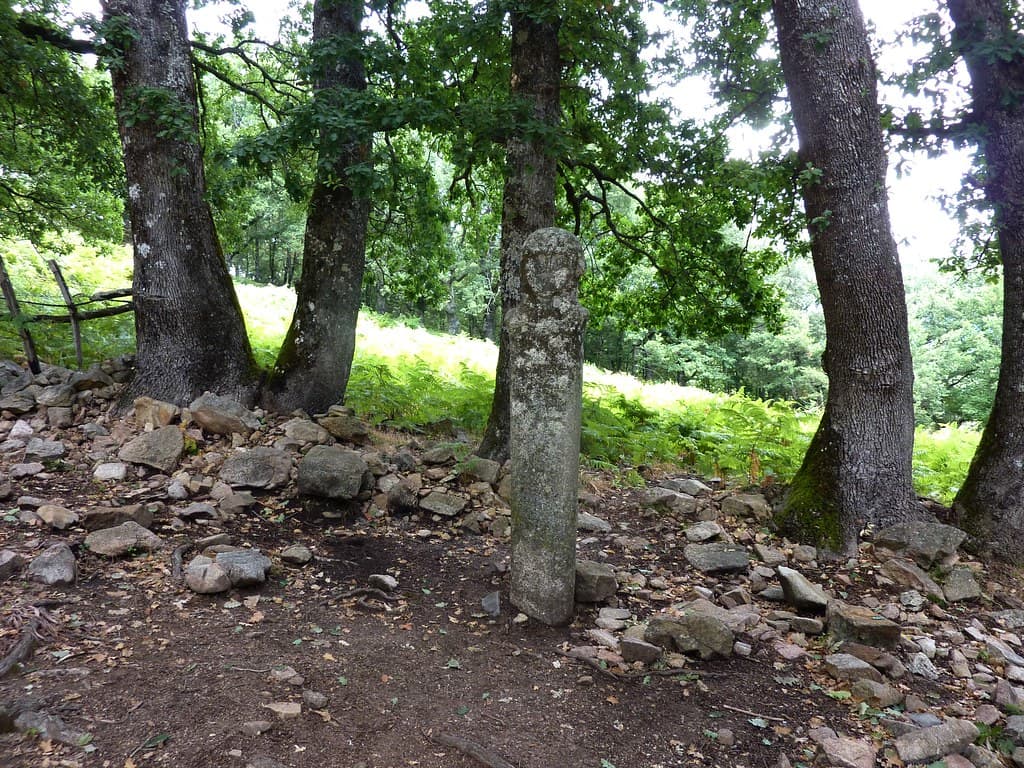
The Santa Maria statue-menhir is a Neolithic or early Bronze Age standing stone at Corsoli near Cambia in Haute-Corse. About 2.10–2.30 metres tall but only 0.35 metres wide, it is Corsica's most attenuated known statue-menhir, pressed toward abstraction by its maker and three or four thousand years of weathering. The damaged head retains a broken crown, a right eye and suggestions of nose and mouth.
An inverted T below the chin may be jewelry or a necklace, a possible status marker; two breast cupules identify the figure as female, or at least feminine.
In the medieval period, someone carved a cross into its chest, and the Romanesque Chapelle Santa Maria was built at the same crossroads. The pagan ancestor figure and Christian chapel now share consecrated ground, with explanatory panels and wooden benches for context or silence. About 200 metres north, Petra Frisgiata's geometric rock engravings of uncertain age and meaning add another layer to this sacred landscape.
Why this place is sacred
The thinness of the Santa Maria site is not metaphorical but structural. A crossroads in any traditional geography marks a boundary between directions, between territories, between the world of ordinary movement and some other order. Prehistoric cultures across the western Mediterranean placed standing stones at such thresholds — passes, fords, junctions — and whatever the specific beliefs that motivated these placements, the underlying intuition was consistent: certain points in the landscape require acknowledgment.
The Santa Maria menhir was placed at this crossroads before the concept of Christianity existed. Centuries or millennia later, medieval Christians built a chapel at exactly the same location — not displacing the ancient stone but building beside it, and eventually carving a cross into its chest. This is not coincidence. It reflects a persistent recognition, across entirely different symbolic systems, that this particular ground carries weight.
The folk legend that subsequently attached to the stone — that it is a woman turned to stone for neglecting to attend church — is a Christianizing morality tale overlaid on something much older, a way of making the monument legible to a new audience without destroying its presence.
For the contemporary visitor, the site offers an encounter with the layering of sacred time: not as an intellectual proposition but as a felt fact, standing between an eroded prehistoric figure and a Romanesque stone chapel at an old crossroads in the Corsican mountains.
The menhir was likely erected as an anthropomorphic standing stone at a territorial or social threshold — a crossroads marking the boundary between communities or routes — serving as a focal point for ancestor veneration, territorial demarcation, or the acknowledgment of some quality of the location that Bronze Age or Neolithic Corsicans recognized as requiring permanent marking.
First documented by scholars in 1893. The Chapelle Santa Maria, built at the same crossroads in the Romanesque period, effectively Christianized the site. A cross was carved into the menhir itself, integrating the prehistoric monument into Christian symbolic space. The site now functions as an open-air heritage site with explanatory panels, benches, and a walking path connecting to the Petra Frisgiata rock art and the Chapelle San Quilico.
Experience and orientation
The path to the Santa Maria site follows old routes through the Castagniccia — Corsica's chestnut-forested interior — toward the hamlet of Corsoli. The crossroads announces itself as a convergence: old mule tracks meeting at a point still marked by the chapel's stone walls and the menhir standing to one side.
The stone's proportions are striking before you approach closely: impossibly slender for something this tall, a ratio that reads as intentional rather than accidental — a formal decision to push the human figure toward its vertical essence.
Move close and read what remains of the face: the right eye socket is still there, a hollow in weathered schist; the nose and mouth are suggestions rather than forms; the head is broken at both sides, giving the figure a worn, slightly bowed quality as if the centuries have pressed down on it. The inverted T-relief at the neck — possibly a necklace or gorget — is legible with patient looking.
The cross engraved on the chest/navel area is more recent and more confident in its marks, cut by someone who understood what they were doing to the stone and did it deliberately. The chapel beside it is small, Romanesque, with thick walls and a low doorway. Together the two structures create an outdoor room with the quality of a place that has been continuously recognized — not maintained with ceremony, but held in awareness across different systems of meaning.
The benches at the site are an invitation to stillness that is worth accepting. The 200-meter walk north to the Petra Frisgiata rock engravings passes through woodland and adds a further layer: geometric carvings of unknown meaning in a landscape already marked by this menhir and chapel. Allow time for both.
The site is in the hamlet of Corsoli near Cambia (Haute-Corse), accessible via the D71 road. Parking is available near the chapel. Explanatory panels are present. The Petra Frisgiata rock art site is approximately 200 meters north. The Chapelle San Quilico is reached by a 20-minute woodland walk.
Context and lineage
The menhir was erected at this crossroads by the prehistoric inhabitants of Corsica — a slender schist figure whose female-coded form (two breast cupules, possible necklace relief) distinguishes it from the more numerous warrior-figure menhirs of the Bronze Age south. Its exact date of erection is not established; schist menhirs of this type may date from the Neolithic through the early Bronze Age.
It stood at its original crossroads location through the Roman period, through the early medieval, until at some point a Romanesque chapel was built beside it — a characteristic act of Christian sacred geography that absorbed rather than erased the older monument. In 1893, scholars first documented the site. The cross carved into the stone's chest belongs to the medieval period of Christianization, though the precise date is undocumented.
The Santa Maria menhir belongs to Corsica's prehistoric anthropomorphic standing stone tradition, one of the most concentrated in Europe. Its schist composition and attenuated form are consistent with a distinct northern Corsican or Castagniccia subtype. The Christianization pattern — chapel construction at pre-existing sacred sites, cross engraving on pagan monuments — is documented across the western Mediterranean and represents the medieval Church's pragmatic strategy of acknowledging and redirecting, rather than suppressing, the sacred charge of ancient places.
The site's folk legend of a woman turned to stone for impiety is a further layer of this Christianizing overlay.
Traditions and practice
Prehistoric crossroads rites at this location are inferrable from the menhir's placement but undocumented in their specifics. What can be said is that crossroads held consistent sacred significance in ancient Corsican culture — as threshold points between territories, routes, and perhaps cosmological zones — and that anthropomorphic standing stones were placed at such points as part of a broader system of ancestor commemoration or territorial marking. The medieval chapel represents the Christian continuation of recognizing this location as sacred ground.
The Chapelle Santa Maria holds periodic Catholic services, though it is not a major active parish. The menhir itself has no formally maintained religious practices. The site is an open heritage landmark with explanatory panels.
Arrive without hurry. The crossroads quality of the site is best felt before reading the explanatory panels — let the place speak before the interpretation does. Walk the perimeter of the menhir and notice its extraordinary slenderness from different angles; from the side it is nearly a blade of stone. Trace the layering of marks on its surface: the eroded prehistoric carving at the head, the inverted T at the neck, the deliberately cut Christian cross at the chest.
These marks represent at least two very different acts of meaning-making, separated by centuries, both choosing the same stone as their surface. Sit on the benches and look at the relationship between the menhir and the chapel. Then walk north to the Petra Frisgiata engravings — the 200-meter path through chestnut woodland is itself a transition, and the geometric rock art adds another layer to what this landscape held for the people who inhabited it.
Return to the crossroads and sit again. The question the site poses — what makes a place sacred, and what authorizes a new tradition to claim an old one — is worth turning over slowly.
Prehistoric Corsican Megalithic
HistoricalThe menhir embodies Corsica's prehistoric anthropomorphic standing stone tradition, likely representing an ancestor or territorial marker at a significant crossroads. Its female-coded form — breast cupules, possible necklace — distinguishes it within the corpus of Corsican statue-menhirs.
Erection of carved anthropomorphic stones at crossroads and threshold locations; inferred ancestor veneration or territorial demarcation rites.
Catholic / Christian
ActiveThe Romanesque Chapelle Santa Maria was built at this crossroads in the medieval period, effectively Christianizing the site. A cross was carved into the menhir's chest, integrating the prehistoric stone into Christian symbolic space. The chapel remains in periodic use.
Periodic Catholic services at the adjacent chapel. The cross engraving on the menhir marks the historic act of Christianization.
Archaeological Heritage
ActiveFirst documented in 1893; studied as an in situ example of Corsican prehistoric sculpture. The site now carries explanatory interpretation for visitors.
Heritage tourism, archaeological documentation, site interpretation.
Perspectives and open questions
The Santa Maria menhir invites interpretation across at least three registers: the prehistoric tradition in which it was carved, the medieval Christian tradition that claimed it, and the folk imagination that has tried to explain it to successive generations.
Scholarly perspective
Archaeological scholarship places the Santa Maria statue-menhir within Corsica's prehistoric anthropomorphic standing stone tradition, dating from the Neolithic through the early Bronze Age. Its schist composition and attenuated form are consistent with a northern Corsican subtype studied through peer-reviewed analysis (Documents d'Archéologie Méridionale and related publications).
The Christianization pattern — a Romanesque chapel constructed at the same crossroads, and a cross engraved on the pagan stone itself — is a documented pan-European strategy for appropriating pre-Christian sacred sites, studied extensively in the context of medieval Catholic expansion. The site was first recorded by scholars in 1893. The nearby Petra Frisgiata engravings are separately documented but their relationship to the menhir and their date remain subjects of ongoing investigation.
Living and traditional perspectives
Corsican folk tradition explains the Santa Maria menhir as a woman transformed into stone as divine punishment for failing to attend church — a morality tale that Christianizes the monument by making it a cautionary marker rather than a pagan presence. This legend belongs to a widespread European pattern of providing social-moral explanations for megalithic monuments that communities could no longer interpret in their original context.
It does not displace the older sacredness so much as translate it into available language.
Alternative interpretations
The crossroads setting and the presence of the Petra Frisgiata geometric rock engravings 200 meters away suggest that the Santa Maria site was embedded in a broader prehistoric sacred landscape. Some researchers investigate whether Corsican megalithic sites encode territorial, cosmological, or ancestor-navigation knowledge in their placement; this crossroads location, at the junction of routes connecting Castagniccia communities, is consistent with a pattern of using standing stones to mark nodes in a social-spatial network.
Open questions
The original deity, ancestor, or principle this menhir commemorated remains unknown. The meaning of the Petra Frisgiata engravings nearby is undeciphered. The exact sequence of events through which the chapel came to be built at this specific crossroads — whether by deliberate Christianization policy, by local initiative, or by the slow accumulation of custom — is undocumented. The other legends associated with this site, mentioned in sources as existing but not recorded, remain inaccessible.
Plan your visit
Access and arrival
Located in the hamlet of Corsoli, commune of Cambia, Haute-Corse. Access via the D71 road. Parking available near the chapel. Site is equipped with explanatory panels and benches. Free and open access. GPS approximately 42°20'N / 9°4'E.
Corte (~30 km south) and Saint-Florent (~50 km northwest) offer the nearest range of accommodation. Gîtes ruraux and chambres d'hôtes are found throughout the Castagniccia. The site does not have on-site facilities beyond the explanatory panels and benches.
Respectful visit
No formal requirements at the menhir. Modest dress if entering the Chapelle Santa Maria.
Permitted at both the menhir and the chapel exterior. Interior chapel photography should defer to local practice.
None established at the menhir. Standard Catholic chapel etiquette applies near the altar inside.
Do not touch the menhir, which is fragile schist. Respect the chapel as an active place of worship.
The menhir is fragile schist; do not touch it. If entering the chapel, observe standard Catholic etiquette. The woodland path to Petra Frisgiata can be slippery in wet conditions; appropriate footwear is advisable.
Location
Map loads as you approach this section.
Pilgrim reflections
A portrait of encounter, not a score
Pilgrims describe what they felt, how present they could become, and whether the place would shape a journey. There are no stars and no ranking of traditions.
No reviewed reflections yet
The first pilgrims can help describe the character of being here.
Share a reflection
Available after an account-backed “Been there.” Every reflection is reviewed before publication.
Nearby sacred places
Explore other sacred places in the region. Proximity does not establish access or travel time; check each place’s guidance.



References
Sources consulted for this page. Source categories describe the publication, not a guarantee that every claim is verified. Traditional accounts and outside interpretations may differ.
- 01Santa Maria statue-menhir [Corsoli Menhir, Petra Frisgiata menhir] Sculptured StoneacademicMegalithic Portal entry with variant names and location data
- 02Les statues-menhirs de Corse : chronologie et contextes, l'exemple de CauriaacademicPeer-reviewed academic journal on Corsican statue-menhir chronology and context
- 03Statue-menhir de Santa Maria — WikipédiaencyclopediaFrench Wikipedia article with physical description, discovery date, and location
- 04Statue-menhir de Santa Maria, Cambia - Vici.orgacademicArchaeological site database entry with map location
- 05Prehistory of Corsica - WikipediaencyclopediaOverview of Corsican prehistoric cultures and megalithic traditions
- 06Statue-menhir de Santa Maria - Encyclopédie WikimondeencyclopediaMirror of Wikipedia content in French
- 07XIII / Chapelle Santa Maria / 2B - Cambia / Sites de Haute-CorseguideHeritage tourism atlas entry with visitor description and access info
- 08Corsoli (Cambia), Petra Frisgiata et la statue-menhir de Santa Maria – Grossu MinutublogDetailed local blog post describing site access, rock art, and menhir condition
- 09Menhir Petra Frisgiada et la Chapelle Santa MariaguideTravel guide with practical access information and cultural context
Share a photo
Help visitors recognize Santa Maria statue-menhir. Every submission is reviewed before publication.