Sanctuary of Torreciudad
A near-millennial Marian shrine rebuilt in brick above the Cinca, tied to Opus Dei's founding story
Understand sacred places, explore living traditions, and learn how to engage respectfully with Pilgrim Map.
Access has not been verified. Check current local guidance before planning a visit.
Secastilla, Huesca, Spain
Read the sources
Visit essentials
A quick read before you go
- Duration
- Roughly 2-3 hours for the main shrine, exhibition spaces, and the short walk to the original…
- Access
- Located in Secastilla, Huesca province, Aragón, about 24 km from Barbastro, the nearest town…
Overview
Above the turquoise El Grado reservoir on the Cinca River, Torreciudad joins two buildings five minutes apart within one devotion.
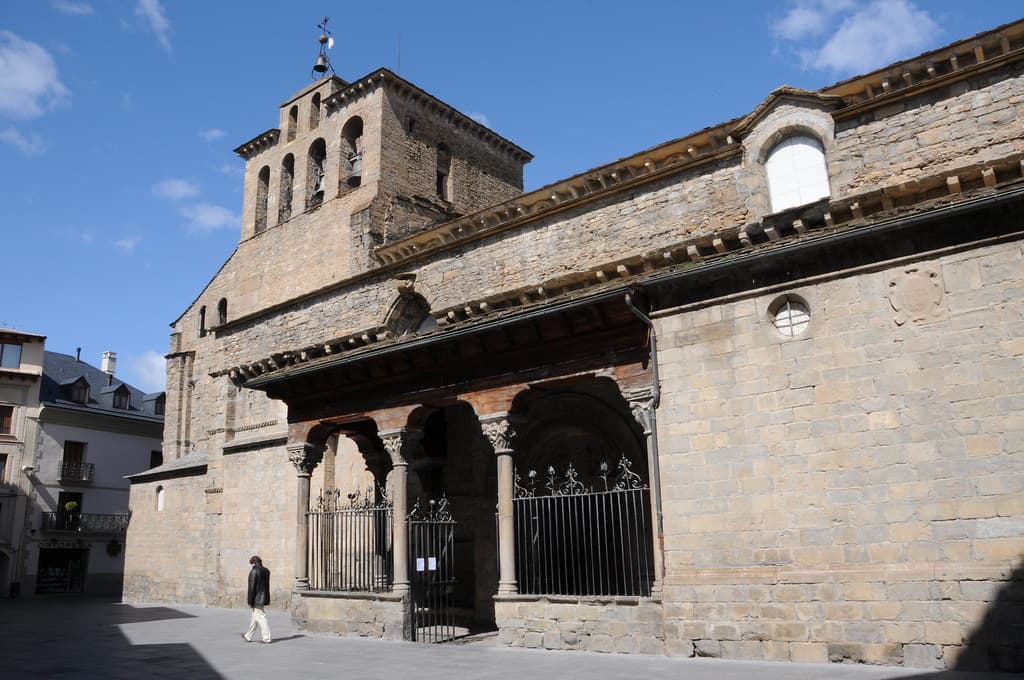
The older promontory hermitage occupies an Arab-era watchtower site. 'Turris Civitatis' gave Torreciudad its name. Tradition says the Virgin's image was hidden during Arab rule, recovered after Christian reconquest, and enthroned here around 1084. For nearly nine centuries, villages of Ribagorza, Sobrarbe, and Somontano de Barbastro walked here in romería with petitions and thanks to a carving stylistically understood as one of the Pyrenees' black Madonnas.
The newer building, the reason most visitors arrive today, is a large brick sanctuary completed in 1975, commissioned by Josemaría Escrivá, Opus Dei's founder and a native of nearby Barbastro. In 1904, as a child, he reportedly survived a life-threatening illness after his mother, Dolores Albás, prayed a novena and vowed pilgrimage to the hermitage. Decades later that story inspired his modern shrine, now both a popular Marian pilgrimage site and flagship Opus Dei devotional landmark.
Why this place is sacred
The old layer is straightforward Iberian Marian devotion of a familiar type: an image found or recovered near water and high ground, a discovery legend involving an ordinary person's exclamation of beauty, a parallel apparition story to woodcutters, and eight centuries of regional romería built up around the resulting cult. None of this required Opus Dei, and none of it depended on the institution that would later attach itself to the site.
The new layer is specific and traceable to one family's vow: Escrivá's mother prayed a novena for her dying son in 1904 and promised a pilgrimage to Torreciudad if he recovered. He did, and that story became, decades later, the stated motivation for building a major sanctuary here rather than treating the old hermitage as sufficient.
The result is a site whose ancient devotional roots and modern institutional identity are both real, well documented, and not entirely reconciled with each other — a tension that surfaces most plainly in an unresolved dispute over who governs the shrine (see Perspectives).
The eleventh-century hermitage served straightforward Marian devotion for villages of the surrounding comarcas following the Christian reconquest of the area. The 1970s sanctuary was built specifically to fulfill Escrivá's family vow and to give Opus Dei a major Marian pilgrimage site of its own.
Devotion continued at the small hermitage for roughly eight centuries with no significant institutional change. That changed abruptly between 1970 and 1975, when Opus Dei constructed the large brick sanctuary beside it, shifting the site's public identity from a local shrine to a destination with national and institutional visibility — while the original hermitage itself remains standing and open, a short walk from the new building.
Experience and orientation
What tends to surprise first-time visitors is the scale and material of the modern building — brick, laid in the Aragonese building tradition, used structurally and decoratively rather than as mere facing. Inside, an alabaster altarpiece and a bronze crucifix anchor spaces built for large numbers of pilgrims, a contrast with the intimacy of the old hermitage five minutes' walk away, where the Romanesque image originally stood.
Visitors commonly mention the exhibition spaces devoted to Escrivá's life and to Marian devotion more broadly, including a video-mapping display on the altarpiece and a gallery of Marian images from around the world. For pilgrims connected to Opus Dei, the visit is often framed explicitly around the founding story; for others, the setting above the water and the older hermitage tend to register as the more affecting parts of a visit.
A visit works best split in two: the modern sanctuary and its exhibition spaces first, then the short walk to the original hermitage, where the contrast between the two buildings — and the two eras of devotion they represent — is easiest to feel.
Context and lineage
Two origin stories run in parallel. The older one holds that a farmer discovered the image of the Virgin at the site and exclaimed 'how beautiful she is,' with a parallel legend describing an apparition to woodcutters from nearby Bolturina; the image is said to have been hidden during Arab rule and recovered after the Christian reconquest, leading to its enthronement around 1084.
The newer story concerns Escrivá himself: in 1904, as a two-year-old given little chance of survival after contracting meningitis, his mother Dolores Albás prayed a novena to Our Lady and vowed a pilgrimage to the Torreciudad hermitage. He recovered, and Opus Dei sources present this event as the motivating origin of his decision, decades later, to build the modern sanctuary.
Villages of Ribagorza, Sobrarbe, and the Somontano de Barbastro maintained romería devotion to the hermitage image for roughly eight centuries before Opus Dei's involvement began in the twentieth century. Since 1975, the site has functioned simultaneously as a continuation of that older regional cult and as an institutional Opus Dei pilgrimage destination — two lineages sharing one location.
Josemaría Escrivá de Balaguer
founder/patron
Founder of Opus Dei, born in nearby Barbastro; initiated construction of the modern sanctuary, reportedly in fulfillment of his mother's 1904 novena vow. Canonized 2002.
Dolores Albás
originating figure
Escrivá's mother, whose 1904 novena and pilgrimage vow to Our Lady of Torreciudad is presented as the origin of the family's — and later the modern shrine's — devotion to the site.
Heliodoro Dols
architect
Lead architect of the 1970-1975 sanctuary, a numerary member of Opus Dei; assisted by architects Santiago Sols and Ramón Mondéjar.
Traditions and practice
Historic romería from surrounding villages to the hermitage, veneration of the Romanesque image, and prayers of petition and thanksgiving date to the medieval period, predating any Opus Dei involvement.
Daily Mass and confession are offered under Opus Dei pastoral care. The annual Fiesta de la Virgen de Torreciudad, held the Sunday after the Feast of the Assumption, features a romería in which the pilgrim image of the Virgin is carried on wooden stretchers along the 'Path of the Sorrows and Joys of Saint Joseph,' the singing of the Canto de los Gozos, and the weighing and presentation of newborns to the Virgin as an act of maternal protection.
The shrine also participates in the Romería de las Vírgenes de Ribagorza, a regional gathering of Marian devotions held the first Saturday of September.
Visitors seeking the site's older devotional register may find more of it at the short walk to the original hermitage than inside the modern sanctuary's exhibition spaces, which are built more for institutional presentation than for quiet, individual visitation.
Roman Catholicism (Marian devotion, Aragonese folk-Catholic tradition)
ActiveContinuous Marian veneration at Torreciudad since at least the eleventh century, with the Romanesque image traditionally enthroned in a hermitage chapel around 1084 following the Christian reconquest of the area; it became a regional pilgrimage focus for the historic comarcas of Ribagorza, Sobrarbe, and the Somontano de Barbastro.
Pilgrimage (romería) to the shrine, veneration of the Romanesque carving, prayers of petition and thanksgiving, the annual Fiesta de la Virgen de Torreciudad, and participation in the regional Romería de las Vírgenes de Ribagorza.
Opus Dei institutional devotion
ActiveThe modern sanctuary was conceived and commissioned by Josemaría Escrivá, native of nearby Barbastro, in connection with his mother's 1904 novena vow following his childhood recovery from illness. The shrine functions as a flagship devotional site for Opus Dei while remaining canonically tied to the local diocese, a relationship that has become a point of institutional tension.
Institutional pastoral care by Opus Dei clergy, guided faith-themed visits and exhibitions on Escrivá's life and Marian devotion, and live-streamed Masses.
Perspectives and open questions
Torreciudad is read differently depending on whether the frame is the older regional Marian cult, the Opus Dei institutional project built atop it, or the governance dispute the two have generated. All three accounts rest on documented fact; none cancels the others out.
Scholarly perspective
Historians generally corroborate that Marian devotion at Torreciudad dates to the eleventh century, with the Romanesque image's enthronement traditionally placed at 1084 following the Christian reconquest of the area from Arab control. The modern shrine's construction and Opus Dei's role are well-documented historical facts: consecration on July 7, 1975, under architect Heliodoro Dols.
Living and traditional perspectives
Local Aragonese folk-Catholic tradition holds the discovery legend — a farmer's exclamation at the image's beauty — and the parallel apparition legend to woodcutters at Bolturina as the origin of the devotion. For centuries the site functioned as a focal point for petition and thanksgiving among villages of Ribagorza, Sobrarbe, and Somontano de Barbastro, independent of any later institutional involvement.
Alternative interpretations
Between 2023 and 2024, a jurisdictional dispute over governance of the shrine between Opus Dei and the Diocese of Barbastro-Monzón was reported by the National Catholic Register and other outlets, mediated by a papal commissioner appointed by the Vatican; a non-Opus Dei rector was named to the shrine in 2023 as part of that process. Separately, a critical journalistic account (U.S.
Catholic) has characterized the modern shrine as having served, in part, as a monument to Escrivá — a framing that Opus Dei's own institutional sources dispute, presenting the sanctuary instead as a Marian devotional project rooted purely in the 1904 healing story. Both accounts are documented viewpoints rather than settled fact, and this content does not take a position on which characterization is correct.
Open questions
The precise dating and workshop origin of the Romanesque carving within the eleventh century are unclear from available sources, as is the exact circumstance of the image's concealment during Arab rule prior to its 1084 enthronement. As of this writing, the current status of the Opus Dei/Diocese of Barbastro-Monzón jurisdictional dispute — and whether the papal commissioner's mediation has reached a resolution — could not be confirmed beyond 2023-2024 reporting.
Plan your visit
Access and arrival
Located in Secastilla, Huesca province, Aragón, about 24 km from Barbastro, the nearest town with public coach access; a taxi stand at Barbastro's bus station offers round-trip service. Free car parking is available on-site. Opening hours are 10:00am-2:00pm and 4:00-6:30pm on weekdays, 10:00am-7:00pm on Saturdays and Sundays.
Respectful visit
Visitors are asked to avoid swimwear, very short shorts, and going shirtless or in suspenders-only attire, out of respect for the site's atmosphere of prayer and spirituality.
No site-specific photography policy was found in available sources; general norms for Catholic shrines — respectful, non-flash photography, discretion during Mass — likely apply.
Entry is free; donations are suggested and can be left at collection boxes located around the shrine.
Location
Map loads as you approach this section.
Pilgrim reflections
A portrait of encounter, not a score
Pilgrims describe what they felt, how present they could become, and whether the place would shape a journey. There are no stars and no ranking of traditions.
No reviewed reflections yet
The first pilgrims can help describe the character of being here.
Share a reflection
Available after an account-backed “Been there.” Every reflection is reviewed before publication.
Nearby sacred places
Explore other sacred places in the region. Proximity does not establish access or travel time; check each place’s guidance.


References
Sources consulted for this page. Source categories describe the publication, not a guarantee that every claim is verified. Traditional accounts and outside interpretations may differ.
- 01What is Torreciudad? - Santuario de Torreciudad — Fundación Torreciudad / Opus Dei PrelatureofficialOfficial shrine site; source for hermitage origins, 1084 enthronement, Romanesque carving description, and devotional continuity.
- 02The New Shrine and St. Josemaria - Santuario de Torreciudad — Fundación Torreciudad / Opus Dei PrelatureofficialOfficial account of Escrivá's childhood illness/healing story and motivation for building the modern shrine.
- 03Fiesta de la Virgen de Torreciudad - Santuario de Torreciudad — Fundación Torreciudad / Opus Dei PrelatureofficialMain annual festival (Sunday after Assumption), the weighing/presentation of newborns tradition, the romería with the pilgrim image on stretchers, Canto de los Gozos.
- 04Frequently Asked Questions - Santuario de Torreciudad — Fundación Torreciudad / Opus Dei PrelatureofficialOpening hours, dress-code guidance, donation-based free entry, guided tour availability, access from Barbastro.
- 05Torreciudad - Wikipedia — Wikipedia contributorsencyclopediaConsecration date (July 7, 1975), architecture details, architects, 2024 economic-impact figures.
- 06Santuario de Torreciudad - Wikipedia, la enciclopedia libre — Wikipedia contributorsencyclopediaSpanish-language corroboration of hermitage history and image origin legend.
- 07The architect of Torreciudad, Heliodoro Dols, passed away — OmnesnewsArchitect biography and construction timeline (1970-1975, brick as primary material, residence in Zaragoza from 1973).
- 08Conflict Between Opus Dei and Spanish Diocese to be Mediated by Papal Commissioner — National Catholic Register / CNAnewsReports on the jurisdictional dispute between Opus Dei and the Diocese of Barbastro-Monzón over governance of Torreciudad, papal commissioner mediation, non-Opus Dei rector appointed 2023.
- 09Torreciudad Shrine in Secastilla — Turespaña (spain.info)guideOfficial Spanish tourism board listing; general visitor/location information.
- 10Our Lady of Torreciudad and St. Josemaria Escriva - St. Josemaria Institute — St. Josemaria InstitutespiritualDevotional/institutional source; detail on 1904 childhood illness and novena promise made by Escrivá's mother, Dolores Albás.
- 11Torreciudad, una historia milenaria de frutos — El Diario de HuescanewsLocal press piece on the origin legend (the farmer's exclamation '¡qué hermosa es!') and the Bolturina woodcutters' apparition legend.
- 12How Opus Dei manipulated its way into power — U.S. CatholicnewsCritical journalistic perspective characterizing the shrine as partly a monument to Escrivá; used here only to represent a documented critical viewpoint, not as a factual claim about the shrine's purpose.
Share a photo
Help visitors recognize Sanctuary of Torreciudad. Every submission is reviewed before publication.