Sammallahdenmäki
Finland's first UNESCO site — 36 Bronze Age cairns on a silent ridge
Understand sacred places, explore living traditions, and learn how to engage respectfully with Pilgrim Map.
Access has not been verified. Check current local guidance before planning a visit.
Rauma, Satakunta, Finland
Read the sources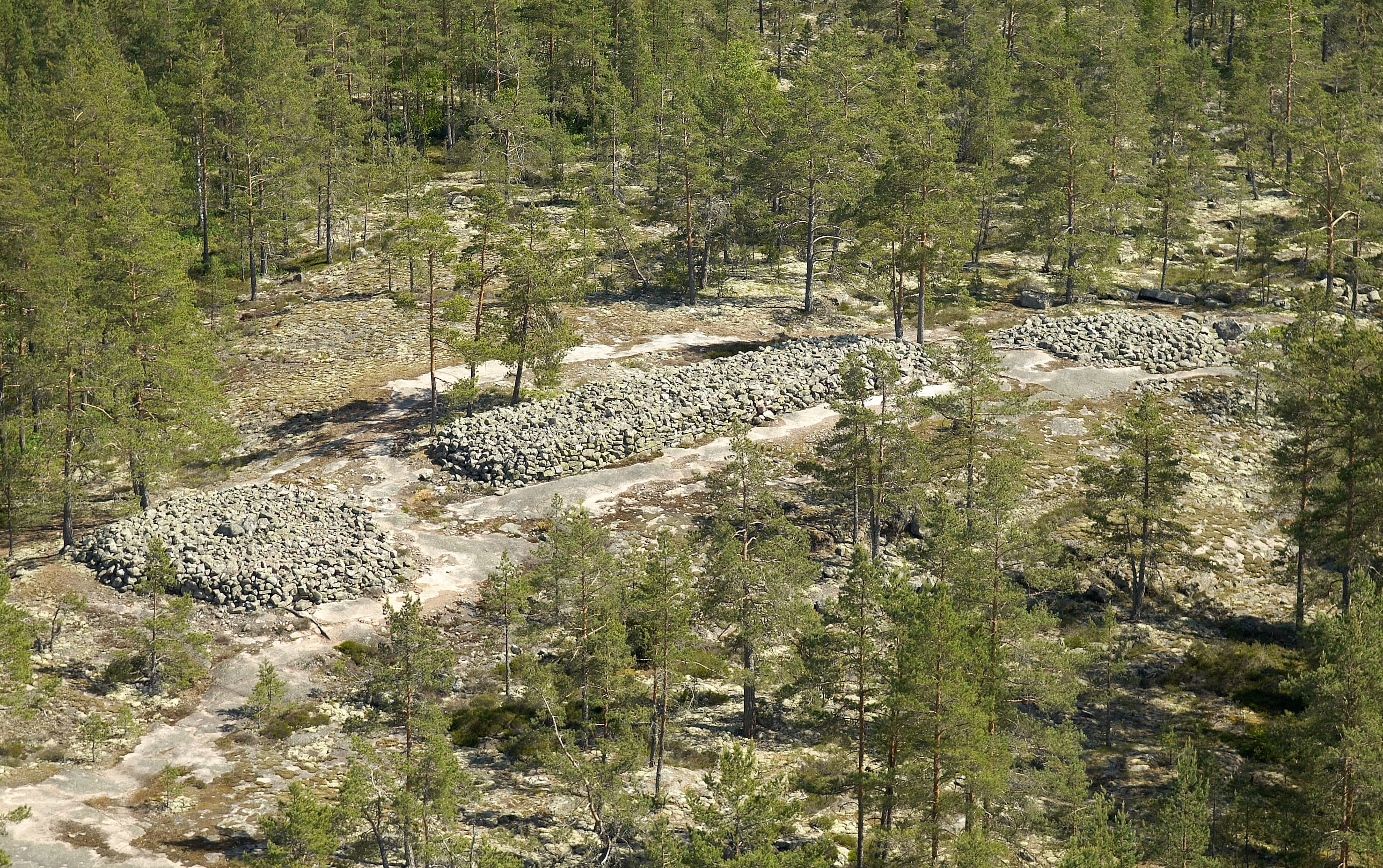
Image of Sammallahdenmäki. Image source
Visit essentials
A quick read before you go
- Duration
- Roughly one to two hours to walk the full one-kilometer cairn field at a contemplative pace.
- Access
- Free and open year-round, with no entry fee or gate.
Overview
On a low bedrock ridge outside Lappi village, some 20 kilometers from Rauma on Finland's southwest coast, 36 stone cairns have stood among pine and lichen for three thousand years. Sammallahdenmäki is among Fennoscandia's largest and best-preserved Bronze Age burial complexes; in 1999 it became Finland's first prehistoric site on the UNESCO World Heritage List.
Most cairns date to the Early Bronze Age, roughly 1500–500 BCE, with a handful from the early Iron Age. Excavation in 2002 recovered cremated human bone from several mounds, confirming that a farming community used the ridge as sacred ground for its dead across generations.
Two structures distinguish the cemetery. The 'Long Ruin of Huilu' is an elongated, stone-walled cairn apparently enlarged in stages. The 'Church Floor' (Kirkonlaattia) is a large, flat-topped rectangular cairn, a form found nowhere else in Scandinavia. Archaeologists connect the site to a Bronze Age solar cult that spread through the region, though its specific rites are inferred, not recorded. Post-glacial land uplift has since drawn the Gulf of Bothnia shoreline away, hiding the sea the cairns once overlooked.
Why this place is sacred
What makes Sammallahdenmäki significant is not a single dramatic monument but sustained, deliberate use: a Fennoscandian farming community returned to this same ridge to bury and cremate its dead across roughly a millennium, building 36 cairns of varying form — round mounds, stone-ringed cairns, and the two anomalous long and rectangular structures.
That repetition across generations, on a site that once commanded a view of the Gulf of Bothnia before the coastline retreated, is what archaeologists read as evidence of settled land claims passed through kin groups, and possibly of a shared solar cosmology. The 'Church Floor' in particular resists easy explanation: its regular, flat-topped rectangular form has no parallel elsewhere in Scandinavia, which leaves open whether it served a communal ritual function distinct from ordinary burial.
Nothing about the site announces itself; its power is cumulative, built from the sheer number and endurance of the cairns rather than from any single relic or inscription.
A cremation and inhumation cemetery for a Bronze Age farming community, likely also marking hereditary land ownership.
First scientifically excavated in 1891, uncovering the Church Floor and the Long Ruin of Huilu. Further excavation in 2002 confirmed cremated remains in multiple cairns. The site was inscribed on the UNESCO World Heritage List in 1999 and is now managed as a protected heritage landscape rather than an active cemetery.
Experience and orientation
The cairns sit close together — all 36 within about a one-kilometer stretch of ridge — so the site rewards a slow pace more than a long one. Paths thread through pine forest and exposed granite, past mounds ranging from modest stone piles to the flat-topped bulk of the Church Floor.
Because the ridge no longer overlooks open water, there is little sense of vista; instead the experience is enclosed, almost interior, despite being outdoors — forest on all sides, stone underfoot, the cairns appearing one after another as the path bends. Visitors consistently describe the quiet of the place more than any single feature: no crowds, no signage clutter, just weathered granite and moss holding a burial landscape three thousand years old.
Free guided tours run daily in July, but most visitors walk the marked routes alone, which suits a site whose meaning depends more on duration and attention than on information delivered in a single stop.
Start from the marked trailhead near the southern information point and follow the ridge path north; the Church Floor and Long Ruin of Huilu are typically highlighted as the two structures to slow down for.
Context and lineage
There is no transmitted foundation myth for Sammallahdenmäki — no named founder or oral legend survives. What is known comes entirely from archaeology: a Bronze Age farming community selected this ridge, likely for its visibility over the then-adjacent coastline, and returned to it across generations to bury and cremate their dead, eventually raising 36 cairns including the two anomalous structures that still puzzle researchers.
No continuous cultural or religious lineage connects the Bronze Age builders to any living community; the site's present-day custodianship is archaeological and municipal rather than devotional.
1891 excavation
The first scientific excavation of the site, uncovering the Church Floor and Long Ruin of Huilu
Finnish Heritage Agency (Museovirasto)
National authority responsible for research, conservation, and stewardship of the site as one of Finland's seven UNESCO World Heritage properties
2002 excavation team
Confirmed cremated human bone in multiple cairns, establishing the site's funerary function beyond doubt
Rauma municipal tourism authority (Visit Rauma)
Manages public access, the July guided-tour program, and visitor information for the site
Traditions and practice
Cremation and inhumation burial in stone cairns, and probable seasonal or solar observance connected to a Bronze Age religious complex that spread across Scandinavia — inferred from the cairns' form and orientation rather than documented directly.
None as ritual; the site's contemporary use is heritage interpretation — free public guided tours run daily in July at 11:00 and 15:00, departing from the southern information point.
Walk the ridge slowly rather than making a circuit of photographs. At the Church Floor, notice its unnatural flatness and regularity against the round and irregular cairns nearby — the same stones, an entirely different intention. At the Long Ruin of Huilu, look for the enclosing stone wall and try to trace where the structure appears to have been extended in phases.
Where the forest opens slightly, consider that this ridge once looked out over open water — the cairns were built to be seen from, and to be seen.
Finnish Prehistoric (Bronze Age Cairn Burial)
HistoricalThe cairns are interpreted as expressions of a Bronze Age Nordic solar-cult religious complex combined with hereditary land-claim marking by farming kin groups; the site is one of the most complete surviving examples of this burial tradition in Fennoscandia.
Cremation and inhumation burial within stone cairns; construction of two singular monumental structures (the Church Floor and the Long Ruin of Huilu) whose specific communal ritual function is inferred, not documented.
Finnish heritage conservation and archaeological stewardship
ActiveThe Finnish Heritage Agency (Museovirasto) and Visit Rauma actively research, protect, and interpret the site as one of Finland's seven UNESCO World Heritage properties, and as the first prehistoric site in the country to receive that designation.
Ongoing conservation management, free public guided interpretation in July, and continued archaeological study (including the 2002 excavation campaign).
Perspectives and open questions
Sammallahdenmäki is read almost entirely through an archaeological lens, since no oral tradition or indigenous custodianship survives to offer a competing interpretation — the open questions here are scholarly rather than spiritual.
Scholarly perspective
Archaeologists regard Sammallahdenmäki as one of the largest, most complete, and most important Bronze Age burial landscapes in Fennoscandia. The 2002 excavation, which confirmed cremated human bone in multiple cairns, settled the site's funerary function. Radiocarbon dating places the oldest graves at 1300–1000 BCE and the youngest at 170–82 BCE, spanning the transition from Bronze Age into Iron Age.
The cairns' form and the site's original coastal-facing position are widely linked to a Bronze Age solar-cult religion that spread across Scandinavia, alongside the marking of kin-based land tenure tied to early farming.
Alternative interpretations
The 'sun worship' interpretation of the cairns is not a fringe theory but the leading scholarly hypothesis; it remains speculative regarding specific rites, since no textual or oral record of the practice survives.
Open questions
The precise function of the rectangular 'Church Floor' — unique in Scandinavia — and the multi-phase 'Long Ruin of Huilu' remain unresolved. With no comparable structures elsewhere in the region, archaeologists have no direct analogy to draw on in interpreting what communal purpose, if any, these two structures served beyond standard burial.
Plan your visit
Access and arrival
Free and open year-round, with no entry fee or gate. The site lies about 20 km east of central Rauma, off the road toward Huittinen/Tampere, in the village of Lappi. Nearest visitor-services contact: Rauma Tourist Information Office, Savilankatu 8, Rauma (open June 1–August 31, Mon–Sun 10:00–17:00; phone +358 (0)2 834 3512, email matkailu@rauma.fi); a local site contact number, +358 44 403 2133, is also listed for Sammallahdenmäki directly.
Mobile phone signal reliability at the ridge itself was not documented in available sources — this is a rural forest site, so visitors should not assume consistent coverage and should plan accordingly, noting that central Rauma (roughly 20 km away) is the nearest point of certain signal and services.
Respectful visit
No specific dress code; sturdy, closed footwear is advisable given the uneven granite and forest terrain.
No restrictions found in available sources; photography appears to be permitted throughout the site.
None — the site is not a location of ongoing devotional practice, so no offering customs apply.
Remain on marked paths; do not climb on, sit on, or move stones from any cairn; do not remove artifacts. The site is legally protected as an ancient monument.
This is an active burial site protected under Finnish antiquities law: stay on marked paths, do not climb on or move cairn stones, and do not remove any stone or object from the site.
Location
Map loads as you approach this section.
Pilgrim reflections
A portrait of encounter, not a score
Pilgrims describe what they felt, how present they could become, and whether the place would shape a journey. There are no stars and no ranking of traditions.
No reviewed reflections yet
The first pilgrims can help describe the character of being here.
Share a reflection
Available after an account-backed “Been there.” Every reflection is reviewed before publication.
Nearby sacred places
Explore other sacred places in the region. Proximity does not establish access or travel time; check each place’s guidance.

References
Sources consulted for this page. Source categories describe the publication, not a guarantee that every claim is verified. Traditional accounts and outside interpretations may differ.
- 01Sammallahdenmäki — Wikipedia — Wikipedia contributorsencyclopediaCairn inventory, dating, coordinates, excavation history, coastal uplift note
- 02Bronze Age Burial Site of Sammallahdenmäki — UNESCO World Heritage Centre — UNESCOofficialOfficial World Heritage listing, inscribed 1999, first prehistoric site in Finland
- 03Welcome to Sammallahdenmäki — Visit Rauma — Visit RaumaofficialGuided tour schedule, tourist info office contact, site layout (36 cairns / 36 hectares)
- 04Sammallahdenmäki Bronze Age Burial Site — Visit Rauma — Visit RaumaofficialMunicipal tourism authority overview page
- 05Sammallahdenmäki Bronze Age Burial Site — Association of World Heritage Sites in Finland — Maailmanperintökohteet ryofficialVisitor numbers (~11,500/year), free year-round access, 1891 excavation, 2002 excavation confirming cremation burials
- 06World Heritage in Finland — Finnish Heritage Agency — Museovirasto (Finnish Heritage Agency)officialNational heritage authority context; cairn construction typology (round cairns, mounds, stone-circle cairns); Long Ruin of Huilu and Church Floor dimensions
- 07Sammallahdenmäki — Bronze Age Burial Cairns Area Rauma — Discovering Finland — Discovering FinlandguidePrecise coordinates 61.1197367, 21.773727; site compactness (1km radius); local contact/website
Share a photo
Help visitors recognize Sammallahdenmäki. Every submission is reviewed before publication.