Käräjämäki
A ridge of Iron Age graves above the Eurajoki
Understand sacred places, explore living traditions, and learn how to engage respectfully with Pilgrim Map.
Access has not been verified. Check current local guidance before planning a visit.
Eura, Satakunta, Finland
Read the sources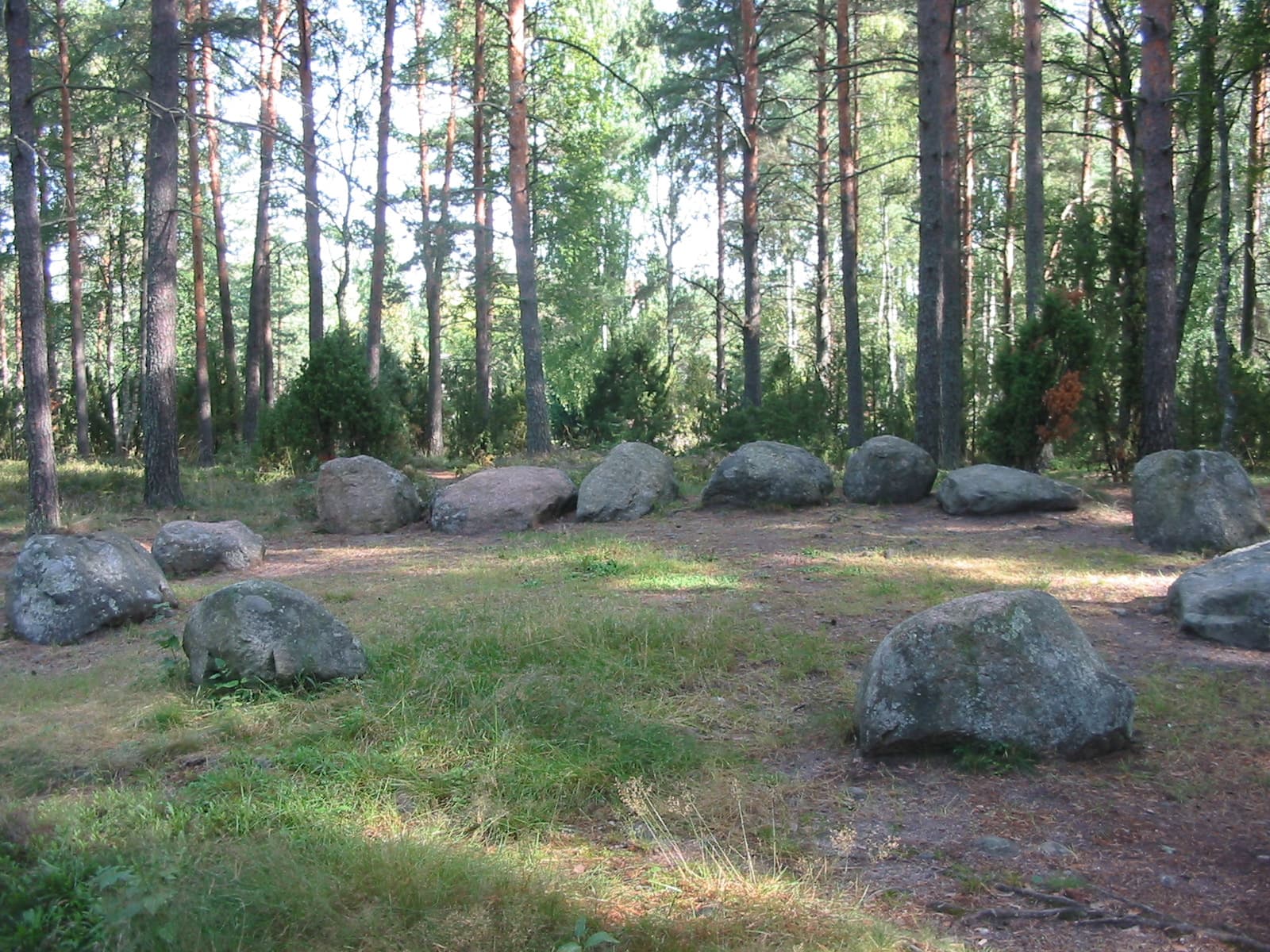
Image of Käräjämäki. Image source
Visit essentials
A quick read before you go
- Duration
- 15-30 minutes for the walk to the stone circle and back; longer if combined with a visit to the…
- Access
- Käräjämäki is a roadside site on Käräjämäentie in Eura, Satakunta, with a small parking area at…
Overview
Käräjämäki-Osmanmäki is an Iron Age cemetery on a low sand ridge east of the Eurajoki river in Eura, southwestern Finland, used continuously for burial from roughly 550 to 1200 CE. More than two hundred graves or pits range from early cremations to later inhumations with weapons, jewelry, and tools.
At the summit, a circle of twelve stones encloses a Merovingian-period cremation grave. For generations before excavation established this, local tradition called it the seat of an old outdoor law court, or käräjät, giving the site its name. A restored grave still visible beside the path held a man with an iron shield, sword, dagger, spearhead, and bronze ring; archaeologists read him as a person of authority, perhaps a chieftain whose standing extended to his followers' weapons.
The site belongs to a cluster of contemporary Eura river-valley cemeteries, including nearby Luistari, Finland's largest and most thoroughly excavated burial ground.
Why this place is sacred
What makes Käräjämäki notable is not a single dramatic event but sustained continuity — a community burying its dead on the same ridge for more than twenty generations, from the late Roman Iron Age through the Viking Age and into the early Crusade Period.
Few Finnish Iron Age cemeteries offer this much surface visibility: the stone settings marking individual graves remain legible on the ground rather than existing only as excavated features, so a visitor walking the ridge today is looking at the same stone arrangements that generations of local people would have recognized as their ancestors' graves.
The later folk-memory shift — from burial ground to imagined law court — adds a second layer of meaning without erasing the first: the stones' physical form as a circle was compelling enough, centuries after the burials themselves were forgotten, to be read as evidence of communal judgment and assembly. Both readings, the funerary and the judicial, now sit layered on the same hill.
Community cemetery for the Iron Age population of the Eurajoki valley.
Cremation burial gave way around 600 CE to inhumation with grave goods, a shift documented at Käräjämäki earlier and more distinctly than in much of the surrounding region; use of the cemetery continued into the twelfth century before the site passed out of active burial and, much later, into local memory as a court site and eventually into state protection.
Experience and orientation
The site is reached from a small roadside parking area on Käräjämäentie, with a short path leading up the hill toward the stone circle at the summit.
It is not a large or dramatic landscape — a modest sand ridge, grass and scattered trees, maintained as what the Finnish Heritage Agency describes as a park-like yet natural area — but the twelve stones at the top, set in their circle, are immediately legible as a deliberate human arrangement rather than a natural feature.
Along the way, on the north side of the road, sits the restored grave of the man buried with his shield and sword, easy to miss without the interpretive signage that marks it. The overall impression is of a place maintained for quiet observation rather than spectacle: no crowds, no admission gate, just a hill that has been kept legible for visitors to read at their own pace.
Start at the roadside interpretive sign and parking area, follow the path up the hill to the stone circle at the summit, and take the short detour to the restored warrior's grave north of the road on the way back down.
Context and lineage
The cemetery's earliest documented investigations date to the 1870s-1890s, with Theodor Schvindt's 1890 excavations producing the most detailed early record of the site's graves. Excavation over the following decades established the site's long chronology, though only a portion of its estimated two hundred-plus graves have been formally examined.
In 1957, landowner Viljo Nohkola donated the site to the Finnish state, after which it came under the joint stewardship of what is now the Finnish Heritage Agency (Museovirasto) and the municipality of Eura, which maintain it today as a protected ancient monument and heritage park.
Part of the broader Iron Age settlement and burial landscape of the Eura river valley, contemporary with the nearby cemeteries of Luistari, Pappilanmäki, and Lauhianmäki.
Theodor Schvindt
Archaeologist whose 1890 excavations produced the site's earliest detailed documentation
Viljo Nohkola
Landowner who donated the site to the Finnish state in 1957, enabling its formal protection
Finnish Heritage Agency (Museovirasto)
Statutory custodian maintaining the site under the Antiquities Act and the national ancient monuments register
Eura municipality
Joint steward of the site, maintaining public access and interpretive signage as part of local heritage programming
Traditions and practice
The graves themselves record Iron Age funerary practice directly: early cremation burial, followed after roughly 600 CE by inhumation accompanied by weapons, tools, and jewelry marking the status and identity of the dead. Separately, and later, local oral tradition treated the summit stone circle as the site of a communal outdoor court, a practice of memory and reinterpretation rather than of ritual.
The Finnish Heritage Agency and Eura municipality maintain the site as an interpreted heritage monument: mowing and clearing the ridge, keeping the path passable, and maintaining interpretive signage — an active tradition of conservation stewardship and public heritage education, even though the original burial practice ended many centuries ago.
Walk the full path from the parking area to the stone circle and back via the restored warrior's grave, pausing at the summit to look out over the ridge before descending. Read the interpretive panels before or after rather than only glancing at them in passing, so the stones register as graves and not just as an arrangement of rock.
Baltic-Finnic / Finnish Iron Age burial culture
HistoricalKäräjämäki-Osmanmäki served as a community cemetery for the Iron Age population of the Eurajoki valley for over six centuries, one of several contemporary burial grounds in Eura that together mark the area as one of the most archaeologically significant Iron Age landscapes in Finland.
Cremation burial in the earlier phase, giving way after roughly 600 CE to inhumation with grave goods — weapons, jewelry, tools — as markers of the deceased's status and identity.
Heritage conservation and interpretation
ActiveThe site is actively maintained as a protected ancient monument and public heritage park by the Finnish Heritage Agency and Eura municipality, keeping the grave stones legible and the site accessible for visitors and continuing local education about the Iron Age history of the Eura valley.
Site maintenance, interpretive signage, and inclusion in Eura's local heritage programming ("Euran 100 helmeä").
Perspectives and open questions
Käräjämäki carries two distinct readings that sit on top of each other without conflict: the archaeological record of a working cemetery, and the folk memory of a communal court, each attached to the same visible stones.
Scholarly perspective
Archaeologists treat Käräjämäki-Osmanmäki as a genuine Iron Age community cemetery in continuous use from roughly 550 to 1200 CE, part of the same river-valley settlement complex as Luistari. The stone circle at the summit is understood to have originated as a Merovingian-period cremation grave; its later association with a law court is read as folk reinterpretation of an already-ancient and visually striking monument, not as evidence of an actual historical assembly site.
Living and traditional perspectives
Local Eura tradition long held — and the name Käräjämäki still preserves — that the twelve-stone circle marked the site of an old outdoor court where disputes were settled in the open air. This belief predates modern archaeological investigation and continues to be repeated in local heritage materials alongside the excavated interpretation.
Open questions
The full extent and chronology of the cemetery remains only partly excavated; the figure of "over two hundred" graves is a working estimate rather than a complete count, and whether the stone circle's hilltop placement carried any deliberate visual or symbolic significance beyond its prominence in the valley is undetermined.
Plan your visit
Access and arrival
Käräjämäki is a roadside site on Käräjämäentie in Eura, Satakunta, with a small parking area at the base of the hill in front of the interpretive sign. A short path leads up to the summit stone circle; the restored warrior's grave sits just off the road on the opposite (north) side. There is no direct public transit stop at the site itself; reaching it practically requires a car or bicycle from Eura's town center.
Mobile phone signal is reliable throughout the Eura area, which is a populated river-valley municipality, so this is not a remote-access concern. No formal seasonal closure applies, though the unpaved path can be muddy or snow-covered outside the summer months. No keyholder or booking is required; access is unrestricted during daylight hours.
Respectful visit
No specific dress code; ordinary outdoor clothing suited to the season and to walking on grass and an unpaved path.
Photography is permitted; the site is an open, unticketed public heritage park.
No offering tradition is associated with this site. Visitors should not leave objects on or among the grave stones.
Do not move, remove, or add to the stone settings, and do not dig or use metal detectors — the site is a protected ancient monument under the Finnish Antiquities Act. Keep to the marked path where one is provided.
This is a burial ground, and its excavated graves still deserve the same basic respect owed any cemetery — avoid disturbing the stone settings or treating them as a casual sitting or climbing surface.
Location
Map loads as you approach this section.
Pilgrim reflections
A portrait of encounter, not a score
Pilgrims describe what they felt, how present they could become, and whether the place would shape a journey. There are no stars and no ranking of traditions.
No reviewed reflections yet
The first pilgrims can help describe the character of being here.
Share a reflection
Available after an account-backed “Been there.” Every reflection is reviewed before publication.
Nearby sacred places
Explore other sacred places in the region. Proximity does not establish access or travel time; check each place’s guidance.


References
Sources consulted for this page. Source categories describe the publication, not a guarantee that every claim is verified. Traditional accounts and outside interpretations may differ.
- 01Käräjämäki — Euran kunta (Euran 100 helmeä) — Eura municipalityofficialLocal official description; chieftain/warrior grave with shield, sword, dagger, spearhead, belt, bronze ring; last known cremation grave in Eura c. 600 CE
- 02Käräjämäki-Osmanmäki — Kulttuuriympäristön palveluikkuna (Finnish Heritage Agency ancient monuments register) — Museovirasto (Finnish Heritage Agency)officialOfficial statutory register entry for the protected ancient monument
- 03Käräjämäki — Kulttuuriympäristön palveluikkuna (site management area) — Museovirasto (Finnish Heritage Agency)officialSite management/stewardship register entry
- 04Käräjämäki (Eura) — Wikipedia — Wikipedia contributorsencyclopediaCoordinates, dating range 550-1200 CE, over 200 graves, käräjäkivet stone circle, donation to Finnish state in 1957, Schvindt 1890 excavations
- 05Around Satakunta: The Big Three of Eura — tvarchaeology (archaeology blog)blogVisitor's-eye description of the twelve-stone court circle, chieftain grave with iron shield/sword/quartzite whetstone, parking and path details, address Käräjämäentie 8, contrasts with Kuninkaanhauta (Bronze Age) and Luistari (Iron Age graveyard)
- 06Luistari Burial Ground, Eura, Finland — SpottingHistoryguideRegional context for Eura's Iron Age cemetery landscape (Luistari, Käräjämäki, Pappilanmäki, Lauhianmäki as contemporary related sites)
Share a photo
Help visitors recognize Käräjämäki. Every submission is reviewed before publication.