Pyramid of Djoser
The first pyramid ever built—where one architect's vision launched 4,700 years of monumental ambition
Understand sacred places, explore living traditions, and learn how to engage respectfully with Pilgrim Map.
Access has not been verified. Check current local guidance before planning a visit.
Saqqara, Giza, Egypt
Read the sources
Visit essentials
A quick read before you go
- Duration
- Plan 2-3 hours for thorough exploration of the Step Pyramid complex.
- Etiquette
- As an archaeological monument rather than active religious site, the Step Pyramid has no…
Overview
The Step Pyramid marks a beginning. Around 2670 BCE, Imhotep conceived a stone mountain built to last forever, replacing mud-brick mastabas that crumbled within generations. It launched the tradition that produced Giza's wonders a century later, influenced Greek and Roman architecture, and inspired builders across four millennia.
More than a tomb, the complex is a complete eternal environment: a festival court where Djoser perpetually celebrates renewal, a serdab where his ka statue watches through two stone holes, and five kilometers of underground tunnels whose 36,000 blue faience tiles evoke the watery underworld. Built to defeat death, it succeeded on Egyptian terms: Djoser's name and stone face remain known, while Imhotep became a god of medicine and wisdom to later generations.
The stepped form may have represented a stairway to the stars, carrying the pharaoh's spirit toward the imperishable ones circling the northern sky.
Why this place is sacred
The thinness of the Step Pyramid lies in its position at a beginning. This is not merely an old pyramid; it is the first pyramid, the birthplace of a form that would define Egypt's sacred landscape for millennia. Standing here is standing at an origin point—the moment when humanity first conceived of building something that would last forever.
The complex was designed as a complete eternal environment. The Heb-sed court contains buildings that never functioned in life; they exist only for eternity, architectural shells where Djoser would celebrate his renewal festival forever. The serdab holds his ka statue behind limestone walls, two holes drilled so his stone eyes could watch offerings being made across the ages.
The underground chambers are decorated with 36,000 blue faience tiles imitating reed matting—a recreation of the palace he knew in life, rendered in materials that would not decay.
This was not architecture for the living. It was architecture against death, and its ambition still resonates. The Egyptians believed the king's immortality ensured cosmic order; the rising of the sun, the flooding of the Nile, the continuation of all things depended on his eternal existence. The pyramid was functional—a machine for transformation, a vehicle for ascent. The stepped form likely represented a stairway to the sky, allowing the pharaoh's ba to climb toward the circumpolar stars that never set.
The site's thinness also lies in presence. The ka statue—the original now resides in Cairo's Egyptian Museum, but a replica occupies the serdab—preserves the personality of a 4,700-year-old individual. Looking through those eye-holes, you encounter someone specific: not abstract royalty but a particular human who commissioned this extraordinary effort against oblivion. Whether you believe in the ka or not, the effect is powerful. Someone wanted to be remembered, and you are remembering.
The Step Pyramid complex was designed to ensure Pharaoh Djoser's eternal existence. It combined burial monument, festival venue, offering chapel, and cosmic vehicle into a single integrated environment. The pyramid itself provided the vehicle for ascent to the stars. The mortuary temple and serdab allowed the ka to receive offerings. The Heb-sed court enabled eternal celebration of the festival that renewed royal power. The underground chambers recreated palace environments in permanent materials.
Every element served the central purpose: defeating death through stone, precision, and ritual.
The site's meaning has evolved across four and a half millennia. During the Old Kingdom, priests maintained Djoser's mortuary cult, performing daily offerings that sustained his ka. By the New Kingdom, a thousand years later, the pyramid was already a tourist attraction—graffiti from ancient visitors survive on its walls, expressing the same wonder that modern visitors feel. The Ptolemaic and Roman periods saw Imhotep's cult flourish; his tomb was sought at Saqqara, and pilgrims came seeking healing wisdom.
Medieval Arab writers marveled at the structure's antiquity. European explorers first entered the burial chamber in 1821. Jean-Philippe Lauer devoted 75 years (1926-2001) to excavating and restoring the complex. A 14-year restoration project (2006-2020) stabilized the structure after earthquake damage. Today the pyramid stands as a monument to origins—the first of its kind, now accessible to anyone who makes the journey.
Experience and orientation
Approach the Step Pyramid from the north and the structure rises in six distinct tiers—not the smooth slopes of Giza but a stepped mountain of limestone, visibly hand-assembled from millions of small blocks. The weathering of nearly five millennia has softened its edges, and the outer casing that once gleamed white has largely disappeared, but the essential form remains: humanity's first pyramid, the prototype for everything that followed.
The complex extends far beyond the pyramid itself. A massive enclosure wall once surrounded the entire ceremonial precinct, its facade carved to imitate bundled reeds in stone—a technique that would never be repeated. Inside, the Heb-sed court contains two rows of dummy chapels with facade entrances leading to solid rubble. These buildings were never meant to function. They exist only for eternity, providing the architectural setting for festivals Djoser would celebrate forever in the afterlife.
Walking between these phantom structures creates a surreal experience: you are in a space designed not for the living but for the eternal dead.
The serdab lies at the pyramid's northeast corner. Through two round holes in the limestone, you can see the face of Pharaoh Djoser—or rather, a replica; the original ka statue, with its rock crystal eyes, resides in Cairo's Egyptian Museum. But even the copy conveys the serdab's function: Djoser's ka watched through these holes as offerings were made on the altar outside. You are being observed by someone 4,700 years old. The effect unsettles and moves.
The pyramid interior, reopened in 2020 after 14 years of restoration, requires a separate ticket and involves descending through narrow, reinforced tunnels. The burial chamber lies 28 meters below ground level, accessible through a maze of passages. The blue faience chambers—three rooms decorated with approximately 36,000 small blue tiles arranged to imitate reed matting—survive in surprising preservation. The color remains vivid, creating an otherworldly aesthetic that feels more like sacred technology than decoration.
These tiles transformed underground chambers into eternal palace rooms, suitable for a king who would live there forever.
Many visitors report a different quality of experience here than at Giza. The Step Pyramid receives fewer crowds, allowing time to sit, to think, to absorb. The complex's smaller scale makes it comprehensible in a way Giza sometimes is not. And there is something about standing at an origin point—the first pyramid, the first monumental stone building—that invites reflection on beginnings, on the ambitions that drive humans to build against death.
Begin at the Imhotep Museum near the site entrance, where artifacts from the complex provide context for what you will see. Enter the complex through the colonnade entrance on the southeast—a covered passage with engaged columns that represents ancient Egypt's earliest stone columns. Emerge into the great court and turn to face the pyramid. Walk counterclockwise around the structure, visiting the Heb-sed court on the southeast and the serdab on the northeast.
If you have purchased interior tickets, the entrance is on the pyramid's north face. After exploring the Step Pyramid complex, nearby sites within Saqqara—the Pyramid of Unas with its Pyramid Texts, the Serapeum's underground galleries, the Mastaba of Ti—extend the experience.
Context and lineage
Ancient Egyptians understood the Step Pyramid as the work of Imhotep, a royal architect whose genius transformed Egyptian civilization. Later traditions credited him with far more: the invention of stone building itself, the development of medicine, the creation of wisdom literature. By the Ptolemaic period, two thousand years after his death, Imhotep had become a god—equated with the Greek Asklepios, sought by pilgrims for healing dreams.
The pyramid's stepped form probably evolved during construction. Archaeological evidence suggests Imhotep began with a conventional flat-topped mastaba tomb, then expanded it in stages, stacking smaller mastabas atop larger ones until the six-tiered mountain emerged. Whether this was original vision or inspired improvisation remains unknown, but the result was unprecedented: the world's first large-scale stone building, rising 62.5 meters above the desert floor.
The name 'Netjerikhet'—Djoser's throne name, meaning 'Divine of Body'—reflects the Egyptian belief that the king was himself divine, a living god whose physical preservation and eternal sustenance were necessary for cosmic order. The pyramid complex was not royal ego but functional necessity: if the king's ka was not maintained, the entire order of existence would falter. This theological context gives the Step Pyramid its weight.
It was not a tomb in our sense but a machine for ensuring that everything continued.
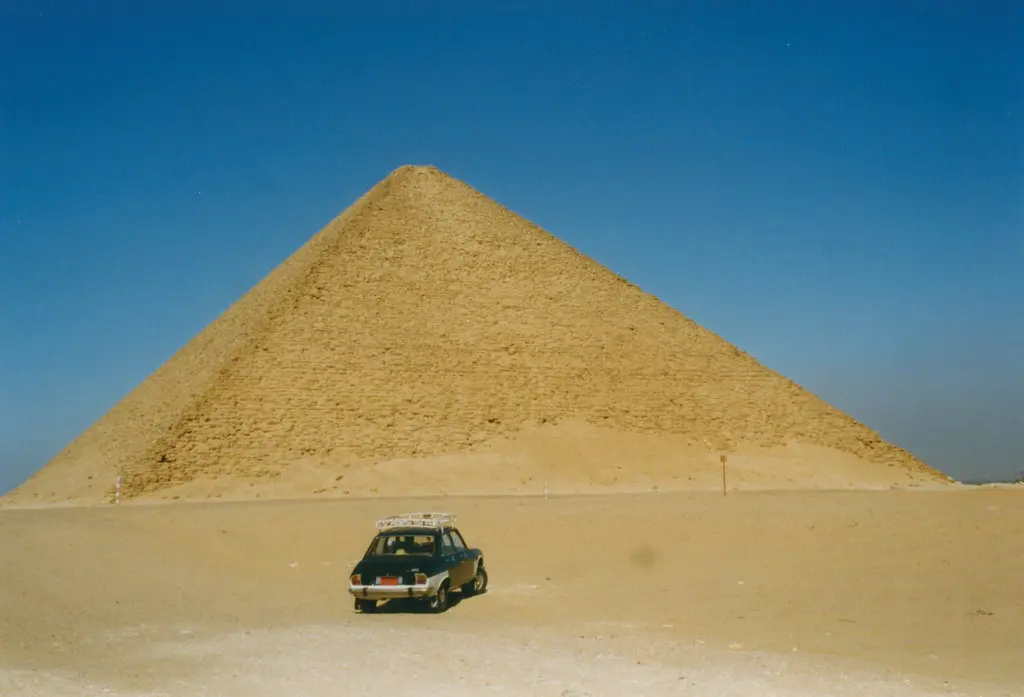
The Step Pyramid stands at the beginning of a lineage. Before Djoser, Egyptian royalty were buried in mastabas—flat-topped rectangular structures of mud-brick that crumbled within generations. Imhotep's innovation was revolutionary: dressed stone, stacked forms, unprecedented scale. Within a century of the Step Pyramid's completion, the builders at Dahshur were experimenting with true pyramids—first the Bent Pyramid with its angle change midway, then the Red Pyramid with its smooth slopes.
A generation later, Khufu's architects at Giza achieved the form's apotheosis: the Great Pyramid, the only surviving Wonder of the Ancient World.
The line extends forward as well. Egyptian pyramids influenced Greek and Roman architecture; the stepped ziggurats of Mesopotamia share conceptual if not historical roots; pyramid forms appear in Mesoamerican cultures with no documented contact. Whether through direct influence or parallel invention, the idea of the sacred mountain—built by human hands, reaching toward the sky—has appeared across civilizations. The Step Pyramid at Saqqara is the oldest example we can date.
Djoser (Netjerikhet)
Pharaoh, Third Dynasty
The pharaoh who commissioned the first pyramid. Djoser's reign appears to have been prosperous and stable enough to support this revolutionary building project—19 years of organized labor transforming Egyptian architecture forever. His face survives in the ka statue now in Cairo's Egyptian Museum: sharp cheekbones, wide eyes rendered in rock crystal, an expression of alert watchfulness across millennia. His mummified remains have never been definitively identified, though bone fragments were found in the burial chamber.
Imhotep
Architect, priest, physician, sage
The first named architect in human history and the creator of the Step Pyramid. Imhotep held multiple titles: Chancellor of the King of Lower Egypt, High Priest of Heliopolis, Chief of the Sculptors, and more. His innovations—the use of dressed stone, the stacking of mastaba forms, the creation of architectural spaces for eternity—launched Egyptian monumental architecture. Two thousand years after his death, he was worshipped as a god of medicine and wisdom, equated with the Greek Asklepios. The Imhotep Museum at Saqqara honors his legacy.
Jean-Philippe Lauer
Archaeologist and restorer
The French Egyptologist who devoted 75 years of his life to the Step Pyramid complex. Arriving at Saqqara in 1926 as a young architect, Lauer never left. He excavated, documented, and restored the complex through political upheavals, wars, and the entire transformation of modern Egyptology. His meticulous work revealed the full extent of Imhotep's achievement and preserved the monument for future generations. He is buried at Saqqara, near the site he loved.
Traditions and practice
For generations after Djoser's death, priests maintained his mortuary cult at the Step Pyramid complex. Daily rituals included food offerings, drink libations, and incense burning—nourishment for the ka that resided in the serdab. The Opening of the Mouth ceremony, performed at burial and potentially renewed periodically, was believed to reanimate the deceased and restore their ability to eat, drink, and speak in the afterlife.
The Heb-sed festival held particular importance. In life, pharaohs celebrated this renewal festival after 30 years of rule, ritually demonstrating their continued vigor. The Heb-sed court at Saqqara architecturally preserved this festival for eternity: its dummy buildings provided the setting where Djoser would celebrate his renewal forever, maintaining the cosmic order through perpetual ceremony.
How long the mortuary cult continued is uncertain. By the New Kingdom, a thousand years after Djoser's death, the pyramid was already a tourist attraction—graffiti from ancient visitors survive on the walls. The cult had likely lapsed by then, but the site retained its sacred character as the burial place of an ancient king.
No religious ceremonies are performed at the Step Pyramid today. The site functions as an archaeological monument within the broader Saqqara necropolis, managed by Egypt's Ministry of Tourism and Antiquities.
Some contemporary spiritual seekers view the Step Pyramid as significant for meditation and energy work. The Heb-sed court, with its strange dummy buildings existing only for eternity, attracts those interested in contemplating the boundaries between life and death. The serdab, with its ka statue watching through stone eye-holes, creates a focal point for reflection on consciousness and presence across millennia.
Imhotep's later deification as a god of healing and wisdom has made the site meaningful for those interested in the origins of mystery traditions.
These contemporary practices have no documented continuity with ancient Egyptian religion. They represent a modern interpretation of the site's sacred qualities rather than a surviving tradition.
Approach the Step Pyramid as an origin point—the beginning of a tradition that would span millennia. Spend time in the Heb-sed court contemplating buildings that never functioned in life, structures that exist only for eternity. Look through the serdab's eye-holes at the ka statue, whether original or replica, and consider what it means to be watched by someone 4,700 years old.
If you enter the pyramid interior, move slowly through the narrow passages and notice the blue faience tiles' otherworldly beauty.
The complex invites reflection on mortality and memory. Djoser wanted to be remembered forever; you are fulfilling his wish by being here. Imhotep wanted to build something permanent; you are walking through his achievement. Jean-Philippe Lauer devoted 75 years to preserving this place; you are benefiting from his devotion. These layers of human aspiration against time create their own kind of sanctity.
Ancient Egyptian Religion
HistoricalThe Step Pyramid represents the first monumental stone architecture in Egypt and the world—a revolutionary leap from earlier mud-brick mastabas that crumbled within generations. Built for Pharaoh Djoser (Netjerikhet) of the Third Dynasty, it embodies the Egyptian belief that the king would join the circumpolar stars and live eternally. The complex functions as an integrated eternal machine: the pyramid provides the vehicle for stellar ascent, the Heb-sed court enables eternal festival celebration, the serdab houses the ka statue for perpetual offerings, and the underground chambers recreate palace environments in permanent materials. The stepped form likely represents a stairway to heaven.
The original mortuary cult included daily offerings of food, drink, and incense performed by designated priests. The Opening of the Mouth ceremony reanimated the deceased king, restoring his ability to consume offerings in the afterlife. The Heb-sed festival, normally celebrated after 30 years of rule, was architecturally preserved so Djoser could celebrate it eternally in the dummy buildings of the Heb-sed court. The ka statue in the serdab received offerings through two eye-holes drilled in the limestone wall.
New Age/Western Esotericism
ActiveContemporary spiritual seekers view the Step Pyramid as the birthplace of sacred geometry in monumental form. The six-tier structure, the complex's astronomical alignments, and the emergence of such sophisticated architecture without clear predecessors attract those interested in ancient knowledge systems and initiatory traditions. Imhotep's later deification as a god of medicine and wisdom—associated with healing dreams and esoteric knowledge—connects the site to mystery tradition lineages that some practitioners trace through Egypt to Greek and Western esotericism.
Meditation in the Heb-sed court, contemplation at the serdab, and energy work in the pyramid interior (when accessible) are common among contemporary spiritual visitors. Some seek to connect with the site's 'original' energy or to access knowledge encoded in the architecture. Group visits organized around solstices or equinoxes occasionally occur.
Perspectives and open questions
The Step Pyramid can be understood through multiple lenses: as an archaeological milestone, as a theological instrument, as a work of individual genius, and as a meditation on mortality. These perspectives need not compete. Holding them together creates a richer encounter with the world's first pyramid.
Scholarly perspective
Egyptologists agree that the Step Pyramid is the first large-scale stone building in human history, designed by the architect Imhotep for Pharaoh Djoser of the Third Dynasty around 2670 BCE. Archaeological evidence suggests the stepped form evolved during construction—beginning as a flat mastaba, then expanded through multiple stages to the six-tiered structure visible today.
The complex represents a complete mortuary environment designed to ensure the king's eternal existence. Jean-Philippe Lauer's 75 years of study (1926-2001) remain foundational; his excavations revealed the full extent of Imhotep's achievement, including the underground galleries, blue faience chambers, and the complex's sophisticated drainage and structural systems.
The Step Pyramid launched the pyramid-building tradition that would culminate at Giza within a century. Its innovations—dressed stone construction, the stacking of mastaba forms, the creation of dummy buildings for eternal function—transformed Egyptian architecture and established the pyramid as the definitive expression of royal immortality.
Living and traditional perspectives
Ancient Egyptian sources identify Imhotep as the Step Pyramid's architect and credit him with revolutionary genius. By the Ptolemaic period, two thousand years after his death, Imhotep had been deified as a god of medicine and wisdom, equated with the Greek Asklepios. Pilgrims came to Saqqara seeking healing dreams, and Imhotep's cult persisted into Roman times.
The pyramid's religious function centered on the king's transformation from mortal to immortal. The stepped form likely represented a stairway to the sky, allowing the pharaoh's ba (soul) to ascend to join the circumpolar stars—the 'imperishables' that never set. The complex's elements worked together: the pyramid enabled ascent, the serdab housed the ka, the mortuary temple received offerings, and the Heb-sed court provided eternal festival celebration. This was sacred technology in the truest sense.
Alternative interpretations
Some alternative researchers propose that the Step Pyramid encodes astronomical or mathematical knowledge beyond conventional interpretation. The six-tiered structure, the complex's precise orientation, and the scale of underground construction attract those seeking hidden meaning or advanced ancient capabilities.
Imhotep's later deification as a healer and sage has made him significant for those interested in mystery traditions and the origins of esoteric knowledge. Some view the Step Pyramid as the beginning of an initiatory tradition that would influence Greek and later Western esotericism.
These interpretations remain speculative and lack support from mainstream Egyptology. However, they reflect a genuine contemporary engagement with the site's mystery—the question of how such sophisticated architecture emerged so early in Egyptian history without clear predecessors.
Open questions
Genuine mysteries remain. The construction methods for the Step Pyramid are not fully understood—how workers without metal tools quarried, transported, and lifted millions of stone blocks remains imperfectly explained. The complete symbolism of the six-step form is debated; while the 'stairway to heaven' interpretation is widely accepted, whether specific numbers held particular meaning is uncertain.
The function of the complex's many dummy buildings—structures with facade entrances leading to solid rubble—is understood in general terms but raises questions about ancient Egyptian concepts of eternal existence. Why create buildings that never functioned? What did the Egyptians believe happened in these spaces after death?
What rituals were performed here and for how long remains largely unknown. Some evidence suggests the mortuary cult continued for generations, but the specific practices, their timing, and their eventual cessation are poorly documented. The Step Pyramid complex operated as a sacred site for millennia; much of its religious life has been lost.
Plan your visit
Access and arrival
Most visitors base themselves in Cairo or Giza and visit Saqqara as a day trip. Hotels near the Giza pyramids (Marriott Mena House, Le Méridien Pyramids) offer convenient bases for exploring both Giza and Saqqara. Cairo's Zamalek and Garden City neighborhoods provide good hotel options with easier access to the south. Combining Saqqara with Memphis and Dahshur creates a full-day excursion from either base.
Respectful visit
No religious requirements. Practical clothing for desert heat recommended: light layers, sun protection, sturdy walking shoes. If entering the pyramid interior, wear clothing suitable for climbing and navigating narrow passages.
Photography is allowed throughout the complex and in most interior areas. Flash photography may be restricted in some decorated chambers to protect ancient pigments. Tripods may require special permission from site management. Video recording typically follows the same rules as still photography.
Not applicable. No active religious practice occurs at the site. Leaving objects is discouraged to protect the archaeological context.
Some tunnels and galleries remain closed for preservation and safety. Interior access is time-limited. Visitors must stay on designated paths. Climbing on the pyramid itself is prohibited. Removing artifacts, including stone fragments, is illegal.
The pyramid interior requires physical fitness for navigating narrow, steep passages. Claustrophobic visitors should consider carefully before entering. Heat can be extreme in summer months, and shade is limited throughout the complex. Vendors may be persistent; engage or decline as you prefer, but anticipate the approach. Some areas remain closed for preservation or ongoing restoration.
Current practical details
Address
Badrshein, Giza Governorate 3352001, Egypt
Hours
Hours, fees, and access can change — verify on the official source before you travel. Practical details last checked Jun 2026.
Location
Map loads as you approach this section.
Pilgrim reflections
A portrait of encounter, not a score
Pilgrims describe what they felt, how present they could become, and whether the place would shape a journey. There are no stars and no ranking of traditions.
No reviewed reflections yet
The first pilgrims can help describe the character of being here.
Share a reflection
Available after an account-backed “Been there.” Every reflection is reviewed before publication.
Watch deeper
Films, episodes, and recorded talks for visitors who want more context before or after a visit. Speculative and alternative-history entries are labelled as perspectives, not as sources for established claims.
Streaming episode
Alternative-history media
Ancient Apocalypse: Legacy of the Sages
Graham Hancock's Giza/Sphinx-focused episode in Ancient Apocalypse season 1.
Perspective note: Highly contested by mainstream archaeology; included as a perspective, not as evidence.
Open on NetflixVideo resource
Alternative-history media
The Revelation of the Pyramids (La Revelation des Pyramides)
Influential 2010 French documentary on pyramid geometry, alignments, and ancient-site pattern claims.
Perspective note: Controversial and not a source for established archaeological claims.
Open on JustWatch MegalithomaniaUK / YouTube
Alternative-history media
Revelations Beneath Khafre's Pyramid FULL UPDATE
Gaia panel discussion connected to Ancient Civilizations and claims beneath Khafre's Pyramid.
Perspective note: Very speculative; pair with mainstream context before treating any claim as factual.
Open on MegalithomaniaUK / YouTubeNearby sacred places
Explore other sacred places in the region. Proximity does not establish access or travel time; check each place’s guidance.


References
Sources consulted for this page. Source categories describe the publication, not a guarantee that every claim is verified. Traditional accounts and outside interpretations may differ.
- 01Memphis and its Necropolis – the Pyramid Fields from Giza to Dahshur — UNESCO World Heritage CentreofficialOfficial UNESCO listing for the broader Memphis necropolis including Saqqara
- 02Step Pyramid of Djoser — Encyclopaedia BritannicaencyclopediaComprehensive overview with construction details
- 03Egypt's Oldest Pyramid Is Officially Open to the Public After 14-Year Renovation — Smithsonian Magazineacademic2020 restoration completion coverage
- 04Egypt Announces New Ticket Prices for Archaeological Sites — Ahram OnlineacademicOfficial Egyptian news source for ticket pricing
- 05The First Pyramid: How Djoser's Architect Changed Ancient Egypt Forever — National GeographicacademicDetailed coverage of architectural innovation and Imhotep
- 06Inside Djoser's Pyramid: What Visitors Can Expect — Egypt TodayacademicContemporary visitor information and interior access details
Share a photo
Help visitors recognize Pyramid of Djoser. Every submission is reviewed before publication.