Orthodox Cathedral of the Nativity, Riga
Five golden domes over central Riga, mother cathedral of Latvian Orthodoxy
Understand sacred places, explore living traditions, and learn how to engage respectfully with Pilgrim Map.
Access has not been verified. Check current local guidance before planning a visit.
Riga, Riga, Latvia
Read the sources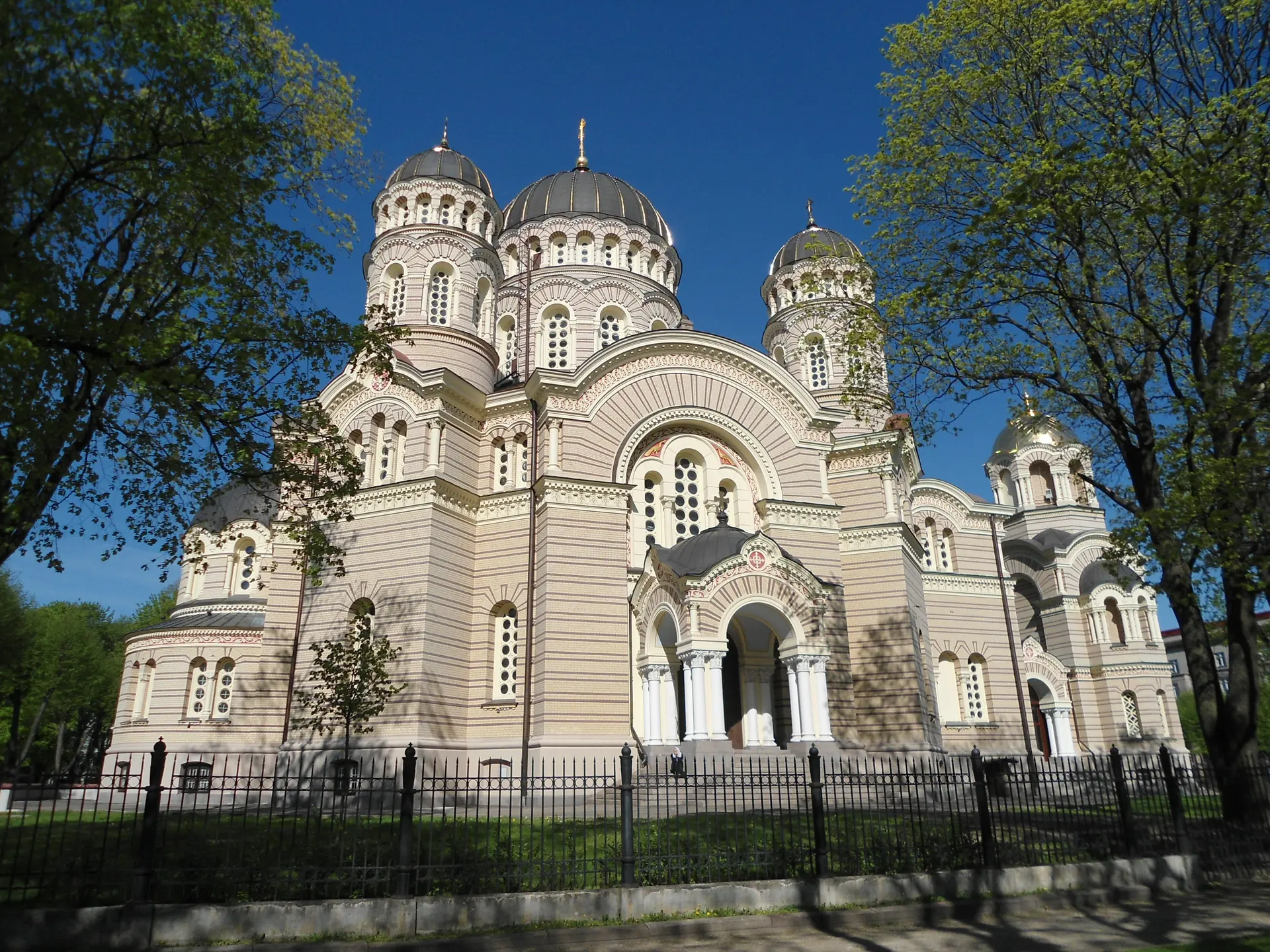
Image of Orthodox Cathedral of the Nativity, Riga. Image source · CC-BY-3.0
Visit essentials
A quick read before you go
- Duration
- 30-60 minutes.
- Access
- Centrally located on the Esplanade in central Riga, easily reached on foot or by tram or bus…
Overview
Five gilded domes rise above Riga's Esplanade; inside are a tall iconostasis, frescoed walls, beeswax and incense, and candles glowing before icons. This is Riga's largest Orthodox church and the cathedral seat of the Latvian Orthodox Church, with a layered history despite being barely older than the city's tram lines. Built in the 1880s as the grandest Orthodox edifice in the Baltic provinces of the Russian Empire, it asserted an imperial religious presence.
Under Soviet rule its bells were removed and crucifixes dismantled; the consecrated space became a planetarium and House of Knowledge, teaching the heavens without God. After Latvia regained independence, the cathedral returned to worship, and its iconostasis was reconsecrated in 2000. Its construction, desecration, and return now meet in chanted liturgy, worshippers lighting candles, and the gold of the icons answering the domes outside.
Why this place is sacred
What makes the cathedral feel charged is partly its survival. As the foremost place of Orthodox worship in Latvia, it is held sacred through its consecrated altars, its iconostasis of icons painted in the lineage of Rublev and Theophanes the Greek, and the daily celebration of the Divine Liturgy. But the sense of a place set apart is deepened by its biography.
The narrative of a building stripped down to a Soviet planetarium and then restored to a cathedral gives the interior a quality of resurrection, of something returned to its purpose against the odds. The incense-filled liturgical atmosphere, the chanted services and the candle-glow before icons are the ordinary means by which Orthodoxy makes a space holy; here they fall on a building that has had to be made holy twice over.
Built as the principal Orthodox cathedral of Riga and the grandest Orthodox church of the Russian Empire's Baltic provinces, asserting imperial religious presence in the region.
Closed and converted into a planetarium and House of Knowledge in the early 1960s, with bells removed and crucifixes dismantled, then restored after 1991, with the iconostasis reconsecrated in 2000. Since a 2022 parliamentary directive it has stood at the center of the Latvian Orthodox Church's move toward autocephaly.
Experience and orientation
The cathedral works on you in two movements. From the Esplanade, the five gilded domes read as ceremonial and monumental, an unmistakable Orthodox silhouette in a Baltic city. Inside, the scale shifts to something more enveloping. Visitors often describe being struck by the opulence of the Neo-Byzantine interior, the frescoes, the height and density of the iconostasis, and the way candlelight pools at the base of the icons.
The atmosphere is hushed and reverent, and many find the beauty of chanted services the most affecting part of the visit. There is no need to understand the liturgy to feel its pull. To come during a service is to encounter the cathedral as a living place of prayer rather than a monument; to come on a quiet weekday morning is to have the space and its stillness more to yourself.
The cathedral stands on the Esplanade in central Riga, a short walk from the Old Town. The main worship space sits beneath the domes, with a crypt below; entry is generally free.
Context and lineage
The cathedral was raised between 1876 and 1883, in Neo-Byzantine style, as the grandest Orthodox edifice in the Baltic provinces of the Russian Empire, and consecrated and officially opened in 1884 (sources give the construction span slightly differently, generally 1876-1883). It was commissioned with the blessing of Tsar Alexander II, at the initiative of the governor-general Pyotr Bagration and Bishop Veniamin. Its decoration drew on St.
Petersburg's leading talent, and the building stood as the largest Orthodox cathedral in the region. After the Soviet conversion to a planetarium in the early 1960s, the cathedral was restored following Latvian independence, its iconostasis reconsecrated in 2000.
Eastern Orthodox Christianity, originally within the Russian Orthodox Church of the imperial era and today the seat of the Latvian Orthodox Church.
Nikolai Chagin and Robert Pflug
Architects of the cathedral, who designed it in Neo-Byzantine style.
August Volz (firm)
Responsible for decorative work in the cathedral's interior.
Vasily Vereshchagin, A. Korzukhin and K. Venig
St. Petersburg Academy artists who painted the cathedral's icons and frescoes.
Tsar Alexander II, Pyotr Bagration and Bishop Veniamin
Imperial sponsor, initiating governor-general and bishop under whom the cathedral was commissioned and built.
Traditions and practice
The Orthodox Divine Liturgy, vespers and matins, the veneration of icons, and the great feasts of the Orthodox calendar, with particular weight on the Nativity of Christ to which the cathedral is dedicated.
Regular services are attended by Riga's Orthodox community, with candle offerings, prayer before icons, and reflection in the crypt beneath the cathedral.
Non-Orthodox visitors are welcome to observe quietly and to light a candle before an icon. Attending part of a service, even briefly, conveys the cathedral's life more than a silent walk-through; sitting in the crypt offers a quieter space for reflection.
Eastern Orthodox Christianity
ActiveThe largest Orthodox church in Riga and the cathedral seat of the Latvian Orthodox Church, anchoring Orthodox liturgical life in Latvia and housing a celebrated iconostasis and collection of icons.
The Divine Liturgy and full Orthodox liturgical cycle, veneration of icons and lighting of candles, and the major feasts, especially the Nativity of Christ.
Perspectives and open questions
The cathedral is read at once as a monument of late-imperial Russian art, a living Orthodox home, and a focal point of present-day political tension.
Scholarly perspective
Art and architectural historians regard it as the largest and most lavish Neo-Byzantine Orthodox cathedral in the former Baltic provinces, a key monument of late-imperial Russian ecclesiastical art whose Soviet conversion and post-1991 restoration document the religious and political history of 20th-century Latvia.
Living and traditional perspectives
For Latvia's Orthodox faithful, historically including Russian, Latvian and Belarusian communities, the cathedral is a living spiritual home and a symbol of the faith's survival through suppression.
Alternative interpretations
No significant esoteric tradition is associated with the cathedral. A reported 'weeping' Marian icon circulates mainly in travel-aggregator accounts and is best treated as a popular devotional tradition rather than an officially documented miracle.
Open questions
The full extent of original 19th-century artworks lost or dispersed during the Soviet planetarium period, and how much has since been recovered, is not fully catalogued in accessible sources.
Plan your visit
Access and arrival
Centrally located on the Esplanade in central Riga, easily reached on foot or by tram or bus from the Old Town. Entry is generally free. Specific daily opening hours and the liturgy schedule are not consistently documented in English sources; confirm locally.
Central Riga offers the full range of accommodation within walking distance, from the Old Town to the surrounding districts.
Respectful visit
Modest dress covering shoulders and knees. Women are customarily encouraged to cover their heads, especially during services, and men remove hats; carrying a scarf is advised.
Interior photography is often restricted or discouraged, particularly during services; follow on-site signage and ask before photographing.
Donations support the cathedral's upkeep, and candles may be purchased and lit before the icons.
Keep phones silent, avoid loud conversation, and do not disrupt worshippers during the liturgy.
Reception of communion is reserved for Orthodox faithful. Visitors should not move through the space during the most solemn moments of the liturgy or position themselves in front of worshippers at prayer.
Location
Map loads as you approach this section.
Pilgrim reflections
A portrait of encounter, not a score
Pilgrims describe what they felt, how present they could become, and whether the place would shape a journey. There are no stars and no ranking of traditions.
No reviewed reflections yet
The first pilgrims can help describe the character of being here.
Share a reflection
Available after an account-backed “Been there.” Every reflection is reviewed before publication.
Nearby sacred places
Explore other sacred places in the region. Proximity does not establish access or travel time; check each place’s guidance.


References
Sources consulted for this page. Source categories describe the publication, not a guarantee that every claim is verified. Traditional accounts and outside interpretations may differ.
- 01Riga's Nativity of Christ Cathedral — LiveRiga (official Riga tourism)officialOfficial tourism description of the cathedral's history and significance.
- 02Riga Nativity of Christ Orthodox Cathedral — latvia.travel (official Latvian tourism)officialOfficial tourism overview.
- 03Cathedral of the Nativity of Christ, Riga — Wikipedia contributorsencyclopediaHistory, architects Chagin and Pflug, Neo-Byzantine style, Soviet planetarium conversion, restoration, iconostasis.
- 04Cathedral of the Nativity of Christ in Riga — russkije.lv (Russian community of Latvia)guideCommunity history of the cathedral and its 19th-century artistic program.
- 05Latvian Orthodox Church — Wikipedia contributorsencyclopedia2022 parliamentary directive of autocephaly following Patriarch Kirill's support of the invasion of Ukraine; cathedral as seat of the Church.
- 06Nativity of Christ Cathedral, Riga — gotobaltic.comguideDetailed build dates 1876-1883, August Volz decorations, artists (Vereshchagin, Korzukhin, Venig), largest Orthodox cathedral in the Baltic provinces.
- 07Nativity of Christ Cathedral — Lonely PlanetguideVisitor-facing description and etiquette.
- 08Nativity of Christ Cathedral — SpottingHistoryguideHistory including bell removal and crucifix dismantling during Soviet conversion.
Share a photo
Help visitors recognize Orthodox Cathedral of the Nativity, Riga. Every submission is reviewed before publication.