Old Town of Ghadames, Libya
A labyrinthine oasis city where Berber, Tuareg, and Islamic traditions converge at the desert's edge
Understand sacred places, explore living traditions, and learn how to engage respectfully with Pilgrim Map.
Access has not been verified. Check current local guidance before planning a visit.
Ghadames, Nalut, Libya
Read the sources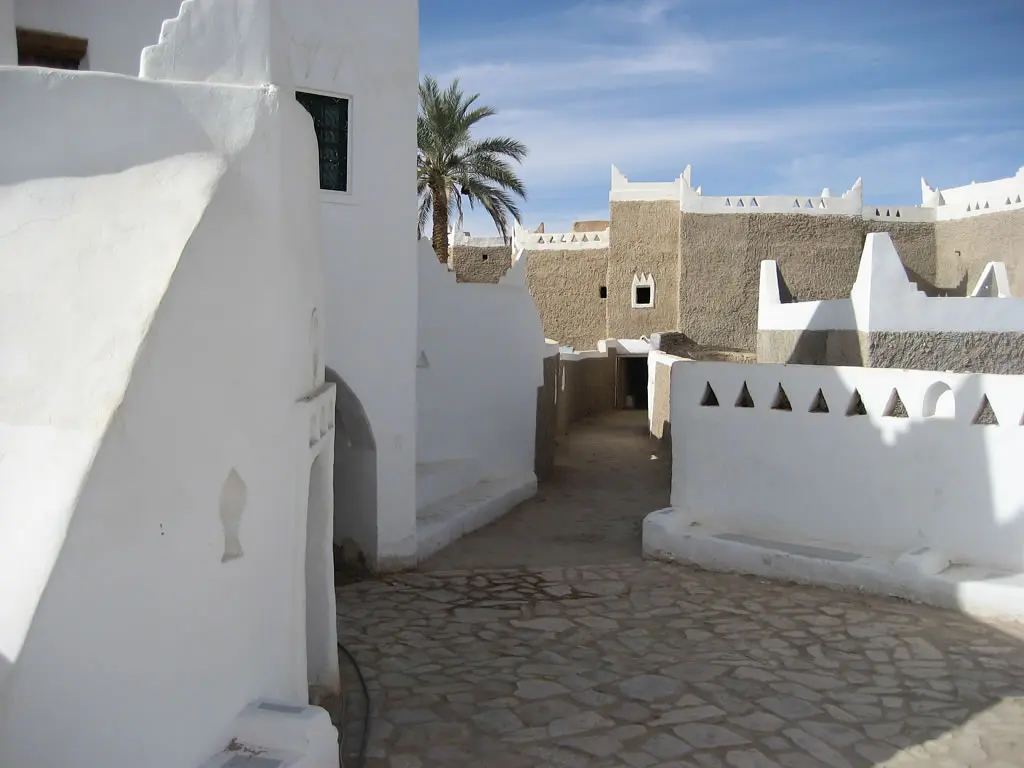
Visit essentials
A quick read before you go
- Duration
- A half-day to full day suffices for exploring the old town itself—two to six hours depending on…
- Etiquette
- Visiting Ghadames requires respect for both Islamic religious practice and Libyan cultural…
Overview
In northwestern Libya, where the Sahara meets Algeria and Tunisia, Ghadames—the Pearl of the Desert—has endured for over two thousand years around the single spring that made life possible in this harsh landscape.
Its architecture is found nowhere else. Covered ground-level passageways gave perpetual shade to men's trade and travelers' respite, while interconnected rooftop terraces formed a second city where women moved freely among households, visited neighbors, and raised children beneath open sky. This vertical division expressed the community's understanding of gender, space, and public and private life.
Residents relocated to the modern town decades ago, but the old city remains culturally vital. During the annual Ghadames International Festival, families return to centuries-old ancestral homes; for three days, covered streets fill with music, traditional dress, and taguella bread baking in hot sand, turning empty passages into living memory.
Seven clan neighborhoods and seven gates share one central spring. Companions of the Prophet Muhammad are buried here, and a mosque built in 1258 still receives worshippers. Beneath this Islamic heritage remain traces of Byzantine Christianity, Berber ancestor veneration, and the Garamantes who first made the desert crossing possible.
Why this place is sacred
The founding story speaks of a mare whose hoof struck the earth and released water where none should exist. Whether literal or mythic, the story captures something essential: Ghadames represents the improbable persistence of life where conditions suggest otherwise. The spring called Ain al-Faras—Spring of the Mare—became the axis around which seven clans organized their existence.
Water in the desert carries inherent sacredness. The Ghadames system of water distribution, al-kadus, was not merely practical but ceremonial—a ritual affirmation that the spring's gift belonged equally to all. The careful channeling of water through the city, the wells within individual homes, the public fountains in each neighborhood plaza—all spoke to a community that understood itself as dependent on a gift that could not be taken for granted.
The vertical organization of space creates its own thinness. At ground level, the covered passages hold near-darkness even at midday—a realm of commerce, travel, and male public life. Ascending through family quarters, one emerges onto rooftop terraces flooded with light, where women maintained a parallel society invisible from below. The architecture enacts a cosmological layering: underground storage, middle world of domestic life, upper realm of light and social connection.
Companions of the Prophet Muhammad who participated in the 667 CE conquest are buried within the city walls. The Atiq Mosque, built in 1258, continues to function. Before Islam, Byzantine Christianity held sway—the town had a bishop in the sixth century, and columns from the Christian church reportedly remain embedded in the Sidi Badri Mosque.
Before Christianity, the Garamantes and indigenous Berbers understood this place according to their own cosmologies, traces of which persist in Berber practices of ancestral consultation and the protective symbols decorating home interiors.
This layering of traditions creates a palimpsest quality. Each faith left traces without erasing what came before. Walking these passages, one moves through strata of human meaning-making—each layer a response to the same fundamental conditions: extreme heat, scarce water, the necessity of cooperation, and the human need to make sense of existence.
Ghadames emerged as a response to geography and trade. Positioned at the intersection of routes linking Tripoli to the Mediterranean, the Sahel to the south, and Tunisia and Algeria to the west, it became an essential waystation on trans-Saharan caravan routes. But its purpose was never merely commercial.
The architecture demonstrates a community organized around values: clan loyalty expressed in seven distinct neighborhoods, gender relations encoded in vertical space, and spiritual life woven into daily routine through the placement of mosques, public plazas, and the ceremonial distribution of water.
For centuries, Ghadames functioned as a living city—trading post, spiritual center, and home to Berber and Tuareg communities. The trans-Saharan trade that gave it purpose gradually declined with the colonial era and the rise of motor transport. In the twentieth century, residents began relocating to a modern town nearby, where amenities and infrastructure made life easier.
The old town emptied but was not abandoned. UNESCO inscribed it as a World Heritage Site in 1986, recognizing its architectural significance. The annual festival maintains connection between living families and ancestral homes. Since 2016, the site has been on the World Heritage in Danger list due to Libya's civil conflict, yet it persists—waiting, like the desert itself, for conditions to change.
Experience and orientation
The first experience is labyrinthine disorientation. Entering the covered passageways, daylight disappears. Skylights punctuate the ceiling, casting circles of brightness onto the sandy floor, but between them stretches shadow. The temperature drops noticeably. What was brutal desert heat becomes tolerable coolness. The architecture itself is relief.
Navigating without a guide is nearly impossible. The passages twist and branch according to logic that reveals itself only gradually. Seven neighborhoods, seven gates, and countless turns create a city that resisted outsiders by design. With a guide, the confusion becomes wonder: here is the plaza where a particular clan gathered, here the mosque where Friday prayers still occur during festivals, here the fountain where the spring's gift was shared.
Climbing to the rooftop level produces a second wonder. Suddenly there is light everywhere, and openness. The terraces connect, allowing movement across the entire old town without descending to street level. This was the women's city—a parallel realm where domestic and social life unfolded in sun and air while male commerce proceeded in shadow below. Standing here, one grasps the social architecture literally: a community that organized itself in three dimensions.
The heritage homes open to visitors display interiors of surprising beauty. White walls set off geometric patterns in deep red paint—Berber symbols whose meanings include protection, fertility, and connection to ancestral presences. Triangles, diamonds, hands (hamsa), eyes, and the Tuareg cross repeat in variations unique to each family. These are not mere decoration but encoded meaning, prayers in pigment.
The prevailing quality is haunting silence. This was a city of thousands; now it holds only memory. Yet the silence is not emptiness. Visitors frequently describe a sense of presence—whether the accumulated weight of human habitation or something less explicable. The architecture holds intention: every covered passage, every light shaft, every terrace connection was made by hands responding to this specific place. That intention persists.
During the annual festival, the quality transforms entirely. Families return. Streets fill with the sound of traditional music, the colors of Tuareg dress, the aroma of taguella bread. For three days, the silent passages become what they were built to be: vessels for living community.
Approach Ghadames as layered encounter: with desert and oasis, with architecture and the values it embodies, with multiple religious traditions that have called this place sacred, and with a community that maintains connection to ancestral homes even while living elsewhere.
Allow time for the pace of discovery. The passages do not reveal themselves quickly. Neither does the meaning of what you encounter. A heritage home's decorative patterns, incomprehensible at first, begin to resonate as you learn the Berber understanding they encode.
If possible, visit during the October or November festival, when the city comes alive. But the emptiness of other seasons has its own teaching: what does it mean for a civilization to persist in absence? The architecture remains. The spring still flows. Something waits.
Context and lineage
According to local tradition, Ghadames was founded when a mare's hoof struck the earth and water sprang forth. The spring that resulted—Ain al-Faras, Spring of the Mare—became the center around which civilization developed. Whether the story records a miraculous event or mythologizes the discovery of an existing spring, it captures the essential truth: without water, nothing here is possible.
Archaeological evidence suggests settlement from at least the fourth millennium BCE. The Romans established a garrison in 19 BCE, naming the place Cydamus. By the sixth century, Byzantine missionaries had converted the population to Christianity, and a bishop served the community. The town became a stronghold of Donatist Christianity, a North African variant the mainstream church considered heretical.
In 667 CE, Arab Muslim forces led by Uqba ibn Nafi conquered Ghadames during the Umayyad expansion into North Africa. Companions of the Prophet Muhammad participated in this conquest, and their graves remain in the city—a connection to the earliest period of Islamic history that gives Ghadames particular significance for Muslims. The conversion was rapid and complete; within a generation, the Christian town had become Islamic.
From Garamantian traders to Roman garrison to Byzantine bishopric to Islamic trading center, Ghadames has accumulated layers of human presence. The physical architecture—though predominantly from the Islamic period—incorporates earlier elements, including Roman-period mausolea outside the walls and Christian columns within the Sidi Badri Mosque.
The trading culture that gave Ghadames its wealth and significance connected Mediterranean ports to sub-Saharan kingdoms. Caravans brought gold, slaves, ivory, and salt across the desert; Ghadames provided water, rest, and the accumulated expertise of people who knew how to survive where others could not. The Tuareg, master navigators of the Sahara, were central to this system, and their presence shaped the city's culture alongside its Berber foundation.
Ottoman rule from the sixteenth century brought the town into a larger Islamic polity. Italian colonization in the twentieth century began the disruption of traditional patterns; Libyan independence and subsequent modernization completed the transition. When residents moved to the new town, seeking the conveniences unavailable in mud-brick architecture designed for other centuries, the old city began its current phase: preserved but not inhabited, sacred but not daily lived-in.
Uqba ibn Nafi
historical
The Arab military commander who led the conquest of Ghadames in 667 CE. His campaign brought Islam to much of North Africa. Companions of the Prophet who accompanied his forces are buried in Ghadames.
The Garamantes
historical
The ancient Saharan civilization that controlled trans-Saharan trade routes before Roman times. Their underground water systems (foggaras) and trade networks made places like Ghadames possible.
Traditions and practice
Ghadames Berbers maintained practices alongside Islam that orthodox teaching might question. The consultation of ancestral spirits through dreams—achieved by sleeping in family tombs—connects to pre-Islamic understanding of the dead as accessible guides. The decorative symbols that cover home interiors carry protective power: the hamsa (hand) against the evil eye, geometric patterns encoding fertility and blessing, the Tuareg cross signifying the four directions.
The al-kadus water distribution system was as much ceremony as infrastructure. The apportioning of the spring's flow among seven clans required agreement, ritual, and the recognition that water belonged to the community as a gift, not to individuals as property.
Islamic practice follows the Maliki school of Sunni jurisprudence. The graves of the Prophet's companions who participated in the 667 CE conquest receive particular veneration. The concept of baraka—holiness or blessing that can be transmitted through people, places, and objects—is highly developed here. Shurifa, descendants of the Prophet Muhammad, hold special spiritual status.
Daily Islamic practice—the five prayers, Friday congregation, Ramadan observance—now occurs primarily in the modern town's mosques. However, the Atiq Mosque in the old city continues to function, particularly during festivals and special occasions.
The Ghadames International Festival, held annually in October or November, represents the most significant contemporary practice. For three days, families return to ancestral homes in the old town. Traditional music and poetry fill the covered passages. Women prepare taguella bread, baking flat rounds in sand heated by fire. Camel and horse races connect to Tuareg heritage. Traditional crafts—pottery, leatherwork, silver jewelry—are demonstrated and sold. The festival is simultaneously heritage preservation and living practice.
Mawlid, the celebration of the Prophet Muhammad's birthday, is observed with particular devotion. Eid al-Fitr and Eid al-Adha bring community together in both old and new towns.
If visiting during the festival, allow the celebrations to guide your experience. Accept hospitality when offered—tea, meals, conversation. This is not tourism but participation in a community's self-renewal.
In the old town, visit one of the heritage homes open to visitors. Let a guide explain the meaning of the decorative patterns. These are not abstract designs but encoded understanding—protection for the household, connection to ancestors, prayer made visible.
At the Atiq Mosque, if accessible and not during prayer time, pause in the courtyard. Consider the continuity: worship in this space since 1258. Before that, different worship, different names for the sacred. The impulse persists.
Watching sunset from the dunes outside the old town offers perspective. The city appears as coherent whole—seven neighborhoods unified by necessity and shared understanding. The scale of human achievement against the scale of desert becomes apparent.
Sunni Islam (Maliki school)
ActiveIslam arrived in Ghadames in 667 CE when Arab Muslim forces led by Uqba ibn Nafi conquered the town during the Umayyad expansion into North Africa. Companions of the Prophet Muhammad participated in this conquest, and their graves remain within the city walls, giving Ghadames direct connection to the earliest period of Islamic history. The Atiq Mosque, constructed in 1258 CE, continues to function as a place of worship. The Maliki school of jurisprudence predominates, as throughout North Africa.
Daily prayers, Friday congregational worship, Ramadan observance, and celebration of the major Islamic holidays structure religious life. Mawlid—the Prophet's birthday—receives particular devotion. The concept of baraka, holiness or blessing that can be transmitted through people, places, and objects, is highly developed. Shurifa, descendants of the Prophet, hold special spiritual status. Veneration of the companions' graves connects the community to foundational Islamic history.
Berber Ancestral Traditions
ActiveThe Ghadames Berbers maintain pre-Islamic spiritual practices alongside their Islamic faith. Unlike strictly orthodox Muslims, Ghadames Berbers traditionally believe the spirits of ancestors can be consulted for guidance. The practice of sleeping in ancestral tombs to receive dreams carries forward ancient understanding of the dead as accessible and concerned with the living. The decorative traditions of homes include sacred Berber symbols encoding protection and blessing.
Consultation of ancestral spirits through dream incubation in family tombs. Application and maintenance of protective symbols in domestic decoration: triangles, diamonds, the sun, the moon, the palm, the eye, the hand (hamsa), and the Tuareg cross. Traditional ceremonies during festivals. Maintenance of matrilineal cultural elements alongside patrilineal Islamic structures. The annual festival represents the most visible expression of these traditions.
Tuareg Cultural Traditions
ActiveGhadames has long been a significant Tuareg settlement, with Tuareg tribes playing a central role in trans-Saharan trade routes linking Tripoli to the Sahel. The annual Ghadames International Festival celebrates Tuareg heritage with traditional music, distinctive indigo dress, camel races, and traditional crafts. Tuareg identity combines matrilineal social structures, preservation of Tamasheq language and tifinagh script, and adaptation to desert life that made the trans-Saharan trade possible.
Taguella bread-making, cooking round flat bread in sand heated by fire. Traditional music featuring the imzad, a single-stringed violin played by women. Poetry in Tamasheq, the Tuareg language. Camel racing connecting to the nomadic heritage. Silver jewelry and leatherwork demonstrating traditional crafts. Traditional dress, including the distinctive tagelmust headwrap for men, during festivals and ceremonies.
Byzantine Christianity
HistoricalDuring the sixth century, Ghadames had a bishop and a Christian population converted by Byzantine missionaries. The town became a stronghold of Donatism, a North African Christian movement that mainstream churches considered heretical. Columns from the Christian church reportedly remain incorporated into the Sidi Badri Mosque, physical traces of the tradition that preceded Islam.
Historical Christian worship following Byzantine forms, with Donatist particularities that emphasized purity of clergy and rigor in practice. The specific rituals conducted in sixth-century Ghadames are not documented. The transition to Islam following the 667 CE conquest was rapid; within a generation, Christianity had ceased as living practice.
Perspectives and open questions
Ghadames invites reading from multiple angles: architectural, archaeological, religious, and cultural. Each perspective illuminates aspects invisible to others. The scholarly focus on climate adaptation and trade routes, the traditional understanding of ancestral presence and spiritual protection, the layered religious history that refuses simple narrative—all are true simultaneously.
Scholarly perspective
UNESCO and architectural historians recognize Ghadames as an outstanding example of pre-Saharan settlement, demonstrating sophisticated adaptation to extreme desert climate. The vertical organization of domestic space and the interconnected rooftop system represent architectural solutions found nowhere else in North Africa. The covered passageways, the calculated use of light shafts, the thermal mass of mud-brick construction—all speak to generations of empirical wisdom about living in the desert.
Archaeologists emphasize the site's importance in trans-Saharan trade from Garamantian times through the medieval period. The town represents a node in networks connecting Mediterranean and sub-Saharan economies, enabling exchange that shaped both regions. The religious transitions—from indigenous practices to Christianity to Islam—reflect larger historical forces while taking local forms.
The settlement pattern, with seven clan neighborhoods each having distinct identity while sharing water, suggests a sophisticated political economy. Competition and cooperation held in balance through architecture and ritual.
Living and traditional perspectives
For the Ghadames Berber and Tuareg peoples, the old town represents ancestral heritage and living memory. The annual return to ancestral homes during the festival maintains connection to ancestors whose spirits are believed to be present and accessible. To sleep in a family tomb is to open oneself to guidance through dreams—a practice that predates Islam but persists alongside it.
The decorative symbols covering home interiors carry protective and blessing power passed through generations. The hamsa, the eye, the geometric patterns—these are not ornamentation but active spiritual technology, maintaining the household's wellbeing through encoded prayer.
The spring is not merely water source but gift requiring reciprocity. The ceremonial distribution of its flow among clans acknowledges that life itself comes from beyond human making. The graves of the Prophet's companions bring baraka to the entire community, a blessing that persists across centuries.
Alternative interpretations
The geometry of the seven-clan structure with seven gates has been noted for symbolic significance beyond practical function. The vertical organization—underground storage, middle living space, upper women's domain—has been interpreted as reflecting cosmological layering: underworld, middle world, heavenly realm.
The covered passageways creating near-darkness at ground level while women moved in light above has been read as encoding symbolic inversions: visible and invisible, public and private, masculine commerce and feminine creation. Whether the builders intended such symbolism or whether pattern recognition imposes meaning retrospectively remains open.
The site's positioning at the intersection of three borders—three lands meeting at one point—suggests liminal geography that various traditions associate with spiritual power.
Open questions
Genuine mysteries persist. What specific Byzantine Christian practices existed here, and what Donatist beliefs shaped the community before Islamic conquest? Columns from the Christian church reportedly remain in the Sidi Badri Mosque, but their original context is lost.
What are the full origins and meanings of the Berber decorative symbols? Interpretations vary, and much knowledge may have been lost with the transition to modern living.
How did the unique rooftop terrace system develop? Was it influenced by practices elsewhere, or did it emerge independently from the specific conditions of this place?
What will become of the relationship between the Tuareg community and Ghadames after displacements during the 2011 conflict? How will heritage preservation balance with living culture as Libya navigates post-conflict reconstruction?
These questions remain open. The site holds knowledge that patient inquiry may recover—and secrets that may be permanently lost.
Plan your visit
Access and arrival
Accommodation in Ghadames is available in the modern town, with guesthouses and small hotels catering to tour groups. Facilities are basic by international standards but adequate. Some tours arrange for meals in heritage homes within the old town, though overnight stays in the old city itself are not typically available. The town of Nalut, often visited en route, also offers accommodation options.
Respectful visit
Conservative dress is essential. Women should cover arms and legs; loose, flowing clothing is more appropriate than fitted Western styles. A headscarf demonstrates respect in Islamic contexts, though enforcement varies. Men should wear long trousers; shorts are not appropriate. During the hot season, lightweight, breathable fabrics in light colors offer practical advantage while maintaining modesty.
Architecture and landscapes present no significant concerns. People require explicit permission before photographing; women should generally not be photographed at all unless they specifically invite it. Inside heritage homes and mosques, ask before using cameras. Some guides may restrict photography in certain areas; follow their direction.
Respect the difference between documentation and extraction. Ghadames is not a stage set but a community's heritage. Photograph to remember, not to perform for social media.
The concept of offerings differs from sites with shrine traditions. The appropriate gift is respectful presence and economic contribution to the community. Tipping guides generously supports local livelihoods. Purchasing crafts—traditional pottery, silver work, leather goods—sustains traditional skills. When meals are served in heritage homes, payment is expected and should be generous.
Non-Muslims may not enter mosques during prayer times; guidance varies about other times. The women's terraces historically had gender restrictions, though tourist access is typically permitted for both genders. Ramadan observance significantly affects daily rhythms and available services. Alcohol is completely prohibited in Libya.
Travel restrictions are the most significant consideration. Libya requires tourist visas obtainable only through licensed tour operators who provide invitation letters. Independent travel is effectively impossible and inadvisable. All movement requires security escort. Government travel advisories from the UK, US, and most Western countries recommend against all travel to Libya. Those who go accept substantial risk.
Libya's security situation makes travel difficult and potentially dangerous. All visits must be arranged through licensed tour operators who can provide necessary security arrangements. This is not discretionary; it is the condition of access.
Respect for Islamic practice is essential. Non-Muslims should not enter mosques during prayer times. Conservative dress is appropriate in all contexts. During Ramadan, avoid eating, drinking, or smoking in public during daylight hours.
Photography requires cultural sensitivity. Architecture and landscape are generally acceptable subjects. People—especially women—should only be photographed with explicit permission. Some visitors and residents may decline; accept this gracefully.
The security situation may change with little warning. Remain with your group and guide at all times. Flexibility and acceptance of limitation are necessary virtues for visitors to Libya.
Current practical details
Address
Gadamis, Libya
Hours, fees, and access can change — verify on the official source before you travel. Practical details last checked Jun 2026.
Location
Map loads as you approach this section.
Pilgrim reflections
A portrait of encounter, not a score
Pilgrims describe what they felt, how present they could become, and whether the place would shape a journey. There are no stars and no ranking of traditions.
No reviewed reflections yet
The first pilgrims can help describe the character of being here.
Share a reflection
Available after an account-backed “Been there.” Every reflection is reviewed before publication.
Nearby sacred places
Explore other sacred places in the region. Proximity does not establish access or travel time; check each place’s guidance.

Mosque of the Seven Sleepers
Chenini, Chenini, Tataouine, Tunisia
317.5 km away

El Ghriba Synagogue
Er Riadh, Er Riadh, Medenine, Tunisia
429.0 km away
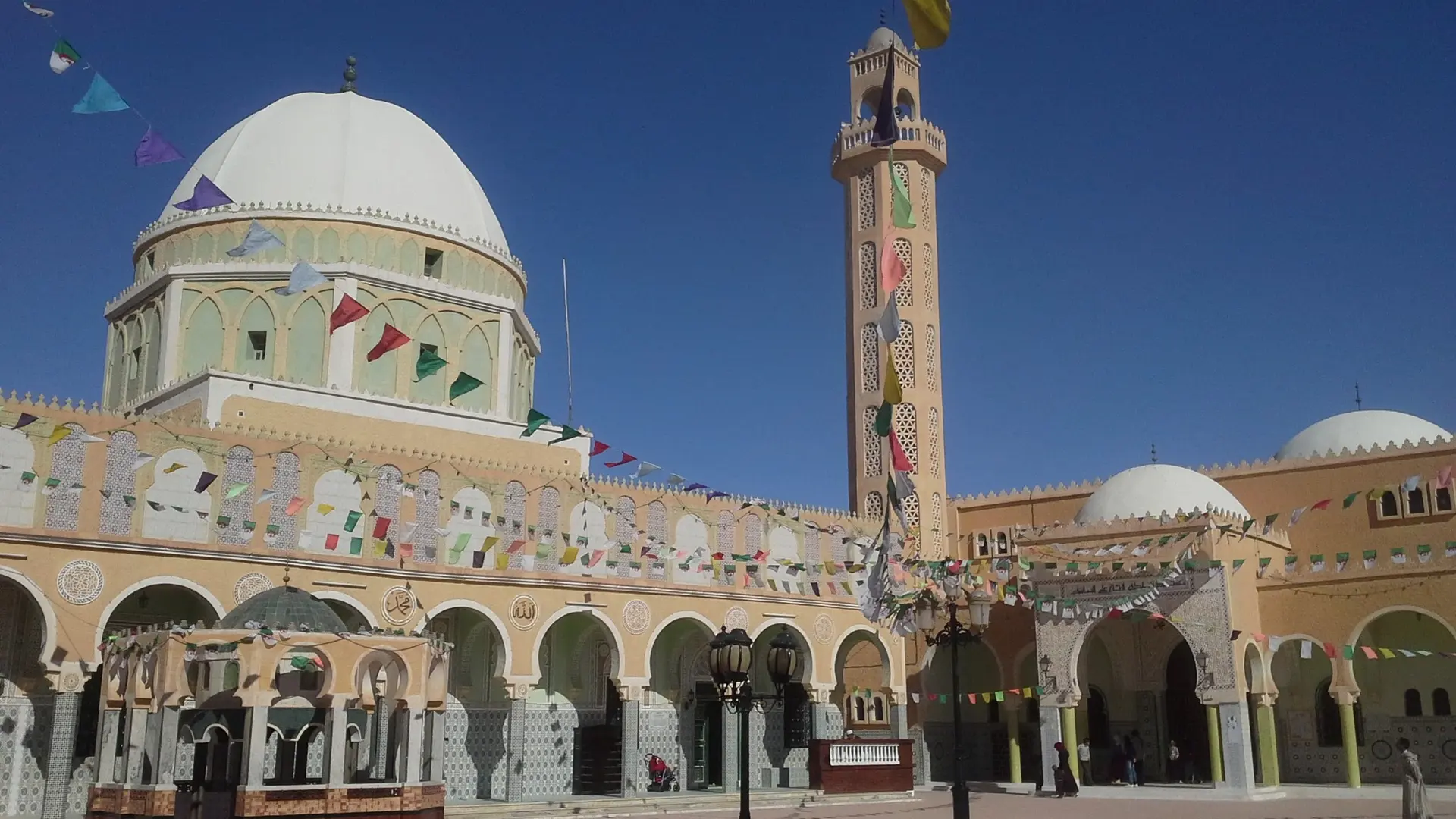
Zaouia Tidjania, Tamaxine, Algeria
Tamacine, Touggourt, Algeria
459.4 km away

Mausoleum (Zawiya) of Sidi Abdul-Salam Al-Asmar Al-Fituri, Zliten, Libya
Zliten, Misrata, Libya
547.1 km away
References
Sources consulted for this page. Source categories describe the publication, not a guarantee that every claim is verified. Traditional accounts and outside interpretations may differ.
- 01Old Town of Ghadamès — UNESCO World Heritage CentreofficialOfficial UNESCO documentation for World Heritage Site inscribed 1986
- 02Ghadames | Town, Architecture, & History — Encyclopaedia BritannicaencyclopediaAuthoritative reference on history and culture
- 03Ghadames — Archnet - Aga Khan Trust for CultureacademicScholarly architectural documentation
- 04Ghadames – Jewel in a Desert Necklace — American Society of Overseas Research (ASOR)academicArchaeological and heritage conservation analysis
- 05The Garamantes and the Origins of Saharan Trade — Cambridge University PressacademicScholarly analysis of trans-Saharan trade history
- 06Ghadames — Wikipedia contributorsencyclopediaComprehensive overview with historical and cultural details
- 07Ghadames (Ghudamis), Cydamus: the Pearl of The Libyan Sahara — TemehuguideDetailed cultural and historical information from Libyan heritage site
- 08Old Town of Ghadames (Libya) — African World Heritage SitesSource contextAfrican heritage perspective
- 09Atiq Mosque (Ghadames) — Wikipedia contributorsencyclopediaInformation on main mosque of Ghadamès
- 10Berber, Ghadames in Libya — Joshua ProjectSource contextInformation on Ghadamès Berber spiritual practices
- 11Ghadames Festival — ToursLibya.comguideInformation on annual cultural festival
- 12Travel to Libya's Saharan Capital, Ghadames — Uncharted BackpackerguideFirst-hand visitor experience and practical information
- 13How to Travel to Libya in 2025 — Against the CompassguideCurrent travel conditions and accessibility
Photo gallery
3 curated photos
Share a photo
Help visitors recognize Old Town of Ghadames, Libya. Every submission is reviewed before publication.