Tempio di Giunone
Part ofValle dei Templi
The highest temple on the ridge, where dawn light first touches the sacred landscape of Akragas
Understand sacred places, explore living traditions, and learn how to engage respectfully with Pilgrim Map.
Access has not been verified. Check current local guidance before planning a visit.
Agrigento, Agrigento, Italy
Read the sources
Visit essentials
A quick read before you go
- Duration
- 20-30 minutes at the temple; part of the 2-4 hour Valle dei Templi visit
- Access
- Eastern end of the Valle dei Templi, reached via the Via Sacra from the eastern entrance.
Overview
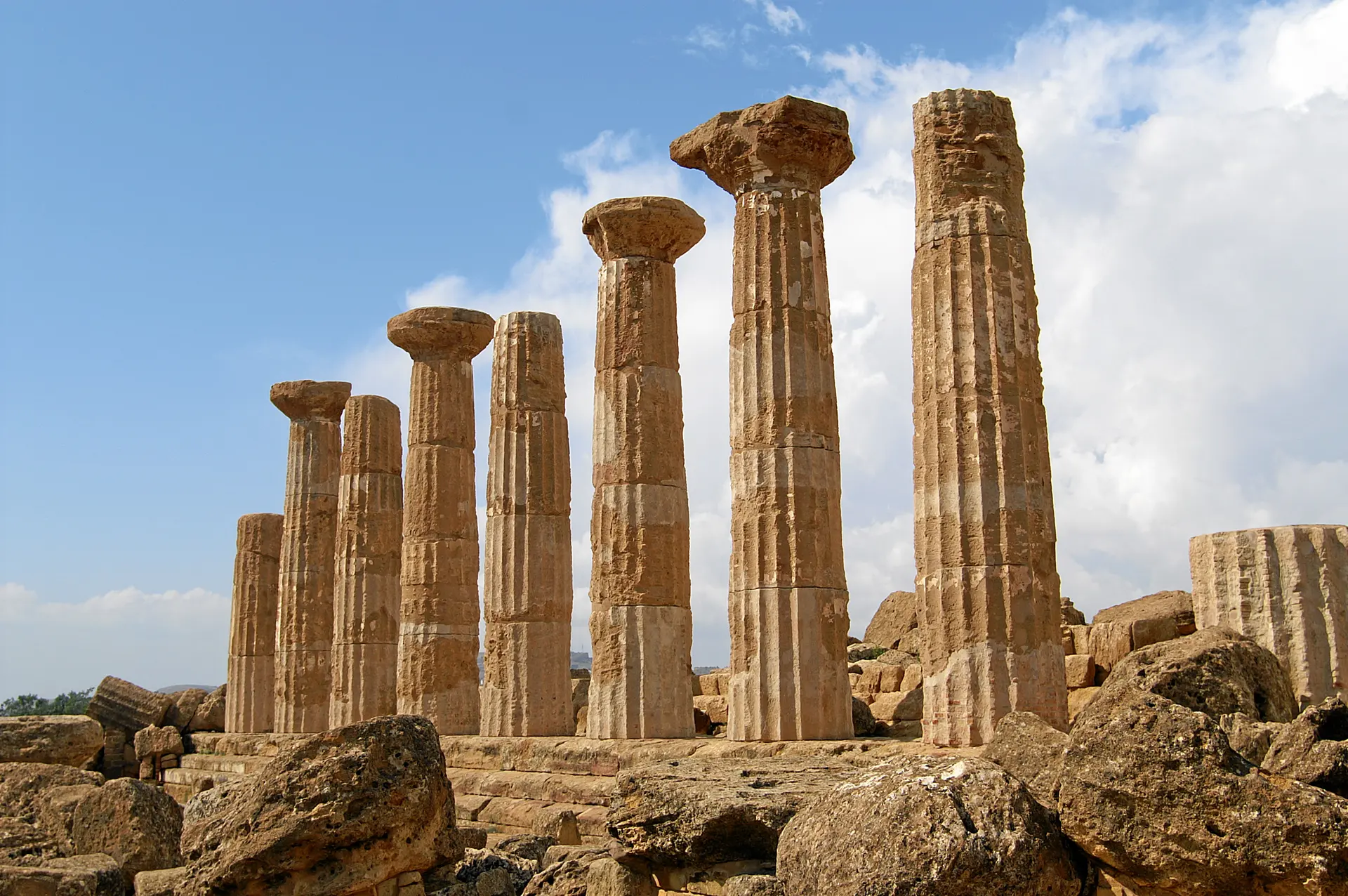
At the eastern summit of the Valle dei Templi, the Temple of Juno commands the highest elevation on the sacred ridge. Thirty of its original thirty-four columns still stand, creating a colonnade whose rhythm remains nearly complete after twenty-five centuries. Built around 450 BC in the Doric style, the temple rises from a high rectangular platform on four steps, its six-by-thirteen column arrangement typical of the mature Akragantine building tradition.
The conventional name — Temple of Juno, or Hera Lacinia — derives from a misreading of Pliny the Elder, who was actually describing a different temple near Crotone in Calabria. The true dedication of this building is unknown, though its prominent position suggests it honored a deity of primary importance. Whatever name the ancient worshippers spoke when they climbed to this summit has been lost along with their voices.
What has not been lost is the evidence of 406 BC. When the Carthaginian army took Akragas after a devastating siege, fire swept through the city. The Temple of Juno bears the marks of that burning — blackened stones that interrupt the golden calcarenite with patches of dark discoloration. These are not abstract historical references but physical traces of a specific day of destruction, inscribed in the stone by heat and smoke.
The Romans who later administered Sicily restored the temple, replacing the original terracotta roof with marble. An earthquake brought part of the structure down in the medieval period, leaving it in its current state: substantially present, partially collapsed, the fire damage still legible.
Why this place is sacred
The Temple of Juno occupies the threshold between earth and sky in the most literal way available to architecture: it sits at the highest point of a ridge that the ancient Greeks chose as their sacred boundary. Its position means it receives the first light of each day — a quality that may have determined its placement and its dedication, connecting whatever deity it honored to the daily renewal of the sun.
The fire marks from 406 BC add a temporal dimension to this spatial thinness: standing here, one is present both to the ongoing cycle of dawn and sunset and to a specific historical catastrophe inscribed in the stone. The thirty surviving columns maintain enough of the original colonnade to communicate its spatial rhythm — the regular pulse of solid and void that defined Greek sacred architecture.
Temple on the highest point of the Valle dei Templi ridge, dedicated to an unknown deity (conventionally identified as Hera). Its eastern position and elevation suggest a connection to sunrise and renewal.
Built c. 450 BC. Damaged by fire during Carthaginian siege of 406 BC. Restored during the Roman period with marble roof replacing terracotta. Partially collapsed in a medieval earthquake. UNESCO World Heritage inscription 1997.
Experience and orientation
The walk to the Temple of Juno follows the Via Sacra uphill from the park's eastern entrance. The path ascends through ancient olive groves, the temple revealing itself gradually as one climbs — first its outline against the sky, then the individual columns becoming distinct, finally the full colonnade opening to view.
Arriving at the platform, the elevation is immediately felt. The ridge drops away to the south toward the Mediterranean, and to the east where the ancient city extended beyond the sacred precinct. The thirty standing columns create a spatial envelope that, while open to the sky, defines an interior distinct from the surrounding landscape.
Walking within the colonnade, the rhythm of the columns — the alternation of stone and light, solid and void — produces a somatic response that precedes thought.
The fire marks are visible on close inspection: patches of darker stone where the calcarenite was discolored by the heat of 406 BC. These traces are most apparent on the interior surfaces, where the flames were most intense. Running a finger near (but not touching) these stones, one can sense the temperature difference that the ancient catastrophe left behind.
At sunset, the temple's position at the ridge's summit places it in the last light of the day. The calcarenite stone, already golden in neutral light, deepens to amber and then to a warm sienna as the sun descends. This daily transformation is one of the most observed phenomena at the Valle dei Templi.
Approach from the eastern entrance and walk uphill along the Via Sacra. The Temple of Juno is the first major temple encountered from this direction and the highest point on the ridge. Face west from the temple to look along the full extent of the Via Sacra toward the other temples. Face south for the Mediterranean view.
Context and lineage
The Temple of Juno was constructed around 450 BC, during the decades of prosperity that followed Theron's military victories and building program. Its placement at the highest point of the ridge gave it a commanding presence within the sacred landscape. The Carthaginian siege of 406 BC brought devastating destruction: the city's walls were breached, 16,000 citizens were killed, and fire swept through the temples. The Temple of Juno survived structurally but bears the marks of that conflagration to this day.
Roman restoration ensured continued cultic use for several additional centuries.
Part of the mid-5th century BC building program at Akragas that also produced the Temple of Concordia. The architectural style belongs to the mature Doric tradition, with proportions that reflect the classical refinements of the period.
Traditions and practice
Worshippers at this temple climbed to the highest point of the ridge to make their offerings — a physical ascent that mirrored the spiritual act of approaching the divine. Sacrifice, libation, and prayer were conducted within and before the colonnade. The Roman restoration, including a new marble roof, suggests continued cultic use for centuries after the Carthaginian destruction.
The temple is one of the principal landmarks of the Valle dei Templi UNESCO World Heritage Site. It serves as a common starting or ending point for visitors walking the ridge.
Arrive at the Temple of Juno in the late afternoon, when the western light brings out the warmth of the calcarenite. Sit on the ancient steps and face west along the ridge — the full sequence of temples stretching into the distance. Look for the fire marks on the interior stone surfaces: dark patches that make 406 BC a physical presence rather than an abstract date. At sunset, observe how the light transforms the stone from gold to amber.
Ancient Greek Religion - Unknown Deity (Conventionally Hera)
HistoricalThe temple at the highest point of the sacred ridge honored a deity of primary importance to Akragas. The conventional Hera attribution, though likely incorrect, has become embedded in the site's cultural identity.
Worship through sacrifice, libation, and prayer at the ridge's summit. Physical ascent as spiritual approach.
Perspectives and open questions
The Temple of Juno stands at the intersection of elevation, light, and historical catastrophe.
Scholarly perspective
The temple is an important example of mid-5th century BC Doric architecture. The conventional Hera/Juno Lacinia attribution derives from a misreading of Pliny the Elder who was actually describing a temple near Crotone in Calabria. The fire damage from 406 BC provides valuable archaeological evidence for the Carthaginian destruction. The Roman-period restoration, including the marble roof, documents continued use of the temple complex centuries after the Greek period.
Living and traditional perspectives
Whatever deity this temple honored, its placement at the ridge's summit expressed the ancient Greek conviction that proximity to the sky was proximity to the divine. The eastward orientation and elevation may connect to solar worship or to the daily renewal signified by dawn.
Alternative interpretations
The temple's alignment with sunrise has been interpreted in archaeoastronomical terms, though such interpretations remain speculative. The fire marks have been read by some as adding a dimension of sacrificial destruction to the temple's spiritual meaning.
Open questions
The true dedication of the temple remains unknown despite the conventional Hera attribution. The extent of Carthaginian damage and the scope of Roman restoration are still being studied through conservation work.
Plan your visit
Access and arrival
Eastern end of the Valle dei Templi, reached via the Via Sacra from the eastern entrance. Standard park admission.
Agrigento city center, approximately 3 km from the park
Respectful visit
Comfortable walking shoes for the uphill approach; sun protection
Permitted throughout
Not applicable
Do not touch the fire-damaged stones | Stay on designated paths | Do not climb the temple structure
The uphill walk from the entrance can be strenuous in summer heat. Bring water and sun protection.
Location
Map loads as you approach this section.
Pilgrim reflections
A portrait of encounter, not a score
Pilgrims describe what they felt, how present they could become, and whether the place would shape a journey. There are no stars and no ranking of traditions.
No reviewed reflections yet
The first pilgrims can help describe the character of being here.
Share a reflection
Available after an account-backed “Been there.” Every reflection is reviewed before publication.
Nearby sacred places
Explore other sacred places in the region. Proximity does not establish access or travel time; check each place’s guidance.


References
Sources consulted for this page. Source categories describe the publication, not a guarantee that every claim is verified. Traditional accounts and outside interpretations may differ.
- 01Temple of Hera - La Valle dei Templi — Parco Valle dei TempliofficialOfficial park description
- 02Temple of Juno Agrigento - Estia Restauro — Estia srlSource contextConservation and restoration details
- 03Temple of Hera, Agrigento - Wikipedia — Wikipedia contributorsencyclopediaComprehensive overview with architectural details
- 04Tempio di Era (Giunone) Lacinia - Agrigento Guide — Agrigento GuideguideDetailed visitor guide
Share a photo
Help visitors recognize Tempio di Giunone. Every submission is reviewed before publication.