Marlborough Mound
Europe's second-largest Neolithic mound rises within a school campus, bearing Merlin's legendary name
Understand sacred places, explore living traditions, and learn how to engage respectfully with Pilgrim Map.
Access has not been verified. Check current local guidance before planning a visit.
Marlborough, England, United Kingdom
Read the sources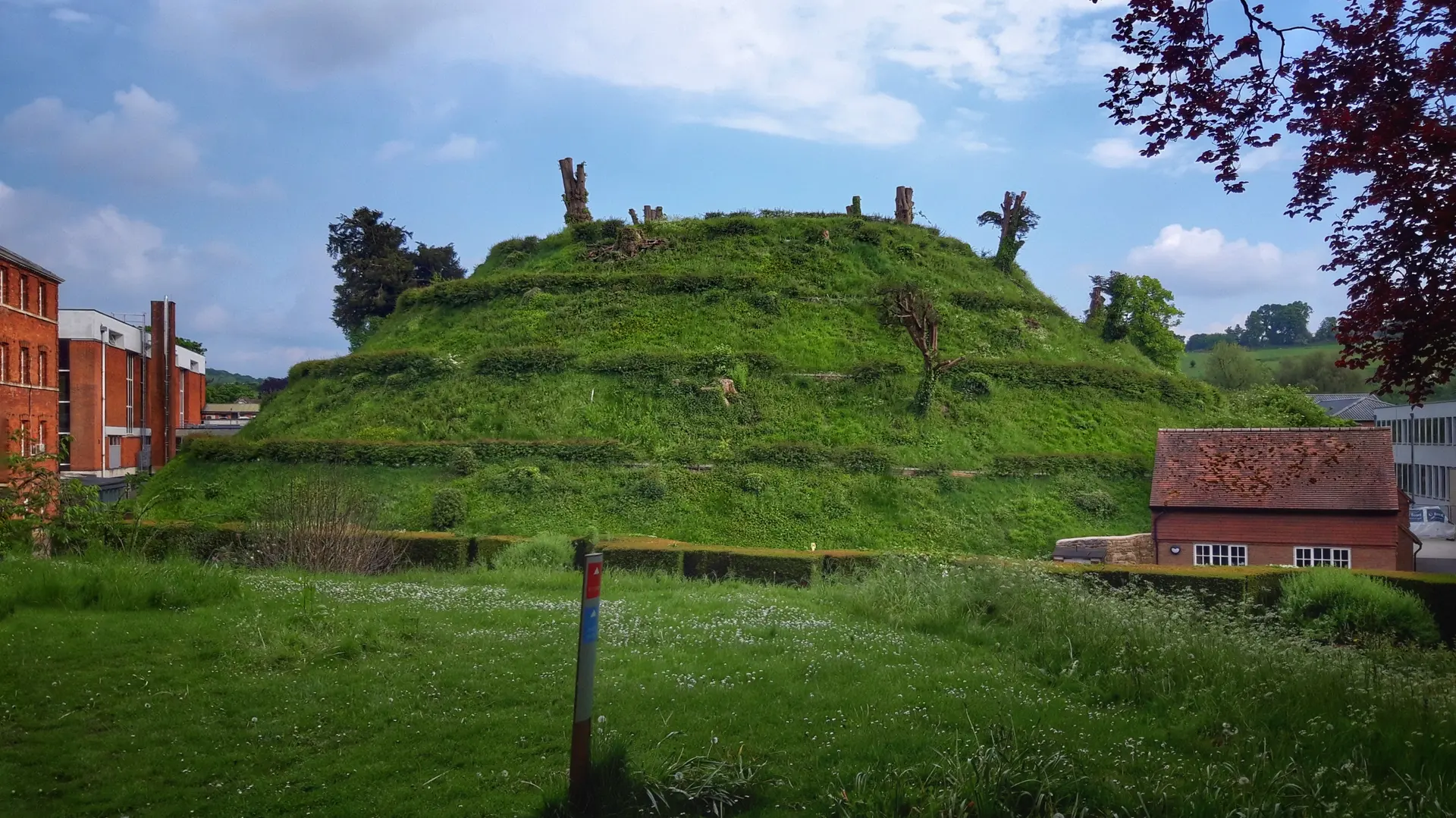
Image of Marlborough Mound. Image source · CC0
Visit essentials
A quick read before you go
- Duration
- Half day combining with Silbury Hill, Avebury, and West Kennet Long Barrow
- Etiquette
- Respect the restricted access.
Overview
Five miles from Silbury Hill, within one of England's elite boarding schools, Marlborough Mound rises 19 meters from an 83-meter base to a flat summit overlooking the Kennet valley. Its age remained uncertain until 2010, when radiocarbon dating of core samples showed construction began around 2400 BC, placing it in the Neolithic period alongside Silbury Hill, Avebury, and Stonehenge. It is Europe's second-largest prehistoric artificial hill.
Local legend calls the mound Merlin's burial place. Marlborough's motto, 'ubi nunc sapientis ossa Merlini,' means 'where now are the bones of the wise Merlin.' Though historically unfounded, the association reflects centuries of fascination. After the Norman Conquest, the mound became Marlborough Castle's motte, part of a royal residence where King John spent 135 nights; later it became a garden feature with spiral paths and grotto.
The Marlborough Mound Trust is restoring the monument toward its original form. Access is restricted on private school property, but annual Open Days offer rare opportunities to climb what Neolithic people built and medieval kings fortified.
Why this place is sacred
What makes a place feel charged with meaning? Perhaps it is the accumulation of human intention across time. Marlborough Mound holds four distinct layers of significance, each generation remaking the monument for their own purposes while acknowledging its power. The Neolithic builders created the original mound around 2400 BC, investing labor comparable to that which raised Silbury Hill five miles away.
We do not know what they intended, but the scale indicates something important: this was not a casual project but a sustained community effort spanning perhaps a century. A thousand years passed. Then the Normans arrived, saw a ready-made fortification platform, and built a castle on top. Kings stayed here; King John made it one of his favorite residences. The medieval period added new meaning to ancient mass.
After the castle fell into ruin, Georgian taste transformed the mound again: spiral paths wound to the summit, a grotto offered romantic contemplation. The Victorians added a water tower, practical infrastructure obscuring prehistoric form. Now the Marlborough Mound Trust works to reverse the later additions, returning the monument to something closer to its original silhouette. Each layer represents a different culture's attempt to claim and use this extraordinary mass of earth.
The original intent remains beyond recovery, but the layered history itself becomes the meaning.
Unknown for the Neolithic period. The mound was constructed in multiple stages over approximately a century, suggesting sustained ceremonial importance. Its position near the confluence of the River Kennet and within sight of Silbury Hill indicates deliberate placement within a significant landscape.
Neolithic construction c. 2400 BC. Norman castle motte 1067. Royal residence through 14th century. Georgian garden mount with spiral walk and grotto. Victorian water tower (now removed). Current restoration by Marlborough Mound Trust aims to reveal and preserve the original form.
Experience and orientation
Most seekers will first encounter Marlborough Mound from outside the college gates, glimpsing its tree-covered bulk rising above the campus. The scale is impressive even from this distance: 19 meters of human-constructed earth, older than the pyramids of Giza, tucked into an English market town. For those fortunate enough to secure tickets to the annual Open Day, the experience deepens. You enter through the college grounds, approach the mound's base, and begin to climb.
The path follows traces of Georgian landscaping, but your feet press earth that Neolithic hands shaped four millennia ago. At the summit, the flat platform offers views across the Kennet valley. Silbury Hill rises in the distance, visible reminder that this landscape once held multiple monuments of comparable ambition. You stand where Norman kings stood, where Georgian garden-walkers paused, where—perhaps—Neolithic priests conducted ceremonies whose content we cannot recover.
The restoration work now underway adds another layer: contemporary commitment to preserving what previous generations nearly obscured. The water tower is gone. The original form is re-emerging. Whether this constitutes reverence or archaeology or both depends on what you bring to the encounter.
The mound is within Marlborough College grounds, visible from the town but not publicly accessible except during organized events. The annual Open Day (typically May half-term) offers guided tours of the site. Tours are free but must be pre-booked; demand is high.
Context and lineage
Around 2400 BC, Neolithic communities began building a massive mound near the confluence of the River Kennet. The construction took approximately a century, proceeding in stages. When complete, it stood 19 meters high—the second-largest such monument in Europe, surpassed only by Silbury Hill five miles to the west. Why they built it, we do not know. The mound is part of a concentrated sacred landscape that includes Avebury Stone Circle and West Kennet Long Barrow.
Something drew Neolithic people to this region, and they marked it with monuments that still command attention four millennia later. Medieval legend claimed the mound as Merlin's burial place, giving Marlborough its name (from 'Merlin's barrow' according to folk etymology) and its motto. After the Norman Conquest, practicality trumped mystery: the mound became a castle motte for William the Conqueror's newly imposed order. The castle grew in importance until King John made it one of his favorite residences.
Later centuries transformed the ruin into garden ornament, then infrastructure site. Now restoration seeks to honor the original form.
Marlborough Mound belongs to the tradition of Neolithic monumental mound-building that includes Silbury Hill and similar monuments across Britain and Ireland. Its precise relationship to Silbury Hill remains unclear, but the contemporaneous dates suggest connected ceremonial purposes.
Merlin (legendary)
Roger of Salisbury
King John
Traditions and practice
Unknown for the Neolithic period. The mound's scale suggests significant ceremonial importance, but specific practices cannot be recovered. Medieval use was secular (royal castle). Georgian use was aesthetic (garden feature).
The Marlborough Mound Trust manages educational outreach including the annual Open Day (guided tours, typically May half-term), the Mound Lecture series exploring archaeological and historical topics, and publication of resources. The ongoing restoration work is itself a form of contemporary practice: honoring the monument by revealing its original form.
If you can attend the Open Day, approach the climb as pilgrimage through layers of time. Pause at the summit to contemplate the landscape: Silbury Hill visible to the west, the Kennet valley spreading below, the college buildings that now surround this ancient monument. If you cannot access the mound itself, the nearby Neolithic sites of Silbury Hill, Avebury, and West Kennet Long Barrow are publicly accessible and share the same prehistoric landscape.
Neolithic ceremonial monument
HistoricalBuilt c. 2400 BC, the mound represents massive community investment in ceremonial construction. It is the second-largest Neolithic mound in Europe, part of a concentrated sacred landscape.
Unknown. The scale suggests significant ceremonial importance, but specific practices cannot be recovered.
Arthurian/Merlin legend
HistoricalLocal legend claims the mound as Merlin's burial place, inspiring the town's name (from 'Merlin's barrow' according to folk etymology) and motto.
No active practices. The legend adds romantic dimension to the monument's significance.
Norman castle motte
HistoricalAfter 1067, the Normans repurposed the prehistoric mound as a castle fortification, recognizing its strategic value.
The castle served as royal residence and administrative center. King John made it one of his favorite residences.
Perspectives and open questions
Marlborough Mound occupies an unusual position: monumentally significant but largely hidden, ancient but recently dated, legendary but understudied.
Scholarly perspective
The 2010 radiocarbon dating revolutionized understanding of Marlborough Mound, confirming it as contemporary with Silbury Hill (c. 2400 BC) and establishing it as Europe's second-largest Neolithic mound. The site is part of a concentrated ceremonial landscape including Avebury, Silbury Hill, and West Kennet Long Barrow. Construction occurred in multiple phases over approximately a century. The original purpose is unknown, but historian Ronald Hutton has speculated it may have served as an oratorical platform or had ritual significance.
The multi-period history (Neolithic, Norman, Georgian) offers unusual opportunity to study how landscapes are reinterpreted across cultures.
Living and traditional perspectives
The Merlin legend, though historically unfounded, reflects medieval fascination with ancient monuments and the tendency to attribute them to legendary figures. The town motto 'ubi nunc sapientis ossa Merlini' memorializes this association. While Merlin was not buried here, the legend preserves a sense of the mound's mysterious importance.
Alternative interpretations
Some see the mound as part of a sacred landscape pattern connecting Silbury Hill, Avebury, and Stonehenge. The Merlin association appeals to those interested in Arthurian mysticism. The concentration of Neolithic monuments in this region suggests ancient understanding of landscape energy that alternative traditions seek to access. The mound's relative obscurity, hidden within school grounds, adds to its mystique.
Open questions
The original purpose of the mound remains its greatest mystery. Why did Neolithic people build two massive mounds within five miles of each other? What was the relationship between Marlborough Mound and Silbury Hill? What ceremonies took place at the summit? Why was this location chosen? The ongoing restoration may reveal new archaeological evidence, but the fundamental questions may never be answered.
Plan your visit
Access and arrival
Marlborough offers hotels, B&Bs, and inns in a charming market town setting. The town makes an excellent base for exploring the Neolithic landscape of northern Wiltshire.
Respectful visit
Appropriate outdoor footwear for climbing the mound.
Presumably permitted during tours; check with guides.
Not applicable.
No public access except during organized events. Pre-booked tickets required for Open Day. School security requirements must be respected.
The mound is not publicly accessible except during organized events. Do not attempt to enter Marlborough College grounds without permission. Book Open Day tickets well in advance; demand exceeds availability.
Current practical details
Address
Marlborough Mound, Marlborough SN8 1PA, UK
Hours, fees, and access can change — verify on the official source before you travel. Practical details last checked Jun 2026.
Location
Map loads as you approach this section.
Pilgrim reflections
A portrait of encounter, not a score
Pilgrims describe what they felt, how present they could become, and whether the place would shape a journey. There are no stars and no ranking of traditions.
No reviewed reflections yet
The first pilgrims can help describe the character of being here.
Share a reflection
Available after an account-backed “Been there.” Every reflection is reviewed before publication.
Nearby sacred places
Explore other sacred places in the region. Proximity does not establish access or travel time; check each place’s guidance.

References
Sources consulted for this page. Source categories describe the publication, not a guarantee that every claim is verified. Traditional accounts and outside interpretations may differ.
- 01The Marlborough Mound Trust — Marlborough Mound TrustSource contextTrust responsible for restoration and public access
- 02The Marlborough Mound — Marlborough CollegeacademicLandowner and partner in preservation
- 03Field survey of the Marlborough Mount — Historic EnglandofficialArchaeological survey
- 04Marlborough Mound — WikipediaencyclopediaWell-referenced article
- 05Marlborough Mound: A Neolithic Monument with a Rich History — The ArchaeologistacademicArchaeological overview
Share a photo
Help visitors recognize Marlborough Mound. Every submission is reviewed before publication.