Adam and Eve Stones, Avebury
Two ancient survivors of an avenue of stones, standing where the midwinter sun once rose over a cove
Understand sacred places, explore living traditions, and learn how to engage respectfully with Pilgrim Map.
Access has not been verified. Check current local guidance before planning a visit.
Beckhampton, England, United Kingdom
Read the sources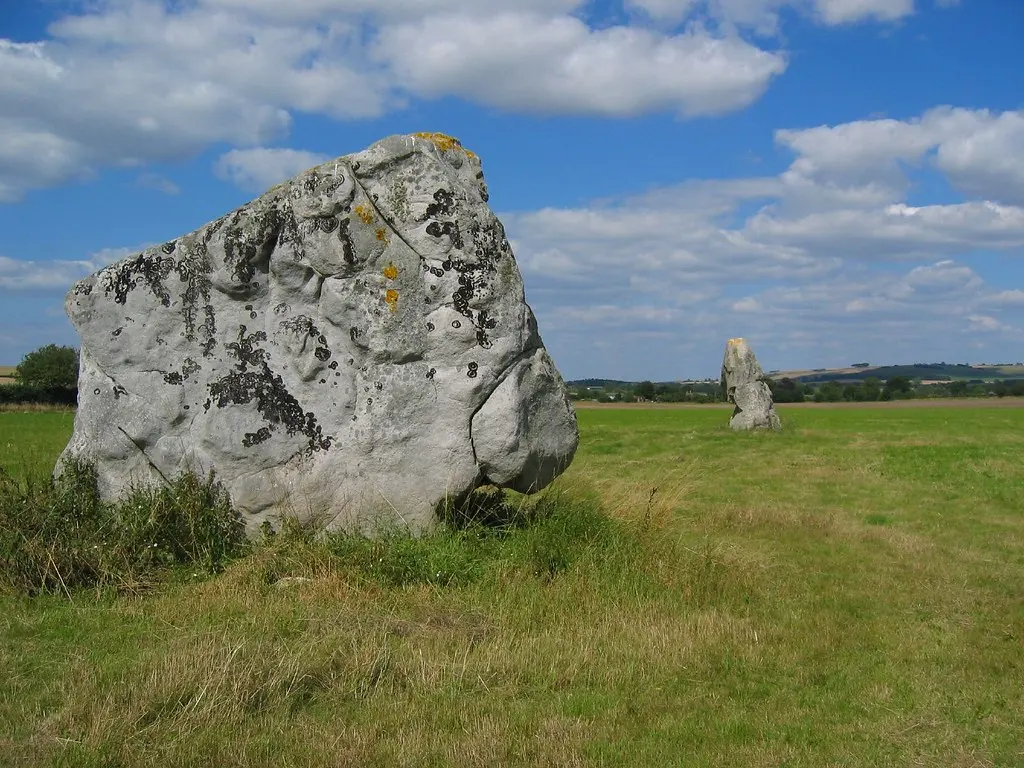
Image of Adam and Eve Stones, Avebury. Image source · CC-BY-NC-SA-2.0
Visit essentials
A quick read before you go
- Duration
- 1-2 hours including walk from/to Avebury
- Etiquette
- Free access.
Overview
A mile southwest of Avebury's better-known henge, avenue, and Silbury Hill, Adam and Eve stand beside a quiet farm track as the surviving western reach of the ceremonial landscape. Adam is a 62-ton shaped sarsen from a four-stone cove aligned to the midwinter sunrise. The more slender Eve anchored the Beckhampton Avenue, a processional route of paired stones linking the cove to Avebury's great circle.
These two megaliths alone survived the avenue's 18th-century destruction, bearing witness both to Neolithic ambition and to later carelessness. Their solitude makes the journey a quieter act of pilgrimage than most visitors to Avebury undertake.
Why this place is sacred
What creates the particular atmosphere of Adam and Eve? Perhaps it is the solitude. No visitor center interprets them. No café sells postcards. You walk down a farm track, enter a field through a gate, and there they are: two massive stones that have stood here for four and a half millennia. The absence of infrastructure forces encounter. You cannot hurry past these stones; there is nothing else here. Adam demands attention.
His 62 tons of sarsen represent hundreds of hours of quarrying, shaping, and hauling across Neolithic landscape. Someone invested enormous effort to place this stone precisely where the midwinter sun would rise above it. The three missing cove stones leave gaps in space and meaning that imagination must fill. Eve stands apart, marking what was once the start of an avenue traced by geophysics: paired stones leading eastward toward Avebury, most now buried or destroyed.
She survives as the avenue's western anchor, proof that what the geophysicists detect was once visible reality. Standing between these two stones, you occupy a space that Neolithic people knew: the terminus of a sacred route, the place where the year turned. The crowds at Avebury cannot offer this.
Adam was part of a four-stone cove aligned to the midwinter sunrise, marking the sun's rebirth at its lowest point. Eve was part of the Beckhampton Avenue connecting this cove to Avebury. Together they represent the western reach of the ceremonial landscape, a destination for processional movement.
The site was part of the Avebury complex built approximately 2650-2500 BC. An oval enclosure nearby dates to this period. In the 18th century, Richard Fowler destroyed most of the avenue for building stone. William Stukeley documented the destruction. Adam fell in 1911 and was re-erected by Maud Cunnington in 1912. Excavations in 1999-2000 by Mark Gillings and Josh Pollard confirmed the avenue's existence and the cove alignment.
Experience and orientation
You can reach Adam and Eve from Avebury by walking approximately a mile westward, or you can drive to Beckhampton and park near the field. Either approach brings you eventually to a gate with an information panel explaining the Beckhampton Avenue. You enter the field and there they are. Adam rises broad and massive, his surface weathered by four thousand winters. Eve stands nearby, more slender but equally ancient. The scale becomes apparent only when you approach.
Adam's 62 tons exceed many of the stones at Avebury itself; this is one of the largest megaliths in the region. Standing beside him, you feel the weight of intention. Someone decided that this stone, this massive sarsen, needed to stand in this precise spot. The midwinter sunrise alignment provides one answer: on the shortest day, standing where you stand, Neolithic people watched dawn break between four massive stones and knew the darkness would begin to retreat.
Three of those stones are gone now, but the alignment remains. Eve offers different meditation. She marks the start of the processional avenue leading toward Avebury. Walking that route today means walking over buried stones, imagining what Stukeley saw before the destruction. Eve alone stands visible, last witness to what was once a corridor of megaliths.
The stones are in Longstones Field, accessible via a gate with an information panel. Adam (the larger cove stone) stands closer to the road. Eve (the avenue stone) is nearby. Approaching from Avebury, you walk west on paths through the landscape. Approaching by car, parking is limited near the field entrance.
Context and lineage
Around 2650-2500 BC, as part of the expanding Avebury ceremonial landscape, Neolithic builders constructed a cove of four massive stones aligned to the midwinter sunrise. Nearby, they laid out the Beckhampton Avenue: paired stones creating a processional route westward from Avebury. This western reach of the complex extended sacred space beyond the great circle, creating a ritual landscape across the Wiltshire downs. For centuries the stones stood.
Then, in the 18th century, an innkeeper named Richard Fowler began breaking them up for building material. William Stukeley, the antiquarian who had documented so much of the Avebury landscape, watched helplessly as stone after stone fell to the sledgehammer. Only Adam and Eve survived. Adam fell in 1911 but was re-erected by archaeologist Maud Cunnington in 1912, set in concrete to ensure survival.
Nearly a century later, excavations confirmed what the survivors suggested: a cove aligned to the sun, an avenue leading to the heart of Avebury.
Adam and Eve are part of the Avebury ceremonial complex, which includes the great stone circle, West Kennet Avenue, Silbury Hill, West Kennet Long Barrow, and Windmill Hill. The Beckhampton Avenue complemented the West Kennet Avenue, creating two processional routes from Avebury.
Richard Fowler
William Stukeley
Maud Cunnington
Mark Gillings and Josh Pollard
Traditions and practice
Unknown specifically. The midwinter sunrise alignment suggests seasonal ceremonies marking the sun's rebirth. The avenue connection indicates processional movement between sacred sites.
Personal pilgrimage to these overlooked stones. Walking the landscape between the Longstones and Avebury, tracing ancient routes. Some gather at midwinter sunrise to mark the alignment. Photography and quiet contemplation. The stones appear in walking guides for those exploring the World Heritage landscape.
Walk from Avebury rather than driving, if possible. The journey across the landscape connects you to the processional route the Neolithic people knew. Spend time with each stone individually. Adam's massive bulk rewards contemplation; Eve's slenderness offers different meditation. If you can visit at midwinter sunrise, the alignment becomes visible. Otherwise, simply being present with these survivors is practice enough.
Neolithic ceremonial landscape
HistoricalThe stones formed part of the western reach of the Avebury complex. Adam's cove was aligned to midwinter sunrise. Eve marked the start of the Beckhampton Avenue processional route.
Unknown specifically. The midwinter alignment suggests ceremonies marking the sun's rebirth. The avenue indicates processional movement through sacred landscape.
Contemporary earth-based spirituality
ActiveThe stones attract pilgrims seeking connection with the prehistoric sacred landscape away from Avebury's crowds.
Personal pilgrimage, meditation at the stones, walking the landscape between monuments. Some mark the midwinter sunrise alignment.
Perspectives and open questions
Adam and Eve represent the overlooked western reach of the Avebury complex, survivors of 18th-century destruction that confirms the landscape's original extent.
Scholarly perspective
The 1999-2000 excavations by Mark Gillings and Josh Pollard confirmed the Beckhampton Avenue's existence, previously known mainly from Stukeley's records. They identified Adam as part of a four-stone cove aligned to midwinter sunrise and discovered an oval enclosure (140 by 110m) dating from 2650-2500 BC. The full extent of the Beckhampton Avenue remains unclear despite geophysical surveys. The Beaker burial found by Maud Cunnington near Adam indicates continued use into the Bronze Age.
Living and traditional perspectives
The names Adam and Eve represent folk attribution of gender to paired stones, a common pattern in British megalithic tradition. The larger, broader stone becomes male; the more slender female. This naming pattern appears at other stone pairs across Britain and Ireland.
Alternative interpretations
Some see the stones as part of the extended energy pattern of the Avebury complex. The midwinter sunrise alignment connects to solar worship traditions and marks the stones as a place of rebirth and renewal. The destruction of most of the avenue is mourned as loss of sacred landscape, with Adam and Eve as sacred survivors.
Open questions
The full extent of the Beckhampton Avenue remains to be discovered. The specific ceremonies conducted at the cove cannot be recovered. Why these two stones alone survived destruction when others fell to the sledgehammer is unclear. The relationship between the oval enclosure and the cove requires further investigation.
Plan your visit
Access and arrival
Avebury village offers limited B&B accommodation in atmospheric setting among the stones. Marlborough (5 miles) has more options. The area makes an excellent base for exploring the World Heritage landscape.
Respectful visit
Appropriate footwear for walking in fields, which can be muddy.
Freely permitted.
Small biodegradable offerings sometimes left. Nothing should damage the stones or litter the field.
The field is agricultural land. Close gates. Dogs under control.
The stones are in agricultural land. Close gates. Respect the farming environment. Dogs should be kept under control.
Current practical details
Address
C4FG+4M, Marlborough SN8 1QU, UK
Hours, fees, and access can change — verify on the official source before you travel. Practical details last checked Jun 2026.
Location
Map loads as you approach this section.
Pilgrim reflections
A portrait of encounter, not a score
Pilgrims describe what they felt, how present they could become, and whether the place would shape a journey. There are no stars and no ranking of traditions.
No reviewed reflections yet
The first pilgrims can help describe the character of being here.
Share a reflection
Available after an account-backed “Been there.” Every reflection is reviewed before publication.
Nearby sacred places
Explore other sacred places in the region. Proximity does not establish access or travel time; check each place’s guidance.

References
Sources consulted for this page. Source categories describe the publication, not a guarantee that every claim is verified. Traditional accounts and outside interpretations may differ.
- 01New Information Panel at Longstones, Avebury — Stonehenge & Avebury WHSofficialWorld Heritage Site information
- 02Avebury's other Avenue — Wiltshire and Swindon History CentreofficialArchaeological context
- 03The Longstones — WikipediaencyclopediaWell-referenced article
- 04Longstone Cove — The Megalithic PortalSource contextDetailed archaeological and visitor information
- 05Adam and Eve (The Longstones) — Atlas ObscuraguideVisitor-focused description
Share a photo
Help visitors recognize Adam and Eve Stones, Avebury. Every submission is reviewed before publication.