Marae Arahurahu
A restored valley temple where Tahiti's past is performed, not practiced
Understand sacred places, explore living traditions, and learn how to engage respectfully with Pilgrim Map.
Access has not been verified. Check current local guidance before planning a visit.
Paea, Tahiti, Society Islands, Windward Islands, French Polynesia
Read the sources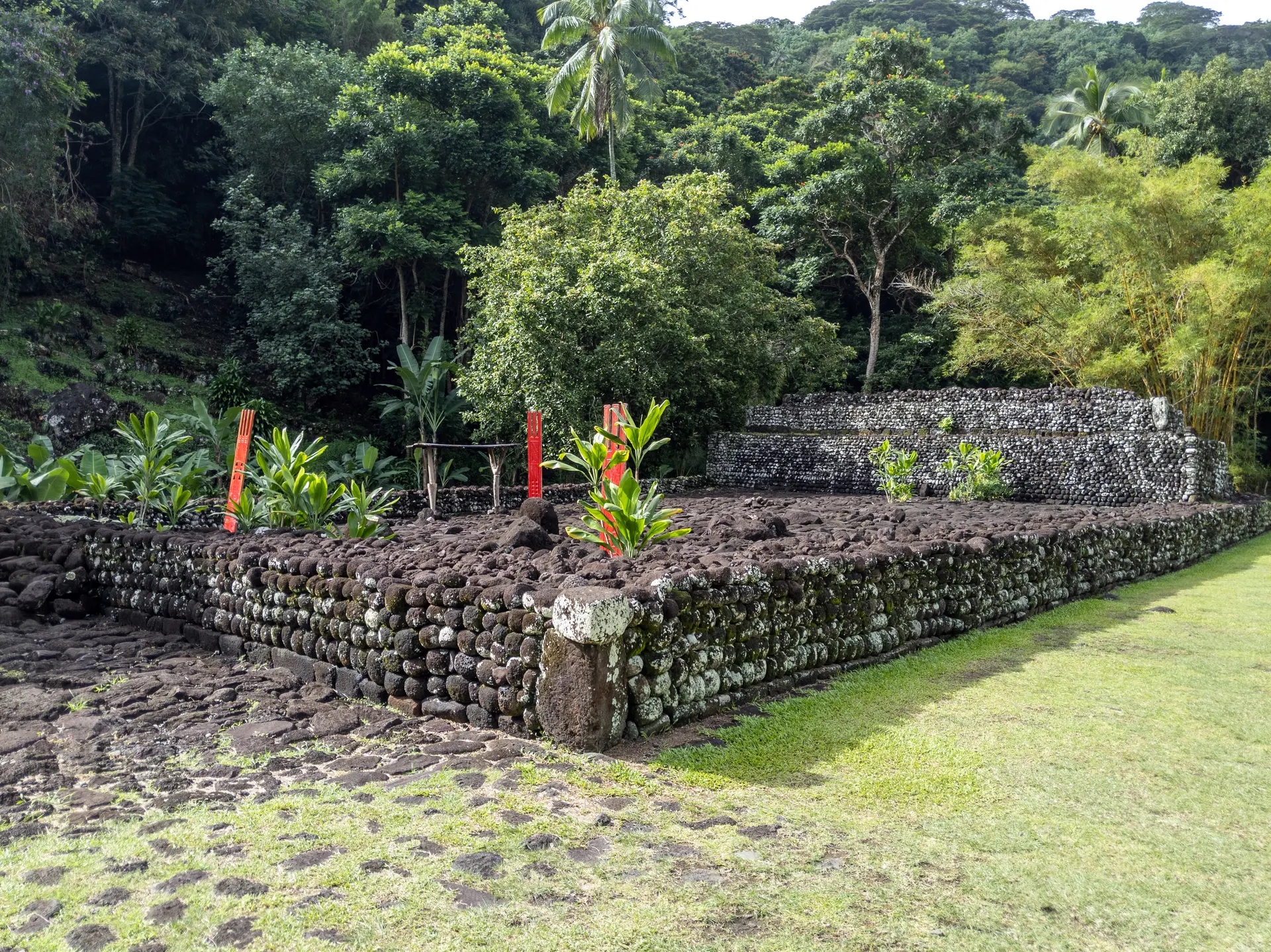
Image of Marae Arahurahu. Image source
Visit essentials
A quick read before you go
- Duration
- About thirty minutes for a general visit; Heiva performances run roughly seventy-five minutes.
- Access
- Located in the Tefa'aiti valley in Paea, on Tahiti's west coast, around PK 22.5 along the…
Overview
Arahurahu asks visitors to hold two truths without collapsing them. It was a working ceremonial complex for the ari'i, the chiefly lineage of the Tefa'aiti valley, where investiture, ancestor veneration, and the pa'iatua rite of dressing sacred divinity objects continued until Christian evangelization ended such practice in 1797. It is also now a stage: after restoration in 1953 and an inaugural reenactment in 1954, it began hosting an annual July Heiva i Tahiti production.
Named companies including O Tahiti E and the Conservatoire Artistique de Polynésie Française stage historical ceremonies for ticketed public audiences.
French Polynesia's cultural heritage authority calls the marae a 'symbol of renaissance': revival as memory-keeping and public education, explicitly distinguished by its operators from resumed religious worship. Outside festival season, it returns to what it has been for most of the past seven decades—a quiet, forested, basalt-paved clearing that rewards a slow half hour without demanding anything.
Why this place is sacred
No single deity is named in the sources as Arahurahu's specific dedicatee — a real gap in the record, not an omission of convenience, and one worth stating plainly rather than papering over with an invented god.
What the site did hold, consistently, was the weight of chiefly authority: this was where the Tefa'aiti valley's ari'i were invested, where ancestor and guardian-spirit figures (the carved unu) stood watch over the courtyard, and where the pa'iatua rite — the ceremonial dressing and undressing of sacred divinity objects, the To'o — was performed until the practice was set aside following evangelization.
That specific ceremony, revived in staged form by the troupe O Tahiti E in 2024, is described by the government's own cultural magazine in language that draws a firm line: the pa'iatua was considered malevolent by arriving missionaries and abandoned as a living rite in 1797, and its 2024 staging is described explicitly as revival for future generations, not a return to belief.
Arahurahu — known before its restoration by the older name Tu-Matamata-Hia — served the Tefa'aiti valley's chiefly lineage as a site for investiture, ancestor and guardian-spirit veneration, and the pa'iatua rite of ritually dressing sacred divinity objects.
Local legend holds the site's current name derives from a battle between two rival chiefs, after which a slain warrior's body was placed in an earth oven and, when uncovered days later, left only coals — arahu, coal in Tahitian — giving the marae its name at the victor's decree.
The pre-contact marae's religious use ended with the 1797 missionary-driven prohibition of indigenous rites. The site was classified a historic monument in 1952, restored beginning in November 1953 by the Société des Études Océaniennes following its documentation by archaeologist Kenneth Emory, and inaugurated in restored form on 31 July 1954 with a reenactment of chiefly consecration.
Since then it has anchored an annual, publicly ticketed Heiva i Tahiti performance each July — a fixture explicitly tied to the twentieth-century Polynesian cultural renaissance rather than to any claim of unbroken religious continuity.
Experience and orientation
For most of the year, the approach to Arahurahu is unremarkable in the best sense: a short walk into the Tefa'aiti valley, basalt stone underfoot, the tahua courtyard opening into forest shade, the ahu altar and carved unu figures standing as they have since restoration. Visitor accounts consistently describe this as an atmospheric rather than dramatic experience — thirty minutes is enough, and the quiet is the point.
In July, the same courtyard is transformed by the Conservatoire Artistique de Polynésie Française and troupes such as O Tahiti E into a ticketed performance venue: the 2024 staging of the pa'iatua rite involved roughly 140 performers across a four-tableau, seventy-five-minute production. Visitors on those nights are explicitly an audience, not participants — the distinction matters, and the site's own custodians are the ones insisting on it.
The marae sits in the Tefa'aiti valley in Paea, on Tahiti's west coast, structured around a tahua (courtyard), ahu (altar), patu (enclosure wall), and unu (carved guardian figures) — a textbook example of Society Islands marae architecture. Outside the July festival period it functions as an open-air heritage site; during Heiva, the same footprint becomes a staged performance ground with seating for a paying audience.
Context and lineage
Local legend recounts a battle at the site between the warriors of two rival kings, Tu-Mata-ira and Tutu-Ai-Aro, that lasted until sunset. A slain warrior's body, placed in a Tahitian earth oven under yellow ti leaves, was uncovered two days later to reveal only coals — arahu — and the victorious Tu-Mata-Ira decreed the marae would thereafter carry that name.
The precise pre-contact construction date of the marae itself is not established in available sources; only its twentieth-century classification and restoration dates are documented with certainty.
The marae's line of custodianship runs from its original Tefa'aiti valley ari'i, through the disruption of nineteenth-century missionization, to Emory's 1933 documentation, the Société des Études Océaniennes' 1953 restoration, and the present-day Direction de la Culture et du Patrimoine and Conservatoire Artistique de Polynésie Française, who together produce its annual staged reenactments.
Kenneth Emory
Archaeologist
American archaeologist whose 1933 survey, 'Stone Remains in the Society Islands,' is a foundational reference for the region's marae typology and is credited by heritage sources with documenting Arahurahu ahead of its restoration.
Marguerite Lai
Troupe leader
Leader of the O Tahiti E performing troupe, which staged the 2024 revival of the pa'iatua ceremony at Arahurahu as part of the annual Heiva i Tahiti production.
Société des Études Océaniennes
Restoring institution
The learned society credited with carrying out the physical 1953 restoration of the marae, reportedly with labor from a colonial infantry regiment, ahead of the site's 1954 inauguration.
Direction de la Culture et du Patrimoine
Contemporary custodial authority
The modern heritage authority stewarding the site today; its Hiro'a magazine is the clearest official source explicitly framing Arahurahu's contemporary ceremonies as revival and cultural memory-keeping rather than continuous religious practice.
Traditions and practice
Historically, Arahurahu hosted the investiture and consecration of an ari'i, communal assembly and veneration at the ahu, and the pa'iatua rite — the ceremonial dressing and undressing of sacred divinity objects known as To'o. These practices ended following the 1797 missionary-driven prohibition of indigenous religious rites, a rupture the record treats as definitive rather than gradual.
Each July, the Conservatoire Artistique de Polynésie Française (Te Fare 'Upa Rau) and troupes such as O Tahiti E stage a large-scale reenactment at the marae as part of Heiva i Tahiti. Themes rotate: the 1954 inaugural production reenacted an ari'i consecration; the 2024 production staged the pa'iatua rite across four tableaux with roughly 140 performers.
These are ticketed public spectacles, produced with government cultural-authority support, and are described by the Direction de la Culture et du Patrimoine's own magazine explicitly as preservation of memory for future generations — a deliberate act of cultural pride and continuity, not a claim of resumed devotion.
Outside festival dates, a visitor's best practice is simply unhurried attention: walk the tahua slowly, take in the ahu and the carved unu figures, and let the thirty minutes be enough. Visitors specifically drawn to the site's performance dimension should plan around the July Heiva calendar and treat the evening as attending a significant, carefully researched cultural production — buying a ticket and watching as an audience member, the way the site's own custodians frame the experience.
Ma'ohi (indigenous Tahitian/Polynesian) pre-contact religion
HistoricalArahurahu functioned as a central ceremonial complex for the Tefa'aiti valley's ari'i, hosting rites, assemblies, and consecrations connecting the community to ancestors and gods, ending with the 1797 missionary-driven prohibition of indigenous rites.
Chiefly investiture and consecration; communal ritual assembly at the tahua; veneration via the ahu and unu; the pa'iatua rite of ritually dressing and undressing sacred divinity objects, the To'o.
Polynesian cultural renaissance / heritage revival
ActiveSince its 1953 restoration and 1954 inauguration, Arahurahu has served as a symbolic anchor for Ma'ohi cultural identity and the mid-twentieth-century-onward Polynesian cultural renaissance.
Annual staged reenactments during Heiva i Tahiti, produced by O Tahiti E and the Conservatoire Artistique de Polynésie Française as ticketed public performances explicitly framed as cultural preservation and public education, not resumed religious worship.
Perspectives and open questions
Archaeology, French Polynesia's own cultural authorities, and the performing companies who stage its reenactments broadly agree on how to read Arahurahu — as a genuine historical religious site whose current ceremonial life is deliberate revival, not unbroken practice — leaving less interpretive disagreement here than at many marae sites.
Scholarly perspective
Archaeologists, building on Kenneth Emory's 1933 survey and later work refining Society Islands marae chronology and typology, treat Arahurahu as a well-preserved example of the region's religious architecture — tahua, ahu, patu, and unu — illustrating pre-contact Ma'ohi religious and social organization. Scholarly and official heritage sources agree that the site's religious function ended with nineteenth-century Christian missionization and that current ceremonial use is twentieth-century-onward restoration and cultural revival, not continuous practice.
Living and traditional perspectives
French Polynesia's own heritage authority, via its Hiro'a magazine, explicitly frames Arahurahu as a 'symbol of renaissance' — a touchstone for reclaiming and performing Ma'ohi identity within the broader Polynesian cultural renaissance, not a site of living unbroken worship. Performing groups such as O Tahiti E describe their purpose in staging productions like the 2024 pa'iatua reenactment as ensuring future generations do not forget these ceremonies — an act of cultural memory-keeping and pride, distinct from religious devotion.
Alternative interpretations
No distinct alternative or esoteric literature specific to Arahurahu was identified; broader 'portal between worlds' language applied to Polynesian marae generally is represented here as indigenous cosmological description rather than a separate esoteric interpretive tradition.
Open questions
The precise original construction date of the pre-contact marae, the specific deity or deities to whom Arahurahu itself — as opposed to Tahitian marae generally — was dedicated, and whether human or animal sacrifice occurred at this particular site, as documented at other Tahitian marae, remain unresolved in the sources gathered.
Plan your visit
Access and arrival
Located in the Tefa'aiti valley in Paea, on Tahiti's west coast, around PK 22.5 along the coastal road, roughly thirty to forty-five minutes by car or taxi from Papeete. Public transport is limited; private transport is recommended.
No specific on-site or Paea-area accommodations were documented in research; most visitors base in Papeete and visit as a day trip along Tahiti's west coast.
Respectful visit
No specific dress code is documented; general modest, respectful attire is advisable but not enforced.
No explicit photography restriction is documented; general respectful conduct is expected, particularly if any performance or rehearsal is underway.
No visitor offering tradition is documented at this site.
Do not touch the carved figures or climb on or move the stone structures; maintain quiet and treat the grounds as sacred to the Ma'ohi people, as tourism and heritage sources consistently describe them.
The Heiva performances are staged theater, not living ritual; visitors and content about the site should avoid describing the annual reenactment as a continuation of unbroken indigenous worship, since this would misrepresent both the historical record and how French Polynesia's own cultural authorities frame the site.
Location
Map loads as you approach this section.
Pilgrim reflections
A portrait of encounter, not a score
Pilgrims describe what they felt, how present they could become, and whether the place would shape a journey. There are no stars and no ranking of traditions.
No reviewed reflections yet
The first pilgrims can help describe the character of being here.
Share a reflection
Available after an account-backed “Been there.” Every reflection is reviewed before publication.
Nearby sacred places
Explore other sacred places in the region. Proximity does not establish access or travel time; check each place’s guidance.

Opunohu Marae Complex
Papetoai / Opunohu Valley, Moorea, Society Islands, Windward Islands, French Polynesia
38.8 km away

Maeva Archaeological Site
Maeva, Huahine, Society Islands, Leeward Islands, French Polynesia
190.6 km away
Marae Taputapuātea
Opoa, Raiatea, Society Islands, Leeward Islands, French Polynesia
219.2 km away

Arai-Te-Tonga Marae
Avarua / Ngatangiia, Rarotonga, Rarotonga, Cook Islands
1141.2 km away
References
Sources consulted for this page. Source categories describe the publication, not a guarantee that every claim is verified. Traditional accounts and outside interpretations may differ.
- 01Marae Arahurahu — Tahiti Tourisme — Tahiti Tourisme (official DMO of French Polynesia)officialOfficial tourism board source; confirms 1953 restoration, 1954 inauguration reenactment, structure (tahua/patu/ahu/unu), and framing as museum-like restored site.
- 02Marae Arahurahu (Paea) — Tahiti Tourisme (official French Polynesia government tourism site) — Tahiti TourismeofficialCorroborates structural details and annual reenactment tradition; ambiguous framing between staged performance and living significance.
- 03Marae Arahurahu de Paea — Tahiti Heritage — Tahiti Heritage (French Polynesian cultural heritage documentation site, cites Service de la Culture et du Patrimoine and K. Emory 1933)officialConfirms 1952 historic monument classification (decree 865, 23 June 1952), restoration credited to Service de la Culture et du Patrimoine, legend of renaming from Tu-Matamata-Hia. Cites Emory (1933) and photographer Pierre Lesage as sources — closest to an indigenous/official heritage-body source located.
- 04O Tahiti E fait revivre la cérémonie du pai'atua au Marae 'Ārahurahu (Hiro'a n°199, juillet 2024) — Direction de la Culture et du Patrimoine / service-public.pf (Hiro'a magazine, official DCP cultural publication)officialMOST IMPORTANT SOURCE for the reenactment-vs-tradition question. Explicitly states the pa'iatua ceremony was 'mise de côté suite à l'évangélisation' (set aside following evangelization) in 1797 and was considered malevolent by missionaries. Confirms this is a theatrical revival/staged production by the O Tahiti E troupe (led by Marguerite Lai) and the Conservatoire Artistique de Polynésie Française (CAPF/Te Fare 'Upa Rau), performed for ticketed public audiences, explicitly framed as preserving memory for future generations — NOT as continuous unbroken religious practice.
- 05Le groupe O Tahiti E invité au marae 'Ārahurahu — Heiva i Tahiti (official Heiva festival organizing body)officialDescribes the annual performances explicitly as 'spectacles produits sur le Marae' (spectacles produced at the marae) — ticketed public entertainment (2,000 CFP for adults), organized by the Conservatoire Artistique. Confirms staged-performance framing, not living ritual.
- 06Un symbole de renaissance : le marae Arahurahu — Hiro'a (official magazine of the Direction de la Culture et du Patrimoine, French Polynesia)officialTitle itself frames the marae as a 'symbol of renaissance' (cultural revival), not unbroken tradition. States the site was 'rediscovered' by archaeologist Kenneth Emory and restored by the Société des Études Océaniennes (SEO); explicitly ties the marae to 50 years of the Polynesian cultural renaissance movement. Accessed via search index (direct fetch failed due to DNS error) — content triangulated with search snippet plus corroborating secondary citations.
- 07Marae — Wikipedia — Wikipedia contributorsacademicGeneral marae typology and religious function context (portal between Po/Ao realms, human bones found at Taputapuatea during restoration, missionary destruction in 19th century, 1994 Taputapuatea restoration by Tahiti Museum archaeologists). Confirms Arahurahu is 'sometimes used as an outdoor theatre' post-restoration but has no dedicated section on Arahurahu itself.
- 08Marae Arahurahu — Practical Tahiti — Tahiti Pratique (local practical-information travel site)Source contextCorroborates 1953 restoration, 31 July 1954 inauguration date, structural description (tahua/patu/ahu/unu), and location (Tefa'aiti valley, PK 22.5). No mention of human/animal sacrifice at this specific site.
- 09Marae Arahurahu — Wondermondo — Wondermondo (geography/heritage travel reference site)Source contextCorroborating secondary source on restoration date and structure; used to cross-check facts, not sole support for any claim.
- 10Sacrifice humain sur un marae de Tahiti — Médiathèque Historique de Polynésie Française — Médiathèque Historique de Polynésie Française (French Polynesian historical media archive)academicDocuments historical human sacrifice practice at Tahitian marae generally (Captain Cook's 1777 account of a ceremony to the war god 'Oro on Tahiti's East coast, illustrated by John Webber) — establishes the historical practice existed on Tahiti but does NOT specifically confirm it occurred at Arahurahu. Used to support general historical_traditions context, not a site-specific sacrifice claim.
- 1128th April: Tahiti (Arahurahu Marae) — Murray Foote travel blog — Murray FooteSource contextIndependent travel account; used only for corroborating visitor-experience texture, not load-bearing facts.
Share a photo
Help visitors recognize Marae Arahurahu. Every submission is reviewed before publication.