Machuqolqa
Fourteen Inca terraces above the Urubamba where the practical work of storing food met the sacred work of sustaining an empire
Chinchero, Cusco, Peru
Plan this visit
Practical context before you go
30-60 minutes
A few minutes outside Chinchero on the road toward the Urubamba Valley. Accessible by taxi or as part of a Sacred Valley tour circuit. No separate entry fee documented. Altitude: approximately 3,850 m.
Standard archaeological site respect. The site is modest and unguarded — treat it accordingly.
At a glance
- Coordinates
- -13.3642, -72.0678
- Type
- Archaeological Site
- Suggested duration
- 30-60 minutes
- Access
- A few minutes outside Chinchero on the road toward the Urubamba Valley. Accessible by taxi or as part of a Sacred Valley tour circuit. No separate entry fee documented. Altitude: approximately 3,850 m.
Pilgrim tips
- Practical clothing; sun protection at altitude
- Permitted
- Altitude is 3,850 m — acclimatise before visiting. The site is briefly visited; no facilities available.
Overview
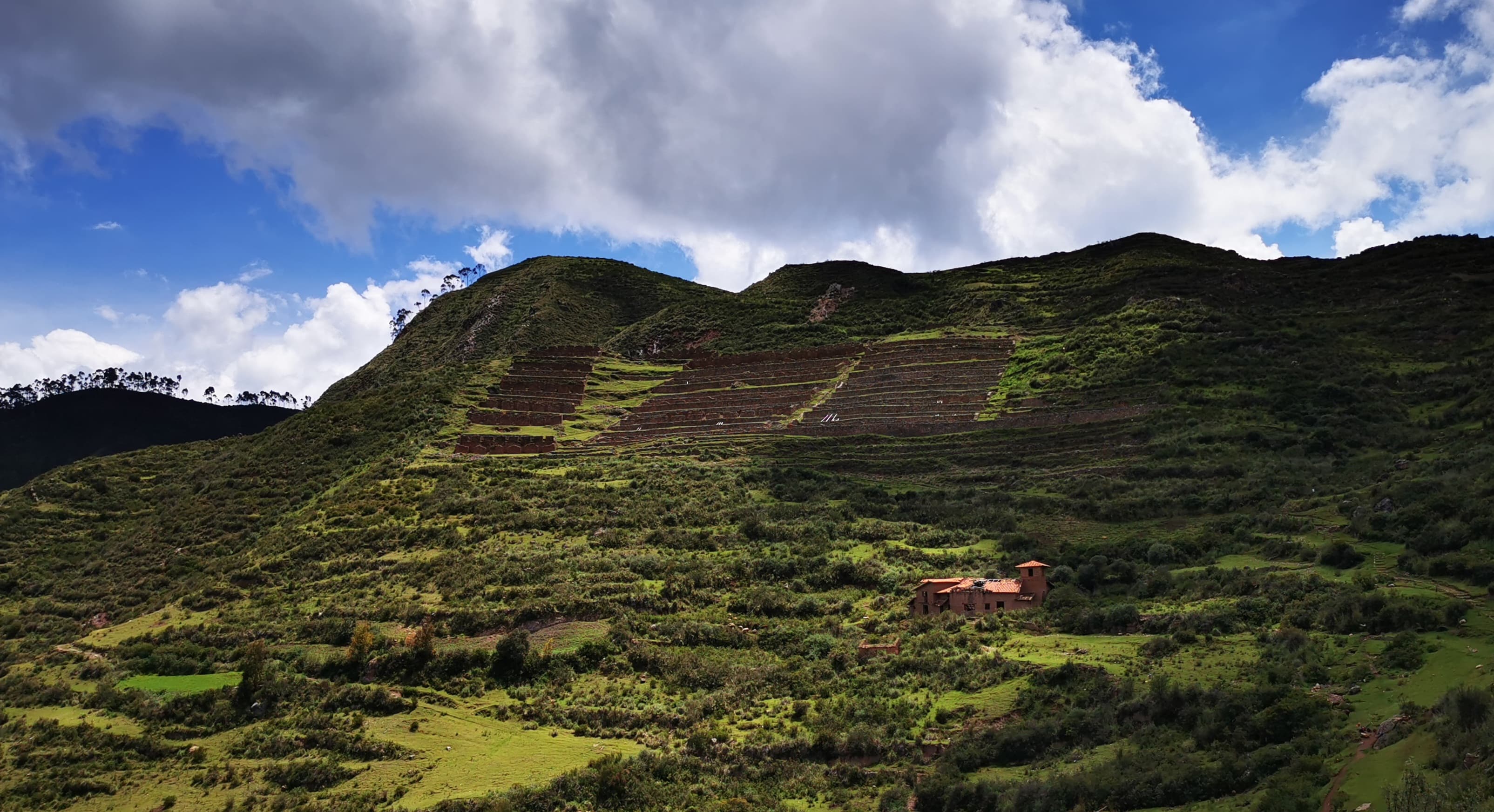
Machuqolqa — 'old storehouse' in Quechua — sits at 3,850 metres above the left bank of the Urubamba River, a few minutes from Chinchero. Its fourteen terraces and partial building foundations served the Inca state's vast redistribution network. In a culture where stored food carried spiritual as well as economic weight, this quiet site offers an encounter with a different kind of sacred: the practical holiness of provision.
The name is direct. Machu means old; qolqa means storehouse. This was a place where food was kept — positioned at altitude where cold winds preserved grains and tubers in stone-walled structures designed for the purpose. The Inca empire depended on thousands of such qolqas, strategically placed to feed armies, sustain populations during famine, and redistribute abundance across ecological zones.
Machuqolqa's fourteen terraces step down the hillside toward the Urubamba Valley, with the snow-capped peak of Chicón rising beyond. The partial building foundations suggest a domestic settlement alongside the storage function — people lived here while tending the stores. The site is modest by Sacred Valley standards, lacking the dramatic stonework of Ollantaytambo or the geometric precision of Moray. Its significance lies elsewhere.
In Inca cosmology, food storage was not a merely logistical concern. The Pleiades constellation was known as Qullqa — 'storehouse' — and its appearance governed the agricultural calendar. Abundance was a gift from Pachamama requiring reciprocity. The qolqa was where this cosmic transaction took material form: harvested abundance, held in stone, waiting to sustain the people through lean seasons. Machuqolqa is a place where the practical and the sacred were never separate.
Context and lineage
Machuqolqa was likely developed as part of Tupac Yupanqui's construction of the Chinchero royal estate in the late fifteenth century. The site's elevated position — where strong, constant winds favoured food preservation — was strategically chosen for the qolqa function.
Part of the Inca state infrastructure network, connected to the Chinchero royal estate. The site's function was economic and agricultural rather than primarily ceremonial, though these categories were not mutually exclusive in Inca thought.
Inca Tupac Yupanqui
Probable developer of the Chinchero area including Machuqolqa
Why this place is sacred
This is not a temple or a ceremonial platform. No known rituals were performed here, no astronomical alignments encoded in its walls. The thinness of Machuqolqa, such as it is, must be found in the Inca worldview that did not distinguish between the spiritual and the agricultural. The Pleiades were a storehouse in the sky. The qolqa on the hillside was a storehouse on the earth. The connection between them was not metaphorical but structural — the same word, the same concept, operating at different scales.
The view from the terraces — down into the green Urubamba Valley, up toward Chicón's glacier — places the visitor between the productive lowlands and the preserved heights. This too is a form of threshold, though one that speaks in the language of ecology rather than mysticism.
Agricultural production on the terraces and food storage in the qolqa structures, serving the broader Chinchero-Urubamba area within the Inca redistribution system. Likely associated with Tupac Yupanqui's development of the Chinchero royal estate.
The site's function ended with the collapse of the Inca state system. The terraces remain visible but unfarmed. Modern tourist infrastructure (handicraft shops, a zipline park) now occupies the adjacent area — a jarring juxtaposition that nonetheless illustrates how sites accumulate uses across time.
Traditions and practice
Agricultural production on terraces and food storage using altitude-driven preservation. Within the Inca state system, stored food was redistributed to populations across the empire according to need — a practice with both practical and cosmological dimensions.
No active ceremonial or agricultural practices at the site.
Walk the terraces with awareness that you are standing in a place where the Inca relationship between land, food, and cosmic order took physical form. The view toward Chicón — an apu in its own right — adds a dimension that the terraces alone do not announce.
Inca agricultural and storage system
HistoricalQolqas were vital to the Inca state's capacity to redistribute food across ecological zones and sustain populations during crisis. Their strategic placement at altitude reflected both practical engineering and cosmological understanding.
Terrace farming, food preservation through altitude and wind exposure, state-managed redistribution
Experience and perspectives
Machuqolqa is not a site that announces itself. The fourteen terraces descend the hillside in orderly steps, their retaining walls intact but their surfaces grassed over. Partial building foundations mark where storage structures and perhaps domestic quarters once stood. The adjacent parking area, lined with handicraft shops and a zipline operation, creates a strange threshold between the archaeological and the commercial.
Walk past the tourist infrastructure and onto the terraces themselves. The views open immediately — the Urubamba River valley below, the surrounding hills, and the glacier of Chicón to the north. The scale is modest, the atmosphere quiet. This is a site where the experience depends on what the visitor brings: an understanding that these terraces once held the food that kept an empire fed, and that the act of holding it was, in Inca thought, continuous with the movements of the stars.
Combine with a visit to nearby Chinchero for the fullest context. The terraces require no guide — walk among them and let the view toward Chicón do its work. The site is brief; thirty to sixty minutes is sufficient.
Machuqolqa asks the visitor to reconsider what counts as sacred — whether a storehouse can be a temple if the culture that built it saw no distinction between the two.
Machuqolqa is understood as part of the Inca qolqa network — strategically positioned storage facilities that served the empire's redistribution economy. The site's elevated position optimised wind-driven food preservation. Its association with the Chinchero royal estate places it within the infrastructure of Inca imperial management.
In Andean cosmology, stored abundance was not a human achievement but a reciprocal gift from Pachamama. The Pleiades constellation — Qullqa, storehouse — governed the agricultural calendar. The earthly qolqa and the celestial Qullqa mirrored each other: what the stars promised, the storehouses held.
No notable alternative interpretations have been proposed for this site.
Whether Machuqolqa served any ceremonial function beyond its storage and agricultural role is unknown. The full extent and phasing of the settlement remains poorly documented.
Visit planning
A few minutes outside Chinchero on the road toward the Urubamba Valley. Accessible by taxi or as part of a Sacred Valley tour circuit. No separate entry fee documented. Altitude: approximately 3,850 m.
Lodging available in Chinchero and throughout the Sacred Valley; Cusco is the primary base.
Standard archaeological site respect. The site is modest and unguarded — treat it accordingly.
Practical clothing; sun protection at altitude
Permitted
No formal protocol
Do not disturb archaeological structures or foundations | Do not remove stones
Plan your visit
Address
Jirón Grau 3314, Urubamba 08670, Peru
Hours, fees, and access can change — verify on the official source before you travel. Practical details last checked Jun 2026.
Nearby sacred places
Sacred places within a half-day’s reach. Pilgrims often visit them together: walk one, stay for the other.


References
Sources consulted when researching this page. Independent verification by readers is welcome.
- 01Machu Colca - Wikipedia — Wikipedia contributors
- 02Machu Colca - Atlas Obscura — Atlas Obscura
- 03Conoce Machuqolqa una aldea doméstica Inca — Cocatambo
- 04Qullqa - Wikipedia — Wikipedia contributors
- 05Chicón Peak and Machu Colca, Peru — Michael Stephen Wills Photography
Key questions
What pilgrims usually ask
- Why is Machuqolqa considered sacred?
- Machuqolqa's fourteen Inca terraces near Chinchero held the food that sustained an empire. A quiet Sacred Valley site where provision and the sacred met.
- What should I wear at Machuqolqa?
- Practical clothing; sun protection at altitude
- Can I take photos at Machuqolqa?
- Permitted
- How long should I spend at Machuqolqa?
- 30-60 minutes
- How do you visit Machuqolqa?
- A few minutes outside Chinchero on the road toward the Urubamba Valley. Accessible by taxi or as part of a Sacred Valley tour circuit. No separate entry fee documented. Altitude: approximately 3,850 m.
- What offerings are appropriate at Machuqolqa?
- No formal protocol
- What etiquette should visitors follow at Machuqolqa?
- Standard archaeological site respect. The site is modest and unguarded — treat it accordingly.
- What is the history of Machuqolqa?
- Machuqolqa was likely developed as part of Tupac Yupanqui's construction of the Chinchero royal estate in the late fifteenth century. The site's elevated position — where strong, constant winds favoured food preservation — was strategically chosen for the qolqa function.