Lisbon Cathedral
Lisbon's patriarchal cathedral, and the church where Camino pilgrims still gather to depart
Understand sacred places, explore living traditions, and learn how to engage respectfully with Pilgrim Map.
Access has not been verified. Check current local guidance before planning a visit.
Lisbon, Lisbon, Portugal
Read the sources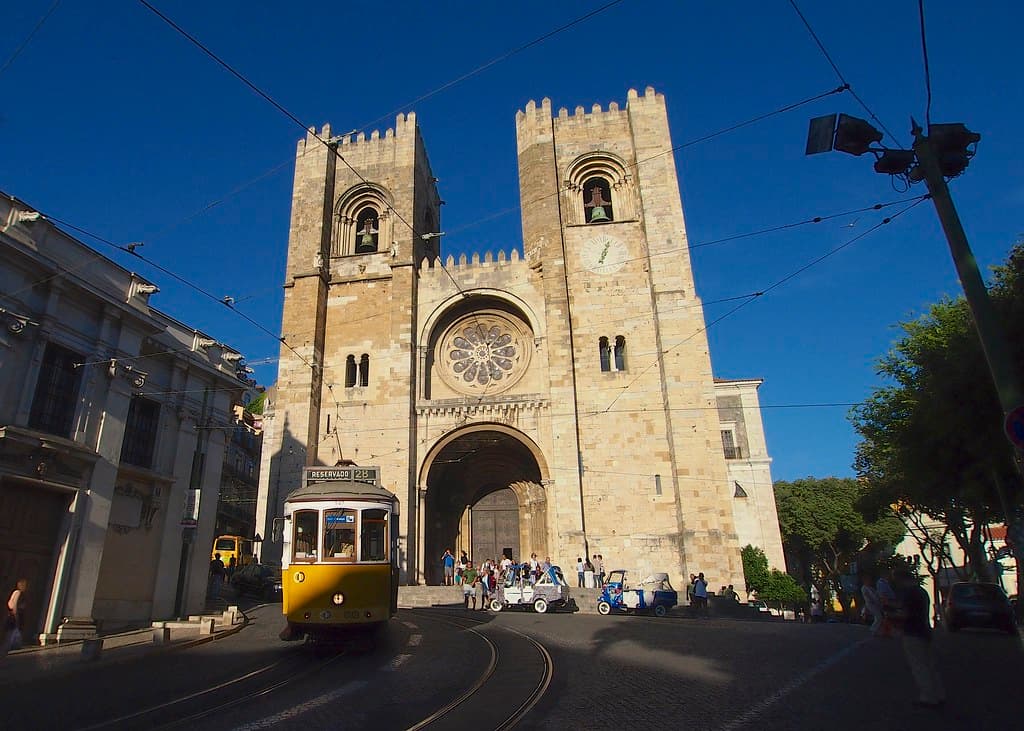
Image of Lisbon Cathedral. Image source
Visit essentials
A quick read before you go
- Duration
- Most visitors spend 45 to 90 minutes; longer visits are typical for those adding the Treasury…
- Access
- Located at Largo da Sé in the Alfama district, reachable on foot from Baixa and Praça do…
Overview
Lisbon Cathedral rises at Alfama's edge with the bearing of a siege structure. Founded in 1147 immediately after the Christian conquest of Lisbon, its twin towers and narrow windows preserve that defensive character while trams pass its door and tourists queue for the treasury.
Nine centuries of use matter more than stone alone. The working cathedral is Lisbon's patriarchal seat, with daily Mass and the relics of the city's patron saint in its treasury. It is also a departure church: walkers beginning the Portuguese Way gather before first light, credential in hand, seeking the first painted arrow.
These identities overlap. A building that has never stopped being a parish church became, through geography and habit, a pilgrimage threshold; visitors arriving for either purpose often encounter the other.
Why this place is sacred
Cloister excavations begun in 1990 have turned up a Roman road with shopfronts, a Visigothic-era church, and sections of wall from the Islamic period, all beneath the cathedral's Gothic deambulatory. That stack of prior use — Roman, Visigothic, Islamic, then Christian again — is what gives the site its particular density.
Popular telling collapses this into a tidier story: that the cathedral was raised directly on, or converted from, Lisbon's main mosque, a physical statement replacing Muslim worship with Christian in the same gesture. Scholars who have examined the record are more cautious.
The wall fragments confirm an Islamic-period structure existed nearby, but there is no clear evidence of an intact mosque repurposed in place — the Romanesque cathedral appears to have been newly built on or adjacent to the site rather than grown out of an existing building. The symbolic force of the conquest narrative and the physical record do not fully agree, and this account does not try to resolve that gap.
The fortress-like exterior adds a different kind of weight — not mystical but visibly defensive, raised by men who had just taken the city by force and were not yet certain they would keep it. The relics of Saint Vincent, brought to the treasury under circumstances remembered through legend rather than record, anchor a second, quieter gravity: a place entrusted with something precious and expected to keep guarding it.
Experience and orientation
Tram 28 passes close enough to the west front that it's often the first thing visitors notice framing the building, before they have even crossed the small square at Largo da Sé. The rose window above the main portal and the twin crenellated towers read, from the street, more like a keep than a church — an impression the builders seem to have intended.
Inside, the nave stays dim and plain by design: thick Romanesque piers, small high windows, an atmosphere closer to endurance than ornament. Moving toward the ambulatory and its Gothic chapels changes the register entirely — taller vaults, more light, a Baroque sacristy with its own separate mood. People who walk the building slowly tend to notice this shift more than any single decorative feature.
The cloister, when open, interrupts the architectural tour altogether. An active excavation trench sits within a working cathedral, Roman paving and Islamic-period wall stubs visible beneath a modern building still in daily liturgical use. Encountering an archaeological dig inside a functioning church, rather than beside it, is what most visitors mention afterward.
Arrive slowly if you can. The free prayer nave rewards simply sitting rather than moving straight toward the ticketed areas, and Mass times are posted at the entrance for those who would rather witness the building in use than as an exhibit. If a paid ticket is part of the plan, save the cloister for last — it reframes everything seen beforehand.
Context and lineage
The cathedral's founding is tied directly to the Siege of Lisbon in 1147, when Afonso Henriques took the city with the help of northern European crusaders en route to the Holy Land. Construction began that same year under Robert of Burgundy and Gilbert of Hastings — an English crusader installed as the city's first post-conquest bishop — with the Romanesque design attributed to Mestre Roberto.
The building grew in stages: a Gothic cloister followed under King Dinis in the late 13th century, then a Gothic royal pantheon chapel under Afonso IV, giving the cathedral a second role as a royal resting place. Earthquakes in 1344 and, far more severely, 1755 damaged the structure repeatedly, and much of what stands today reflects centuries of restoration over the original Romanesque core.
The see was elevated to patriarchal rank by papal bull in 1716, making the cathedral's bishop the Patriarch of Lisbon and giving the building its full current title, Sé Catedral Metropolitana Patriarcal de Santa Maria Maior de Lisboa. It was classified a National Monument of Portugal in 1910 and has not been separately inscribed as a UNESCO World Heritage Site, though it sits within the historic fabric of Alfama that draws heritage protection more broadly.
Afonso Henriques
founder
First king of Portugal, who ordered the cathedral's construction in 1147 immediately after leading the conquest of Lisbon from Almoravid rule.
Gilbert of Hastings
founder
English crusader installed as Lisbon's first post-conquest bishop, overseeing the cathedral's founding alongside Robert of Burgundy.
Mestre Roberto
builder
The master builder credited with the cathedral's original Late Romanesque design.
Saint Vincent of Saragossa
patron saint
Deacon-martyr of Zaragoza, died c. 304, patron saint of Lisbon. His relics are held in the cathedral treasury, and the legend of their raven-guided arrival by boat is depicted on the city's coat of arms.
King Dinis
patron
Portuguese king who commissioned the Gothic cloister in the late 13th century.
Traditions and practice
Historically the cathedral's Gothic pantheon chapel served as a royal burial site during the 13th and 14th centuries, and the treasury has long held the relics of Saint Vincent as an object of pilgrimage devotion in their own right, separate from any Camino route.
Mass and the sacraments continue on a regular schedule, as they have for centuries. The most visible annual event is Santo António Day, June 12 into the 13th, when the cathedral hosts community wedding ceremonies organized with Lisbon's city hall while the Procissão de Santo António moves through the surrounding Alfama streets.
Separately, walkers beginning the Portuguese Way commonly stop at the cathedral in the early morning to have their credencial stamped and to find the first yellow arrow near the façade before setting out on the roughly 610-kilometer route toward Santiago de Compostela.
If you are there to pray, come during a posted Mass and stay at the back of the nave rather than treating the service as a viewing. If you are there to begin walking, arrive early enough that the stamp and the quiet of the empty nave happen before the day's tour groups do — the two purposes share the same room but not the same hour.
Roman Catholicism
ActiveThe cathedral is the patriarchal seat of the Patriarchate of Lisbon and has served as the city's principal church since 1147, venerating the Virgin Mary as Santa Maria Maior and housing the relics of Saint Vincent of Saragossa, patron saint of Lisbon.
Regular Mass and sacraments; the annual Santo António Day community weddings on June 13, organized with the city; the Procissão de Santo António through Alfama; veneration of Saint Vincent's relics in the treasury.
Camino de Santiago (Portuguese Way) pilgrimage
ActiveThe cathedral functions as the traditional and practical starting point for pilgrims beginning the roughly 610-kilometer Portuguese Way from Lisbon to Santiago de Compostela, though some sources consider the nearby, often-closed Igreja de Santiago the technically designated waymarked start instead.
Pilgrim credential stamping at the cathedral; departure from in front of the Sé following the first yellow arrow northward toward Santarém, Coimbra, and Porto.
Perspectives and open questions
Two questions about the cathedral resist tidy answers, and both are worth holding open rather than resolving in either direction: what the building's relationship really was to the mosque it is popularly said to have replaced, and which church actually counts as the starting point of the Camino Portugués from Lisbon.
Scholarly perspective
Historians and archaeologists agree on the outline: founding in 1147 immediately after the conquest, a Late Romanesque design under Bishop Gilbert of Hastings and Robert of Burgundy, later Gothic expansion under Kings Dinis and Afonso IV.
Scholarship grows more careful on the conquest-narrative detail — excavations confirm Roman, Visigothic, and Islamic-period occupation of the site, but researchers caution against the popular shorthand of a mosque 'converted' directly into a cathedral, since the evidence points to new Romanesque construction on or near the site rather than a repurposed intact building.
Living and traditional perspectives
Within Portuguese Catholic memory, the cathedral's founding is read as the decisive religious seal on the Reconquista's triumph over Moorish rule in Lisbon, and the arrival of Saint Vincent's relics — guided, in the devotional telling, by ravens escorting the boat that carried them in 1173 — is remembered as a mark of divine favor on the newly Christian city, an image the city still carries on its coat of arms.
Open questions
Whether the builders incorporated an existing mosque structure or simply built anew on the same ground remains an open question in the archaeological record. Separately, and on a much smaller stake, sources differ on which building is the 'official' start of the Camino Portugués from Lisbon: some regard the cathedral as the practical starting point, where the first stamp and first arrow are found, while others hold that the technically designated start is the nearby Igreja de Santiago.
Plan your visit
Access and arrival
Located at Largo da Sé in the Alfama district, reachable on foot from Baixa and Praça do Comércio or via the historic Tram 28, which passes directly in front. The main nave prayer area is free; the High Choir, Treasury Museum, and cloister/deambulatory require a paid ticket.
Respectful visit
Modest dress is expected: shoulders and knees covered, hats removed on entry, and clothing with vulgar or offensive imagery avoided. This applies throughout the building, not only during services.
General photography is tolerated in most areas, but flash is prohibited. Treasury objects and sacred furnishings are for viewing only — not for touching or as props for photographs.
No specific offering practice is documented beyond the ordinary Catholic custom of lighting a votive candle; sources do not confirm further detail.
Food and drink are not permitted inside, phones should be silenced, and noise kept low. Some areas may close to visitors during active services, and the Treasury Museum and cloister/deambulatory require a paid ticket beyond the free prayer nave.
Confirm opening hours before relying on the cathedral for a pilgrim stamp early in the day; it closes to visitors on Sundays and Holy Days, which can disrupt a departure schedule if not checked in advance.
Location
Map loads as you approach this section.
Pilgrim reflections
A portrait of encounter, not a score
Pilgrims describe what they felt, how present they could become, and whether the place would shape a journey. There are no stars and no ranking of traditions.
No reviewed reflections yet
The first pilgrims can help describe the character of being here.
Share a reflection
Available after an account-backed “Been there.” Every reflection is reviewed before publication.
Nearby sacred places
Explore other sacred places in the region. Proximity does not establish access or travel time; check each place’s guidance.


References
Sources consulted for this page. Source categories describe the publication, not a guarantee that every claim is verified. Traditional accounts and outside interpretations may differ.
- 01Lisbon Cathedral — Wikipedia — Wikipedia contributorsacademicCore historical timeline: 1147 founding after siege, Romanesque construction, Gothic cloister, royal pantheon, 1755 earthquake damage, National Monument status since 1910, relics of St Vincent, archaeological findings.
- 02History – Sé de Lisboa — Sé de Lisboa (Cathedral/Patriarchate official site)officialOfficial cathedral site's own historical account of construction and later modifications.
- 03Building – Sé de Lisboa — Sé de Lisboa (Cathedral/Patriarchate official site)officialOfficial description of architecture, Romanesque design by Mestre Roberto, fortress-like exterior, rose window.
- 04Tickets – Sé de Lisboa — Sé de Lisboa (Cathedral/Patriarchate official site)officialOfficial visiting information: free prayer area in main nave vs. paid access to High Choir, Treasury Museum, cloister/deambulatory.
- 05Patriarchate of Lisbon — Wikipedia — Wikipedia contributorsacademicConfirms cathedral as archiepiscopal/patriarchal see; 1716 papal bull elevating the see to patriarchal rank.
- 06Vincent of Saragossa — Wikipedia — Wikipedia contributorsacademicBackground on St Vincent, deacon-martyr of Zaragoza (d. c.304), patron saint of Lisbon; raven-boat legend of relic translation depicted on Lisbon's coat of arms.
- 07Portuguese Way — Wikipedia — Wikipedia contributorsacademicConfirms Portuguese Way route length (~610 km from Lisbon vs ~260 km from Porto) and general route context for the Camino de Santiago.
- 08Lisbon Cathedral: What Lies Beneath — Church HeritageacademicCloister archaeological excavations since 1990 revealing Roman road/shops/kitchen/sewage system, Visigothic remains, and Islamic-period structures including a mosque wall section.
- 09The Official Starting Point of the Camino Portugués in Lisbon — Pilgrimage TravelerSource contextExplains the debate over which building is the technically 'official' start — some consider it Igreja de Santiago — versus the Cathedral as the practical/traditional starting point where pilgrims get credential stamps and find the first yellow arrow.
- 10Santo António Festival Lisbon 2026: dates, marches, and weddings — Idealista NewsSource contextDescribes June 12-13 Santo António festivities including mass weddings held at the Sé and the Procissão de Santo António passing by the cathedral in the Alfama district.
- 11Visit Lisbon Cathedral: Opening Hours, Location & Tips — Tickets LisbonSource contextSeasonal opening hours (Nov-May 10:00-18:00, Jun-Oct 09:30-19:00, Mon-Sat, closed Sundays/Holy Days), dress code and photography etiquette.
Share a photo
Help visitors recognize Lisbon Cathedral. Every submission is reviewed before publication.