Tenhola Castle Hill
A sand-ridge refuge fort in Finland's Häme signal chain
Understand sacred places, explore living traditions, and learn how to engage respectfully with Pilgrim Map.
Access has not been verified. Check current local guidance before planning a visit.
Hattula, Kanta-Häme, Finland
Read the sources
Visit essentials
A quick read before you go
- Duration
- Approximately 1 to 1.5 hours round trip: about a 1-kilometre walk from the parking area to the…
- Access
- The site is free, unstaffed, and open year-round with no booking or keyholder required — there…
Overview
Tenholan linnavuori is a bare, wind-scoured ridge above flooded lowlands that once formed Lake Vanajavesi's shoreline, in Hattula municipality in Finland's Kanta-Häme region. Baltic-Finnic communities of the Migration and Viking periods chose its narrow summit for sightlines to two sister hillforts: Rapola at Sääksmäki and Aulanko near Hämeenlinna. Together they could pass fire or smoke warnings faster than a messenger.
A wooden palisade with three narrow gates and earth-filled log-wall firing platforms made the ridge a last refuge during raids. Finds include pottery, iron slag, jewelry fragments, and a cannonball or early firearm shot dated no earlier than the 1400s, possibly linked to a Russian incursion into Häme in 1496. With no known cult, dedication, or origin myth, Tenhola's significance is historical: Iron Age and medieval defensive infrastructure surviving the threats and shoreline for which it was built.
Why this place is sacred
There is no thin place here in the usual sense — no reported threshold experience, no origin legend explaining why this particular ridge was chosen over another. What the site offers instead is a legible piece of defensive logic: stand at the crest and the reason for the location declares itself, because the same crest that gave refuge also gave sight.
The value of Tenholan linnavuori was always relational — it existed because Rapola and Aulanko existed, each hillfort a node in a signal network rather than a self-sufficient sacred center. That relational, functional character is itself worth sitting with: this is a landscape organized around visibility and warning, in an era when a smoke column seen at dusk could be the difference between a village prepared and a village taken by surprise.
A refuge and beacon/signal station within the Häme ancient hillfort chain, built for temporary defense and long-distance visual communication rather than permanent settlement.
Active from the Migration Period (c. 575-800 CE) through the Viking Age (800-1025 CE) and into the medieval period; a 15th/16th-century firearm-related find suggests intermittent relevance even after the original hillfort tradition had largely ended elsewhere in Häme. Since the water level of Vanajavesi has fallen over the centuries, the lake shoreline that once lapped closer to the ridge has receded, changing the site's relationship to the water it was built to watch over.
Today it survives as a legally protected national monument with a reconstructed section of palisade, interpretive signage, and a municipal hiking route.
Experience and orientation
Visitors reach Tenholan linnavuori by a signposted route from a small parking area on Tenholantie, walking roughly a kilometre through forest to a municipal campfire clearing at the foot of the ridge before the real climb begins. The ascent is short but abrupt — wooden steps have been added on the steepest pitches, and the descent on the northern side is steeper still, demanding sound footing rather than technical skill.
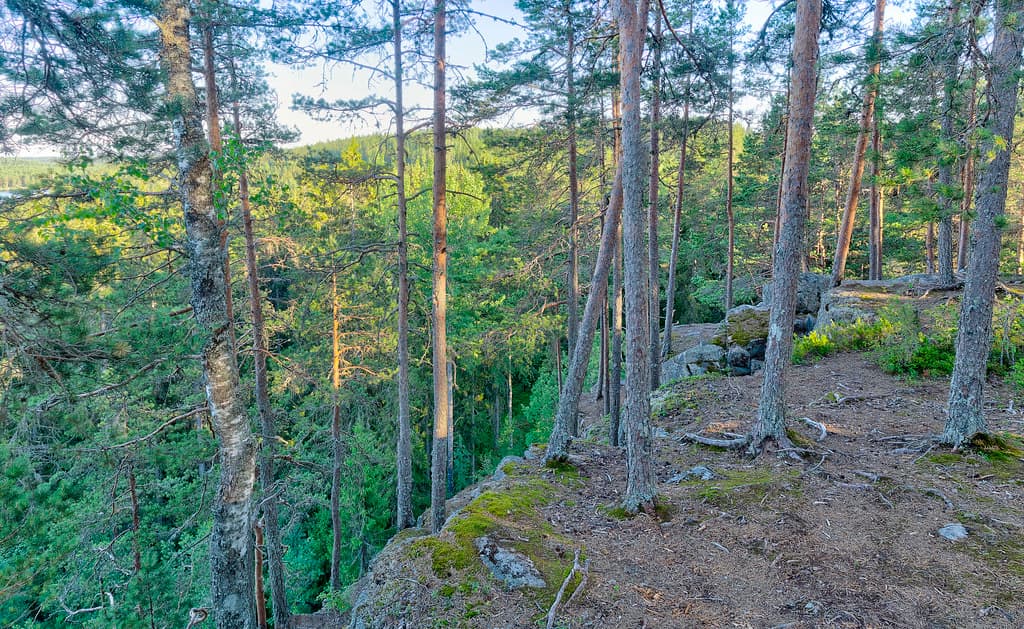
What opens up at the top is a bare, elongated summit, only sparsely treed, where the ground itself narrows to little more than a footpath's width in places. A reconstructed stretch of log palisade, pierced with narrow viewing and shooting slits, stands where the original defensive line once ran; looking through one of those slits toward the horizon is the closest the site offers to a felt sense of the year 800 rather than the year 2026.
On a clear day the promised sightlines to Rapola and Aulanko are, in principle, there to be picked out — though neither fort is signed or obviously identifiable to an untrained eye, and confirming the exact line of sight is more an exercise for a map than for the naked eye on a hazy afternoon.
Come for the climb and the historical logic of the place rather than for atmosphere or ritual: this is a site that rewards attention to sightlines, structure, and terrain more than it rewards silence or stillness.
Context and lineage
No foundational legend or origin myth is recorded for Tenholan linnavuori. Its story, as far as sources tell it, is archaeological rather than mythic: a fortified ridge built and periodically reinforced by Iron Age and medieval Häme communities as one link in a district-wide chain of refuge forts and signal stations, its site chosen for command of the surrounding lake basin rather than for any recorded sacred association.
Part of the Häme ancient hillfort chain, a network of Baltic-Finnic defensive sites in the Vanajavesi watershed that includes Rapola at Sääksmäki and Aulanko near Hämeenlinna; these three forts are understood to have functioned together as a coordinated visual-signal system rather than as independent strongholds.
Traditions and practice
The historical 'practice' of the site was entirely defensive and communicative: manning the palisade during a raid, or watching for and relaying a beacon signal from Rapola or Aulanko. No devotional ritual, offering practice, or seasonal ceremony is documented at any point in its use.
Present-day engagement with the site is heritage tourism and casual recreation — hiking, picnicking at the municipal campfire clearing, and reading the interpretive panels describing the fortification's history. The Finnish Heritage Agency's ongoing legal protection and Hattula municipality's trail maintenance constitute an active, if quiet, conservation-stewardship tradition.
Walk the summit slowly enough to notice where the ground narrows toward the old gate positions, and look outward through the reconstructed palisade's viewing slits before reading the signage — forming your own sense of what the builders could and couldn't see is more instructive than starting with the explanation.
Baltic-Finnic Iron Age and medieval hillfort tradition (Häme ancient hillfort chain)
HistoricalTenholan linnavuori was one link in a chain of Häme-region hillforts — with Rapola at Sääksmäki and Aulanko near Hämeenlinna — built for refuge and for relaying fire or smoke warnings across the Vanajavesi basin. Its significance lies in what it reveals about Iron Age and medieval settlement organization and regional defense in Baltic-Finnic Häme, not in any devotional or cultic practice.
Defensive occupation during raids, manning of the wooden palisade and its three gates, and participation in the visual signal chain with neighboring hillforts; no ritual observance is documented.
Archaeological research and heritage conservation stewardship
ActiveThe site's protection under Finland's 1963 Ancient Monuments Act, its status as a nationally significant archaeological site, and Hattula municipality's ongoing trail and signage maintenance constitute a living tradition of study and stewardship that continues long after the original defensive function ended.
Legal protection administered by Museovirasto (Finnish Heritage Agency), periodic excavation (most recently 1999 per the national registry), and municipal maintenance of the visitor trail, campfire area, fitness stairs, and reconstructed palisade.
Perspectives and open questions
Because Tenholan linnavuori carries no devotional tradition, its interpretive lenses are archaeological and historical rather than theological — the open questions concern dating, function, and the limits of what the physical evidence can tell us.
Scholarly perspective
Archaeologists place Tenholan linnavuori within the broader Häme hillfort network, active from the Migration Period through the Viking Age and into the Middle Ages, and interpret its remote, narrow, sand-ridge setting as suited to short-term refuge and visual signalling rather than permanent occupation.
Early comparative work by Hjalmar Appelgren linked its layout to the nearby Hakovuori (Linnanpää) hillfort at Vanaja, and the four documented excavation campaigns (1939, 1946-1948, 1985, 1999) have built up a material record of pottery, bone, iron slag, jewelry fragments, and stone structures without, on the evidence available, resolving every question about the site's building phases.
Living and traditional perspectives
No distinct folk-religious or indigenous tradition specific to this site survives in the record; local memory of the ridge centers on its practical identity as a lookout and beacon point within the Häme fort chain rather than on any mythic or devotional narrative.
Open questions
The precise circumstances of the 15th/16th-century cannonball or early firearm find — whether it reflects the 1496 Russian campaign into Häme or a separate, undocumented episode — remain unresolved, as does the full extent and relative dating of the stone structures uncovered on the summit across the four excavation campaigns.
Plan your visit
Access and arrival
The site is free, unstaffed, and open year-round with no booking or keyholder required — there is no gate, ticket office, or custodian to arrange access through. Parking is available at Tenholantie 1, 13720 Hattula, Finland, with signage marking the roughly 1-kilometre walking route to the hillfort. The final stretch of access road can become muddy and difficult for ordinary vehicles after heavy rain.
No specific mobile-phone-signal data for the summit was found in research; treat it as ordinary rural, forested Finnish terrain, carry a charged phone, and let someone know your route before setting out, since there is no on-site staff to assist. The nearest point of certain phone coverage and assistance is the Hattula municipality center; Finland's general emergency number is 112.
No seasonal closure is documented for the trail or monument itself, though winter ice and post-rain mud are treated above as practical access warnings rather than formal closures.
Respectful visit
No specific dress is required; sturdy footwear is strongly advised given the steep, sometimes muddy or icy ascent and descent.
Photography is unrestricted; no sources note any limitation.
Not applicable — the site has no devotional tradition and no custom of leaving offerings.
As a monument protected under Finland's 1963 Ancient Monuments Act, digging, metal-detecting, and removing stones, timber, or artifacts are prohibited. Visitors should keep to the marked trail and avoid climbing on or altering the reconstructed palisade and surviving stone structures.
The climb is steeper than its short length suggests, with hazardous footing in wet weather or winter ice; this is a physical caution rather than a ritual one, since no ceremonial restrictions apply.
Location
Map loads as you approach this section.
Pilgrim reflections
A portrait of encounter, not a score
Pilgrims describe what they felt, how present they could become, and whether the place would shape a journey. There are no stars and no ranking of traditions.
No reviewed reflections yet
The first pilgrims can help describe the character of being here.
Share a reflection
Available after an account-backed “Been there.” Every reflection is reviewed before publication.
Nearby sacred places
Explore other sacred places in the region. Proximity does not establish access or travel time; check each place’s guidance.


References
Sources consulted for this page. Source categories describe the publication, not a guarantee that every claim is verified. Traditional accounts and outside interpretations may differ.
- 01Tenholan linnavuori — Wikipedia — Wikipedia contributorsencyclopediaConfirms location in Hattula, Kanta-Häme; coordinates; dating to Migration/Viking/medieval periods; cannonball find possibly linked to 1496 Russian campaign; notes researcher Hjalmar Appelgren's comparison to Hakovuori.
- 02Tenholan linnavuori — Muinaisjäännösrekisteri (Finnish Heritage Agency ancient monuments register), ID 82010019 — Museovirasto (Finnish Heritage Agency)officialOfficial national registry entry: municipality Hattula, region Kanta-Häme, precise ETRS89/WGS84 coordinates 61°5'48.8730"N 24°17'14.7035"E, protection status under 1963 Ancient Monuments Act, nationally significant archaeological site (VARK), excavation years 1939/1946-1948/1985/1999, list of finds.
- 03Tenholan linnavuori — Hattula.fi visitor page — Hattula MunicipalityofficialMunicipal tourism page: address Tenholantie 1, 13720 Hattula; parking, ~1 km walking route, campfire site, fitness stairs, municipal contact info; no booking/keyholder requirement; no documented seasonal closure.
- 04Tenholan linnavuori — Häme-Wiki — Häme-Wiki contributorsencyclopediaRegional heritage wiki; dates finds to Merovingian era (575-800 AD) and Viking Age (800-1025); describes earth-filled log-wall shooting platforms and three gate locations (west, south, north).
- 05Tenhola hillfort — Wikidata — Wikidata contributorsencyclopediaStructured-data entry corroborating the site's identity and Hattula location; cross-referenced from Wikimedia Commons category 'Tenhola hill fort'.
- 06Tenholan muinaislinna, Hattula — Retkipaikka — Retkipaikka.figuideHiking guide: trail difficulty (steep, wooden steps), access road becomes muddy/impassable in wet weather, no freshwater on summit, recommends clear-weather visits for views.
- 07Tenholan Linnavuori — Visit Häme — Visit HämeguideRegional tourism board listing confirming Hattula location and Häme ancient hillfort chain context.
- 08Tenholan linnavuori, Hattula — Retkiseikkailu — Retkiseikkailu.comguideIndependent hiking blog; used only to corroborate access/route description already confirmed by higher-reliability sources.
Share a photo
Help visitors recognize Tenhola Castle Hill. Every submission is reviewed before publication.