Kata Tjuṯa
Where the domes hold law that is not for outsiders to know
Understand sacred places, explore living traditions, and learn how to engage respectfully with Pilgrim Map.
Access has not been verified. Check current local guidance before planning a visit.
Yulara / Mutitjulu, Northern Territory, Northern Territory, Australia
Read the sources
Visit essentials
A quick read before you go
- Duration
- The Valley of the Winds full circuit is 7.4 km and takes roughly three to four hours (Grade 4,…
- Access
- A paid Uluru-Kata Tjuṭa National Park Pass is required (approximately AUD $25 per adult or $65…
Overview
Forty kilometers west of Uluru, Kata Tjuṭa's thirty-six red-conglomerate domes rise from the central Australian desert. Its Pitjantjatjara name means 'many heads.' Geologists understand the rock as compressed alluvial-fan deposits laid down over 500 million years ago, then tilted and uplifted through a mountain-building period lasting tens of millions of years.
Anangu Traditional Owners understand the same landscape through Tjukurpa—the law, religious philosophy, and creation narrative binding Pitjantjatjara and Yankunytjatjara people to this country—and as shaped by ancestral beings during creation.
Unlike Uluru stories that Traditional Owners have chosen to share at least partly, Kata Tjuṭa is a significant men's ceremonial site. Its Tjukurpa and even the connected ancestral beings' identities remain restricted to initiated Anangu men. This is an actively maintained boundary, not missing information, and visitors walking the trails are asked to uphold it with the same seriousness as Traditional Owners.
Why this place is sacred
What official Anangu and joint-management sources emphasize about Kata Tjuṭa is continuity, not memory. The domes are not treated as a monument to a creation event that happened and ended; Tjukurpa is described as law that the ancestral beings established and that continues to bind and govern the land and its custodians in the present tense. This distinction matters to how the site is understood as thin.
It is not that visitors sense an echo of something long past — traditional owners hold that the ancestral presence embedded in the rock during the creation period never receded, and that ceremonial responsibilities tied to that presence continue to be exercised today. Parks Australia's own framing follows this: Tjukurpa is 'not a historical account, not mythology' but a body of law and knowledge that keeps functioning.
For outsiders, the thinness of Kata Tjuṭa is therefore encountered obliquely — through scale, silence, and the visible seriousness with which its traditional custodians treat the site — rather than through any story told to visitors about what specifically happened here. That obliqueness is itself part of what the site asks of a visitor: an experience of sacredness that does not require, and is not owed, full explanation.
Kata Tjuṭa's original and ongoing purpose, per the traditional owners, is as ceremonial country under Anangu men's law — a role distinct from Uluru's more varied and partially shared Tjukurpa. Its purpose was never primarily geological or scenic in Anangu understanding, though its formation over 500+ million years is well documented separately by earth science.
European explorer Ernest Giles named the formation 'Mount Olga' in 1872; the site was declared part of Ayers Rock National Park in 1958, and title was formally handed back to Anangu traditional owners on 26 October 1985, with the land then leased to the Australian Government for 99 years under joint management.
Since the 1990s, Central Land Council reporting notes ceremonial activity has continued and strengthened under joint management, and a 2020s lease renegotiation explicitly reinforced protections for sacred sites, songlines, and cultural intellectual property connected to the park.
Experience and orientation
The two walking routes open to the public shape almost everyone's experience of Kata Tjuṭa. The Valley of the Winds is a 7.4-kilometer circuit, graded difficult for its steep and rocky sections, that threads between the domes to two lookout points; many visitors walk only as far as the first lookout, Karu, and return, while the full circuit takes three to four hours.
Walpa Gorge, at 2.6 kilometers, is a gentler walk along a corridor between two of the tallest domes, where wind is funneled and concentrated — the gorge's name is often translated as relating to this wind effect, and visitors consistently describe a shift in temperature and sound as they enter it.
Photography is restricted for most of the Valley of the Winds route: signage and traditional owners ask visitors not to photograph or film this section, since it passes through culturally sensitive men's ceremonial country, with the Karingana lookout set aside as the one point where photography is explicitly permitted.
This restriction shapes the experience rather than diminishing it — many visitors report that walking without a camera changes how closely they attend to the domes, the light, and the sound of wind moving through the gaps between them.
Extreme heat governs access for much of the year: the Valley of the Winds closes at the first lookout from 11am whenever the forecast or actual temperature reaches 36°C or higher, a safety measure that during the hotter months (October to March) can significantly shorten what's possible in a single visit.
Arrive early. Both walks are best begun at or before sunrise, both for the cooler temperatures and for the way early light strikes the domes' red conglomerate face. Water, sun protection, and sturdy footwear are essential; there is no shade for much of the Valley of the Winds route, and no water available on either trail.
Context and lineage
Anangu traditional owners hold that ancestral beings shaped Kata Tjuṭa's domes and valleys during the Tjukurpa creation period. Per Parks Australia's explicit guidance, the specific identities of these ancestral beings and the narratives describing their actions are restricted to initiated men and are not disclosed to the public — a boundary this account maintains rather than works around.
Some general encyclopedic sources reference a named ancestral figure associated with the site, but this conflicts with the joint-management authority's position that such identities are too sensitive to reveal, and this account follows the traditional-owner position rather than the secondary claim.
Governance runs through the Uluru-Kata Tjuṭa Board of Management, on which Anangu traditional owners hold the majority of seats, working jointly with Parks Australia. The Central Land Council represents traditional owners in matters such as the 2020s lease renegotiation, which reinforced protections for sacred sites, songlines, and cultural intellectual property across the park.
Ernest Giles
European namer
English-born explorer who named the formation 'Mount Olga' in 1872 after Queen Olga of Württemberg, during an era of European exploration that gave many Anangu sites new external names.
Anangu Traditional Owners (Pitjantjatjara and Yankunytjatjara peoples)
custodians and ceremonial law-holders
The collective traditional owners of Uluru-Kata Tjuṭa National Park, who hold and exercise Tjukurpa law, received formal title back to the land in 1985, and govern the park through an Anangu-majority Board of Management.
Traditions and practice
Central Land Council and Parks Australia sources confirm that ceremonies connected to men's law have continued at Kata Tjuṭa, noted as ongoing since at least the mid-1990s under joint management. What those ceremonies involve, and the ancestral narratives that underlie them, are restricted to initiated Anangu men and are not part of the public record — a restriction stated plainly by the traditional owners themselves rather than a gap in outside research.
Anangu women may gather plant and animal resources in limited zones, away from men's ceremonial areas and only when men's business is not underway.
Traditional owners exercise ongoing custodial responsibility through the Board of Management and through ranger programs, and the 2020s lease renegotiation strengthened formal protections for songs, dances, stories, and other cultural knowledge tied to the park.
Visitors are not invited to participate in ceremonial practice at Kata Tjuṭa. What is offered instead is walking the Valley of the Winds or Walpa Gorge attentively and without recording devices where asked, treating the silence and scale of the domes as the extent of what's meant to be shared, and, for those wanting fuller context, visiting the Cultural Centre near Uluru, where some Tjukurpa content — though not Kata Tjuṭa's specifically — is presented with traditional owner involvement.
Anangu Tjukurpa (Pitjantjatjara and Yankunytjatjara traditional law, religion, and philosophy)
ActiveTjukurpa is the foundational law, knowledge system, and religious philosophy binding Anangu to the land, encompassing creation narratives, moral law, and land-management responsibility; Kata Tjuṭa is understood as shaped by ancestral beings whose creative actions during this period remain embedded in the landscape and continue to govern conduct today.
Ongoing ceremonial use restricted to initiated Anangu men; specific ceremonial content, songs, and ancestral-being narratives are not disclosed publicly. Anangu women may gather plant and animal resources in limited zones away from men's ceremonial areas.
Perspectives and open questions
Kata Tjuṭa is read through at least two distinct and, by design, incompletely reconcilable lenses: the geological account of its formation, and the Anangu traditional understanding of it as active ceremonial law — the second of which is deliberately withheld in its specifics from the first.
Scholarly perspective
Geologists describe Kata Tjuṭa's conglomerate domes as having formed from alluvial fan deposits within the Amadeus Basin more than 500 million years ago, later uplifted and tilted roughly 15 to 20 degrees during the Alice Springs Orogeny, a mountain-building period spanning roughly 400 to 300 million years ago. Academically, the site is also treated as a significant case study in Indigenous co-management and post-colonial heritage governance, particularly in scholarship examining the 1985 handback and its aftermath.
Living and traditional perspectives
Anangu traditional owners hold that Kata Tjuṭa was shaped by ancestral beings during the Tjukurpa creation period and that the site continues to carry binding law and ceremonial significance today, specifically as men's ceremonial country. The content of that law — the ancestral beings' identities, the associated narratives — is restricted to initiated men and deliberately not shared with outsiders; this is an active, ongoing choice by traditional owners, not a silence to be filled in by others.
Alternative interpretations
Some tourism-oriented and general-reference sources name a specific ancestral or serpent-being associated with Kata Tjuṭa. This account treats such claims as unverified and does not repeat them, since they conflict with the explicit position of the joint-management authority and traditional owners that such identities are restricted knowledge not intended for public disclosure.
Open questions
The specific content of Kata Tjuṭa's Tjukurpa — the ancestral beings connected to it, the ceremonial narratives, and the body of men's law tied to the site — is not meant to be resolved or known by outsiders. This is best understood not as a gap in the historical record but as an intentional, ongoing act of protection by the people whose law it is.
Plan your visit
Access and arrival
A paid Uluru-Kata Tjuṭa National Park Pass is required (approximately AUD $25 per adult or $65 per family, valid three days with unlimited re-entry; children under 18 free), purchasable online or at the park entry station. The park sits in the Northern Territory, roughly 360 km southwest of Alice Springs, with Kata Tjuṭa about 40 km west of Uluru within the same park boundary.
Accommodation is concentrated at Yulara (the Ayers Rock Resort township), roughly 50 km from Kata Tjuṭa, ranging from camping to luxury lodging; no accommodation exists within the park itself.
Respectful visit
No dress code is formally mandated beyond practical sun protection — a hat, sun-safe clothing, and sturdy walking shoes suited to steep, rocky terrain, particularly for the Valley of the Winds circuit.
Photography and filming are requested not to occur along most of the Valley of the Winds walk, since the route passes through culturally sensitive men's ceremonial country; the Karingana lookout is the one point along that route where photography is explicitly permitted. General photography elsewhere on marked trails, including Walpa Gorge, is permitted unless specific signage states otherwise.
No traditional-owner-sanctioned practice of visitor offerings exists at this site; visitors are not invited to leave objects, markings, or tokens anywhere at Kata Tjuṭa.
Visitors must remain on the two marked trails (Valley of the Winds and Walpa Gorge); off-track walking and climbing on the domes are discouraged and restricted by park management. Access to cultural knowledge about the site — including the identities of associated ancestral beings — is restricted under Tjukurpa to initiated Anangu men and is not disclosed to visitors under any circumstance.
The Valley of the Winds closes at the first lookout from 11am whenever temperatures reach or are forecast to reach 36°C, for visitor safety.
Do not attempt to access areas beyond marked trails, do not photograph or film along the Valley of the Winds except at the designated Karingana lookout, and do not ask Anangu guides or rangers to describe restricted ceremonial content — the request itself, however well-intentioned, asks someone to break their own law.
Location
Map loads as you approach this section.
Pilgrim reflections
A portrait of encounter, not a score
Pilgrims describe what they felt, how present they could become, and whether the place would shape a journey. There are no stars and no ranking of traditions.
No reviewed reflections yet
The first pilgrims can help describe the character of being here.
Share a reflection
Available after an account-backed “Been there.” Every reflection is reviewed before publication.
Nearby sacred places
Explore other sacred places in the region. Proximity does not establish access or travel time; check each place’s guidance.

Ayers Rock (Uluru)
Macdonnell Region, Northern Territory, Australia
30.2 km away
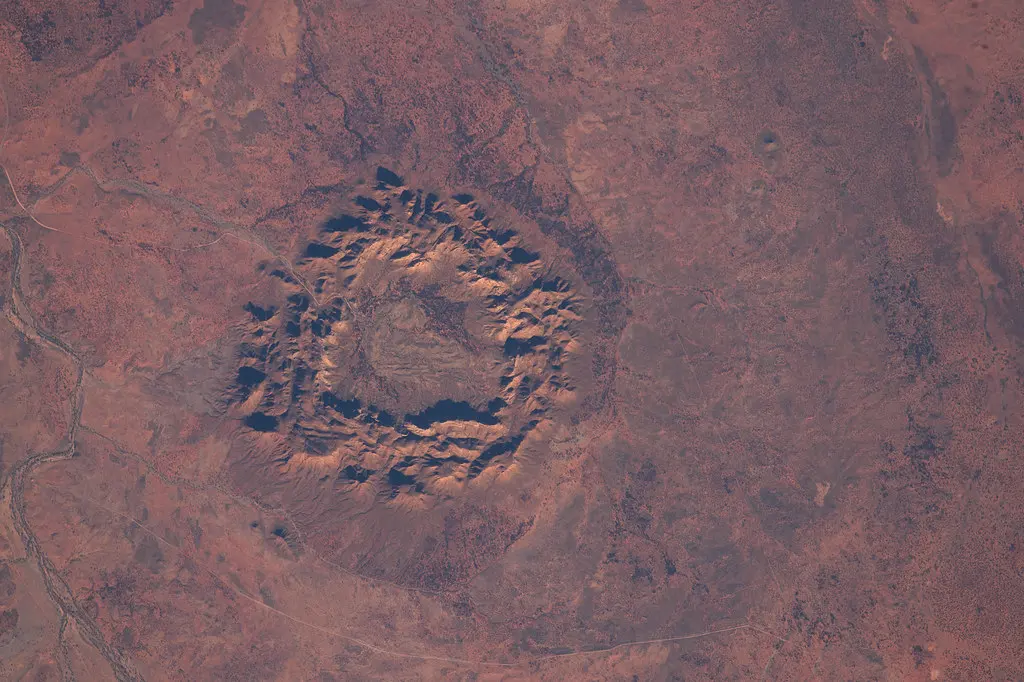
Gosses Bluff Crater, Australia
Macdonnell Region, Northern Territory, Australia
232.4 km away

Chambers Pillar Historical Reserve
Hugh / Alice Springs region, Northern Territory, Northern Territory, Australia
317.7 km away

Simpsons Gap
Alice Springs / Tjoritja, Northern Territory, Northern Territory, Australia
351.8 km away
References
Sources consulted for this page. Source categories describe the publication, not a guarantee that every claim is verified. Traditional accounts and outside interpretations may differ.
- 01AṆangu Culture | Uluru-Kata Tjuṭa National Park — Parks Australia / Director of National ParksofficialOfficial joint-management authority page on AṆangu culture and Tjukurpa.
- 02History of Uluru-Kata Tjuṭa National Park — Parks AustraliaofficialOfficial chronology of park history, handback, and heritage listing.
- 03Stories of Kata Tjuṭa | Uluru-Kata Tjuṭa National Park — Parks AustraliaofficialOfficial statement that Kata Tjuṭa Tjukurpa is restricted to initiated men and not shared with visitors; states even ancestral beings' names are not revealed publicly.
- 04Joint management | Uluru-Kata Tjuṭa National Park — Parks AustraliaofficialDescribes Board of Management structure and Anangu-majority governance.
- 05World heritage | Uluru-Kata Tjuṭa National Park — Parks AustraliaofficialOfficial summary of dual (natural + cultural landscape) UNESCO listing.
- 06Geology | Uluru-Kata Tjuṭa National Park — Parks AustraliaofficialOfficial geological formation data for Kata Tjuṭa conglomerate domes.
- 07Valley of the Winds walks | Uluru-Kata Tjuṭa National Park — Parks AustraliaofficialOfficial walk details, closures, and cultural/photography guidance.
- 08Park management - Uluru-Kata Tjuṭa National Park — Department of Climate Change, Energy, the Environment and Water (DCCEEW)officialAustralian Government department page on park management and conservation.
- 09Uluru-Kata Tjuṭa National Park - UNESCO World Heritage Centre — UNESCOofficialOfficial World Heritage listing page (site returned 403 on direct fetch; corroborated via search excerpts and secondary official summaries).
- 10Anangu traditional owners sign updated Uluru lease — Central Land CouncilSource contextTraditional-owner-representative land council statement on 2020s lease renegotiation, revenue share, and protection of sacred sites/songlines and cultural intellectual property.
- 11Acknowledging the handback of Uluru-Kata Tjuta — National Indigenous Australians Agency (indigenous.gov.au)officialAustralian Government Indigenous affairs page on the 1985 handback.
- 12Handback of Uluru to the Anangu — National Museum of AustraliaofficialNational museum account of the 1985 handback as a defining moment in Australian history.
- 13Closing the climb: refusal or reconciliation in Uluru-Kata Tjuta National Park? — Taylor & Francis (peer-reviewed journal article)academicPeer-reviewed article on visitor behavior, cultural refusal, and reconciliation politics at the park (primarily Uluru climb closure, contextually relevant).
- 14Buy your pass | Uluru-Kata Tjuṭa National Park — Parks AustraliaofficialOfficial park pass purchasing and fee information.
- 15Kata Tjuta — Wikipedia contributorsacademicGeneral encyclopedia entry; geology and naming history corroborated elsewhere, but its reference to a named ancestral being conflicts with official restricted-knowledge guidance and is treated cautiously.
- 16Uluru-Kata Tjuta – Australia — Sacred Land Film ProjectspiritualAdvocacy/spiritual-geography organization profile on Tjukurpa, iwara (ancestral paths), and site protection issues.
- 17Joint management at Uluru-Kata Tjuta National Park — ResearchGate (academic publication)academicAcademic treatment of co-management model; used to corroborate governance structure claims.
- 18Passes & permits in the NT — Northern Territory Tourism (northernterritory.com)Source contextOfficial-adjacent tourism board page on park pass requirements and pricing.
Share a photo
Help visitors recognize Kata Tjuṯa. Every submission is reviewed before publication.