Gosses Bluff Crater, Australia
A circular mountain range formed by something that fell from the sky — told by both science and Dreaming
Understand sacred places, explore living traditions, and learn how to engage respectfully with Pilgrim Map.
Access has not been verified. Check current local guidance before planning a visit.
Macdonnell Region, Northern Territory, Australia
Read the sources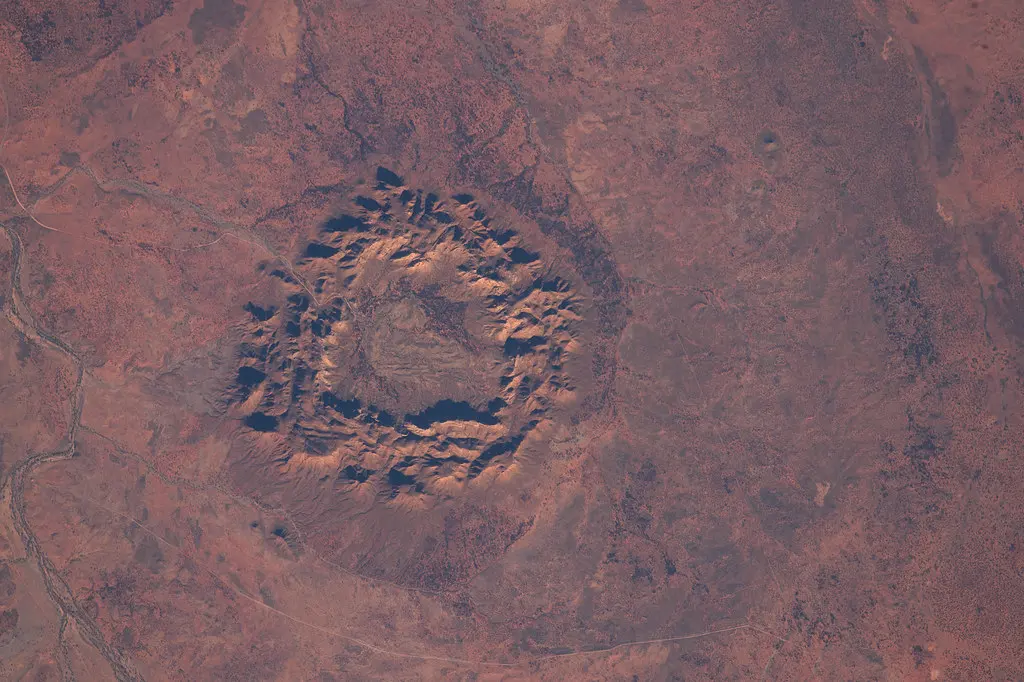
Image of Gosses Bluff Crater, Australia. Image source
Visit essentials
A quick read before you go
- Duration
- 1-2 hours at the site.
- Access
- Approximately 175 km west of Alice Springs via Larapinta Drive and unsealed road.
Overview
Tnorala sits in the red landscape west of Alice Springs, a circular formation of sandstone ridges rising 180 metres from the surrounding plain. From the air, the shape is unmistakable: a ring, five kilometres across, marking the central uplift of an impact crater whose original rim — 22 kilometres in diameter — has been eroded away over 142 million years. From the ground, the ridges form a circular horizon that encloses a space of peculiar stillness.
The Western Arrernte people, whose Country this is, hold a Dreaming account that converges precisely with the scientific record without depending on it: a baby falls from a wooden turna and forces the rocks upward into the circular formation, while its evening-star and morning-star parents continue searching at dawn and dusk.
The site is a registered sacred place. Traditional Owners welcome visitors but ask that the crater rim not be walked upon and that no one camp at the site, out of respect for those who lived and died here. The restrictions are gentle in form but absolute in intent. This is a place of grief as well as creation — a mother and father still looking for a child who fell.
Why this place is sacred
What makes Tnorala extraordinary is not the impact crater alone, nor the Dreaming story alone, but their convergence. Both accounts agree: something fell from the sky and struck this ground with enough force to reshape the earth. The scientific account measures the event in megatons and millions of years. The Dreaming account measures it in love and loss — a baby who fell, parents who search.
Neither account reduces to the other. The scientific narrative does not explain why the Western Arrernte story exists with such specificity. The Dreaming narrative does not require scientific validation to function as truth within its own system. Standing in the crater, both are present simultaneously, and the visitor is left with a doubled awareness that neither the laboratory nor the ceremony can fully contain.
The evening and morning stars complete the thinness. They are visible from within the crater — the parents still searching. The scientific mind knows them as Venus in its two apparitions. The Dreaming mind knows them as beings animated by grief. Both minds can look at the same points of light and hold both understandings without contradiction. This is what Tnorala teaches: that the sky is larger than any single way of reading it.
The site has been a place of ceremony, habitation, and cultural significance for the Western Arrernte people since antiquity. Ancestors lived, hunted, camped, and performed ceremonies here.
The Western Arrernte Dreaming story predates European contact. The scientific identification of the crater as an asteroid impact was a 20th-century development. The convergence of the two narratives has drawn attention from scholars of Aboriginal astronomy.
Experience and orientation
The drive from Alice Springs takes several hours, much of it on unsealed road through country that flattens and reddens as the MacDonnell Ranges fall behind. Tnorala does not announce itself from a great distance; the ridges resolve gradually from the landscape, their circular form becoming apparent only as you approach from the correct angle.
Inside the crater, the experience is one of enclosure and quiet. The ridges form a horizon in every direction, creating a contained space that feels both sheltered and exposed — sheltered from the surrounding desert, exposed to the sky above. The rock is red and orange sandstone, weathered into formations that catch the light differently throughout the day. In early morning and late afternoon, the ridges glow.
The silence is a presence. Central Australian quiet is not the absence of sound but a quality of its own — the wind across stone, the distance between things. Within the crater, this quality is amplified by the enclosure. The circular form creates a natural amphitheatre of silence.
At dawn and dusk, look for the evening and morning stars. They are there, as the Dreaming says, still searching.
Drive to the crater and enter through the access track. Park and walk into the interior of the formation. Do not climb the ridges. Allow time for the silence to establish itself. Visit at dawn or dusk if possible, when the light on the ridges is most affecting and the parents — the evening and morning stars — are visible.
Context and lineage
In the Dreamtime, celestial women were dancing as stars in the Milky Way. One woman placed her baby in a turna (carrying basket) while she danced. The basket tipped, and the baby fell to earth, striking the ground with force that pushed the rocks upward into the circular mountain range. The baby's parents, the evening star and the morning star, continue to search for their child and are visible in the sky at dawn and dusk.
The Western Arrernte people are the Traditional Owners and custodians of Tnorala. Their Dreaming narrative is a living tradition maintained through cultural practice and transmission.
Traditions and practice
Western Arrernte ancestors lived, hunted, camped, and performed ceremonies at Tnorala. Specific ceremonial practices are maintained by Traditional Owners.
Traditional Owners maintain cultural authority over the site through the conservation reserve management. Visitors are welcomed with restrictions.
Enter the crater quietly. Sit in the interior and allow the circular horizon and the silence to work. If visiting at dawn or dusk, watch for the evening and morning stars — the parents still searching. The Dreaming story is not separate from the landscape; it is the landscape's meaning.
Western Arrernte
ActiveTnorala is a registered sacred site of the Western Arrernte people. The Dreaming narrative of the baby falling from the Milky Way is a living tradition that gives the landscape its meaning and connects the visible sky (evening and morning stars) to the physical formation below.
Cultural authority maintained through conservation reserve management. Ceremonial practices continue under Traditional Owner guidance.
Perspectives and open questions
Tnorala holds two narratives of cosmic impact — scientific and Aboriginal — that neither contradict nor exhaust each other.
Scholarly perspective
Geologists identify the formation as the eroded central uplift of an asteroid or comet impact crater approximately 142.5 million years old. The original crater was about 22 km in diameter. The current 5 km ring is the remnant central uplift, composed of Hermannsburg Sandstone thrust upward by the impact.
Living and traditional perspectives
For the Western Arrernte people, Tnorala is the place where a baby fell from the Milky Way. The Dreaming story is not a metaphor or a pre-scientific explanation; it is a way of knowing that holds the site's meaning within a framework of relationship, loss, and ongoing search. The evening and morning stars as parents searching for their child gives the sky above the crater an emotional geography that the scientific account does not provide.
Alternative interpretations
The convergence of scientific impact narrative and Aboriginal Dreaming story has drawn attention from scholars who argue that Aboriginal knowledge systems may preserve observational data about celestial events in narrative form across vast timescales.
Open questions
Whether the Dreaming story preserves a cultural memory of the actual impact — which occurred 142 million years ago, long before human presence — or whether the narrative was generated in response to the visible formation is genuinely unknowable. The question itself may reflect a Western assumption that one origin must be primary.
Plan your visit
Access and arrival
Approximately 175 km west of Alice Springs via Larapinta Drive and unsealed road. 4WD recommended. No facilities at the site. Carry water, food, and fuel.
No facilities at Tnorala. Hermannsburg (approximately 50 km east) has limited services. Alice Springs is the nearest town with full services.
Respectful visit
Desert-appropriate clothing. Sun protection essential. Temperatures can be extreme.
Photography permitted from designated areas.
None expected.
Do not walk on the crater rim | No camping at the site | Stay in designated areas | Obey all signage
Do not walk on the crater rim. Do not camp. Respect all signage. The drive to Tnorala requires preparation for remote central Australian travel.
Current practical details
Address
Hermannsburg NT 0872, Australia
Hours
Hours, fees, and access can change — verify on the official source before you travel. Practical details last checked Jun 2026.
Location
Map loads as you approach this section.
Pilgrim reflections
A portrait of encounter, not a score
Pilgrims describe what they felt, how present they could become, and whether the place would shape a journey. There are no stars and no ranking of traditions.
No reviewed reflections yet
The first pilgrims can help describe the character of being here.
Share a reflection
Available after an account-backed “Been there.” Every reflection is reviewed before publication.
Nearby sacred places
Explore other sacred places in the region. Proximity does not establish access or travel time; check each place’s guidance.

Simpsons Gap
Alice Springs / Tjoritja, Northern Territory, Northern Territory, Australia
142.5 km away

Napwerte / Ewaninga Rock Carvings Conservation Reserve
Hale / Alice Springs region, Northern Territory, Northern Territory, Australia
165.7 km away
Yeperenye / Emily and Jessie Gaps Nature Park
Alice Springs, Northern Territory, Northern Territory, Australia
167.7 km away

N'Dhala Gorge Nature Park
Ross River / Alice Springs region, Northern Territory, Northern Territory, Australia
181.6 km away
References
Sources consulted for this page. Source categories describe the publication, not a guarantee that every claim is verified. Traditional accounts and outside interpretations may differ.
- 01Tnorala (Gosse Bluff) Conservation Reserve — Northern Territory GovernmentofficialOfficial park management
- 02Gosses Bluff impact structure - Wikipedia — Wikipedia contributorsencyclopediaScientific and cultural overview
- 03Impact Craters in Aboriginal Dreamings: Tnorala — Aboriginal Astronomy BlogacademicAboriginal astronomy research
- 04Gosse Bluff - Atlas Obscura — Atlas ObscuraguideVisitor perspective
- 05Tnorala - Tourism Central Australia — Discover Central AustraliaSource contextTourist information
Share a photo
Help visitors recognize Gosses Bluff Crater, Australia. Every submission is reviewed before publication.