Jebel Haroun
A white-domed shrine on the highest peak above Petra, sacred to three faiths as the tomb of Aaron
Understand sacred places, explore living traditions, and learn how to engage respectfully with Pilgrim Map.
Access has not been verified. Check current local guidance before planning a visit.
Wadi Araba Sub-District, Ma'an, Jordan
Read the sources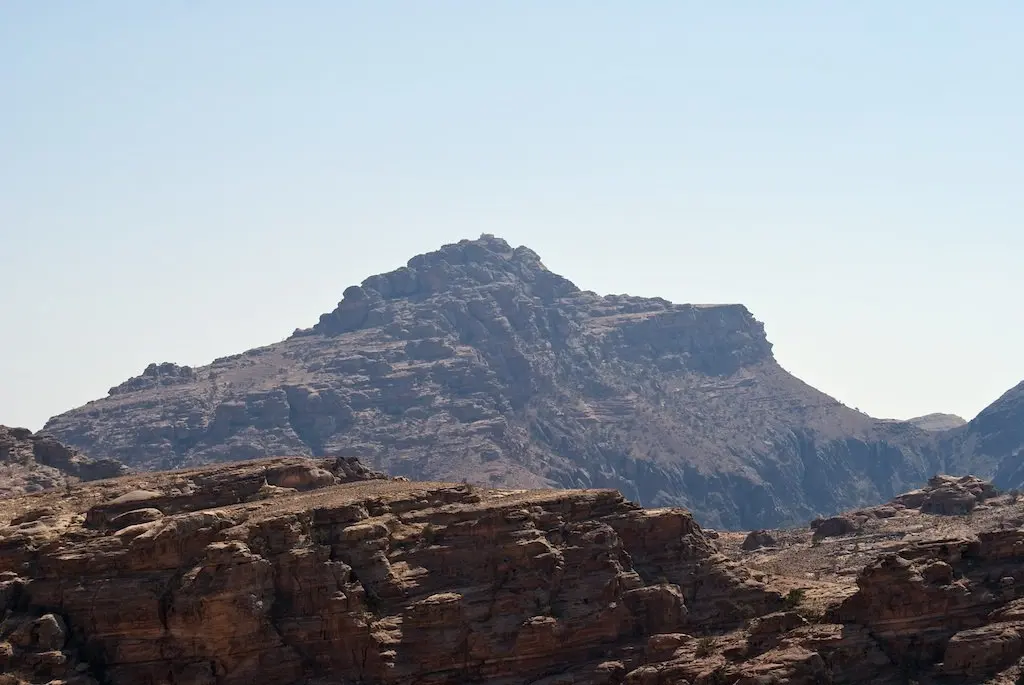
Image of Jebel Haroun. Image source
Visit essentials
A quick read before you go
- Duration
- A full day: roughly 5 to 7 hours round trip on foot from central Petra, covering about 13 km (8…
- Access
- Reached on foot only, from within the Petra Archaeological Park, with the trail starting near…
Overview
Jebel Haroun, the Mountain of Aaron, rises roughly 1,350 to 1,400 metres above rock-cut Petra as the surrounding mountains' highest peak. A single white summit dome, visible across the ranges, marks what tradition holds to be the burial place of Aaron—Harun in Arabic—the first High Priest and brother of Moses, honored as a prophet in Judaism, Christianity, and Islam.
Excavation has shown a first-century Nabataean sanctuary beneath a Byzantine monastery and pilgrimage center; the present Islamic shrine came much later, in the 14th and 15th centuries. Scholars trace continuity from a pre-Christian deity through Saint Aaron's veneration to the Muslim Nabi Harun: two millennia of worship attached to one summit.
Reaching it is itself a pilgrimage, requiring a demanding several-hour hike from central Petra along an unmarked route and a steep final ascent. The normally locked summit shrine is opened by a key-holder; inside, a cenotaph chamber is sometimes reached down a few steps. Visitors describe the climb's effort, sweeping views over Petra and the Wadi Araba, and profound silence on ground sacred to three faiths.
Why this place is sacred
The mountain's power lies in its solitude and its long continuity of reverence. A single white shrine stands on the highest peak above Petra, reached only by a long and exposed climb, so that arrival is earned and the silence at the top feels absolute. Beneath the dome lie the traces of older devotions: a Nabataean sanctuary, a Byzantine monastery, the figure of Aaron honored in turn by three faiths.
Scholars describe a passage 'from goddess to prophet' on this summit, suggesting its sanctity predates Aaron and may descend from a Nabataean deity venerated here before the prophet's name attached to the peak. That layering, deity and saint and prophet over two thousand years, gives the mountain an unusual density of the sacred.
To stand at the dome after the climb, with Petra below and the Wadi Araba stretching west, is to feel both the effort of pilgrimage and the weight of a holiness that has gathered here across many traditions and ages.
Experience and orientation
The visit is a full-day climb on foot from central Petra, and the effort shapes the encounter. The trail is unmarked and the final ascent is steep, so the route winds upward through the wider Petra landscape, often with a local guide to find the way. Hikers describe a long, exposed, rewarding climb with widening views back over the rock-cut city and out toward the Wadi Araba.
At the top stands a small whitewashed shrine with a single dome, holding a cenotaph chamber that is sometimes reached down a few steps inside. The shrine is normally locked; entering depends on a key-holder opening it. Even when it is closed, the summit itself is the reward: profound silence, a long panorama on clear days, and the sense of standing on a peak sacred to three faiths.
Below the summit lie the ruins of the Byzantine monastery and basilica, an archaeological site rather than a living one. The whole experience carries a pilgrimage feeling, the physical effort, the height, and the shared reverence often evoking humility and reflection.
The summit holds the white domed weli with its cenotaph chamber, sometimes entered down a few steps; the shrine is normally locked and opened by a key-holder. On the high plateau below the summit lie the ruins of the Byzantine monastery and basilica. The trail begins in central Petra near the Theatre and Qasr al-Bint.
Context and lineage
In the biblical account of Numbers 20, Aaron ascends Mount Hor with Moses and his son Eleazar, hands over the high-priestly vestments, and dies there. Long tradition identifies that Mount Hor with this peak above Petra, and Islamic tradition holds the same mountain to be the resting place of Nabi Harun.
Archaeology reveals an even older sanctity: a first-century Nabataean sanctuary occupied the site, possibly dedicated to a deity such as the goddess al-Uzza, before a Byzantine monastery and basilica were built on the high plateau in the later 5th century CE, functioning for centuries as a Christian pilgrimage center dedicated to Saint Aaron.
The present whitewashed, single-domed Islamic shrine on the summit dates to the mid-14th century; a tablet records its construction by Muhammad, son of Qalawun, Sultan of Egypt, in 739 AH, around 1363, with a later rebuild dated 1459 CE. The Swiss traveler Johann Ludwig Burckhardt, who rediscovered Petra for the wider world in 1812, also brought the mountain to renewed Western attention. The Byzantine monastery was excavated by the Finnish Jabal Haroun Project under Z. T. Fiema and J.
Frosen, working from 1997 onward.
The peak holds a continuity from a Nabataean cult, possibly of al-Uzza, through Byzantine Christian monasticism and the veneration of Saint Aaron, to Islamic veneration of Nabi Harun, with the Mamluk-era shrine still standing. It lies within the Petra UNESCO World Heritage Site, inscribed in 1985, inside the Petra Archaeological Park.
Aaron (Harun)
Brother of Moses and the first High Priest, venerated as a prophet in all three Abrahamic faiths; traditional occupant of the summit tomb
Muhammad son of Qalawun (al-Nasir Muhammad)
Mamluk Sultan of Egypt under whom the summit shrine was built around 1363 (739 AH)
Johann Ludwig Burckhardt
Swiss traveler who rediscovered Petra and the mountain for the wider world in 1812
Z. T. Fiema and Jaakko Frosen
Archaeologists who led the Finnish Jabal Haroun Project excavating the Byzantine monastery from 1997
The Bedul and Liyathnah Bedouin
Local tribes whose pilgrimages, annual for the Bedul and twice-yearly for the Liyathnah, sustained the shrine's living devotion
Traditions and practice
The living tradition is Islamic pilgrimage to the weli: in the early 20th century the Bedul tribe made an annual pilgrimage and the Liyathnah came twice yearly, with prayer, offerings, and votive devotion at the shrine. Jewish, including Hasidic, pilgrims have made the arduous climb out of reverence for Aaron, and Christian travelers honor him as a holy figure, while the Byzantine monastery below, once a center of monastic liturgy and pilgrimage to Saint Aaron, is now a ruin.
Today the mountain receives pilgrim and trekker visits; prayer takes place at the summit shrine when the key-holder opens it, and quiet devotion is offered by visitors of any tradition.
Treat the climb itself as the practice. The hours of effort, the height, and the silence at the top lend themselves to reflection on the journey of Moses and Aaron and on what is reached only by hard ascent. If the shrine is open, enter quietly; if it is locked, the summit and its long views still reward stillness. Start early so the round trip finishes in daylight.
Islam
ActiveVenerated as the tomb of the prophet Nabi Harun (Aaron), brother of Musa (Moses). The summit weli is an Islamic shrine; the present whitewashed, single-domed structure dates to the mid-14th century, with a tablet recording construction by Muhammad, son of Qalawun, Sultan of Egypt, around 1363 (739 AH), and a later rebuild dated 1459 CE.
Pilgrimage and prayer at the weli; in the early 20th century the Bedul tribe made an annual pilgrimage and the Liyathnah twice yearly, with offerings and votive devotion at the shrine.
Judaism
ActiveIdentified with Mount Hor, where Numbers 20 records that Aaron the High Priest died and was buried after Moses transferred the priestly garments to his son Eleazar. A revered site of the brother of Moses, the first High Priest.
Jewish pilgrims, including Hasidim, make the arduous climb out of reverence for Aaron and pray at the summit.
Christianity
ActiveAaron is honored as a holy figure, and a Byzantine monastery and basilica on the high plateau, built in the later 5th century CE, functioned for centuries as a pilgrimage center dedicated to the veneration of Saint Aaron.
Historically monastic life and Christian pilgrimage; today Christian travelers visit as part of a Petra pilgrimage, and the monastery survives as an archaeological ruin.
Perspectives and open questions
The peak draws together firm three-faith tradition, careful archaeology, and a striking story of continuity.
Scholarly perspective
Archaeology, through the Finnish Jabal Haroun Project, confirms a first-century Nabataean sanctuary overlain by a later-5th-century Byzantine monastery and pilgrimage center, with the summit Islamic shrine built in the 14th and 15th centuries. The identification of the peak as the biblical Mount Hor is a long-standing tradition rather than a proven fact.
Living and traditional perspectives
Local Bedouin, the Bedul and Liyathnah, and broader Muslim tradition firmly venerate the summit as Nabi Harun's tomb and have made pilgrimage here for centuries; Jewish and Christian traditions equally honor Aaron's burial here.
Alternative interpretations
Scholars note a 'from goddess to prophet' continuity, suggesting the mountain's sanctity predates Aaron and may descend from a Nabataean deity such as al-Uzza, a reading that frames the peak as one of the longest continuously venerated places in the region.
Open questions
Whether Aaron is actually buried here cannot be verified; biblical accounts themselves differ, with Deuteronomy naming Moserah rather than Mount Hor. The exact identity of the pre-Christian Nabataean deity of the mountain and the reason the cult attached to this peak remain open questions.
Plan your visit
Access and arrival
Reached on foot only, from within the Petra Archaeological Park, with the trail starting near the Theatre and Qasr al-Bint. The route is unmarked and the final ascent is steep, so a local guide is strongly recommended both for route-finding and to open the locked shrine. Donkeys can assist part of the way. Carry ample water, sun protection, and sturdy shoes.
Mobile signal is patchy to absent on the remote sections of the trail and at the summit, so do not rely on it; tell someone your plan before setting out. Access depends on Petra park entry and daylight hours.
Most visitors base in Wadi Musa, the town at Petra's entrance, which offers a wide range of accommodation, and set out for the climb early.
Respectful visit
Wear practical hiking clothing for the climb, but dress modestly and respectfully at the shrine, covering shoulders and knees, and remove your shoes before entering the tomb chamber.
Photography is generally permitted; be respectful inside the shrine and ask the guide or key-holder first.
Small votive offerings and donations toward the upkeep of the weli are customary.
Do not climb on or damage the shrine or the Byzantine ruins, carry out all litter, and respect the instructions of any guardian or guide.
This is a strenuous, exposed, full-day hike on an unmarked route; a local guide is strongly advised for both route-finding and access to the shrine. Carry ample water and sun protection, and do not attempt it in midday summer heat or winter storms.
Location
Map loads as you approach this section.
Pilgrim reflections
A portrait of encounter, not a score
Pilgrims describe what they felt, how present they could become, and whether the place would shape a journey. There are no stars and no ranking of traditions.
No reviewed reflections yet
The first pilgrims can help describe the character of being here.
Share a reflection
Available after an account-backed “Been there.” Every reflection is reviewed before publication.
Nearby sacred places
Explore other sacred places in the region. Proximity does not establish access or travel time; check each place’s guidance.

Petra
Petra Sub-District, Ma'an, Jordan
3.3 km away

Sanctuary of Agios Lot at Deir 'Ain 'Abata
Ghor al-Safi, Ghor al-Safi, Karak Governorate, Jordan
81.6 km away

Shrine of Zayd ibn Harithah
Al-Mazar al-Janubi, Al-Mazar al-Janubi, Karak Governorate, Jordan
87.7 km away

Tomb of Jafar bin Abi Talib, Mutah, Jordan
Al Mazar, Karak, Jordan
87.8 km away
References
Sources consulted for this page. Source categories describe the publication, not a guarantee that every claim is verified. Traditional accounts and outside interpretations may differ.
- 01Petra, The Mountain of Aaron: The Finnish Archaeological Project in Jordan, Vol. 2 — The Nabataean Sanctuary and the Byzantine Monastery — Z. T. Fiema, J. Frosen, M. Holappa (rev. AJA)academicDefinitive excavation report: Nabataean 1st-c. sanctuary beneath later-5th-c. Byzantine monastery and pilgrimage center
- 02From Goddess to Prophet: 2000 Years of Continuity on the Mountain of Aaron near Petra — Temenos / Nordic Journal for the Study of ReligionacademicArgues continuity from a pre-Christian deity (possibly al-Uzza) through Christian St Aaron veneration to Muslim Nabi Harun
- 03Jabal Harun Trail — Visit Petra (official)guideOfficial trail information for the hike from Petra
- 04Prophet on the Mount — Smithsonian MagazinenewsThree-faith pilgrimage narrative, Jewish Hasidim, Muslim villagers, Christian visitors
- 05Tomb of Aaron — Madain ProjectacademicByzantine chapel later turned Muslim shrine; mid-14th century mosque built by Muhammad son of Calaon, Sultan of Egypt, 739 AH (~1363)
- 06Tomb of Aaron (Jordan) — WikipediaencyclopediaThree-faith veneration, weli dated 1459 CE / mid-14th century mosque, Burckhardt rediscovery 1812, Bedul and Liyathnah tribal pilgrimages
- 07Petra to Jabal Harun trail — AllTrailsguideDistance ~7.9 mi, elevation gain ~1,624 ft, difficulty
- 08Jebel Haroun, Petra — Sacred Sites (Martin Gray)spiritualPilgrimage and sacred-mountain framing
Share a photo
Help visitors recognize Jebel Haroun. Every submission is reviewed before publication.