Petra
A sacred city carved from living rock, oriented to the Nabataean gods and the turning sun
Understand sacred places, explore living traditions, and learn how to engage respectfully with Pilgrim Map.
Access has not been verified. Check current local guidance before planning a visit.
Petra Sub-District, Ma'an, Jordan
Read the sources
Visit essentials
A quick read before you go
- Duration
- A full day at minimum; two to three days to include the Monastery, the High Place of Sacrifice,…
- Access
- Entry is at Wadi Musa, followed by a walk of about 1.2 km through the Siq to the Treasury.
Overview
Petra is famous for the carved facade of Al-Khazneh glimpsed at the end of the shadowed Siq, but the city was far more than one monument. From the 4th century BCE, the Nabataeans—masters of the desert incense trade—raised a capital that was both commercial center and sacred city, dedicated above all to Dushara, 'Lord of the Shara mountains', and the goddesses al-Uzza, al-Lat, and Manat.
Their worship was largely aniconic: gods were present not in human images but in betyls, sacred carved stones. Across rose-gold sandstone they cut monumental tombs, high places of sacrifice, processional ways, and the great Monastery, Ad-Deir, binding architecture, landscape, and heavens into one religious whole. Archaeoastronomers argue that major monuments were oriented to solstices and equinoxes, with winter-solstice light entering the Monastery to illuminate the god's throne block.
Rome annexed the kingdom in 106 CE, and a Christian phase followed. Earthquakes and shifting trade routes brought decline, and Petra was largely lost to the wider world until 1812. The Nabataean cult is no longer practiced; Petra is now a UNESCO World Heritage Site and one of the New Seven Wonders, while local Bdoul Bedouin maintain a living relationship with the landscape. To walk it is to move through a holy city carved from rock itself.
Why this place is sacred
Petra's atmosphere is built on threshold and revelation. The approach runs through the Siq, a narrow, deep cleft in the rock, once lined with niches and betyls that made it a sacred entrance, until it opens suddenly onto the sunlit facade of Al-Khazneh. That passage from shadow to light is the city's defining sensation, and the Nabataeans seem to have understood and staged such effects deliberately. The rose-gold sandstone shifts color through the day, glowing at dawn and dusk.
At the Monastery, winter-solstice light is said to enter and fall on the motab, the god's throne block, while the opposing mountain casts a shadow likened to a lion's head, the lion being the animal of the goddess al-Uzza, a staged solar theophany. The sheer scale of a holy city cut from the rock, oriented to the turning of the sun, creates an overwhelming sense of wonder and threshold.
Even emptied of its ancient cult, the place keeps a charged, liminal power, the feeling of stepping into a sacred world made of stone and light.
Experience and orientation
Entry begins at Wadi Musa with a walk of more than a kilometre through the Siq, the winding rock corridor that builds anticipation until Al-Khazneh appears in a sudden frame of sunlit stone, the moment most visitors single out. Beyond it the landscape opens into a vast sacred city: rows of rock-cut tombs, a theatre, colonnaded streets, and trails climbing to the high places. The sandstone changes color through the day, deepest and richest in early morning and late afternoon.
Two strenuous climbs reward the effort, one to the High Place of Sacrifice on Jabal Madbah, the other a long stairway to the Monastery, Ad-Deir, whose huge facade catches the late-afternoon and winter-solstice light. On select evenings Petra by Night lights the route to the Treasury with candles for a quieter, slower encounter. A full day is the minimum; two or three days allow the back trails and Little Petra.
Visitors describe awe at the scale and beauty, the physical demand of the climbs, and a profound, almost pilgrimage-like response to walking through a lost world carved from living rock.
Enter at Wadi Musa and walk the Siq (about 1.2 km) to Al-Khazneh (the Treasury). Beyond lie the tombs, theatre, and colonnaded street; a long stair climbs to the Monastery (Ad-Deir), and a separate steep path reaches the High Place of Sacrifice on Jabal Madbah. Little Petra (Siq al-Barid) lies a short drive away.
Context and lineage
The Nabataeans, an Arab people grown wealthy on the desert incense and spice trade, settled the site from the 4th century BCE and made it their capital from the 2nd century BCE. Around their supreme god Dushara, 'Lord of the Shara mountains', associated with the mountains, the sun, and sovereignty, and the goddesses al-Uzza, al-Lat, and Manat, they shaped a sacred landscape of rock-cut monuments, high places, and processional ways, worshipping through aniconic betyls rather than human images.
Al-Khazneh, long known by the Bedouin legend that named it the Treasury, is now understood as a royal mausoleum carved in the early 1st century CE under King Aretas IV; in 2024 twelve skeletons were discovered beneath it. Rome annexed the Nabataean kingdom in 106 CE, and in late antiquity Petra became a Christian center, attested by the Petra Church with its 6th-century mosaics and the archive of the Petra papyri.
Earthquakes, notably in 363 CE, and the shifting of trade routes brought decline, and the city faded from outside knowledge until the Swiss traveler Johann Ludwig Burckhardt reached it in 1812. The site was inscribed as a UNESCO World Heritage Site in 1985 and named one of the New Seven Wonders of the World in 2007.
Petra's sacred history runs from Nabataean polytheism through a Roman provincial period and a Byzantine Christian phase to centuries of obscurity, and today to its status as heritage. The Bdoul Bedouin, relocated to Umm Sayhoun in the 1980s, sustain a living relationship with the landscape through crafts, guiding, and ancestral ties.
The Nabataeans
The Arab traders who carved the city, engineered its water systems, and shaped its sacred landscape around Dushara and his goddesses
King Aretas IV Philopatris
Nabataean king under whom Al-Khazneh, the royal mausoleum, was carved in the early 1st century CE
Johann Ludwig Burckhardt
Swiss explorer who rediscovered Petra for the wider world in 1812
Juan Antonio Belmonte
Archaeoastronomer whose studies argue for the solstice and equinox orientation of Petra's major monuments
The Bdoul Bedouin
The community who lived in Petra's caves until their relocation in the 1980s and who keep a living connection to the site
Traditions and practice
Nabataean worship centered on processions, animal sacrifice, and libations at high places, notably the High Place of Sacrifice on Jabal Madbah, on cultic banquets in rock-cut triclinia, and on festival pilgrimage to the Monastery, likely tied to a winter-solstice festival of Dushara and al-Uzza. These rites are historical and reconstructed from archaeology and archaeoastronomy rather than practiced today.
No religious ritual is performed at Petra now. The living engagement is contemplative and embodied: walking the Siq, climbing to the high places, attending the candle-lit Petra by Night, and reading the site through its light, scale, and orientation. The local Bdoul Bedouin sustain crafts, guiding, and a continuing connection to the place.
Let the walk itself be the practice. Move slowly through the Siq and let the Treasury reveal itself rather than rushing the famous view. Time the climbs to the High Place of Sacrifice and the Monastery for the low, raking light of early morning or late afternoon, when the sandstone is most alive and the heat least punishing.
If you can visit near the winter solstice, the Monastery's alignment with the setting sun is the site's most deliberate sacred light effect. Attending Petra by Night offers the landscape in stillness and candlelight.
Nabataean religion
HistoricalPetra was the sacred capital of the Nabataeans, dedicated above all to Dushara, the supreme god of mountains, sun, and sovereignty, and to the goddesses al-Uzza, al-Lat, and Manat. Worship was largely aniconic: the deities were embodied in betyls, sacred carved stones, rather than in human images.
Processions, animal sacrifice and libations at high places (notably the High Place of Sacrifice on Jabal Madbah), cultic banquets in triclinia, and festival pilgrimage to the Monastery (Ad-Deir), likely tied to the winter-solstice festival of Dushara and al-Uzza.
Byzantine Christianity
HistoricalIn late antiquity Petra became a Christian center; the Petra Church, with its 6th-century mosaics and the Petra papyri archive, and other converted monuments attest a Christian phase before the city's decline.
Christian liturgy in churches built or adapted from earlier structures, now surviving as ruins.
Perspectives and open questions
Petra is read through firm archaeology, debated archaeoastronomy, and the living ties of its Bedouin community.
Scholarly perspective
Petra is firmly understood as the Nabataean capital and a sacred-commercial city. Archaeology continues to refine the dating and function of its monuments, including the confirmation of Al-Khazneh as a royal mausoleum by the 2024 discovery of twelve skeletons beneath it. Nabataean religion was aniconic, centered on Dushara and his goddesses, worshipped through betyls.
Living and traditional perspectives
The local Bdoul Bedouin, who lived in Petra's caves until their relocation in the 1980s, hold deep ancestral ties to the site. Bedouin legend gave Al-Khazneh its 'Treasury' name and explained the bullet scars on its urn as the marks of treasure-hunters.
Alternative interpretations
Archaeoastronomical studies argue that most major monuments are solar-oriented, with the Monastery staging a winter-solstice light-and-shadow theophany. These claims are influential but debated, and popular accounts sometimes overstate their precision; one study's figure of around 80 percent of structures being aligned is not universally accepted.
Open questions
Much of Petra remains unexcavated. The exact ritual use of many structures, the full extent of the sacred landscape, and aspects of the Nabataean calendar and theology are still being uncovered. The early phases of the city's construction are not precisely dated, and much about its founding remains open.
Plan your visit
Access and arrival
Entry is at Wadi Musa, followed by a walk of about 1.2 km through the Siq to the Treasury. Tickets are available at the Petra Visitor Centre or through the Jordan Pass, which can also cover the entry visa. Horse, carriage, donkey, and camel rides exist but raise welfare concerns. Expect considerable walking and steep climbs. Mobile signal is reliable around the main valley and the visitor centre but patchy on the higher trails.
The park keeps daily hours; some areas are restricted for conservation, and the Siq may close or become hazardous during winter flash floods.
Wadi Musa, the town at Petra's entrance, offers a wide range of accommodation from budget to luxury; staying overnight allows an early start before the day's heat and crowds.
Respectful visit
Wear practical walking or hiking clothing and sturdy shoes, with essential sun protection; modest dress is respectful in Jordan and at Bedouin sites.
Photography is permitted throughout, but be respectful when photographing local Bedouin and ask before close portraits; tripods are restricted in some areas and during Petra by Night.
There are no religious offerings; supporting local Bedouin vendors and guides fairly is appreciated.
Do not climb on, carve, or touch the carved facades, stay on the paths in protected areas, and do not remove stones or artifacts.
Petra involves long walking and steep, exposed climbs; carry ample water and sun protection, and avoid the midday heat in summer, when temperatures can exceed 40 C / 104 F. The Siq carries a flash-flood risk in winter rains. Do not climb on, carve, or touch the carved facades, which are fragile sandstone under conservation pressure.
Location
Map loads as you approach this section.
Pilgrim reflections
A portrait of encounter, not a score
Pilgrims describe what they felt, how present they could become, and whether the place would shape a journey. There are no stars and no ranking of traditions.
No reviewed reflections yet
The first pilgrims can help describe the character of being here.
Share a reflection
Available after an account-backed “Been there.” Every reflection is reviewed before publication.
Nearby sacred places
Explore other sacred places in the region. Proximity does not establish access or travel time; check each place’s guidance.
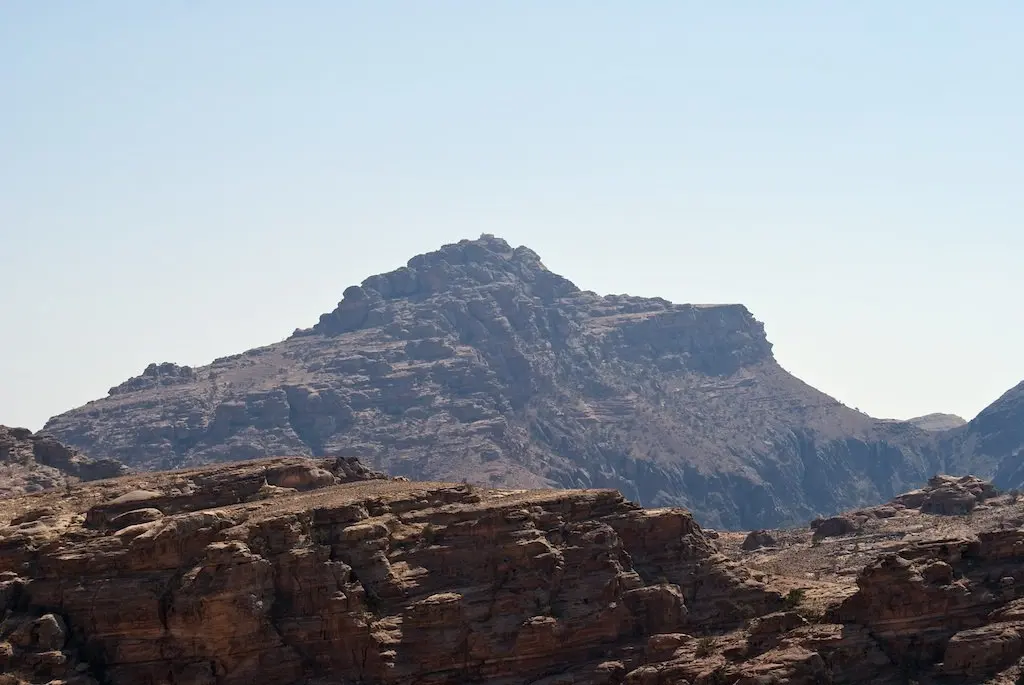
Jebel Haroun
Wadi Araba Sub-District, Ma'an, Jordan
3.3 km away

Sanctuary of Agios Lot at Deir 'Ain 'Abata
Ghor al-Safi, Ghor al-Safi, Karak Governorate, Jordan
79.1 km away

Shrine of Zayd ibn Harithah
Al-Mazar al-Janubi, Al-Mazar al-Janubi, Karak Governorate, Jordan
84.8 km away

Tomb of Jafar bin Abi Talib, Mutah, Jordan
Al Mazar, Karak, Jordan
84.9 km away
References
Sources consulted for this page. Source categories describe the publication, not a guarantee that every claim is verified. Traditional accounts and outside interpretations may differ.
- 01Petra, Jordan, archaeology and history — National GeographicnewsTrade-route wealth, incense routes, rise and decline of the city
- 02The Betyls of Petra — ResearchGate (scholarly paper)academicAniconic stone representations of deities, divine presence concept
- 03Petra Revisited: An Astronomical Approach to the Nabataean Cultic Calendar — Belmonte et al. (Culture and Cosmos / academia.edu)academicWinter-solstice light into Ad-Deir illuminating the motab; lunisolar cultic calendar; festival of Dushara and al-Uzza
- 04Shadows of Petra awaken its astronomical orientation — ScienceDaily (reporting Juan Antonio Belmonte study)newsSolstice/equinox orientations of major monuments including the Monastery and Treasury
- 05Petra Fees / Visit Petra — Visit Petra (PDTRA official)officialOfficial ticket pricing and visitor information
- 06Petra — WikipediaencyclopediaNabataean settlement 4th c. BCE, capital from 2nd c. BCE, Roman annexation 106 CE, rock-cut architecture, water systems, UNESCO 1985, New 7 Wonders 2007
- 07Nabataean religion — WikipediaencyclopediaDushara supreme god, goddesses al-Uzza, al-Lat, Manat; aniconic worship; betyls (sacred stones)
- 08Al-Khazneh — WikipediaencyclopediaRoyal mausoleum, early 1st c. CE under Aretas IV; 2024 discovery of 12 skeletons beneath the Treasury
- 09Visiting Petra: everything you need to know — On the LuceguidePractical visiting, Siq, Treasury, Petra by Night, best seasons
Photo gallery
3 curated photos
Share a photo
Help visitors recognize Petra. Every submission is reviewed before publication.