Janaki Mandir
Where Sita emerged from the earth and Rama broke Shiva's bow, the Ramayana lives in white stone
Understand sacred places, explore living traditions, and learn how to engage respectfully with Pilgrim Map.
Access has not been verified. Check current local guidance before planning a visit.
Janakpur, Madhesh Province, Nepal
Read the sources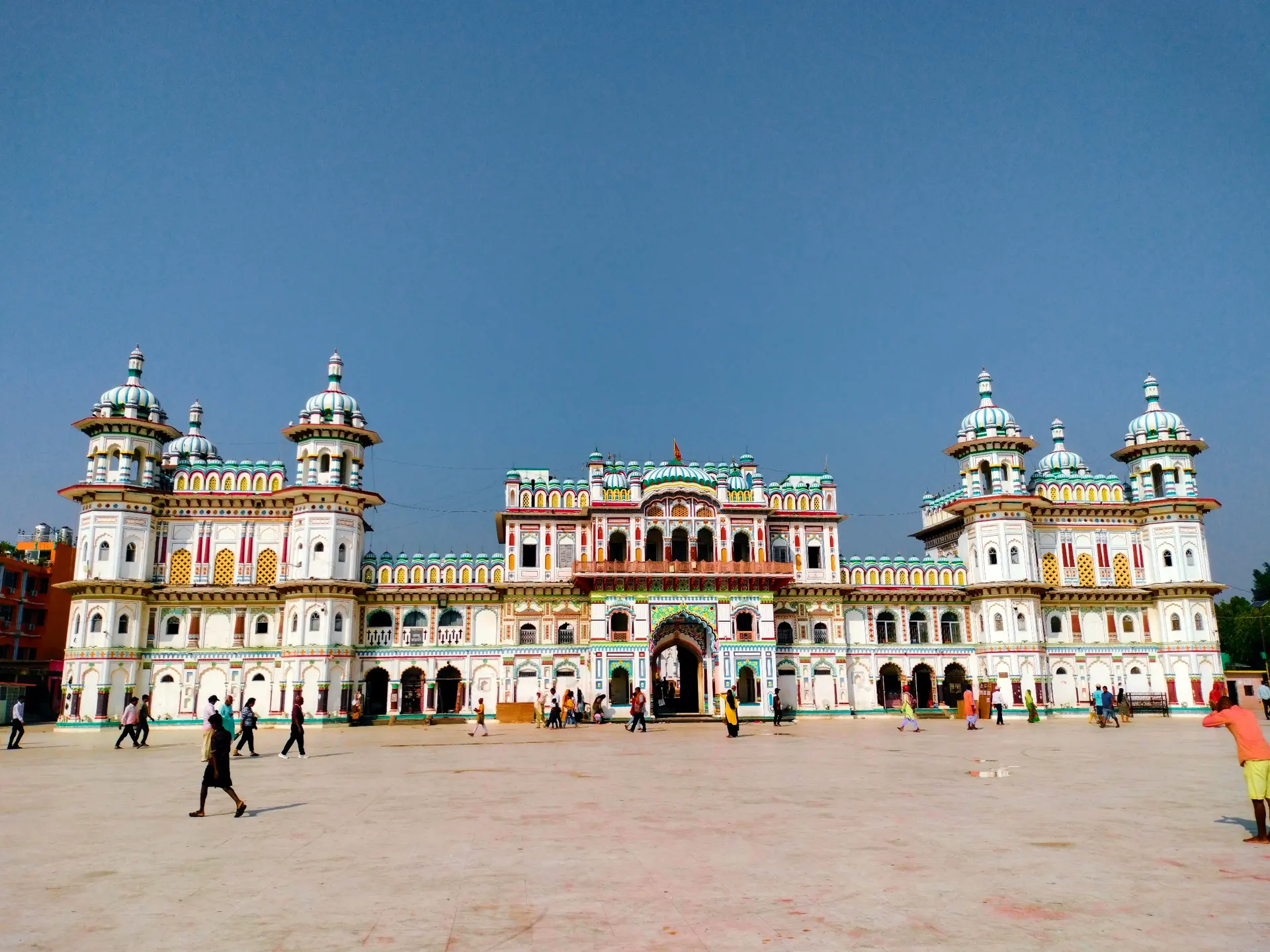
Visit essentials
A quick read before you go
- Duration
- Two to three hours for the temple itself.
- Access
- Janakpur is accessible by air, with Janakpur Airport receiving flights from Kathmandu.
Overview
Far south of the Himalayan peaks, Janakpur's warm, flat terrain and cultural gravity turn toward the Gangetic plain and ancient Mithila civilization, which once stretched across today's Nepal-India border. At this cultural center stands Janaki Mandir, a temple of striking ambition in a modest-scale city.
Built in white stone and marble, it blends Mughal arches, Rajput turrets, and Hindu decorative motifs in a style found nowhere else in Nepal. Sixty rooms occupy two stories; lattice windows light corridors where devotees move between shrines, and Madhubani paintings—the distinctive Mithila art form—cover interior walls with geometric precision and narrative depth. This is a monument to one of Hindu cosmology's most revered figures.
Sita, known here as Janaki, daughter of King Janaka, is understood not as a supporting character in Rama's story but as a divine presence in her own right. According to the Ramayana, Janaka found her as an infant in a golden casket within a furrow while plowing for a sacrificial ritual; her name means furrow. Her Swayamvara drew princes from across the land, and her abduction by Ravana set the epic's defining conflict in motion.
For Vaishnavite Hindus, she embodies dharma, devotion, courage, and the generative power of the feminine divine.
Devotees understand the temple ground as the actual earth from which Sita emerged and where Rama lifted and broke Lord Shiva's celestial bow to win her hand. A short walk away, the Vivah Mandap marks the precise place of their wedding, while sacred ponds carry other Ramayana associations. The city becomes a living text whose sacred narrative feels present in its geography.
Why this place is sacred
Several dimensions converge to create conditions of thinness at Janaki Mandir. The most fundamental is the site's claimed identity as the birthplace of Goddess Sita. In Hindu understanding, this is the earth from which the divine feminine emerged, a point of direct contact between the cosmic and the terrestrial. Whether or not archaeology can verify such a claim is beside the point for those who come here in devotion. The ground itself is understood as a threshold.
The discovery of the golden statue of Sita in 1657 by Sannyasi Shurkishordas deepened this sense of the site as a place where the sacred breaks through. Shurkishordas, a poet and saint who preached the Sita Upasana philosophy, is said to have found the statue at the exact location tradition associated with Sita's birth. The discovery was understood not as archaeological accident but as divine confirmation, a message from the earth that the sacred presence remained.
The landscape amplifies the temple's power. Dhanush Sagar, a large sacred pond near the temple, is held to have formed when fragments of Shiva's bow struck the ground after Rama broke it during the Swayamvara. Ganga Sagar, an adjacent pond, is understood to receive its waters from the Ganges itself. Pilgrims bathe in these ponds before approaching the temple, performing purification rites that link them to the narrative before they even enter the shrine.
The entire surrounding terrain is encoded with meaning.
The Mithila cultural tradition provides a further dimension. For the Maithili-speaking community, these stories are not mythology but living history, transmitted through the distinctive Madhubani painting tradition, through devotional songs in Maithili, and through festivals that reenact the sacred events annually. The Vivah Panchami festival, which dramatizes the wedding of Rama and Sita, draws hundreds of thousands of participants each year. This is not a commemoration of something past.
It is a renewal, a making-present, a refusal to let the sacred story become merely ancient.
The accumulated weight of continuous devotion since at least the 17th century, combined with mythological roots extending into what tradition calls the Treta Yuga, creates at Janaki Mandir a density of intention that is palpable. Pilgrims come here not to learn about Sita but to be in her presence.
The site is understood as the birthplace of Goddess Sita and the location of the legendary Swayamvara where Rama won her hand. The modern temple was built to honor this sacred identity and provide a fitting architectural frame for devotion that had been gathering here for centuries.
The site's significance has roots in the ancient Mithila kingdom of King Janaka, referenced in Vedic-era texts. Modern worship was catalyzed by Shurkishordas's 1657 discovery of the golden Sita statue. The current temple structure, commissioned by Queen Vrisha Bhanu Kunwari of Tikamgarh and completed circa 1910-1911, gave the site architectural permanence. The 2015 earthquake caused damage, though details of the restoration remain limited.
In 2008, the temple was placed on Nepal's UNESCO tentative list, signaling growing international recognition of its cultural importance.
Experience and orientation
The first thing that strikes visitors approaching Janaki Mandir is the sheer visual incongruity. Nepal's temple architecture is dominated by pagoda roofs and carved wooden struts. Janaki Mandir belongs to another world entirely. The white stone facade, the domed turrets, the arched gateways, the lattice windows that fracture light into geometric patterns, all speak of Mughal and Rajput design traditions more commonly associated with Rajasthan or Madhya Pradesh. This is no accident.
The temple was commissioned by a queen of Tikamgarh in central India, and its architects brought with them an aesthetic vocabulary rooted in the Indian heartland.
Passing through the main entrance, the interior reveals sixty rooms spread across two floors, connected by corridors whose walls bear Madhubani paintings. These are not decorative afterthoughts. The Madhubani tradition, indigenous to the Mithila region, uses geometric patterns and natural pigments to depict scenes from the Ramayana and Hindu cosmology. The paintings on these walls are part of the temple's voice, telling the same stories through image that the priests tell through chant.
The inner sanctum holds the central image of Goddess Sita, adorned with flowers and surrounded by statues of Rama, Lakshman, Bharat, and Satrughna. Devotees queue for darshan, the viewing of the deity that constitutes a core Hindu devotional practice. The atmosphere here is concentrated. The scent of incense and flower garlands is heavy in the enclosed space. The sound of bells and murmured prayers creates a continuous low hum.
For devotees, this is not a viewing but a meeting, a moment of direct encounter with the divine.
Evening transforms the temple. Colored lights illuminate the exterior, and the white stone seems to glow against the darkening sky. The evening aarti draws pilgrims into collective worship. Devotional songs rise from the gathered crowd. The effect is one of a building becoming fully alive after dusk, as if the temple's deepest nature emerges when the ordinary world recedes.
Beyond the temple walls, the broader sacred landscape invites exploration. The Vivah Mandap, believed to be the precise site of Rama and Sita's wedding, stands nearby. The sacred ponds of Dhanush Sagar and Ganga Sagar lie within easy walking distance. Pilgrims approach these as stations in a larger devotional circuit, bathing in the ponds for purification before or after temple worship.
The ponds carry their own atmosphere, particularly at dawn, when the water is still and the surrounding trees hold the residue of night.
During Vivah Panchami, the entire city becomes a stage. Decorated chariots carry images of Rama and Sita through the streets in a reenactment of their wedding procession. Drums beat. Devotional music fills every lane. The crowd numbers swell to several hundred thousand. Those who witness this describe an experience that overwhelms ordinary categories. It is festival, pilgrimage, theater, and devotion collapsed into a single event that makes the Ramayana narrative feel not historical but immediate.
The temple sits at the center of Janakpur, surrounded by the broader sacred landscape. The Vivah Mandap is adjacent. The sacred ponds of Dhanush Sagar and Ganga Sagar lie near Ram Mandir, roughly a ten-minute walk away. The temple is easily reached on foot from most accommodations in the city.
Context and lineage
The founding narrative reaches into Hindu cosmological time. According to the Ramayana, King Janaka of Videha ruled the Mithila kingdom from this region. While plowing the earth in preparation for a yajna, a sacrificial ritual, he discovered a divine infant girl in a golden casket within a furrow. He named her Sita, meaning furrow, and raised her as his daughter. In Hindu understanding, Sita is an incarnation of Goddess Lakshmi.
When Sita reached marriageable age, Janaka organized a Swayamvara, declaring that the prince who could string the divine bow of Lord Shiva, known as Pinaka, would win her hand. Royal suitors from across the land attempted and failed. Prince Rama of Ayodhya not only strung the bow but broke it in two. The wedding that followed, celebrated at the Vivah Mandap, is one of the most revered events in Hindu scripture.
The site's modern history as a pilgrimage center begins in 1657, when Sannyasi Shurkishordas discovered a golden statue of Goddess Sita at the location tradition identified as her birthplace. Shurkishordas, who preached the Sita Upasana philosophy emphasizing devotion to Sita as a divine ideal, established Janakpur as a center of worship. The discovery was understood as miraculous confirmation that the sacred identity of the place had endured through the centuries.
The temple standing today was commissioned by Queen Vrisha Bhanu Kunwari of Tikamgarh, a princely state in what is now Madhya Pradesh, India. Completed circa 1910-1911, it is sometimes called Nau Lakha Mandir, meaning nine-lakh temple, a reference to its construction cost. The architectural style, a fusion of Mughal, Rajput, and Hindu design elements, reflects the queen's Indian origins and gives the temple its distinctive character within Nepal's built environment.
The temple's spiritual lineage flows through Vaishnavite Hinduism, specifically the devotion to Rama and Sita that forms one of the tradition's most beloved strands. The Sita Upasana philosophy established by Shurkishordas in the 17th century added a distinct devotional emphasis on Sita as a primary object of worship, not merely as Rama's consort but as a divine ideal in her own right.
The Mithila cultural tradition, with its deep roots in Vedic civilization, provides the broader cultural matrix within which the temple's significance unfolds.
King Janaka of Videha
The philosopher-king of the ancient Mithila kingdom, revered in Vedic literature for his wisdom and patronage of learning. In the Ramayana, he is Sita's father, who discovered her in the earth and hosted the Swayamvara.
Sannyasi Shurkishordas
The 17th-century saint and poet who discovered the golden statue of Sita in 1657, establishing modern Janakpur as a pilgrimage center. He preached the Sita Upasana philosophy, emphasizing devotion to Sita as an ideal of feminine virtue and courage.
Queen Vrisha Bhanu Kunwari
The queen of Tikamgarh (Orchha State) in Madhya Pradesh, India, who commissioned the construction of the current Janaki Mandir. The temple, completed circa 1910-1911, reflects her vision of creating a monument worthy of the site's sacred significance.
Traditions and practice
The devotional rhythm at Janaki Mandir follows patterns established across Hindu temple worship, yet here they carry specific resonance because of the site's association with Sita. Morning and evening pujas and aartis form the daily framework. Priests attend to the deities with offerings of flowers, rice, incense, and lamps. The sound of bells punctuates these rituals, calling devotees to attention and marking transitions between phases of worship.
Circumambulation of the temple, moving clockwise, is a common devotional practice. Pilgrims walk the perimeter with focused intention, sometimes counting repetitions, sometimes simply allowing the movement to serve as a form of embodied prayer. The practice mirrors the broader Hindu understanding of sacred space as something to be circled, approached from all directions, honored as a center.
Ritual bathing in the sacred ponds, particularly Dhanush Sagar and Ganga Sagar, traditionally precedes temple worship. Pilgrims immerse themselves as an act of purification, preparing body and mind for the encounter with the divine. This practice connects directly to the Ramayana narrative, as the ponds themselves carry mythological associations. Dhanush Sagar is held to have formed when fragments of Shiva's bow struck the earth after Rama broke it.
During major festivals, the devotional intensity amplifies significantly. Panchamrit Puja, involving offerings of milk, curd, honey, ghee, and sugar, accompanies important ceremonial occasions. The temple becomes the focal point of communal worship that extends far beyond the building itself, drawing the surrounding city and its sacred landscape into a unified devotional field.
Vivah Panchami, celebrated in November or December, is the temple's most significant annual event and one of the largest religious gatherings in Nepal. The festival reenacts the wedding of Rama and Sita with elaborate processions through the streets of Janakpur. Decorated chariots, horses, musicians, and hundreds of thousands of devotees participate in a dramatization that blurs the boundary between performance and ritual. For those present, the reenactment is not theater.
It is a making-present of the sacred event, a renewal of the divine marriage that occurred on this ground.
Ram Navami, celebrating the birth of Lord Rama, draws another major wave of pilgrims in March or April. Chhath Puja, a four-day festival honoring the Sun deity celebrated in October or November, finds its focus at the sacred ponds, where devotees stand in water at dawn and dusk performing offerings. This festival, deeply rooted in the Mithila cultural tradition, demonstrates the broader devotional ecosystem within which Janaki Mandir sits.
Cultural programs featuring Mithila art and Maithili devotional music take place throughout the year. Mithila art workshops offer visitors an entry point into the region's distinctive artistic heritage, connecting the visual tradition to the narrative and spiritual traditions it expresses.
Visitors can participate in darshan, the viewing of the deity in the inner sanctum, and make offerings of flowers, rice, or incense. Circumambulation of the temple is open to all. Those seeking a fuller experience may take a ritual bath at Dhanush Sagar or Ganga Sagar before approaching the temple, following the traditional pilgrim sequence of purification before worship.
The broader sacred landscape rewards unhurried exploration. Walk from Janaki Mandir to the Vivah Mandap, then continue to the sacred ponds and Ram Mandir. Allow the geography to unfold the Ramayana narrative spatially. Each site adds another layer of meaning to what begins as a temple visit and gradually becomes immersion in a living mythological landscape.
For those visiting during Vivah Panchami, joining the wedding procession as it moves through the streets offers an experience of communal devotion that is difficult to encounter elsewhere in this form. Accommodation should be arranged well in advance, as the city's limited capacity is strained by the influx of several hundred thousand visitors.
Hinduism (Vaishnavism)
ActiveJanaki Mandir is the preeminent temple dedicated to Goddess Sita, understood as the site of her birth from the earth and the location of the Swayamvara where Rama won her hand. For Vaishnavite Hindus, the site embodies the ideals of dharma, devotion, and the sacred union of the masculine and feminine divine.
Daily pujas and aartis, circumambulation, offerings of flowers, rice, incense, and lamps, ritual bathing in sacred ponds before temple worship, Vivah Panchami reenactment of Rama and Sita's wedding, Ram Navami celebrations, pilgrimages by newlyweds seeking conjugal blessings.
Mithila Cultural Tradition
ActiveThe temple is the cultural heart of the Mithila region, home to the Maithili-speaking community and the distinctive Madhubani art tradition. Janakpur functions as the cultural capital of a civilization whose roots extend to the Vedic era, and the temple anchors this identity in sacred architecture.
Madhubani painting tradition decorating temple walls and city buildings, Maithili-language devotional songs and literature, Chhath Puja at sacred ponds, traditional marriage customs inspired by the Rama-Sita wedding, cultural programs and art workshops.
Perspectives and open questions
Janaki Mandir sits at the intersection of mythological narrative, historical evidence, living devotional practice, and regional cultural identity. Each perspective reveals different dimensions of the site's significance, and none alone captures the whole.
Scholarly perspective
Scholars recognize Janakpur as the historical center of the ancient Mithila kingdom, referenced in late Vedic literature including the Shatapatha Brahmana and the Brihadaranyaka Upanishad, dating to approximately the 8th to 7th century BCE. King Janaka appears in these texts as a philosopher-king renowned for patronage of Vedic learning and spiritual inquiry.
Vestiges from the 11th and 12th centuries CE have been found at the site, indicating sustained habitation and likely worship across many centuries, though the specific continuity of devotional practice between the Vedic era and the 17th-century rediscovery remains archaeologically unclear.
The current temple structure, completed circa 1910-1911, is recognized as architecturally distinctive within Nepal for its Mughal-Rajput fusion style, an anomaly that reflects the Indian patronage of its construction. The UNESCO tentative listing, dating to 2008, acknowledges the site's exceptional cultural and religious significance. As of 2025, UNESCO has initiated preparation of a Management Framework for the temple complex, a step that may support eventual full inscription.
The dating of the temple's construction illustrates the challenges of working with multiple sources. Various accounts cite 1874, 1898, 1910, or 1911. The most commonly referenced and widely supported date is 1910-1911, attributed to the patronage of Queen Vrisha Bhanu Kunwari of Tikamgarh.
Living and traditional perspectives
For the Maithili-speaking community, the distinction between mythology and history that scholars draw does not apply to Janakpur in the way outsiders might expect. The Ramayana narratives are understood not as literature but as accounts of events that occurred at these specific locations. Sita was born here. Rama broke the bow here. The wedding procession moved through these streets.
This understanding is maintained not through archaeological argument but through living tradition: the Madhubani paintings that depict these scenes, the Maithili devotional songs that retell them, the annual Vivah Panchami that reenacts them.
The Sita Upasana philosophy established by Shurkishordas in the 17th century adds a distinctive theological emphasis. Within this framework, Sita is not merely Rama's consort but a primary divine figure, an embodiment of courage, selflessness, and feminine spiritual power. The temple's very existence as a shrine dedicated principally to Sita rather than to Rama reflects this emphasis. Devotees who come here for conjugal blessings, particularly newlyweds, consciously link their own partnerships to the divine archetype of Rama and Sita's union.
Alternative interpretations
Some interpretive traditions read the Rama-Sita narrative as allegory. In this framework, Rama represents consciousness and Sita represents Shakti, the creative energy of the cosmos. Their union symbolizes the integration of awareness and creative power that constitutes spiritual wholeness. Sita's emergence from the earth connects to goddess worship traditions in which the feminine divine arises from the land itself, grounding transcendence in the physical world.
The sacred ponds surrounding the temple are sometimes interpreted as expressing the purifying and generative power of water in Hindu cosmology, embodying the principle that spiritual transformation requires immersion and release.
Open questions
The pre-17th century history of the specific site where Janaki Mandir now stands is poorly documented through archaeological methods. While vestiges from the 11th and 12th centuries have been found, the extent of continuous worship between the Vedic era and Shurkishordas's 1657 discovery remains an open question. The golden statue of Sita that catalyzed the site's modern significance has not been independently dated or studied through archaeological methods, leaving its provenance to tradition rather than material analysis.
The 2015 earthquake caused damage to the temple, but detailed documentation of the extent and nature of subsequent restoration work remains limited in publicly available sources. These gaps do not diminish the site's living significance, but they mark the boundaries of what can be stated with historical certainty.
Plan your visit
Access and arrival
Janakpur is accessible by air, with Janakpur Airport receiving flights from Kathmandu. Road access is available by bus or private vehicle from Kathmandu, a distance of approximately 400 kilometers, or from the border town of Birgunj. The temple is centrally located in Janakpur and walkable from most hotels. During major festivals, limited accommodation means advance booking is essential. The temple is open daily from 6 AM to 8 PM.
Janakpur offers a range of accommodations from simple guesthouses to mid-range hotels. Options are limited compared to Nepal's major tourist centers. During Vivah Panchami and other major festivals, the city's capacity is severely strained and advance booking is necessary. Some visitors base themselves in the city for several days to experience the full sacred landscape at an unhurried pace.
Respectful visit
Modest dress covering shoulders and knees. Traditional red and yellow garments are considered auspicious. Avoid leather items inside the temple premises.
Allowed in some areas but restricted in the inner sanctum and during active rituals. Always ask permission before photographing worship or devotees.
Flowers, rice, incense, and lamps are standard offerings available for purchase near the entrance. During special pujas, Panchamrit offerings of milk, curd, honey, ghee, and sugar are made. Donations are welcome but not required.
{"Remove shoes before entering the temple premises","Maintain quiet and respectful behavior during worship","Do not touch sacred objects or statues without permission","Avoid leather items inside the temple","Photography restricted in the inner sanctum and during rituals"}
The temple is an active site of worship. Visitors are welcome, but the primary function of the space is devotional, not touristic. During puja and aarti, remain respectful and allow devotees priority access to the inner sanctum. The temple is open to people of all faiths, but this openness is an invitation to participate with sincerity rather than to observe as spectacle.
Current practical details
Address
Janaki chowk, Janakpur 45600, Nepal
Hours
Hours, fees, and access can change — verify on the official source before you travel. Practical details last checked Jun 2026.
Location
Map loads as you approach this section.
Pilgrim reflections
A portrait of encounter, not a score
Pilgrims describe what they felt, how present they could become, and whether the place would shape a journey. There are no stars and no ranking of traditions.
No reviewed reflections yet
The first pilgrims can help describe the character of being here.
Share a reflection
Available after an account-backed “Been there.” Every reflection is reviewed before publication.
Nearby sacred places
Explore other sacred places in the region. Proximity does not establish access or travel time; check each place’s guidance.



References
Sources consulted for this page. Source categories describe the publication, not a guarantee that every claim is verified. Traditional accounts and outside interpretations may differ.
- 01Ram Janaki Temple - UNESCO World Heritage Centre — UNESCOofficialOfficial UNESCO tentative list entry
- 02Janaki Mandir - Nepal Tourism Board — Nepal Tourism BoardofficialOfficial government tourism information
- 03Janaki Mandir - Wikipedia — Wikipedia contributorsencyclopediaComprehensive overview with citations
- 04Janakpur - World Pilgrimage Guide — Martin GrayguideDetailed pilgrimage context and historical background
- 05Janaki Mandir - Atlas Obscura — Atlas ObscuraguideArchitectural and cultural details
- 06Janaki Temple in Janakpur: A Journey into Devotion, History, and Mithila Culture — Prayag SamagamacademicDetailed cultural and spiritual context
- 07Janaka - Wikipedia — Wikipedia contributorsencyclopediaBackground on King Janaka and Vedic connections
- 08Call to list Janaki temple as world heritage site — Kathmandu PostnewsNews coverage of UNESCO listing campaign
- 09Janaki Temple, Janakpur Dham – The Divine Abode of Goddess Sita — Dharmik VibesspiritualHindu devotional perspective with historical detail
- 10Vivah Panchami Janakpur Guide — Hotel SitasharanguideDetailed festival description from local source
Photo gallery
3 curated photos
Pilgrim glossary
- Dharma
- The teachings of the Buddha; also the universal law underlying them.
Share a photo
Help visitors recognize Janaki Mandir. Every submission is reviewed before publication.