Igreja de Santiago de Palmela
Headquarters church of the Knights of Santiago, now a museum inside its own castle
Understand sacred places, explore living traditions, and learn how to engage respectfully with Pilgrim Map.
Access has not been verified. Check current local guidance before planning a visit.
Palmela, Setúbal, Portugal
Read the sources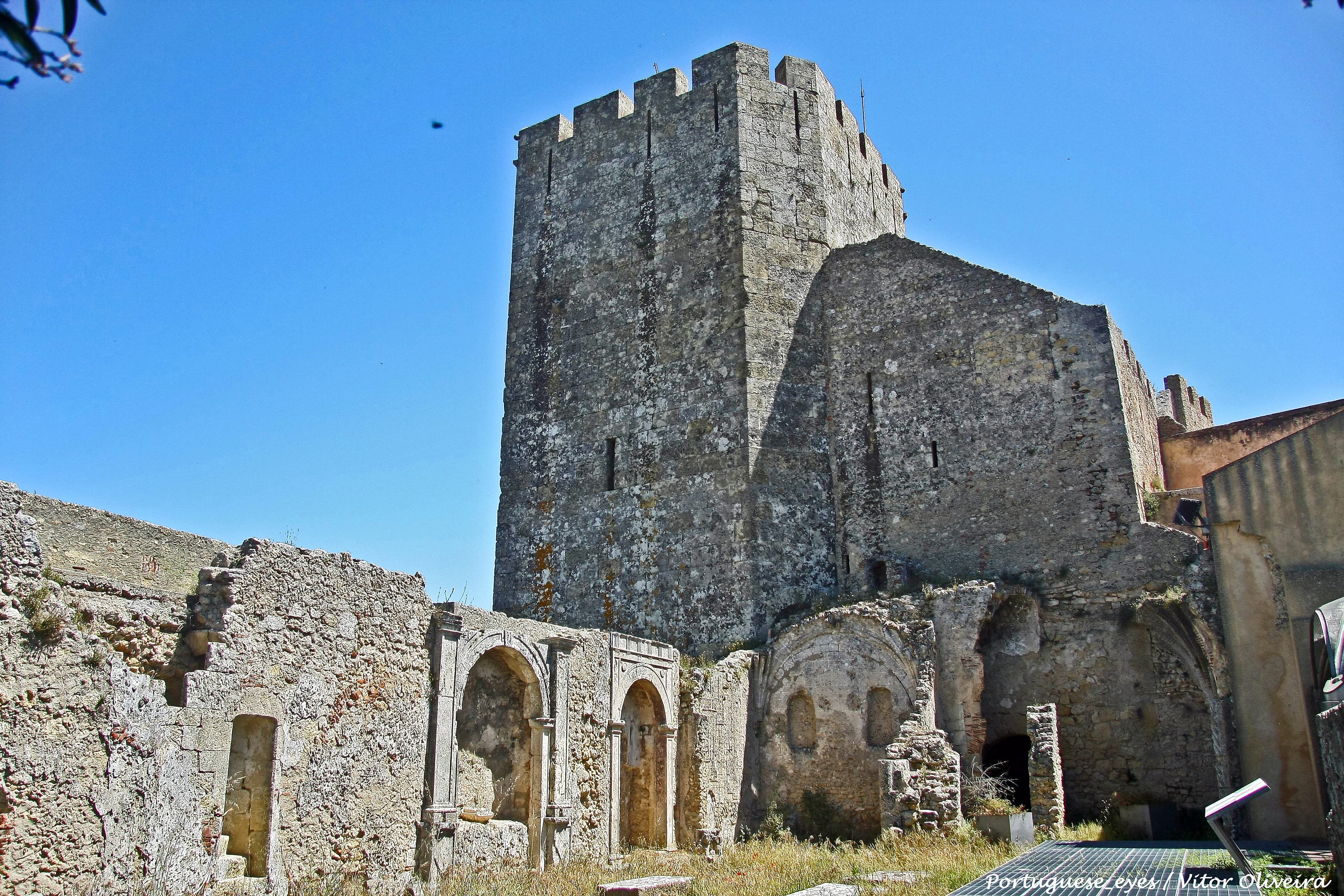
Image of Igreja de Santiago de Palmela. Image source
Visit essentials
A quick read before you go
- Access
- Located within the walls of Palmela Castle in the town of Palmela, Setúbal District, Portugal.
- Etiquette
- No site-specific dress code, photography rule, or offering custom is documented in the sources…
Overview
After the Christian reconquest, Palmela Castle was granted to the Order of Santiago de Espada, whose chapter was established there by 1205. King João I, as grand master, later ordered the church within its walls; construction ran from 1443 to 1482.
Its three naves, ogival arches, and lack of ornamental capitals express a military order's austere restraint. Grand Master Jorge de Lencastre later added Manueline details and his red Arrábida-marble tomb, which remains inside. The Order's chapter functions ended when Portugal abolished religious orders in 1834.
Unlike a neighboring castle building, the church did not fall to ruin: it became municipal patrimony, and the Câmara Municipal de Palmela now operates it as an exhibition and events space within the Museu Municipal de Palmela. The Order's former solemn interior is now visited chiefly as a monument to its history.
Why this place is sacred
No origin legend or miraculous apparition explains this church's importance; its significance is documented institutional history rather than devotional narrative. Palmela's lands passed to the Order of Santiago following the Christian reconquest of the region, with the Order's chapter installed in the castle by 1205.
The church itself, built from 1443 as the Order's headquarters, physically embodies the fusion of religious devotion and military discipline that defined Iberian crusading orders — a fusion visible in the building's own restraint: no ornamental capitals, three plain naves, the discipline of a fighting order rendered in stone.
The presence of the believed remains of D. Jorge, the Order's last Grand Master, in an Arrábida-marble tomb within the church, alongside centuries-old azulejos bearing the Order's insignia, gives the space a felt quality of accumulated historical and dynastic gravity.
Sources describe this in art-historical and heritage terms rather than explicitly numinous language, and that framing seems apt: what the space offers is less a thin place than a dense one — centuries of a specific institution's identity compressed into a single interior.
Experience and orientation
Approach the church as part of the wider castle circuit rather than as an isolated stop. Walk the nave slowly, noting how the absence of ornamental capitals changes the building's rhythm compared to more decorated Portuguese churches of the same period — the eye has less to rest on, which sharpens attention to scale and proportion instead.
Stand for a moment at the tomb of Jorge de Lencastre before moving to the tile panels; the contrast between his personal, ornamented Manueline monument and the surrounding austerity says something about how much the Order's later Grand Masters departed from its founding restraint. Give the 1752 Liège clock a longer look than its size suggests it deserves — it is one of the few objects in the room built for daily use rather than commemoration.
Context and lineage
No local apparition or miracle narrative attaches to this church; its founding is documented institutional history. Following the Christian reconquest of the region under King Afonso Henriques, Palmela's lands were granted to the Order of Santiago de Espada, and the Order's chapter was installed within the castle by 1205.
Sources describe the Order's headquarters arriving at Palmela in stages, though the exact year the church itself became the seat varies by source — an initial grant, the 1205 chapter installation, and finally the church itself, said to have been built from 1443 as the Order's formal seat under King João I's mastership, completed by 1482.
Decorative work continued afterward: Grand Master Jorge de Lencastre commissioned Manueline detailing and 17th- and 18th-century tile programs bearing the Order's insignia, and had himself buried within the church he had helped adorn, in a red Arrábida-marble tomb, upon his death in 1551.
The Order of Santiago occupied this church as its conventual and headquarters seat from 1443 until 1834, when Portugal abolished religious orders. Rather than falling into ruin — as the neighboring Igreja de Santa Maria within the same castle did — this building passed into municipal stewardship and was declared a National Monument in 1910.
Its living tradition today is one of heritage conservation and museum interpretation rather than religious practice: the Câmara Municipal de Palmela maintains it as a exhibition and events venue within the Museu Municipal de Palmela, and academic interest in the Order of Santiago's history, including work by researchers at the Universidade de Évora, keeps the building's institutional story actively studied.
João I of Portugal
royal patron / grand master
King of Portugal and grand master of the Order of Santiago, who ordered construction of the current church; building proceeded from 1443, completed by 1482.
Jorge de Lencastre
grand master
Illegitimate son of King João II and the Order's last Grand Master, who commissioned Manueline ornamentation and tile programs for the church and is buried within it in a red Arrábida-marble tomb, following his death in 1551.
Sancho I of Portugal
royal patron
King under whom the Order's chapter was first installed in Palmela Castle, by 1205, following the region's reconquest.
Câmara Municipal de Palmela
conservation steward
The municipal authority that now manages the church as part of the Museu Municipal de Palmela, running it as an exhibition and events space and the primary public-facing steward of its ongoing conservation.
Traditions and practice
Historically, the church hosted the conventual liturgy of the Order of Santiago, chapter meetings, and burial rites for Order dignitaries, including the interment of Grand Master Jorge de Lencastre after his death in 1551. Academic sources on the Order's convents in Palmela reference feast-day processions for São Tiago moving from the village to the convent, though further detail on their frequency or form was not found, and whether any such observance continues today remains unclear.
The building is used by the Câmara Municipal de Palmela as an exhibition space and venue for lectures and musical performances, run alongside the Museu Municipal de Palmela circuit that also includes the castle ruins. This is best understood as an active tradition of heritage stewardship and public interpretation rather than of religious practice — the church's current life is organized around conservation and education, not liturgy.
Approach the nave the way the Order's own austerity suggests: slowly, without expecting ornament to guide your attention. Stand at Jorge de Lencastre's tomb and consider that this was the closing chapter of an institution nearly four centuries old by the time he was buried here. Notice the 17th- and 18th-century tile panels not as decoration but as a record — the Order literally worked its own insignia into the walls of the room it prayed in.
Roman Catholic veneration of Saint James (Santiago/São Tiago), Order of Santiago de Espada
HistoricalThe church was built and dedicated as the conventual church of the Order of Santiago de Espada, a Portuguese military-religious order under the patronage of Saint James the Greater. It served as the Order's headquarters from 1443 until religious orders were abolished in Portugal in 1834.
Historically: conventual liturgy, chapter meetings of the Order, and burial rites for Order dignitaries, including the tomb of Grand Master Jorge de Lencastre, who died in 1551. Feast-day processions honoring São Tiago are referenced in academic sources on the Order's convents in Palmela, though it is unclear whether any such observance continues today.
Heritage conservation and museum stewardship
ActiveSince its 1910 classification as a National Monument, the church has been maintained through an active tradition of heritage conservation, with the Câmara Municipal de Palmela managing it as part of the Museu Municipal de Palmela and academic institutions, including the Universidade de Évora, studying the Order of Santiago's history connected to the site.
Ongoing conservation and public interpretation; use of the interior for museum exhibitions, lectures, and musical performances; continued academic research into the Order's convents at Palmela.
Perspectives and open questions
Historians and heritage authorities largely agree on this church's documented institutional history; the open questions concern not what it was, but what, if anything, it still is in devotional terms.
Scholarly perspective
Historians and heritage authorities agree the church was constructed from 1443 as the conventual and headquarters church of the Order of Santiago de Espada under King João I, with major decorative campaigns under Grand Master Jorge de Lencastre in the mid-16th century. It was classified a National Monument in 1910 and now functions as municipal museum and exhibition space.
Scholars treat its stripped, capital-less late-Gothic interior as a deliberate expression of the military order's identity rather than an accident of budget.
Open questions
The exact scope and current status, if any, of living devotional or processional practice tied to the church, as distinct from Palmela's active parish churches, is not clearly documented in available sources — whether any Mass or feast-day observance still occurs at or near this specific building remains unclear. Whether the church is marked or used as a stop on any living pilgrimage route, as opposed to being a historical Order-of-Santiago monument, is likewise unconfirmed.
Plan your visit
Access and arrival
Located within the walls of Palmela Castle in the town of Palmela, Setúbal District, Portugal. Both the castle ruins and the church are reported to be free to enter. The precinct also includes the Museu Municipal de Palmela, the ruined Igreja de Santa Maria (now housing the Office of Studies on the Order of Santiago), the Pousada Histórica de Palmela, and the local Tourist Office.
No mobile phone signal information for the site was available at time of writing; visitors relying on connectivity should check with the Câmara Municipal de Palmela or the Tourist Office directly. No opening-hours, keyholder, or seasonal-closure information verified against an official source was available at time of writing beyond one secondary aggregator's unconfirmed claim of Tuesday-to-Sunday 10:00-20:00; contact the Câmara Municipal de Palmela or consult cm-palmela.pt for current details before visiting.
The Pousada Histórica de Palmela, a hotel occupying part of the former convent complex within the same castle precinct, is the accommodation most directly tied to the site; no other lodging information specific to the church was found.
Respectful visit
No specific dress code, photography restriction, or offering custom was documented in the sources consulted. Given the church's current use as an exhibition and events venue rather than an active place of worship, standard museum-visit etiquette — quiet conduct, no touching artifacts — likely applies but was not explicitly stated by any source; confirm current visitor rules with the Câmara Municipal de Palmela.
One interior installation, described in a source as the 'Escultura São Tiago,' reportedly requires advance booking; confirm current arrangements with the Câmara Municipal de Palmela before visiting if this is a priority.
Location
Map loads as you approach this section.
Pilgrim reflections
A portrait of encounter, not a score
Pilgrims describe what they felt, how present they could become, and whether the place would shape a journey. There are no stars and no ranking of traditions.
No reviewed reflections yet
The first pilgrims can help describe the character of being here.
Share a reflection
Available after an account-backed “Been there.” Every reflection is reviewed before publication.
Nearby sacred places
Explore other sacred places in the region. Proximity does not establish access or travel time; check each place’s guidance.



References
Sources consulted for this page. Source categories describe the publication, not a guarantee that every claim is verified. Traditional accounts and outside interpretations may differ.
- 01Igreja de Santiago - Castelo de Palmela — Câmara Municipal de PalmelaofficialOfficial municipal museum page identifying the church as part of the Castelo de Palmela museum complex managed by the municipality.
- 02Igreja de Santiago | Turismo de Palmela - Palmela Conquista — Câmara Municipal de Palmela (Turismo)officialOfficial tourism site: late-Gothic architecture, National Monument designation (1910), ossuary ark believed to hold remains of D. Jorge, 17th/18th-century azulejos, 1752 Liège clock, current exhibition use.
- 03Igreja de Santiago de Palmela — Turismo de Portugal (visitportugal.com)officialNational tourism authority page: construction ordered by João I as grand master of the Order of Santiago; 1443 headquarters; tomb of Jorge de Lencastre (d. 1551) in Arrábida red marble, Manueline details; 18th-century 'carpet' tiles with Order insignia; Manueline ribbed dome in chancel.
- 04Convento e Igreja de Santiago de Palmela / Pousada de Santiago — SIPA / DGPC (Direção-Geral do Património Cultural), monumentos.gov.ptofficialOfficial Portuguese heritage inventory (SIPA) listing for the convent and church; identified via search results as the primary heritage record, though full page text was not directly retrievable during this research session.
- 05Os Conventos da Ordem de Santiago em Palmela — Universidade de Évora (dspace.uevora.pt repository)academicAcademic repository document on the Order of Santiago's convents in Palmela, referenced in search results as discussing historical processions from the village to the convent for the feast of São Tiago.
- 06Igreja de Santiago - Palmela — Entidade Regional de Turismo de Lisboa (ERT-RL), Turismo ReligiosoofficialRegional tourism authority's religious-tourism listing for the church, corroborating its status as a religious heritage site within Lisbon region tourism religious circuits.
- 07Igreja de Santiago de Palmela — Wikipedia — Wikipedia contributorsacademicConfirms coordinates (38°33'56"N 8°54'13"W), construction 1443–1482, National Monument status, categorized among burial sites of the House of Aviz. Marked as a stub needing expansion; less detailed than the Portuguese-language sources.
- 08Journey to Portugal 1: Palmela and the Monks of War — Algarve History AssociationacademicHistorical feature covering the Order of Santiago's military-religious role and the transformation of Palmela Castle after the Reconquista; confirms 1205 chapter installation under Sancho I and 1423 monastery construction order by João I.
- 09Order of Santiago — Wikipedia — Wikipedia contributorsacademicBackground on the Order of Santiago de Espada (Order of the Sword) as a Portuguese military-religious order, corroborating context for the Palmela headquarters claim.
- 10Igreja de Santiago de Palmela — Portugal de Norte a SulSource contextPortuguese travel/heritage guide corroborating architectural and historical details found in official sources.
Share a photo
Help visitors recognize Igreja de Santiago de Palmela. Every submission is reviewed before publication.