Glendalough
Where a hermit's cave grew into Ireland's monastic city
Understand sacred places, explore living traditions, and learn how to engage respectfully with Pilgrim Map.
Access has not been verified. Check current local guidance before planning a visit.
County Wicklow, Wicklow, Ireland
Read the sources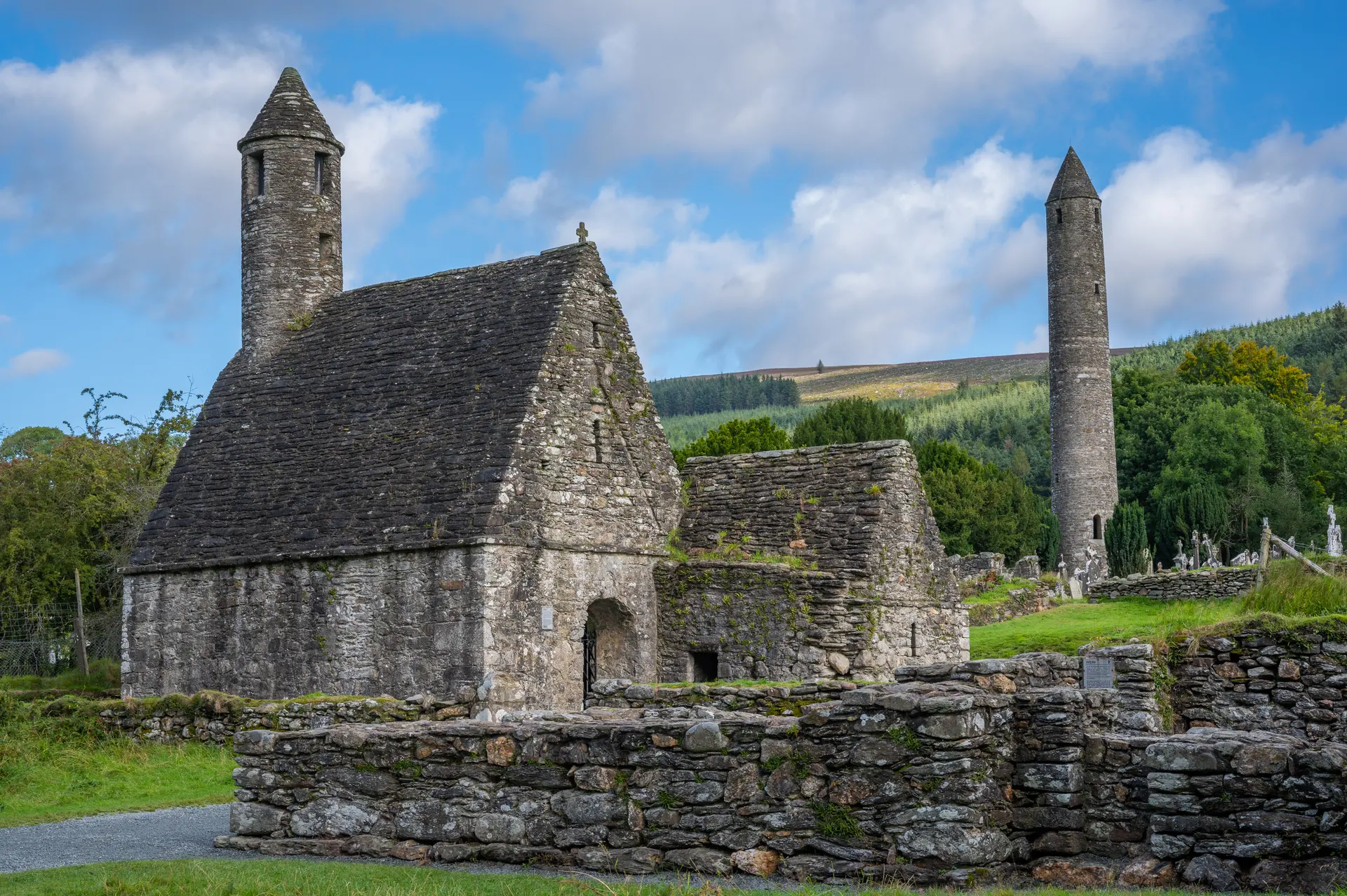
St. Kevin's Kitchen, Glendalough, Co. Wicklow (2023). Image source · CC BY-SA 4.0
Station end of 3
St Kevin's WayVisit essentials
A quick read before you go
- Duration
- 1-2 hours for the core monastic city (round tower, churches, high crosses, graveyard); half a…
- Access
- Glendalough is in County Wicklow, roughly 50km (about an hour's drive) south of Dublin,…
Overview
Glendalough, “valley of the two lakes,” is among Ireland's most complete early medieval monastic landscapes, formed over some six centuries around one monk's hermitage. St Kevin sought solitude in a lakeside cave; by the eleventh and twelfth centuries the community ranked among Ireland's most influential religious centers, producing scholars, drawing pilgrims, and surviving Viking raids that its 33-metre round tower was partly built to withstand.
English forces burned it in 1398, and it never fully recovered as a monastery, yet pilgrimage continued into the nineteenth century. Hikers now finish the 30-kilometre St Kevin's Way amid a Bronze Age tomb reused as a hermit's cell, Viking-era bell tower, medieval churches, and active graveyard. Steep oak woodland and quiet water bind these layers in a valley changed only modestly since Kevin arrived.
Why this place is sacred
The valley was chosen before it was built on. Kevin's decision to withdraw here in the late sixth or early seventh century (sources disagree on the exact date) was a decision about geography as much as devotion: a narrow glacial valley between two lakes, hemmed by steep slopes, offering the kind of remove from settled life that the early Irish monastic tradition prized. The site's holiness accumulated in stages rather than arriving at once.
First came the hermit phase — a lone figure living in a Bronze Age tomb-cave above the Upper Lake, subsisting on herbs and, tradition says, showing a gentleness toward animals that became his most repeated legend.
Then came community: followers drawn by his reputation built the wattle huts that archaeology has traced near the valley floor, and over the following centuries that settlement became a stone 'monastic city' with its own economy, craft production, and political ties to the Leinster and Munster kings who patronized it.
Finally came pilgrimage: medieval visitors travelling specifically to Kevin's tomb, a practice with enough staying power that it persisted, in the form of the Pattern Day gathering on his 3 June feast day, until Church authorities suppressed it in 1862 over concerns about disorderly conduct.
Today the sacredness is held less by ritual than by accumulation and continuity — the same valley, the same lakes, the same tower, still approached on foot by people walking St Kevin's Way, still holding burials in an active graveyard beside eleventh-century masonry.
A solitary hermitage for prayer and withdrawal from the world, chosen specifically for its remoteness and enclosure by water and hillside.
Grew from a single hermit's cell into a major monastic settlement and seat of learning by the 11th-12th centuries, was destroyed by English forces in 1398, continued afterward as a site of local pilgrimage and burial, and today functions as a state-managed heritage site, national park, and the terminus of a recognized pilgrim path.
Experience and orientation
The approach from the visitor centre puts the round tower in view almost immediately, rising above the roofless nave of the cathedral and the small, steep-roofed St Kevin's Church — nicknamed locally, for its round belfry, 'Kevin's Kitchen.' This lower cluster rewards slow attention: high crosses worn smooth by centuries of weather, doorway lintels cut for buildings that predate most of Western Europe's cathedrals, a graveyard where new burials sit within metres of graves a thousand years older.
The path onward to the Upper Lake changes register. Trees close in, the ground rises, and the two lakes' names — Lower and Upper — start to feel like a description of a journey rather than just a map.
At the Upper Lake, the valley narrows further; the cave known as Kevin's Bed sits in the cliff face across the water, visible but not easily reached, which for many visitors is itself part of the point — the hermit's retreat remains slightly out of reach, glimpsed rather than entered.
Early morning and late afternoon thin the crowds considerably and change the quality of light on the water; midday in summer brings coach parties and a busier, more social atmosphere around the visitor centre.
Start at the Visitor Centre for context, then walk the short loop through the monastic city (round tower, cathedral, St Kevin's Church, high crosses, graveyard) before continuing along the lakeshore path to the Upper Lake — allow the walk between the two lakes to function as a transition from historical site to landscape.
Context and lineage
St Kevin (Coemgen, meaning 'fair-begotten'), born around 498 AD to a noble Leinster family, came to Glendalough to live as a hermit, taking as his cell a Bronze Age tomb-cave above the Upper Lake still known as Kevin's Bed. Tradition holds that his solitary holiness drew followers who established the first monastic community nearby; archaeological traces of hazel-wattle huts near the valley floor may represent this earliest phase. Two legends recur across the sources.
In one, a blackbird lays an egg in Kevin's outstretched palm while he prays, and he holds perfectly still until the chick hatches — an image used ever since to represent his patience and closeness to the natural world.
In the other, the local ruler King O'Toole asks Kevin to heal his ailing pet goose; Kevin agrees on condition that whatever land the healed goose flies over becomes the monastery's, and the goose's flight is said to explain the extent of Glendalough's original landholding. Kevin died, by most accounts, on 3 June in either 618 or 622 AD, and was buried at the site that became his tomb-shrine and, for centuries afterward, a pilgrimage destination in its own right.
Glendalough belongs to the Insular Irish monastic tradition founded by figures such as Kevin, Colmcille, and Ciarán, and itself became a 'parent' foundation whose monks went on to establish daughter monasteries elsewhere in Ireland.
St Kevin (Coemgen)
Founder and first abbot; the monastery's namesake hermit and object of veneration
Muirchertach Ua Briain, Diarmait mac Murchada, and Toirdelbach Ua Conchobair
Regional Irish kings whose patronage and rivalry for the high kingship coincided with Glendalough's peak development, c. 1000-1150 AD
Cardinal Paul Cullen, Archbishop of Dublin
Suppressed the traditional 3 June Pattern Day pilgrimage in 1862 over concerns about disorderly conduct among pilgrims
UCD School of Archaeology
Conducted recent excavations clarifying the site's role as a centre of craft and trade alongside its religious function
Office of Public Works (OPW)
State body managing conservation, the visitor centre, and public access to the monastic site today
Traditions and practice
For much of the medieval and early modern period, pilgrims followed a set circuit or 'stations' around the monastic remains, culminating at Kevin's grave, with the largest gathering occurring on his feast day, 3 June, known locally as Pattern Day. This annual observance combined devotion with fair-like socializing and persisted until 1862, when Archbishop Cullen ended it amid concern over its increasingly secular and disorderly character.
Today's most visible living practice is the completion of St Kevin's Way, the 30-kilometre pilgrim path that runs from Hollywood or Valleymount over the Wicklow Gap to Glendalough. Walkers can carry a National Pilgrim Passport, stamped at recognized points along Ireland's medieval pilgrim paths, of which St Kevin's Way is one; the route is recognized by the Camino Society of Ireland.
Church of Ireland and Catholic services and occasional blessings are still held at or near the site, and individual visitors light candles or pray quietly within St Kevin's Church or at the graveyard.
Walkers approaching via St Kevin's Way might treat the final descent from the Wicklow Gap into the valley as the devotional core of the visit, arriving at the round tower as medieval pilgrims once did — on foot, after a genuine physical crossing.
Visitors arriving by car can recreate something of that same shift in register by walking from the Lower Lake to the Upper Lake before returning to the ruins, letting the landscape itself do the work that a formal ritual once did.
Irish Christianity (Insular monastic tradition)
ActiveGlendalough was founded by St Kevin as a hermitage and grew into one of early medieval Ireland's foremost monastic cities, producing scholars and daughter foundations and drawing centuries of pilgrims to Kevin's tomb.
Historically: fasting, psalmody, manuscript and craft work, hospitality to pilgrims, and an annual Pattern Day pilgrimage on Kevin's 3 June feast day. Today: walking St Kevin's Way, quiet prayer at the ruins and graveyard, and occasional formal church services held at or near the site.
Heritage stewardship and archaeological research
ActiveGlendalough functions today as a managed national monument within Wicklow Mountains National Park, with ongoing conservation, excavation, and public interpretation led by the Office of Public Works and university archaeology departments.
Conservation of the round tower and churches, staffed visitor interpretation, and continuing excavation (including recent work by UCD's School of Archaeology) that has reframed the site as a centre of craft and trade as well as religion.
Perspectives and open questions
Glendalough is read differently depending on the lens brought to it — as an archaeological record of monastic Ireland, as sanctified ground tied to a specific saint, or as a landscape whose felt stillness invites a looser, more personal sense of the sacred.
Scholarly perspective
Archaeologists and historians treat Glendalough as a case study in how an early Irish hermitage could grow, over several centuries, into a settlement with genuine economic and political weight — its location near the Wicklow Gap trade route mattered as much to its growth as its reputation for holiness, and recent excavation work (including by UCD's School of Archaeology) has emphasized craft production and trade alongside religious life.
The precise year of Kevin's death (618 or 622 AD, depending on source) and the exact extent of the earliest hermitage phase remain open questions.
Living and traditional perspectives
Within Irish Catholic and Church of Ireland devotion, Kevin is remembered as a model of ascetic patience and gentleness toward nature — the blackbird story is the touchstone image — and Glendalough is regarded as sanctified specifically because he lived, died, and was buried there. The historic Pattern Day pilgrimage on his feast day reflected this understanding directly, treating the site as a place where proximity to the saint's remains carried spiritual weight.
Alternative interpretations
Some contemporary visitors, including those with no formal religious affiliation, describe Glendalough in the language of Celtic spirituality's 'thin places' — locations where the boundary between ordinary and sacred experience feels unusually permeable — attributing this less to doctrine than to the valley's enclosed geography and the visible depth of time layered into it.
Open questions
The full layout and chronology of Kevin's original hermitage and the earliest wattle-hut settlement are only partially recovered archaeologically, and no contemporary sixth-century record of the founding survives — what is known comes from later hagiography and physical remains rather than an eyewitness account.
Plan your visit
Access and arrival
Glendalough is in County Wicklow, roughly 50km (about an hour's drive) south of Dublin, reachable by car or by seasonal/scheduled coach service (St Kevin's Bus) from the city. The outdoor monastic site, round tower exterior, high crosses, and both lakes are free to visit; the Upper Lake car park charges a parking fee, and the Visitor Centre (with exhibition and access to some interiors) charges a modest entrance fee.
Mobile phone signal is generally reliable at the Visitor Centre and Lower Lake but can be intermittent along remoter stretches of the Upper Lake trails and the Wicklow Gap section of St Kevin's Way; anyone attempting the full pilgrim path should not rely on continuous signal and should tell someone their planned route and timing.
Glendalough itself has limited on-site accommodation; most visitors stay in nearby villages such as Laragh or in Dublin and visit as a day trip. Hostels, B&Bs, and a campsite operate in the immediate area for those walking St Kevin's Way or wishing to stay overnight near the valley.
Respectful visit
No specific dress code applies. Comfortable, sturdy walking shoes are strongly advised — the monastic site itself is level, but the lakeshore paths and any section of St Kevin's Way involve uneven, sometimes wet terrain.
Photography is permitted throughout the outdoor monastic site, round tower, churches, and lakes. Visitors are asked to be mindful of others, particularly around the graveyard, and to avoid disrupting any service or private moment of prayer taking place at the time.
There is no established or expected offering practice at Glendalough. Some visitors leave flowers informally at graves or within St Kevin's Church; this is not a required or historically continuous ritual, and anything left should be biodegradable and unobtrusive, not treated as litter.
Metal detecting and removal of stones, artefacts, or any material from the site are prohibited, as at any protected national monument. Dogs are permitted in the wider park but must be kept on leads at all times, both for wildlife conservation and out of respect within the graveyard.
The graveyard is an active burial ground for the local parish; visitors should treat it with the same decorum expected at any working cemetery, not only as a historical monument.
Location
Map loads as you approach this section.
Pilgrim reflections
A portrait of encounter, not a score
Pilgrims describe what they felt, how present they could become, and whether the place would shape a journey. There are no stars and no ranking of traditions.
No reviewed reflections yet
The first pilgrims can help describe the character of being here.
Share a reflection
Available after an account-backed “Been there.” Every reflection is reviewed before publication.
Nearby sacred places
Explore other sacred places in the region. Proximity does not establish access or travel time; check each place’s guidance.


References
Sources consulted for this page. Source categories describe the publication, not a guarantee that every claim is verified. Traditional accounts and outside interpretations may differ.
- 01Glendalough — Wikipedia — Wikipedia contributorsacademicGeneral overview of site history, geography, and monastic remains
- 02Kevin of Glendalough — Wikipedia — Wikipedia contributorsacademicBiography, hagiographical legends including the O'Toole's goose story and hermitage in Kevin's Bed
- 03Glendalough Monastic Site and Visitor Centre — Heritage Ireland — Office of Public Works, IrelandofficialOfficial state heritage body description of the monastic city and visitor access
- 04Glendalough — Monastic Ireland — Monastic Ireland (UCD-affiliated research project)academicScholarly overview of founding, strategic location near the Wicklow Gap, and peak period c. 1000-1150 AD under regional kings; notes recent UCD School of Archaeology excavations
- 05Saint Kevin's Way — Wikipedia — Wikipedia contributorsacademicRoute details for the 30km pilgrim path from Hollywood/Valleymount over the Wicklow Gap to Glendalough
- 06Saint Kevin's Way Pilgrim Path — Wicklow County Tourism — Wicklow County TourismofficialConfirms recognition as an official pilgrim route by the Camino Society of Ireland and inclusion in the National Pilgrim Passport (2016)
- 07Early Medieval Monastic Sites — UNESCO Tentative List — UNESCO World Heritage CentreofficialGlendalough is part of Ireland's tentative UNESCO World Heritage nomination for early medieval monastic sites
- 08Monastic City — Glendalough.ie — Glendalough Visitor Centre / OPWSource contextVisitor-facing description of the round tower, churches, and high crosses across the site
- 09Ultimate Guide To Hiking The St. Kevin's Way & Glendalough Trail — Hillwalk ToursSource contextPractical route and terrain detail for the pilgrim path
- 10Ireland Wildlife Photography Guide — Nature TTLSource contextNotes on Wicklow Mountains National Park wildlife (deer rut in autumn, birdlife) relevant to seasonal visiting
Photo gallery
3 curated photos
Share a photo
Help visitors recognize Glendalough. Every submission is reviewed before publication.