Black Madonna of Dublin
InsideWhitefriar Street Carmelite Church
A medieval Madonna who survived the Reformation in darkness and emerged to reclaim her altar
Understand sacred places, explore living traditions, and learn how to engage respectfully with Pilgrim Map.
Access has not been verified. Check current local guidance before planning a visit.
Dublin, County Dublin, Ireland
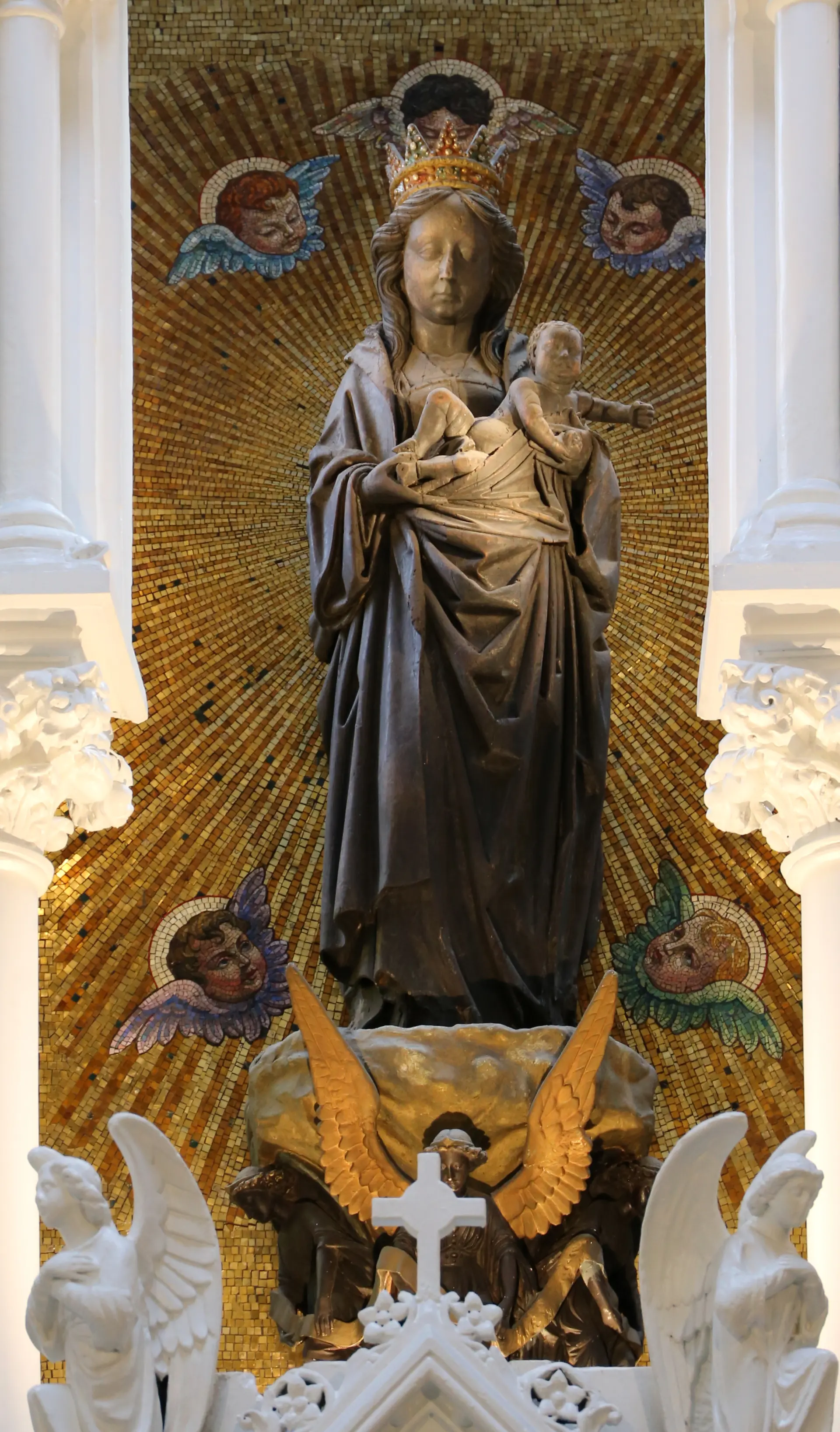
Image of Black Madonna of Dublin. Image source · CC-BY-3.0
Visit essentials
A quick read before you go
- Duration
- 30 to 45 minutes to explore the church architecture, both shrines, and spend time in…
- Etiquette
- Standard Catholic church etiquette: quiet behaviour, respectful dress, sensitivity to…
Overview
The statue known as Our Lady of Dublin stands in the Carmelite Church on Whitefriar Street, a few minutes' walk from St. Stephen's Green in the centre of Dublin. She is carved from a single block of oak, life-sized, holding the Christ Child.
Her surface is dark, the original bright polychrome of gold and blue long gone, replaced by the deep patina of age and whatever fires, neglect, and weather she endured during the centuries between the Reformation and her recovery.
According to legend, the statue originated in St. Mary's Abbey, one of medieval Dublin's richest and most powerful religious houses, a Cistercian monastery founded in 1139. When Henry VIII dissolved the abbey in 1539, the statue survived the destruction but was degraded.
The story, which scholars describe as having tenuous documentary support but powerful cultural resonance, holds that the hollow carved into the Madonna's back, a standard technique to prevent the wood from splitting, made her suitable for use as a pig trough in an inn beside the ruined abbey. The image of the Mother of God serving as a trough for animals echoes the Nativity itself, and this symmetry has not been lost on those who venerate her.
The statue disappeared from the historical record for over two hundred years. She surfaces in 1749 in a survey of Catholic chapels, housed in a small chapel on St. Mary's Lane. When that chapel was demolished in 1816, she vanished again until Father John Spratt of the Carmelite Order found her in 1824 and brought her to the newly built Whitefriar Street Church.
She has stood near the high altar since 1915, in a purpose-built shrine, dark and silent, receiving the prayers and candles of Dublin's faithful.
Our Lady of Dublin is Ireland's representative in the European tradition of Black Madonnas, those dark-skinned images of the Virgin found from Czestochowa to Montserrat, whose darkness is interpreted variously as original pigmentation, fire damage, the patina of age, or a deliberate evocation of the earth, the womb, and the hidden places where the sacred persists unseen.
Why this place is sacred
The thinness at Whitefriar Street Church does not come from landscape or ancient stone. It comes from a narrative of survival and the accumulated weight of centuries of devotion, interruption, degradation, and renewal. Our Lady of Dublin is thin because she has been through the fire, literally and figuratively, and what remains is not the bright medieval original but something darker, deeper, and more honest.
Consider her journey. If the legend is true, she stood in St. Mary's Abbey when it was one of the most powerful religious houses in Ireland. She was gilded and painted, brilliant with gold and blue. The monks processed before her. Pilgrims venerated her. Then the Reformation came. The abbey was dissolved. The gold was stripped, the monks expelled, the buildings cannibalized for stone.
The Madonna, too large to destroy easily and too beautiful in form to burn, was put to other uses. A pig trough. The hollow in her back, which the original carver had made to prevent warping, now served to hold feed for animals. The Mother of God, inverted, filled with slop.
Whether this happened exactly as told is uncertain. What is certain is the statue's two-hundred-year absence from the historical record, the gap between 1539 and 1749 during which an object of medieval veneration simply disappeared. This gap is itself a kind of thinness, an absence that speaks. Where was she? Who kept her? Why did she survive when virtually every other piece of medieval devotional art in Dublin was destroyed?
When she reappears in 1749, she is in a small Catholic chapel, unremarked, her identity as a significant medieval devotional image apparently forgotten. She disappears again in 1816 when the chapel is demolished. She is found once more in 1824 by Father John Spratt, a Carmelite friar, and brought to the new church. Each disappearance and recovery adds a layer to her meaning. She is not merely a statue of the Madonna.
She is a Madonna who has been lost and found, debased and restored, forgotten and remembered.
The statue was carved, probably in the fifteenth or early sixteenth century, as a devotional image for veneration in a Catholic church or monastery. The original bright polychrome indicates she was intended to be visually prominent and liturgically significant.
From a gilded medieval devotional image to a degraded object of uncertain provenance, through two centuries of obscurity, to her nineteenth-century rescue by Father John Spratt and eventual placement in a purpose-built shrine near the high altar of Whitefriar Street Church. The statue's darkened surface, whether from fire, age, or exposure, has transformed her from a bright medieval madonna into a Black Madonna, connecting her to a much older and wider European devotional tradition.
Experience and orientation
The threshold effect is immediate. Aungier Street is one of Dublin's busy commercial corridors, lined with shops and restaurants, heavy with traffic. The entrance to Whitefriar Street Church opens directly from this urban noise into a space of candlelight, silence, and stone. The contrast is sharp enough to feel physical. Your eyes adjust. The street recedes.
Whitefriar Street Church is one of Dublin's largest churches, and its interior is generous with space and light filtered through stained glass. The church is active: people come and go throughout the day, slipping into pews for a few minutes of prayer between errands, lighting candles, attending one of the multiple daily masses. This is not a museum. The sacred objects here are in use.
Our Lady of Dublin stands in a shrine near the high altar, on the left side of the church as you face forward. She is life-sized, carved in oak, holding the Christ Child. Her surface is dark, the colour of old wood long weathered, with traces of the original polychrome visible in certain lights. She is not dramatically lit or theatrically presented.
She stands in her shrine with the quiet authority of something that has been here a long time and intends to stay.
What strikes many visitors first is the weight of her presence. This is not a reproduction or a modern interpretation. This is a medieval object, carved by a hand that has been dust for five centuries, from a tree that grew in an Ireland that no longer exists. The surface carries the marks of time in its grain and darkness. Place your attention on the face and hands: the carving, beneath the darkened surface, is accomplished and expressive.
The Christ Child sits naturally on her arm. Her expression, insofar as it can be read through the patina, is neither smiling nor sorrowful but present.
The shrine is modest and intimate. Candles burn before the statue. Prayer cards and devotional items are available. Catholic visitors kneel and pray. Others simply stand and look. The experience does not require any particular belief framework. The encounter is with age, survival, and the human impulse to venerate what endures.
Before leaving, visit the shrine of St. Valentine on the opposite side of the church. The relics of the third-century martyr were presented to Father Spratt by Pope Gregory XVI in 1836, and they draw large crowds on February 14. The combination of these two devotional centres, the medieval Black Madonna and the ancient saint of love, gives Whitefriar Street Church a devotional richness unusual in Dublin.
Whitefriar Street Carmelite Church is located at 56 Aungier Street, Dublin 2, approximately five minutes' walk from St. Stephen's Green. Our Lady of Dublin is in a shrine near the high altar on the left side. The shrine of St. Valentine is also prominently displayed.
Context and lineage
The legend traces the statue to St. Mary's Abbey, a Cistercian monastery founded in 1139 that became one of the wealthiest and most powerful religious houses in medieval Dublin. When Henry VIII dissolved the monastery in 1539, the stone was carted away for building material and the treasures dispersed.
According to tradition, the oak Madonna survived because the hollow carved into her back, a standard woodworking technique to prevent splitting, made her useful as a pig trough in an inn beside the ruined abbey.
This story, scholars note, has tenuous documentary support. It may be a folk embellishment that crystallized around a genuine medieval statue whose actual provenance is unknown. What is documented is that a survey of Catholic chapels in Dublin in 1749 records a statue matching her description in a small chapel on St. Mary's Lane. When that chapel was demolished in 1816, the statue disappeared again.
In 1824, Father John Spratt, a Carmelite friar known for his social activism and oratorical gifts, found the statue and brought it to the newly consecrated Whitefriar Street Church. The church had been built by the Carmelites, who had first arrived in Dublin in 1279, been dissolved in 1539, and gradually re-established in the area from the early seventeenth century. The statue was placed near the high altar, where she has remained since.
In 1915, a purpose-built shrine was constructed for her.
Our Lady of Dublin belongs to the European tradition of Black Madonnas, dark-skinned images of the Virgin Mary found across Europe from Czestochowa in Poland to Montserrat in Catalonia to Le Puy in France. Whether her darkness is original, the result of fire damage, or the natural darkening of oak over centuries is unknown.
Within Ireland, she is the most significant surviving medieval devotional statue and one of the very few pieces of pre-Reformation sacred art to survive the dissolution of the monasteries.
Father John Spratt, O.Carm.
Unknown medieval carver
George Papworth
Traditions and practice
Medieval Marian devotion at the original location would have included liturgical celebrations of Marian feasts, processions, and prayers before the brightly painted statue. After the Reformation, the statue's devotional use went underground along with Irish Catholic practice under the Penal Laws. Since her restoration to public veneration in the nineteenth century, standard Catholic Marian devotions have been practiced before her, rooted in the Carmelite tradition with its particular emphasis on the Blessed Mother.
The feast day of Our Lady of Dublin is celebrated on September 8, coinciding with the feast of the Nativity of the Blessed Virgin Mary. Regular church devotions include the Miraculous Medal prayers on Mondays at 2:30pm, Our Lady of Mount Carmel Rosary on Saturdays at 2:30pm, and Prayer for Vocations on Fridays at 2:30pm. Multiple daily masses are celebrated throughout the week. St.
Valentine's Day on February 14 is the busiest day of the year, as couples come to have relationships blessed at the shrine of St. Valentine. Candle-lighting at the statue of Our Lady of Dublin is continuous.
Enter the church and allow your eyes to adjust to the candlelight. Find the statue of Our Lady of Dublin near the high altar on the left side. Stand before her and take time to observe the carved details beneath the darkened surface. Notice the quality of the woodwork, the naturalistic positioning of the Child, the expression on the face.
If you wish, light a candle at the shrine. This is a simple gesture available to visitors of all backgrounds, and the act of striking a match and placing a flame in a dark church connects you to a practice that has accompanied this statue for centuries.
Spend time with the statue's story. The information available at the shrine and in the church describes her journey from medieval abbey to pig trough to shrine. Let the narrative of descent and restoration speak to whatever in your own life has been lost and found, degraded and honoured, hidden and brought to light.
Before leaving, visit the shrine of St. Valentine on the opposite side of the church. The two devotional centres create a conversation between medieval Marian piety and early Christian martyrdom that is unique in Dublin.
Roman Catholic Marian Devotion
ActiveOur Lady of Dublin is one of Ireland's most significant Marian images and a rare surviving medieval devotional statue. The life-sized oak carving has been venerated continuously since at least 1749 and, according to tradition, since before the Reformation. Her survival through centuries of persecution and neglect embodies the resilience of Catholic faith in Ireland.
Veneration with prayer and candle-lighting. Feast day celebration on September 8 (Nativity of the Blessed Virgin Mary). Regular Marian devotions including the Rosary and Miraculous Medal prayers. Pilgrimage to the statue as part of Catholic visits to Dublin.
Carmelite Spirituality
ActiveThe church is dedicated to Our Lady of Mount Carmel and has been under Carmelite care since re-establishment in 1825 (originally founded 1279, dissolved 1539). The Carmelite order's strong Marian devotion is deepened by the presence of this medieval Madonna.
Our Lady of Mount Carmel Rosary on Saturdays at 2:30pm. Brown Scapular devotion. Regular masses and sacramental services. Contemplative prayer in the Carmelite tradition.
Black Madonna Tradition
ActiveOur Lady of Dublin is Ireland's representative in the broader European tradition of Black Madonnas, dark-skinned images of the Virgin found across Europe. Her dark colouring, whether from age, fire, or original pigmentation, connects her to a medieval devotional tradition that some scholars link to pre-Christian earth-mother veneration.
Devotees of the Black Madonna tradition visit specifically for this aspect of the statue's identity. The symbolism of a Madonna who has survived persecution, degradation, and obscurity carries particular power for those who identify with experiences of suffering and marginalization.
Perspectives and open questions
Our Lady of Dublin is understood through art historical, theological, and symbolic frameworks. Her meaning shifts depending on whether you approach her as a medieval artefact, a devotional image, or a symbol of faith surviving persecution.
Scholarly perspective
Art historians date the statue to the fifteenth or early sixteenth century based on stylistic comparison with other wooden statuary of the period. The association with St. Mary's Abbey is described as having tenuous documentary support. The first confirmed historical mention dates to 1749. The practice of hollowing the back of wooden statues to prevent warping was standard and explains the pig trough legend.
Scholars recognize the statue as one of the very few surviving pieces of pre-Reformation devotional art from Dublin.
Living and traditional perspectives
In Irish Catholic tradition, the survival of Our Lady of Dublin through the Reformation is seen as providential, an emblem of the persistence of faith despite persecution. The narrative mirrors the broader Irish Catholic experience: faith driven underground, debased and forgotten, only to re-emerge and be restored to honour. Father Spratt's rescue of the statue in 1824, during the era of Catholic Emancipation, gives it particular resonance in Irish religious history.
Alternative interpretations
Within the Black Madonna tradition, Our Lady of Dublin is interpreted as an expression of the hidden divine feminine, the aspect of the sacred that dwells in darkness, earth, and suffering before emerging into light. Some interpret the statue's blackening as connecting her to pre-Christian goddess traditions, particularly Irish earth-mother figures. The narrative of descent from altar to pig trough and ascent back to the altar mirrors alchemical and psychological themes of transformation through degradation.
Open questions
The exact origin of the statue remains unknown. The St. Mary's Abbey provenance is legend, not documented fact. The two-hundred-year gap between 1539 and 1749 is unexplained. Whether the statue was actually used as a pig trough cannot be confirmed. The original appearance, with bright gold and blue polychrome, was dramatically different from her current dark form. Whether she was originally intended as a Black Madonna or acquired her darkness over time is uncertain.
Plan your visit
Access and arrival
Dublin city centre offers extensive accommodation at all price levels. The church is easily accessible from any central Dublin location. Mobile phone signal is fully reliable throughout the area. Phone: 01 475 8821.
Respectful visit
Modest, respectful attire appropriate for an active Catholic church. No specific dress requirements beyond standard courtesy.
Photography is generally permitted but should be done discreetly and never during services. Flash photography may disturb other visitors. Respect the privacy of worshippers.
Candles can be purchased and lit at the shrines. Monetary donations are welcomed. No physical offerings are placed on the statue.
Maintain quiet, especially during services. Do not touch the statue or shrine. Turn off mobile phones during services. The church closes at posted hours, which vary by day. Tuesday is the latest closing (9pm). Sunday hours are 10am to 2pm.
The church is an active parish with services throughout the day. Visitors should be mindful of worshippers engaged in prayer. Photography is generally permitted but should be done discreetly and not during services.
Current practical details
Address
Pro-Cathedral House, 83 Marlborough Pl, North City, Dublin 1, D01 TX49, Ireland
Phone
Hours
Hours, fees, and access can change — verify on the official source before you travel. Practical details last checked Jun 2026.
Location
Map loads as you approach this section.
Pilgrim reflections
A portrait of encounter, not a score
Pilgrims describe what they felt, how present they could become, and whether the place would shape a journey. There are no stars and no ranking of traditions.
No reviewed reflections yet
The first pilgrims can help describe the character of being here.
Share a reflection
Available after an account-backed “Been there.” Every reflection is reviewed before publication.
Nearby sacred places
Explore other sacred places in the region. Proximity does not establish access or travel time; check each place’s guidance.

Photo gallery
3 curated photos
Share a photo
Help visitors recognize Black Madonna of Dublin. Every submission is reviewed before publication.