Faro Cathedral
Roman temple, Visigothic basilica, mosque, and cathedral stacked on one Algarve square
Understand sacred places, explore living traditions, and learn how to engage respectfully with Pilgrim Map.
Access has not been verified. Check current local guidance before planning a visit.
Faro, Faro, Portugal
Read the sources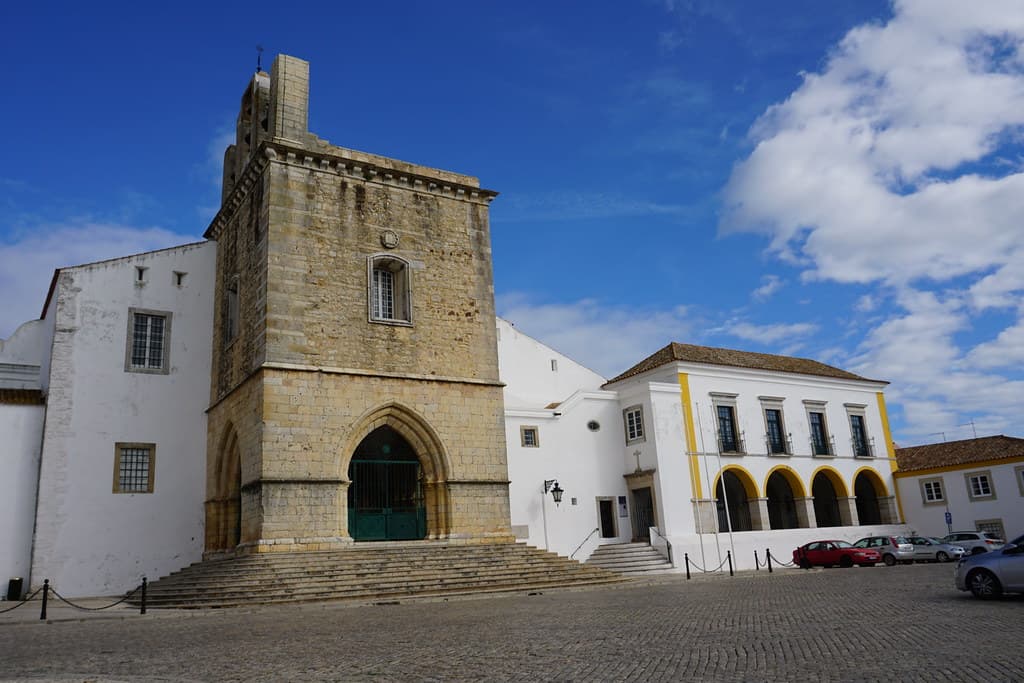
Image of Faro Cathedral. Image source
Visit essentials
A quick read before you go
- Duration
- 45 minutes to 1.5 hours, including the nave, treasury museum, bone altar courtyard, and…
- Access
- Located on Largo da Sé in Faro's walled Old Town (Cidade Velha), reached via the Arco da Vila…
Overview
Faro Cathedral stands on ground used for worship in different forms for over two thousand years. Beneath the present Mannerist-Baroque building lie successive footprints of a Roman temple, early Christian basilica, and mosque from centuries of Moorish Algarve rule. The cathedral dates to Faro's Christian reconquest in 1249 and partly reuses the mosque's stones.
In 1596, Robert Devereux, second Earl of Essex, sacked Faro, destroyed much of the cathedral, and carried off the bishop's library. Essex donated the looted books to Thomas Bodley, unexpectedly enriching Oxford's Bodleian Library. The Gothic sanctuary chapels, tower, and nave walls survived; the rest was rebuilt in today's Mannerist style. The 1755 earthquake required only moderate further repairs because Faro's sandbanks blunted the tsunami.
The active seat of the Diocese of the Algarve holds regular Masses alongside paid access to its bell tower, treasury museum, and a small outdoor altar of human bones, distinct from Faro's larger bone chapel.
Why this place is sacred
What distinguishes Faro Cathedral is not a single foundational event but layered continuity: this site in ancient Ossonoba appears to have hosted a Roman temple, then an early Christian basilica sometime in the fourth to sixth centuries, then a mosque after the eighth-century Moorish conquest, before becoming a Catholic cathedral following the 1249 Reconquista.
Tradition holds that a bishop of Ossónoba, Vicente, signed the acts of the Council of Elvira in 303 CE — evidence, if accurate, of an organized Church presence here well before the Islamic period, though the precise scale of that early basilica rests on tradition rather than confirmed excavation.
The building's survival is its own kind of testimony. Robert Devereux, Earl of Essex, sacked the cathedral in 1596, and the 1755 earthquake that leveled much of Lisbon reached Faro too, though the Ria Formosa's sandbanks softened its force here relative to elsewhere in the Algarve. Neither event ended the cathedral's function; each time, the diocese rebuilt and Mass resumed.
The current structure was substantially reconstructed in Mannerist style during the seventeenth century after the 1596 destruction, reusing surviving Gothic sanctuary chapels, tower, and nave walls. The 1755 earthquake required only moderate repair work, thanks to Faro's relative geographic protection. The cathedral remains a Portuguese National Monument, without UNESCO designation.
Experience and orientation
The climb up the cathedral's 68-step bell tower is, for many visitors, the reason to come: a narrow staircase opening onto a panoramic view over Faro's terracotta rooftops and the Ria Formosa lagoon beyond the old city walls. Late afternoon, closer to golden hour, gives the clearest light for both the view and the exterior facade.
Below, the whitewashed Baroque nave holds gilded woodwork and azulejo tile chapels depicting biblical scenes, alongside an eighteenth-century organ decorated with chinoiserie paintings by a local Tavira artist. A small outdoor altar built from human bones sits in a courtyard — distinct from, and smaller than, the more elaborate Capela dos Ossos at the nearby Igreja do Carmo, a distinction worth knowing before visiting either.
The tower bells ring roughly every fifteen minutes and are loud enough to catch visitors off guard mid-visit — a reminder, more than anything, that this is a working bell tower rather than a museum piece.
Ticketed access (around €5, €3.50 reduced) covers the nave, bell tower, treasury museum, and bone altar. There is no elevator to the tower — only the 68-step staircase, awkward with large luggage. The cathedral closes to general visits during scheduled Masses.
Context and lineage
Tradition places organized Christian worship in this part of the Algarve as early as 303 CE, when Bishop Vicente of Ossónoba is said to have signed the acts of the Council of Elvira — evidence, if the tradition holds, of a functioning Church presence well before the Moorish conquest, though the claim rests on tradition rather than confirmed archaeology.
The site itself layers a Roman temple, an early Christian basilica of the fourth to sixth centuries, and a mosque built after the eighth-century Moorish conquest of the Algarve (called Al-Gharb).
Following the Christian reconquest of Faro in 1249, the mosque was demolished and its stones reused to build the current cathedral, consecrated to the Blessed Virgin Mary by the late thirteenth century. In 1596, Robert Devereux, second Earl of Essex, sacked Faro and severely damaged the cathedral, looting the bishop's library — books that Essex later donated to Thomas Bodley, becoming part of the founding collection of Oxford's Bodleian Library.
The Gothic sanctuary chapels, tower, and nave walls survived the attack; the rest was rebuilt in Mannerist style during the seventeenth century. Sources disagree on when the diocesan seat formally moved to Faro — one account gives 1540 under King John III, another gives 1577 — and this account leaves the discrepancy unresolved rather than asserting either as definitive.
As the seat of the Diocese of the Algarve, Faro Cathedral has anchored Catholic ecclesiastical authority in the region since the thirteenth-century Reconquista, surviving the 1596 sacking and the 1755 earthquake to remain in continuous use for worship nearly 800 years on.
Bishop Vicente of Ossónoba
historical
Traditionally said to have attended the Council of Elvira in 303 CE, representing the earliest claimed evidence of an organized Church presence at the site — a tradition, not an archaeologically confirmed fact.
Robert Devereux, 2nd Earl of Essex
historical
English nobleman who sacked Faro and severely damaged the cathedral in 1596, looting the bishop's library; the stolen books were later donated to Thomas Bodley and became part of Oxford's Bodleian Library.
Johann Heinrich Hulenkampf
historical
Builder of the cathedral's 1715 pipe organ, later decorated with 1751 chinoiserie paintings by a local Tavira artist.
Traditions and practice
Historic processions and civic-religious ceremonies accompanied the cathedral's role as diocesan seat across nearly eight centuries, including observances tied to community festivals referenced in historical accounts, though specifics beyond this general pattern are not well documented.
Scheduled Catholic Masses continue on weekdays (around 08:45-09:00), Saturday evenings (18:00 vigil), and Sunday (12:00 principal Mass), alongside occasional classical and sacred music concerts using the cathedral's chinoiserie-painted pipe organ.
Attending the quieter Sunday Mass, rather than visiting only as a ticketed sightseer, offers a different register of encounter with a building otherwise experienced mainly through its tower views and museum pieces.
Roman Catholicism
ActiveFaro Cathedral is the seat of the Diocese of the Algarve, consecrated to the Blessed Virgin Mary, and the site of continuous Catholic worship since the thirteenth-century Reconquista, following a layered history as a Roman temple, early Christian basilica, and mosque.
Regular weekday and Sunday Mass, a Saturday vigil Mass, and occasional sacred music concerts on the eighteenth-century pipe organ.
Sunni Islam (historical)
HistoricalThe site functioned as a mosque during the centuries of Moorish rule over the Algarve (Al-Gharb), prior to the Christian Reconquista of Faro in 1249.
Historical Islamic congregational prayer; no current practice at the site.
Perspectives and open questions
Faro Cathedral's layered religious history across Roman, Visigothic, Islamic, and Catholic use is broadly agreed upon; what remains genuinely unsettled is a narrower question — the exact year the diocesan seat formally moved here.
Scholarly perspective
Historians and archaeologists broadly agree on the site's layered religious use — Roman Ossonoba, a Christian basilica, a mosque under Moorish rule, and the current cathedral built after the 1249 Reconquista — though precise dating of the earliest Christian basilica phase relies partly on tradition rather than confirmed excavation.
Living and traditional perspectives
Local Catholic tradition emphasizes continuity of the Algarve's Christian identity from the third-century Council of Elvira attendance through to the present diocesan seat, framing the cathedral as an unbroken thread of regional faith despite the intervening Islamic period.
Open questions
The exact scale and form of the pre-mosque Visigothic or early Christian basilica remain uncertain, as does the precise year the diocesan seat formally moved to Faro — sources conflict between 1540 and 1577, and this account does not resolve the discrepancy.
Plan your visit
Access and arrival
Located on Largo da Sé in Faro's walled Old Town (Cidade Velha), reached via the Arco da Vila gateway; ticket around €5 standard, €3.50 reduced for students and seniors, covering the nave, bell tower, treasury museum, and outdoor bone altar. No elevator to the bell tower — only a steep 68-step staircase.
Respectful visit
Standard modest church dress is expected — shoulders and knees covered — consistent with Catholic cathedral norms generally, though no site-specific enforcement details were found.
Photography is generally permitted inside, but flash should be avoided, particularly near azulejos and altarpieces or during religious services.
Visitors should avoid disrupting active Masses; large luggage is discouraged on the narrow 68-step bell-tower staircase, which has no elevator alternative.
The cathedral closes to general ticketed visits during scheduled Masses; check the weekday, Saturday vigil, and Sunday times before planning a visit that includes the tower or treasury museum.
Location
Map loads as you approach this section.
Pilgrim reflections
A portrait of encounter, not a score
Pilgrims describe what they felt, how present they could become, and whether the place would shape a journey. There are no stars and no ranking of traditions.
No reviewed reflections yet
The first pilgrims can help describe the character of being here.
Share a reflection
Available after an account-backed “Been there.” Every reflection is reviewed before publication.
Nearby sacred places
Explore other sacred places in the region. Proximity does not establish access or travel time; check each place’s guidance.


References
Sources consulted for this page. Source categories describe the publication, not a guarantee that every claim is verified. Traditional accounts and outside interpretations may differ.
- 01Sé Catedral de Faro — Turismo de PortugalofficialOfficial tourism-board description; consecration to Blessed Virgin Mary in late 13th century, diocesan seat history, Mannerist 17th-century rebuild.
- 02The Earl of Essex and the Bishop's Library — Algarve History Associationacademic1596 sacking of Faro/cathedral by Robert Devereux, 2nd Earl of Essex; looted bishop's library donated to Thomas Bodley/Oxford; survival of Gothic sanctuary chapels, tower, and nave walls.
- 03The 1755 Lisbon Earthquake and the Algarve — Algarve History AssociationacademicFaro's relative protection from the 1755 earthquake/tsunami due to the sandbanks of Ria Formosa, contrasted with heavier damage elsewhere in the Algarve; 1722/1755 earthquakes caused only moderate additional repair work to the cathedral.
- 04Faro Cathedral - Wikipedia — Wikipedia contributorsSource contextConstruction timeline, 1249 Reconquista conversion, 1596 destruction by Earl of Essex, architectural mix (Gothic, Baroque, Portuguese Plain Style), National Monument status, organ by Johann Heinrich Hulenkampf, outdoor bone altar.
- 05The Cathedral of Faro was built at the site of an Muslim mosque in 1251 — Islamic History and TravelSource contextCorroborates the Roman temple → Visigothic basilica → mosque → cathedral layering narrative from an Islamic-heritage perspective.
- 06The Sé de Faro Cathedral: A Guide to the Algarve's Ecclesiastical Heart — Algarve TouristSource contextLayered history (Roman forum/temple, early Christian basilica 4th-6th c., mosque after 8th-c. Moorish conquest), demolition of mosque stones reused in new church.
- 07FARO CATHEDRAL - Complete Visitor's Guide — Faro Portugal TourismSource contextOpening hours by season, ticket pricing (~€5/€3.50 reduced), bell tower access via 68-step staircase, views over Ria Formosa, mass schedule (weekday ~08:45/09:00, Saturday vigil 18:00, Sunday principal Mass 12:00).
- 08The Carmelite "Capela des Ossos" (Chapel of the Bones) in Faro, Portugal — Liturgical Arts JournalspiritualDistinguishes the cathedral's small courtyard bone altar from the larger, separate Capela dos Ossos at Igreja do Carmo (built 1816 from ~1,245 monks' remains); clarifies Faro has two distinct bone-related sites.
- 09Visiting Faro's Awesome Cathedral - Igreja de Santa Maria — Rota PortugalSource contextAzulejo tile chapels depicting biblical scenes; 1715 organ by Johann Heinrich Hulenkampf decorated with 1751 chinoiserie paintings by a local Tavira artist.
- 10Caminho de Santiago (Faro > Santiago de Compostela) — SunlighthouseSource contextFaro/Sé de Faro described as a southern starting point for the Caminho Central, an extension of the Camino Português connecting to Santarém and the historical Order of Santiago territories.
Share a photo
Help visitors recognize Faro Cathedral. Every submission is reviewed before publication.