Corrimony Cairn
A Neolithic passage grave where ancestors rest beneath cup-marked stone and solstice light
Understand sacred places, explore living traditions, and learn how to engage respectfully with Pilgrim Map.
Access has not been verified. Check current local guidance before planning a visit.
Drumnadrochit, Scotland, United Kingdom
Read the sources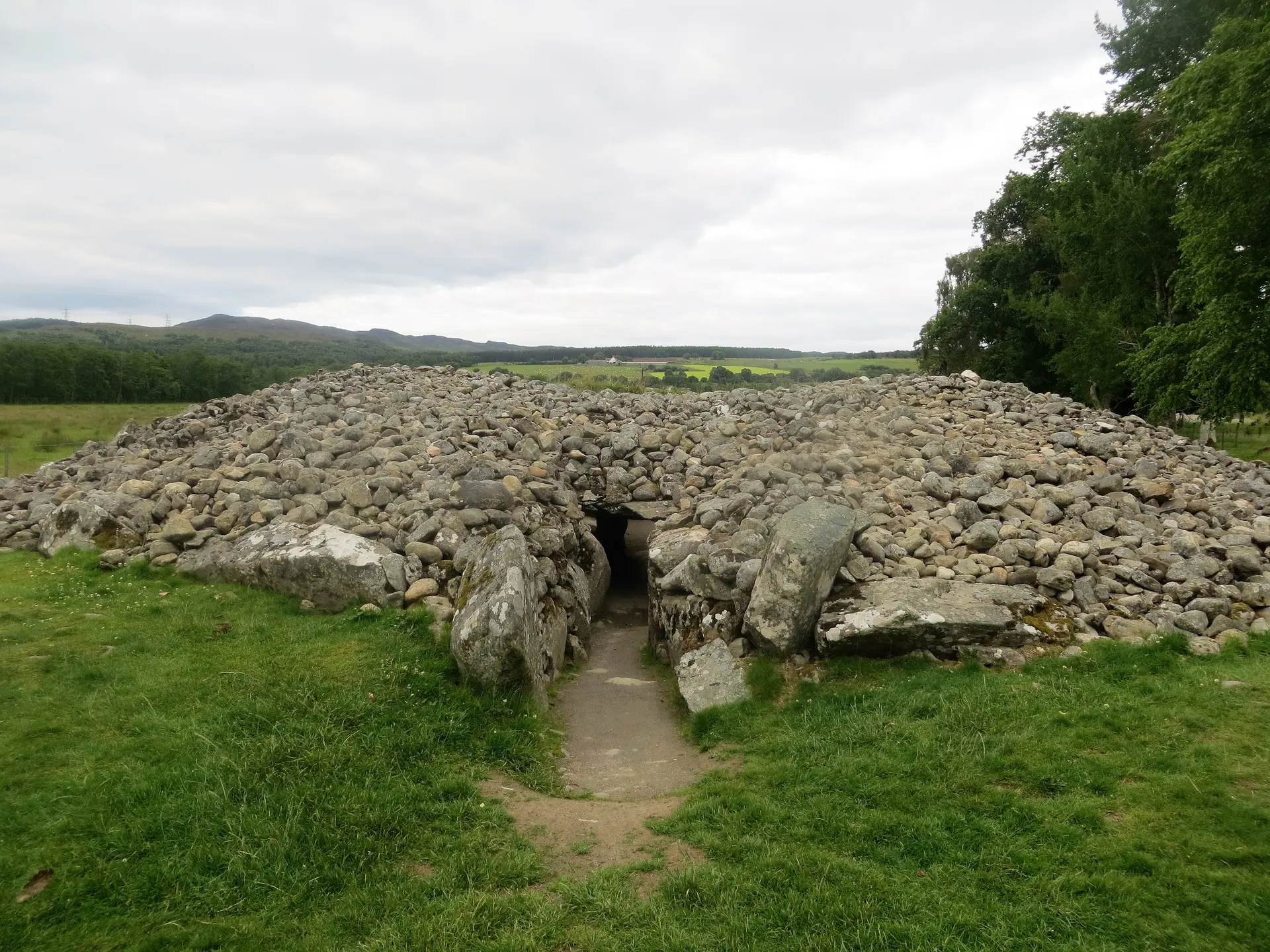
Image of Corrimony Cairn. Image source · CC-BY-SA-2.0
Visit essentials
A quick read before you go
- Duration
- A thoughtful visit takes thirty minutes to an hour.
- Access
- From Inverness, drive southwest on the A82 along Loch Ness to Drumnadrochit, then west on the…
Overview
Corrimony is a passage grave in Glen Urquhart, a green valley west of Inverness bordered by birch woodland and Highland quiet. Built around four thousand years ago, it held the honored dead of a community that farmed these soils and cleared these forests.
Its passage points southwest toward the winter-solstice sunset. On the shortest day, light would have reached the chamber where a woman lay in a fetal position facing the entrance. The ceremonies and words are unknowable, but the alignment suggests people weaving their dead into celestial rhythms and treating burial as transition rather than ending.
Visitors often describe gentleness rather than drama: a sense of protection shaped by the standing-stone ring, cup-marked capstone, peaceful glen, and accumulated reverence. Corrimony asks not to overwhelm but to be heard.
Why this place is sacred
The Neolithic builders of Corrimony understood something about the relationship between death and the cosmos that their monument still embodies. They placed the passage to catch the winter solstice sunset, the moment when the sun reaches its lowest point before beginning its return. In this alignment, burial becomes participation in the great cycle: the dead descend with the dying light, held in darkness through the long night, awaiting renewal.
The passage itself functioned as a threshold. Unlike sealed tombs, Clava-type passage graves allowed repeated entry. Evidence suggests communities returned to their dead over centuries, adding remains or performing ceremonies of remembrance. The boundary between living and dead was permeable here, maintained through ritual attention rather than absolute separation.
Visitors today encounter this quality without necessarily knowing its origins. The stones still hold their alignment. The passage still admits the winter light. Whatever accumulates in places where humans have gathered with intention for four thousand years, it gathers here. People describe a listening quality, as though the glen itself attends to those who enter it quietly.
Archaeological evidence indicates Corrimony was built as a burial monument for high-status individuals, likely community leaders or figures of spiritual importance. The considerable labor required to gather water-worn stones, construct the chamber, and erect the standing stone ring suggests this was a site of profound communal investment. In Neolithic understanding, such monuments likely served not merely as tombs but as places where the boundary between living and ancestral worlds could be maintained and crossed.
The cairn remained in use for centuries, perhaps longer, before its original tradition faded into the Bronze Age and beyond. The site survived the coming of Christianity, the clearances, the modern age. An excavation around 1830 removed the cup-marked capstone from its position over the chamber. Professor Stuart Piggott's careful excavation in 1952 revealed the crouched burial and the bone pin that accompanied her into death.
Today, Historic Environment Scotland maintains the site as a scheduled monument, open freely to those who find their way to this quiet glen.
Experience and orientation
Corrimony rewards those who come with patience. The site is rarely crowded, often empty. This solitude is part of its gift. Where busier monuments offer spectacle, Corrimony offers intimacy: a chance to sit with the standing stones, to trace the cup marks with your eyes, to consider the woman who was laid to rest here before the pyramids rose in Egypt.
Those who enter the passage, crawling through the low corridor, describe the experience as surprisingly moving. The chamber opens into a space just large enough to sit in, where faint light filters through cracks in the roof. You are inside the earth, inside the cairn, in a place designed to hold the dead. For a moment, the gap of four thousand years contracts.
The surrounding glen contributes to the atmosphere. Birch trees filter the light. The RSPB nature reserve nearby hosts black grouse and golden eagles. The Highlands stretch in every direction. Corrimony feels held, protected, apart from the rush of the modern world. Visitors frequently use the word gentle, as though the site extends a kind of welcome across millennia.
Come without expectation. The cairn is not dramatic in the way of Stonehenge or Callanish. Its power lies in subtlety, in the invitation to slow down. If you enter the passage, do so respectfully, remembering that this was a resting place for the honored dead. Sit with the standing stones afterward. Notice what arises when you stop seeking sensation and simply attend to what is here.
Context and lineage
The Clava cairn tradition emerged among the first farming communities of the Scottish Highlands, people who had only recently transitioned from hunting and gathering to settled agriculture. These communities cleared forests, tended livestock, and cultivated crops in a landscape still wild. Their burial monuments, built with immense communal effort, suggest a society that invested deeply in honoring the dead and maintaining connection with ancestral spirits.
After the cairn's use ended, perhaps in the Bronze Age, the site passed into memory and then into mystery. Local people would have known the stones, perhaps adding them to the folk geography of a Christianized Scotland, but the original meaning was lost. The 19th-century excavation disturbed the site; Piggott's more careful work in the 1950s recovered what could be recovered. What remains is a monument whose builders are nameless but whose work endures.
Traditions and practice
The original practices at Corrimony can only be inferred. Burials were likely accompanied by ceremony, perhaps involving offerings, songs, or prayers we cannot recover. The passage alignment suggests that the winter solstice held special significance, possibly marking a time when ceremonies were performed to honor the dead and the turning of the year. The repeated access to the chamber indicates ongoing ritual engagement rather than a single burial event.
No organized spiritual practices occur at Corrimony today. Visitors come to experience the site's atmosphere, to photograph the standing stones and cup marks, and to enter the passage if they choose. Some visitors with interest in paganism or earth spirituality may conduct personal observances, though this is not common or expected.
If you seek more than a heritage visit, consider entering the passage with intention. The low crawl requires humility. Once inside, sit in the chamber and let your eyes adjust. You are in a space designed to hold the dead, built by hands that reached toward something beyond what we can name.
If you visit near the winter solstice, arrive in late afternoon to watch the sunset light approach the passage. You will see what the builders saw, the dying sun reaching toward the dead before turning back toward life.
Before leaving, spend time with the standing stones. They have kept their circle for four millennia. Simply being present with them is its own form of practice.
Neolithic/Bronze Age Burial Tradition
HistoricalCorrimony represents the sophisticated burial practices of Scotland's Neolithic and Early Bronze Age peoples. These Clava-type cairns were built for high-status individuals and served as focal points for ancestor veneration and community ritual. The considerable resources required for construction indicate profound spiritual importance to communities for whom honoring the dead was central to maintaining cosmic and social order.
The crouched burial found during excavation, probably female, was placed in a fetal position facing the entrance passage, possibly symbolizing rebirth or a journey to the afterlife. The passage alignment with the winter solstice sunset suggests ceremonies tied to celestial cycles of death and renewal. Evidence from similar sites indicates they were re-entered repeatedly over centuries, pointing to ongoing rituals of remembrance rather than single interments.
Scottish Highland Cairn Traditions
HistoricalThe Gaelic tradition of building and adding stones to cairns as marks of respect for the dead persisted in the Scottish Highlands for millennia after the original Neolithic practices ceased. This cultural continuity suggests that something of the ancient relationship between living and dead survived, even as its original meaning was forgotten.
Before Highland clan battles, warriors would place stones in a pile. Survivors removed their stones afterward, with remaining stones built into a cairn honoring the fallen. The practice of adding a stone to a cairn, particularly on hilltops, signified respect and helped preserve monuments across generations.
Perspectives and open questions
Corrimony invites interpretation from multiple angles. Scholarly archaeology provides what can be measured and dated. The absent voices of those who built and used the site leave room for contemplation. Alternative perspectives offer frameworks for experiences that resist conventional explanation. Honest engagement holds these together without forcing resolution.
Scholarly perspective
Archaeologists classify Corrimony as a Clava-type passage grave, one of a distinctive group of Bronze Age burial monuments found only in the Scottish Highlands. Stuart Piggott's 1952 excavation revealed a crouched burial, probably female, with a single bone pin. The passage alignment toward the winter solstice sunset places Corrimony within a tradition of astronomically oriented burial monuments.
Scholars understand these cairns as serving not merely as tombs but as shrines for ancestor veneration, with passages allowing repeated ceremonial access over generations. The cup marks on the capstone represent typical Bronze Age rock art whose precise meaning remains one of British archaeology's unsolved puzzles.
Living and traditional perspectives
No indigenous tradition survives with direct connection to Corrimony. The Scottish Gaelic practice of building and adding to cairns as marks of respect for the dead represents a cultural echo of prehistoric customs. The blessing 'Cuiridh mi clach air do charn' (I will put a stone on your cairn) preserves something of the ancient relationship between living and dead that monuments like Corrimony embodied.
Alternative interpretations
Some visitors perceive special energy at the site and report feelings of peace and protection that they attribute to spiritual rather than psychological sources. Alternative researchers have suggested the cup marks may be astronomical maps, representations of altered states of consciousness, or markers of sacred geography. The passage alignment has been interpreted by some investigators as relating to lunar rather than solar events, specifically the moon's southern minor standstill.
These interpretations lack scholarly consensus but emerge from genuine attempts to understand experiences that resist conventional explanation.
Open questions
Genuine mysteries remain. The precise meaning of the cup marks continues to elude interpretation. Whether the passage aligns with winter solstice sunset, lunar standstill, or both remains debated. The identity and status of the woman buried in the chamber, why only one burial was found when similar sites often contain multiple interments, and the original ceremonial practices conducted here all remain open questions.
This uncertainty is appropriate: the builders left no written record, and four thousand years have eroded much that might have been known.
Plan your visit
Access and arrival
From Inverness, drive southwest on the A82 along Loch Ness to Drumnadrochit, then west on the A831 for approximately eight miles. Turn onto the minor road signed for Corrimony. The car park is about three-quarters of a mile along on the left. A short walk via a footbridge leads to the cairn. Entering the passage requires crawling through a low corridor. The site is not wheelchair accessible due to a kissing gate, footbridge, and uneven ground.
Respectful visit
No formal requirements. Waterproof footwear is strongly recommended, as the site and passage can be wet. Layered clothing suits Highland weather, which changes quickly.
Photography is freely permitted. The site offers opportunities for atmospheric images, particularly in soft light or mist. Be mindful of other visitors seeking quiet contemplation.
Leaving offerings is not part of any tradition associated with this site. If you feel moved to offer something, let it be internal: a moment of gratitude, a silent acknowledgment of those who built and were buried here. Do not leave physical objects.
The site is a scheduled monument protected by law. Damaging or disturbing it carries legal penalties. Climbing, excavation, and removal of material are prohibited. The passage requires crawling and may not be accessible to all visitors.
The passage can be wet and muddy, especially in wetter months. Those with mobility limitations may not be able to enter. The crawl requires getting on hands and knees, which is not appropriate for everyone. There is no shame in honoring the site from outside.
Current practical details
Address
Inverness IV63 6TW, UK
Phone
Hours
Hours, fees, and access can change — verify on the official source before you travel. Practical details last checked Jun 2026.
Location
Map loads as you approach this section.
Pilgrim reflections
A portrait of encounter, not a score
Pilgrims describe what they felt, how present they could become, and whether the place would shape a journey. There are no stars and no ranking of traditions.
No reviewed reflections yet
The first pilgrims can help describe the character of being here.
Share a reflection
Available after an account-backed “Been there.” Every reflection is reviewed before publication.
Nearby sacred places
Explore other sacred places in the region. Proximity does not establish access or travel time; check each place’s guidance.


References
Sources consulted for this page. Source categories describe the publication, not a guarantee that every claim is verified. Traditional accounts and outside interpretations may differ.
- 01Corrimony Chambered Cairn - History — Historic Environment ScotlandofficialOfficial Scottish heritage authority historical information
- 02Corrimony Chambered Cairn - Visitor Information — Historic Environment ScotlandofficialOfficial site management and visitor information
- 03Corrimony - Canmore — Historic Environment ScotlandofficialNational database of Scottish archaeological sites with detailed survey records
- 04Corrimony - Trove Scotland — Trove ScotlandofficialScottish heritage database with classification and coordinates
- 05MHG2626 - Clava-type Cairn - Corrimony — Highland Historic Environment RecordofficialOfficial Highland Council archaeological record
- 06Corrimony Nature Reserve — RSPB ScotlandSource contextOfficial RSPB reserve information adjacent to the cairn
- 07Clava Cairns: Monuments to Memory and More — World History EncyclopediaacademicAcademic overview of Clava-type cairns and their significance
- 08Corrimony chambered cairn - Wikipedia — Wikipedia contributorsencyclopediaGeneral reference with archaeological details and citations
- 09Scottish History: Corrimony Chambered Cairn — Wilderness ScotlandguideDetailed historical and visitor information from reputable tour operator
- 10The Corrimony Chambered Cairn, Scotland — My Voyage ScotlandguidePractical visitor information and historical context
- 11Corrimony Chambered Cairn — Wee Wild AdventuresacademicDetailed visitor experience and cup mark information
- 12Ancient Scotland - Corrimony — Ancient ScotlandacademicDetailed archaeological and historical information
- 13Corrimony Chambered Cairn - Sacred Scotland — Sacred ScotlandacademicSpiritual and sacred significance perspective
- 14Corrimony - The Modern Antiquarian — The Modern AntiquarianofficialCommunity megalithic research database with visitor reports
- 15Corrimony Chambered Cairn - Undiscovered Scotland — Undiscovered ScotlandguideComprehensive visitor guide with historical context
- 16Corrimony chambered cairn and its astronomical alignment — Stones of WonderacademicAstronomical alignment research and interpretation
- 17Corrimony Chambered Cairn, Glen Urquhart — The Orkney NewsnewsContemporary visitor perspective and historical context
Share a photo
Help visitors recognize Corrimony Cairn. Every submission is reviewed before publication.