Convent of Christ
A round Templar church built to echo Jerusalem, still consecrated ground
Understand sacred places, explore living traditions, and learn how to engage respectfully with Pilgrim Map.
Access has not been verified. Check current local guidance before planning a visit.
Tomar, Santarém, Portugal
Read the sources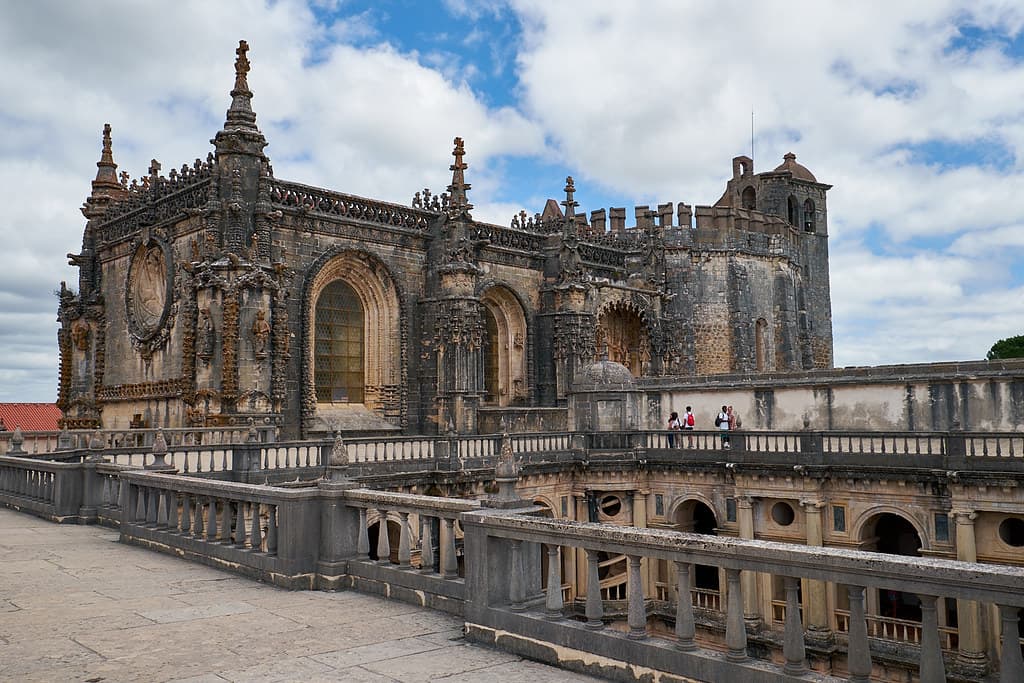
Image of Convent of Christ. Image source
Visit essentials
A quick read before you go
- Duration
- Most visitors spend ninety minutes to two hours on a focused visit; guides recommending fuller…
- Access
- Located on a wooded hilltop on the western edge of Tomar, in Portugal's Centro region (Santarém…
Overview
Grand Master Gualdim Pais laid this castle and its round church in 1160, on land the Templars had received the year before from King Afonso Henriques. The design was not incidental: the Charola's sixteen-sided plan deliberately echoed the Church of the Holy Sepulchre in Jerusalem, connecting a Templar garrison on the Portuguese frontier to the holiest site in Christendom, and — practically — letting knights hear Mass from horseback before riding out.
When the Templar Order was suppressed across Europe in the early 14th century, Portugal took a different path than France. Rather than confiscating the order's assets outright, King Dinis lobbied Pope John XXII to re-found them as the Order of Christ, which took up residence at Tomar and preserved an unbroken institutional line at this site.
Two centuries later, King Manuel I funded a spectacular Manueline expansion, financed in large part by the same order's stake in Portugal's maritime ventures — the Chapter House Window's nautical carving is a direct record of where that money came from.
No religious community has lived here since the 19th century. The complex is managed today as a national monument and UNESCO World Heritage Site, and the Charola remains consecrated, occasionally hosting Mass or ceremonial events, even as its primary daily function is now that of a heavily visited museum.
Why this place is sacred
The Charola was not built by accident into a circular form. Comparative architectural history treats this pattern — round or polygonal Templar church plans evoking the Holy Sepulchre — as a recognized feature of European Templar building, and Tomar's version is one of the clearest surviving examples of it: a deliberate echo rather than a mystical coincidence.
What makes the site unusual is not just this one gesture but what followed it. When the Templars were suppressed, most of Europe saw their assets seized outright. Portugal's King Dinis instead negotiated a re-founding — the Order of Christ inherited the Templars' 'castle, lands, treasure and personnel' according to one account, preserving continuity rather than rupture.
Two centuries after that, the same institution's financial stake in the Age of Discoveries paid for the Manueline additions that now define the complex's most photographed feature, the Chapter House Window. Few sites make so legible, in a single walk from Charola to Window, the transition from crusading order to colonial financier.
The Templars built the castle and Charola as both a defensive stronghold on Portugal's Reconquista frontier and a consecrated oratory where knights could maintain religious observance without leaving their military posture — the rotunda's design allowed Mass to be heard by mounted knights circling the central altar. Its purpose was therefore simultaneously military and devotional, categories the order did not treat as separate.
Following the Templars' 1312 suppression, Portugal's King Dinis secured papal approval in 1319 to re-found the order's Portuguese holdings as the Order of Christ; the new order's occupation of the Tomar seat is variously dated 1338, 1344, or 1357 across sources, reflecting a multi-year institutional transition rather than a single sharp handover.
From 1510 to 1513, King Manuel I funded major Manueline additions, including the church nave and the Chapter House Window, financed substantially by the Order of Christ's involvement in Portugal's maritime expansion under Henry the Navigator. Renaissance-era work continued under King John III through the mid-16th century. The Order of Christ was progressively secularized over the 18th and 19th centuries, and the last resident friars left in the 19th century, ending continuous religious community life at the site.
Since 1983, the complex has held UNESCO World Heritage status and is managed as a national monument by Portugal's Directorate-General for Cultural Heritage.
Experience and orientation
Visitors frequently describe the interior of the Charola as visually overwhelming — its gilded Byzantine-influenced décor, frescoes, and vertical scale are commonly reported as producing an awestruck or otherworldly first impression, distinct from the more austere feel of typical Portuguese parish churches.
Outside the Charola, the Manueline Chapter House Window draws the most sustained attention of any single feature in the complex — heavily photographed, heavily analyzed, its maritime and nautical carving read as a direct record of the Age of Discoveries wealth that paid for it. The eight cloisters offer a different register entirely; the Renaissance-era John III Cloister in particular is described as calmer and more contemplative, a counterpoint to the ornate Charola rather than an extension of it.
Most visitor accounts center on aesthetic and historical awe rather than personal spiritual transformation — the Convent of Christ draws people fascinated by Templar history and 'lost history' more than seekers of devotional experience, a reported cultural effect rather than a verified metaphysical one.
Arrive at opening or after mid-afternoon if crowds concern you; tour groups tend to concentrate in the Charola and Royal Cloister around midday. Give the Charola time before moving on — its scale and decoration reward a slow circuit rather than a single glance. The Chapter House Window is best seen and photographed in early-morning or late-afternoon light, when it's reported as most favorable for both the gilded interior and the sunlit cloisters.
Context and lineage
The Templars, granted the site by King Afonso Henriques in gratitude for military support in the Reconquista, built a round church deliberately echoing the Dome of the Rock and Church of the Holy Sepulchre in Jerusalem — buildings the Crusaders associated with the Temple of Solomon and the site of Christ's resurrection.
When the Templar Order was suppressed in the early 14th century, King Dinis avoided the wholesale confiscation seen elsewhere in Europe by lobbying the Pope to re-found the order's Portuguese holdings as the new Order of Christ, preserving an unbroken religious and institutional lineage at Tomar.
Templar knights maintained mounted liturgy and monastic-military life at the Charola through the 12th to 14th centuries. The Order of Christ then held conventual life at the site from the 14th through the 18th centuries, expanding the complex substantially under Manuel I and John III. Secularization proceeded gradually across the 18th and 19th centuries, and the last resident friars left in the 19th century.
Since then, the site has been managed as a national monument and museum, with occasional Masses or ceremonial religious events maintaining a thread of consecrated use alongside its primary function as a heritage destination.
Gualdim Pais
founder
Templar Grand Master who founded the castle and Charola in 1160 on land granted by King Afonso Henriques the previous year.
King Dinis of Portugal
historical
Negotiated with Pope John XXII to re-found the suppressed Templars' Portuguese holdings as the Order of Christ in 1319, avoiding the outright confiscation seen elsewhere in Europe.
King Manuel I
patron
Funded the Manueline-era expansion of 1510–1513, including the church nave and the Chapter House Window, financed substantially through the Order of Christ's stake in Portugal's maritime expansion.
Henry the Navigator
historical
Governor of the Order of Christ whose maritime ventures were financed in part through the order's wealth, a connection made visually explicit in the Chapter House Window's nautical iconography.
Traditions and practice
Historically, mounted Mass for Templar knights took place within the Charola, armored riders circling the central altar before departing for battle — a liturgical form suited to a garrison rather than a parish. Daily conventual offices and chapter meetings of the Order of Christ later filled the Chapter House and choir for several centuries.
Occasional Masses or Catholic ceremonial events are still held in the consecrated church spaces, but the site's primary current function is as a museum and heritage monument, with regular paid public visitation rather than daily liturgical use.
Move through the Charola slowly rather than photographing immediately — the gilded decoration rewards a full circuit before a single frame. In the Chapter House, look for the maritime carving in the window and let it register as a financial record as much as an aesthetic one: this ornament was paid for by voyages, not just imagined by artists.
In the John III Cloister, slow down further still; several sources describe it as the calmest space in the complex, a deliberate counterpoint to the Charola's density.
Catholic Christianity (Knights Templar / Order of Christ)
ActiveFounded as a Templar stronghold and oratory in 1160, the site is one of the most important surviving monuments of the Knights Templar in Europe, and became the seat of the Portuguese Order of Christ from the 14th century onward — the chivalric order whose wealth financed Portugal's 15th-century maritime expansion under Henry the Navigator.
Historically, mounted Mass by armored knights in the circular Charola, and conventual monastic life of the Order of Christ, including choir offices and chapter meetings in the Chapter House. Currently, the church retains consecrated status, and occasional Masses or ceremonial religious events are held, though day-to-day the site functions as a museum.
Perspectives and open questions
The Convent of Christ sits at an unusual intersection of solid institutional history and widely circulated popular legend, and the two should be kept clearly separated rather than blended together.
Scholarly perspective
Academic and heritage-authority consensus treats the Convent of Christ as a genuine and well-documented Templar-to-Order-of-Christ institutional continuity: founded by the Templars in 1160, transferred intact to the newly chartered Order of Christ following the 1312–1319 suppression — avoiding the violent confiscations seen in France — and later transformed architecturally under Manuel I into a showcase of Manueline art symbolizing Portugal's maritime expansion.
The Charola's design is understood, based on comparative architectural history, as a deliberate echo of the Church of the Holy Sepulchre and Dome of the Rock — a recognized pattern among European Templar round churches — rather than a mystical or coded structure.
Living and traditional perspectives
Within institutional Catholic and chivalric-order tradition, the Templar-to-Order-of-Christ transition at Tomar is remembered as an act of preserved continuity: King Dinis's negotiation with the papacy kept the order's wealth, personnel, and religious mission largely intact at a moment when similar institutions elsewhere in Europe were dissolved outright.
Alternative interpretations
Popular and esoteric literature — travel blogs, some documentary and pseudo-historical media — frequently associates the Convent of Christ with Freemasonry, hidden Templar treasure, and claims that the Manueline Chapter House Window's ornamentation encodes a secret plan of Portuguese world domination devised by the Templars and Manuel I. One travel-blog source also claimed that 'recent archaeological work' found astronomical alignments in the Charola's orientation, without citing any peer-reviewed study.
These claims circulate widely online but are not corroborated by UNESCO, academic art history, or the historical summary consulted for this research, and are presented here explicitly as unverified popular legend rather than established fact.
Open questions
Open, genuinely unresolved questions include the precise symbolic program intended by the Chapter House Window's designers — attribution and full iconographic intent remain debated among art historians — the extent to which the Order of Christ's Templar predecessors directly shaped early Portuguese maritime strategy versus simply funding it, and whether any deliberate astronomical or geometric alignment was built into the Charola's orientation, a question current sources have not settled through rigorous published archaeoastronomical study.
Plan your visit
Access and arrival
Located on a wooded hilltop on the western edge of Tomar, in Portugal's Centro region (Santarém district), roughly 130km/1.5–2 hours by car or train from Lisbon. Entrance fee reported by third-party guides (verify against official pricing): around €6 standard adult admission, €3 concession; a combined 'World Heritage Route' ticket covering Tomar, Batalha, and Alcobaça reported around €15.
The site is wheelchair-accessible in parts but includes uneven historic stone surfaces, stairs, and hilltop terrain that may limit full accessibility in some areas.
Respectful visit
As a former consecrated Catholic church and monastery, modest dress is recommended: shoulders and knees covered, and men advised to avoid shorts where possible. This is general Portuguese religious-site etiquette guidance rather than a strictly enforced posted rule.
General tourist photography without flash is understood to be permitted in most areas as a paid heritage and museum site; no explicit official photography ban has been documented for the Convent specifically. Visitors are advised to avoid photographing others without consent and to be considerate if any religious ceremony is in progress.
No evidence of an active offerings tradition — candles, ex-votos — has been found at this site; unlike an active pilgrimage shrine, the Convent functions primarily as a heritage monument.
Standard museum-site restrictions apply: no touching fragile stonework or frescoes, respect roped-off conservation areas, and maintain quiet, respectful conduct especially near the Charola and Chapter House. Normal church etiquette — quiet, no flash, no interrupting — applies during any active religious service.
Standard museum-site restrictions apply throughout: no touching fragile stonework or frescoes, respect roped-off conservation areas, and maintain quiet, respectful conduct especially near the Charola and Chapter House. If any religious ceremony is in progress, treat it with ordinary church etiquette rather than museum-visitor behavior.
Location
Map loads as you approach this section.
Pilgrim reflections
A portrait of encounter, not a score
Pilgrims describe what they felt, how present they could become, and whether the place would shape a journey. There are no stars and no ranking of traditions.
No reviewed reflections yet
The first pilgrims can help describe the character of being here.
Share a reflection
Available after an account-backed “Been there.” Every reflection is reviewed before publication.
Nearby sacred places
Explore other sacred places in the region. Proximity does not establish access or travel time; check each place’s guidance.


References
Sources consulted for this page. Source categories describe the publication, not a guarantee that every claim is verified. Traditional accounts and outside interpretations may differ.
- 01Convent of Christ in Tomar — UNESCO World Heritage Centre — UNESCO World Heritage CentreofficialOfficial UNESCO listing (inscribed 1983). Confirms site combines Romanesque, Gothic, Manueline, Renaissance, Mannerist and Baroque elements over five centuries of construction; centerpiece is the 12th-century Templar rotunda influenced by the Church of the Holy Sepulchre. Direct fetch of full page text was blocked (403); facts drawn from search-result summary of this official source.
- 02Convento de Cristo e Castelo Templário — Turismo de Portugal (visitportugal.com)officialNational tourism board page; used to corroborate Templar founding narrative and site framing as national heritage landmark.
- 03Convent of Christ (Tomar) — Wikipedia — Wikipedia contributorsacademicCore historical timeline: 1118/1160 Templar founding, 1319 papal institution of Order of Christ, 1357 seat transfer, Manueline nave construction from 1506, architectural periods (Romanesque, Gothic, Manueline, Renaissance), 1983 UNESCO listing. No esoteric/Freemasonry content found in this source.
- 04On the trail of the Knights Templar in Portugal — Rough Guides editorial staffSource contextReputable travel-journalism source. Describes the Charola's 16-sided design allowing mounted Mass, and the 1319 transfer of the Templars' 'castle, lands, treasure and personnel' to the newly chartered Order of Christ under King Dinis. Also carries an unsubstantiated claim ('recent archaeological work discovered astronomical alignments') that has no cited primary study — flagged as alternative/unverified in interpretive_perspectives, not stated as fact.
- 05Convento de Cristo Tomar - UNESCO Templar Monastery Guide 2026 — MyPortugalHoliday.com editorial staffSource contextUsed for current-year (2026) practical visitor detail: time allocation per area of the complex, crowd patterns by time of day, general orientation. Independently cross-checked against other travel guides below before being treated as reliable for practicalities.
- 06How To Visit The Convent Of Christ This Year — Daniela Santos AraújoSource contextPortugal-based travel writer; used for opening-hours and entrance-fee figures (seasonal hours, €6/€3 tiers, free Sunday/holiday admission for Portuguese residents, combined World Heritage Route ticket). Figures should be reverified against the official ticketing site before publishing, as they are time-sensitive.
- 07Religious Sites in Portugal: What to Wear and How to Behave Respectfully — Portugal MagikSource contextGeneral Portuguese Catholic-site etiquette guide (shoulders/knees covered, quiet conduct, no photography of worshippers) used to fill in etiquette fields generically, since the Convent's own signage/policy text was not independently retrievable.
- 08How to Spot Portugal's Manueline Architecture and Where to See the Best — TheCollector.com editorial staffSource contextArt/architecture history publication; corroborates the Chapter House (Manueline) Window's dating to 1510–1513 and its maritime/nautical iconography symbolizing Portugal's Age of Discovery under Manuel I.
- 0910 Things You Need to Know to Visit the Convent of Christ in Tomar, Portugal — History Fangirl (Jessica Spiegel)Source contextHistory-focused independent travel blog with clear epistemic framing of personal visitor experience; used only for etiquette/dress-code corroboration, not for factual/historical claims.
- 10Tomar: Templars' Convento de Cristo and its Unique Window — Victor (Не галопом по Европам travel blog)Source contextPersonal travel blog repeating the popular but unverifiable legend that the Manueline window's decoration secretly encoded a Templar/Manuel I 'plan of Portuguese world domination.' Included only as a clearly marked alternative/esoteric legend in interpretive_perspectives, per source-evaluation red-flag rules for extraordinary, non-peer-reviewed, self-referential claims — never presented as fact.
Share a photo
Help visitors recognize Convent of Christ. Every submission is reviewed before publication.