Church of the Pilgrim Virgin, Pontevedra
A church shaped like a scallop shell, for a Virgin who walks the Camino herself
Understand sacred places, explore living traditions, and learn how to engage respectfully with Pilgrim Map.
Access has not been verified. Check current local guidance before planning a visit.
Pontevedra, Pontevedra, Spain
Read the sources
Visit essentials
A quick read before you go
- Duration
- 15 to 30 minutes for the interior; pilgrims often rest longer in the surrounding Plaza de la…
- Access
- Located at Plaza de la Peregrina, s/n, in the heart of Pontevedra's pedestrianized old town,…
Overview
Seen from above, the Church of the Pilgrim Virgin forms a scallop shell, the emblem every Camino de Santiago walker wears or carries: the building is a pilgrim's badge at architectural scale.
Inside, the Virgin appears not enthroned or crowned but as a traveler, with staff and gourd—the ordinary equipment of a long road. Local tradition says French pilgrims brought such an image to Pontevedra in the 18th century, and the Archbishop of Santiago formalized the devotion by authorizing a confraternity in 1753.
Two and a half centuries later, that confraternity still dresses the image in one of fifteen vestments through the liturgical year and leads the August festival, Pontevedra's principal civic celebration, although her formal title is more precisely scoped than that prominence suggests.
Why this place is sacred
The shell-shaped plan is not a decorative flourish applied to an otherwise ordinary church; it is the entire organizing geometry of the building, making the Church of the Pilgrim Virgin one of the few Camino-associated churches anywhere to render the pilgrim's emblem architecturally rather than symbolically. Walking the perimeter of the nave traces, roughly, the shell's ribs.
The image inside carries its own inversion of expectation. Marian iconography across Catholic Iberia overwhelmingly favors crowns, thrones, and royal vestments — Mary as queen of heaven. The Virgen Peregrina wears a traveler's cloak and carries a pilgrim's staff and gourd, shown, in effect, mid-journey.
Art historians associate this specific iconographic type with early Camino devotion documented at 16th-century Sahagún, León, and traditionally link it to the mystical writings of the nun Sor María de Jesús de Ágreda, though the exact chronological relationship between the two remains unclear in accessible sources. The type reached Pontevedra by the mid-1700s.
What the image communicates to a walking pilgrim is a specific kind of company: not a distant intercessor to be petitioned from below, but a figure who has, iconographically, taken up the same staff and the same road. Whether or not a visitor holds any belief in the image's spiritual efficacy, the choice to depict Mary this way, in this building, on this exact route, is doing deliberate symbolic work that few other Camino churches attempt so directly.
The church was purpose-built between 1778 and 1794 as a sanctuary for the growing 18th-century devotion to the Virgen Peregrina, following the Archbishop of Santiago's 1753 authorization of a formal confraternity in her honor. Its scallop-shell plan and its position directly on the Camino Portugués route indicate the building was conceived from the outset as a pilgrimage church in the fullest sense — image, architecture, and route aligned around a single symbolic program.
The devotion has remained continuously active since its 18th-century formalization, sustained by the Cofradía de la Virgen Peregrina, which still maintains the image's wardrobe and processional traditions today.
The August festival, moved from its original December date in 1757 after repeated weather-related cancellations, has grown from a devotional observance into Pontevedra's largest annual civic event — a shift in scale and audience that has, at times, outpaced the precision with which her actual title is understood or repeated in tourism materials.
Experience and orientation
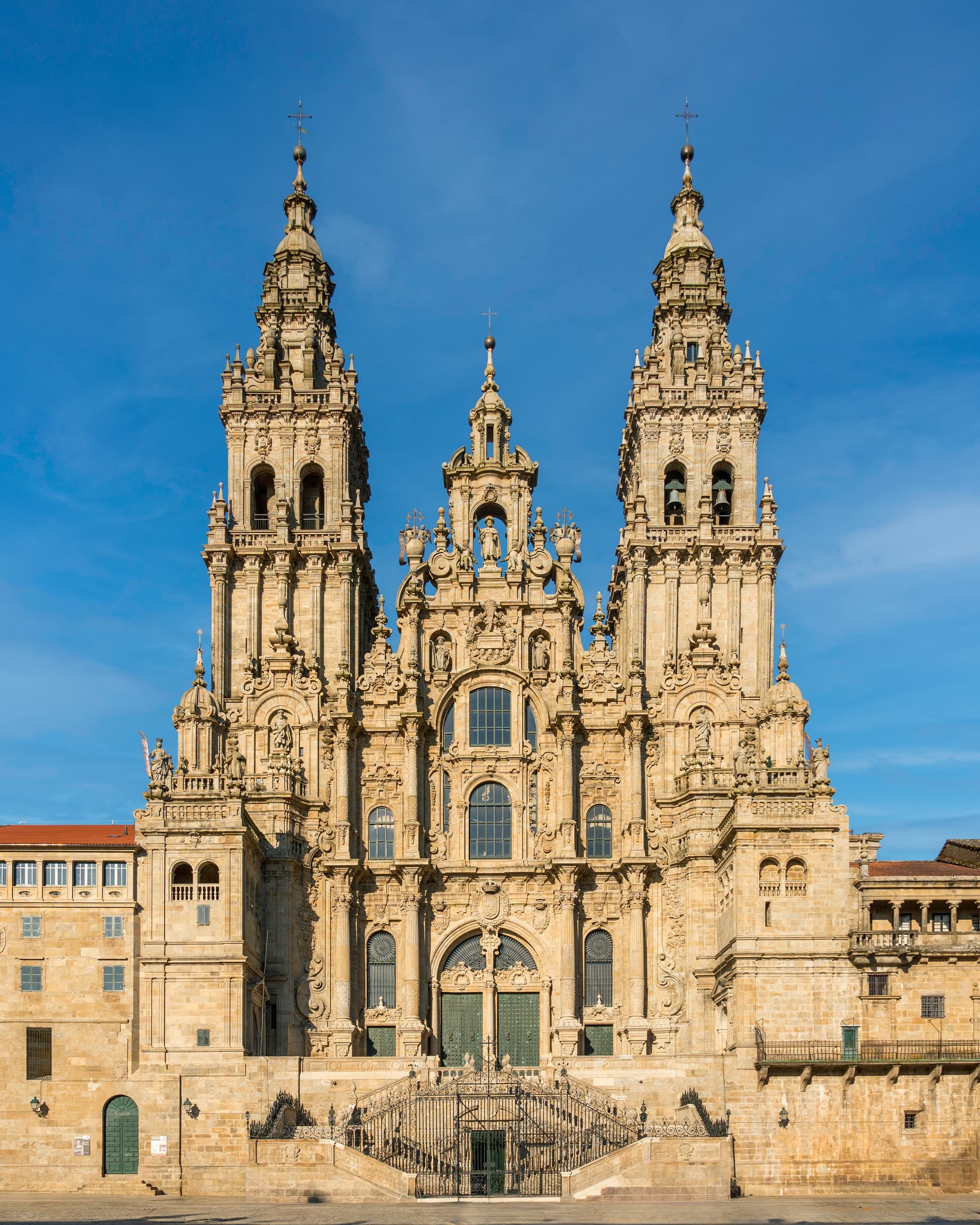
The façade announces itself before the shell-shaped plan does. Convex, ornamented, and set at the head of its own small plaza, the Church of the Pilgrim Virgin functions as a landmark long before most visitors learn anything about its geometry or its Marian devotion — it is simply one of the buildings people photograph in Pontevedra, regardless of pilgrimage interest.
Entering shifts the register. The neoclassical altarpiece, the outsized Tridacna-shell font donated by Admiral Casto Méndez Núñez, and the image of the Virgen Peregrina herself in her traveler's dress create a smaller, more devotional scale than the façade suggests. Pilgrims moving through on the Camino Portugués describe the church less as a monument to visit than a waypoint to inhabit briefly — a place to sit, rest legs, and continue.
The August festival changes the character of the site entirely. For nine days, the plaza and surrounding streets fill with a civic energy closer to a city holiday than a narrowly religious observance, though the two register together in the annual dressing of the image and the procession of the silver pilgrim's staff.
Visitors present during the festival describe an atmosphere markedly different from the quiet weekday church — communal, loud, and, by local account, central to how Pontevedra understands itself for that week.
If your visit isn't timed to the August festival, go inside rather than only photographing the façade — the scallop-shell plan registers better from within, walking its curve, than from any single external vantage point. Pilgrims should know the church sits squarely on the Camino Portugués route itself, making it a natural, unforced stop rather than a detour.
Context and lineage
According to local tradition, an image of the Virgin dressed as a pilgrim — staff and gourd in hand rather than crown and throne — was brought to Pontevedra by French travelers on the Camino sometime in the 18th century, and the devotion it inspired grew quickly enough that the Archbishop of Santiago, Bartolomé Rajoy y Losada, authorized a formal confraternity, the Congregación de Nuestra Señora del Camino, in 1753.
The specific iconographic type — Mary as humble traveler — is associated with early Camino devotion documented at 16th-century Sahagún, León, and traditionally linked to the mystical writings of the nun Sor María de Jesús de Ágreda, though the precise chronological relationship between the two is not fully clear in accessible sources.
The church itself followed the devotion rather than preceding it. Ground was broken on 18 June 1778, construction was largely complete by 1792, and the building was consecrated on 2 August 1794 — designed by the master builder Antonio Souto, with Bernardo José de Mier contributing to the façade. Its scallop-shell floor plan made the pilgrim's emblem into architecture.
A distinction worth holding precisely: the Virgen Peregrina's formal patronage covers the Camino Portugués and, by provincial declaration in July 1955, the province of Pontevedra. She is not the official patroness of the city of Pontevedra itself. That role belongs to a different image, the Virgin of Franqueira, recognized as such by the Diocese of Tui-Vigo — a nuance regularly glossed over in tourism copy that calls the Peregrina simply 'Pontevedra's patron saint.'
The confusion is understandable: the Fiestas de la Peregrina function, in practice, as the city's largest annual civic festival, and have done so since the observance moved from December to August in 1757 to avoid weather-related cancellations. Civic prominence and formal patronage, in this case, do not fully overlap.
The Cofradía de la Virgen Peregrina, descended from the 1753 confraternity, continues to maintain the image's wardrobe of fifteen vestments and lead the processional traditions of the August festival today, including the silver staff traditionally carried by descendants of a specific local family — an unbroken devotional lineage of roughly two and a half centuries, running in parallel with the building's own continuous use as an active parish church.
Sor María de Jesús de Ágreda
mystic and writer
Spanish nun whose mystical writings are traditionally linked to the iconographic type of Mary as a traveling pilgrim, though the exact chronological relationship to the type's earlier documented appearance at Sahagún, León, is unclear.
Antonio Souto
master builder
Credited as the church's primary designer, responsible for its distinctive scallop-shell floor plan, built 1778–1792.
Bernardo José de Mier
architect
Contributed to the design of the church's convex Baroque façade.
Bartolomé Rajoy y Losada
Archbishop of Santiago
Authorized the Congregación de Nuestra Señora del Camino in 1753, formalizing devotion to the Virgen Peregrina decades before the church itself was built.
Admiral Casto Méndez Núñez
donor
19th-century Spanish admiral who donated the outsized Tridacna-shell font used for holy water inside the church.
Traditions and practice
From the 18th century onward, devotion centered on the confraternity structure established in 1753, with the image dressed for major feasts and processed through the streets during what was originally a December festival. Two vestments in the current wardrobe of fifteen have unusual provenance, fashioned from retired matador costumes donated in 1948 and 1973 — a detail reflecting the informal, community-embedded character the devotion has held alongside its formal ecclesiastical authorization.
Daily and Sunday Masses continue on a published schedule, with reduced hours in July and August. The Cofradía de la Virgen Peregrina organizes the annual Fiestas de la Peregrina, nine days beginning the second Saturday of August, including the ceremonial dressing of the image and a procession featuring a silver staff that symbolizes the Jacobean pilgrimage, traditionally carried by descendants of a particular Pontevedra family.
Visitors present outside festival season can still see the church's core devotional gesture in miniature: the image's vestments change with the liturgical calendar, so no two visits need look identical. Pilgrims walking the Camino Portugués might pause at the Tridacna-shell font — a functional object with an unusual maritime origin — before continuing toward Santiago, treating it as a small, concrete point of contact with the building's layered history of gifts and devotion.
Roman Catholicism
ActiveMarian devotion centered on the Virgen Peregrina, an unusual iconographic depiction of Mary dressed as a humble traveling pilgrim rather than in royal vestments — emphasizing spiritual journey and hospitality toward pilgrims over hierarchical majesty. She is venerated as patroness of the Camino Portugués and of the province of Pontevedra, a scope distinct from patroness of the city itself (discussed in context.origin_story).
Daily and Sunday Mass; the annual Fiestas de la Peregrina, a nine-day patronal festival beginning the second Saturday of August; ceremonial dressing of the image in one of fifteen liturgical vestments, some donated, including two fashioned from matador costumes in 1948 and 1973; a procession bearing a silver staff symbolizing the Jacobean pilgrimage, traditionally carried by descendants of a local family; and pilgrim blessings for those walking the Camino Portugués.
Perspectives and open questions
The church supports at least three distinct readings — architectural, devotional, and civic — that overlap in practice more than they align in formal terms, particularly around the precise scope of the Virgen Peregrina's patronage.
Scholarly perspective
Architectural historians treat the church as a significant, transitional example of Galician ecclesiastical building moving from Baroque toward Neoclassical form, and single out its scallop-shell ground plan as a rare, direct architectural quotation of the pilgrim's emblem — unusual even among churches associated with the Camino. Its 1982 historic-artistic monument designation and 2011 Bien de Interés Cultural status reflect broad consensus on its heritage significance.
Living and traditional perspectives
For the Cofradía de la Virgen Peregrina and the wider devotional community, the church's significance centers on the image itself — Mary as fellow traveler rather than distant queen — and on an unbroken tradition of care for that image stretching back to the 1753 confraternity.
This community draws a careful distinction that outsiders often miss: the Virgen Peregrina's authority as patroness covers the Camino Portugués and, since 1955, Pontevedra province — a scope the tradition itself maintains precisely, even where popular civic enthusiasm during the August festival might suggest a broader, city-wide patronage that was never formally declared. The Diocese of Tui-Vigo recognizes a different image, the Virgin of Franqueira, as its own patroness.
Open questions
The exact provenance and date of the original pilgrim-brought image remain imprecisely documented beyond the general tradition of French pilgrims and the 1753 formal authorization; earlier oral tradition is not independently verifiable. The precise chronological relationship between the 16th-century Sahagún iconography and the 17th-century writings of Sor María de Jesús de Ágreda is also unresolved in accessible sources.
Plan your visit
Access and arrival
Located at Plaza de la Peregrina, s/n, in the heart of Pontevedra's pedestrianized old town, directly on the Camino Portugués route, and reachable entirely on foot.
No specific accommodation recommendations were found in research; Pontevedra's old town offers standard pilgrim and tourist lodging typical of larger Camino Portugués towns.
Respectful visit
Modest dress — covered shoulders and knees — is customary though not formally enforced, particularly appropriate if visiting during a service.
General tourist photography is common and largely unrestricted; the façade in particular is one of the most photographed buildings in Pontevedra. Visitors should avoid photographing during active Mass or private devotion out of ordinary courtesy.
Votive candles are customary, as in most Catholic churches. No site-specific offering ritual beyond standard Marian devotion is documented.
None beyond standard church etiquette — silence during Mass, and general courtesy toward the congregation. The church is open to visitors of any faith or none.
No special ritual participation is expected of visitors; regular Mass is open to anyone regardless of tradition or belief. During the August festival, the plaza and surrounding streets become genuinely crowded — those seeking a quiet devotional visit rather than the civic celebration should plan for another week.
Location
Map loads as you approach this section.
Pilgrim reflections
A portrait of encounter, not a score
Pilgrims describe what they felt, how present they could become, and whether the place would shape a journey. There are no stars and no ranking of traditions.
No reviewed reflections yet
The first pilgrims can help describe the character of being here.
Share a reflection
Available after an account-backed “Been there.” Every reflection is reviewed before publication.
Nearby sacred places
Explore other sacred places in the region. Proximity does not establish access or travel time; check each place’s guidance.


References
Sources consulted for this page. Source categories describe the publication, not a guarantee that every claim is verified. Traditional accounts and outside interpretations may differ.
- 01Church of the Pilgrim Virgin — Wikipedia — Wikipedia contributorsacademicCoordinates, construction timeline (1778-1792, consecrated 1794), architects (Antonio Souto, Bernardo José de Mier), 1982 historic-artistic monument declaration, 2011 Bien de Interés Cultural declaration, scallop-shell floor plan, Tridacna shell font donated by Admiral Méndez Núñez.
- 02Iglesia de la Virgen Peregrina — Wikipedia, la enciclopedia libre — Wikipedia contributorsacademicArchitectural details, BIC monument designation (13 October 2011), role as essential stop on Camino Portugués, cultural recognition (coin/stamp).
- 03Virgen Peregrina (Pontevedra) — Wikipedia, la enciclopedia libre — Wikipedia contributorsacademicOrigin legend of the image brought by French pilgrims, 1753 ecclesiastical authorization of the Congregación de Nuestra Señora del Camino, festival traditions (rotating vestments, silver pilgrim's staff), iconographic significance of Mary depicted as a humble traveler rather than in royal vestments.
- 04Fiestas de La Peregrina — Wikipedia, la enciclopedia libre — Wikipedia contributorsacademicConfirms the Fiestas de La Peregrina are Pontevedra's patronal festival, held annually over nine days starting the second Saturday of August; explains 1757 move of the feast from December to August due to weather-related procession cancellations.
- 05Pontevedra vive con fervor e tradición a festividade da Virxe Peregrina — Archdiocese of Santiago de Compostela (archicompostela.org)officialOfficial archdiocesan communication describing the annual festival's religious observance and civic-devotional character.
- 06Church of La Peregrina in Pontevedra — spain.info (official tourism board of Spain, Turespaña)Source contextOfficial Spanish government tourism description confirming role as pilgrim waypoint on Camino Portugués and general visitor orientation.
- 07Historia de la Cofradía de la Virgen Peregrina de Pontevedra — Cofradía de la Virgen PeregrinaspiritualConfraternity's own account of its founding history and devotional traditions; primary devotional-community source, corroborates 1753 authorization and festival relocation to August.
- 08La Virgen Peregrina no es la patrona de la Boa Vila — Pontevedra VivaSource contextLocal journalism clarifying the precise scope of the Peregrina's patronage (province, not city; Diocese of Tui-Vigo's actual patroness is the Virgin of Franqueira) — used to source the conflicts_noted entry and avoid overstating patronage claims.
- 09Santuario de la Virgen Peregrina — Pontevedra (Mass schedule listing) — misas.orgSource contextAggregator listing of Mass times and visiting hours; used for practicalities section, cross-checked against similar aggregator (misas.com.es) for consistency.
Share a photo
Help visitors recognize Church of the Pilgrim Virgin, Pontevedra. Every submission is reviewed before publication.