Church of the Holy Rood, Holybourne
A Norman church beside a holy spring on the ancient Pilgrim's Way to Canterbury
Understand sacred places, explore living traditions, and learn how to engage respectfully with Pilgrim Map.
Access has not been verified. Check current local guidance before planning a visit.
Holybourne, England, United Kingdom
Read the sources
Visit essentials
A quick read before you go
- Duration
- 15 to 45 minutes is typical for a visit including the interior and a churchyard circuit.
- Etiquette
- Standard etiquette for an active Anglican church applies: quiet and respectful behaviour, modest…
Overview
At the edge of Holybourne village, where a bourne surfaces beside the road, stands a church whose name and dedication encode its sacred geography. Holy Rood—the True Cross—was among the medieval Christian world's most potent devotions, and this post-Norman-Conquest building carries it forward through unbroken worship.
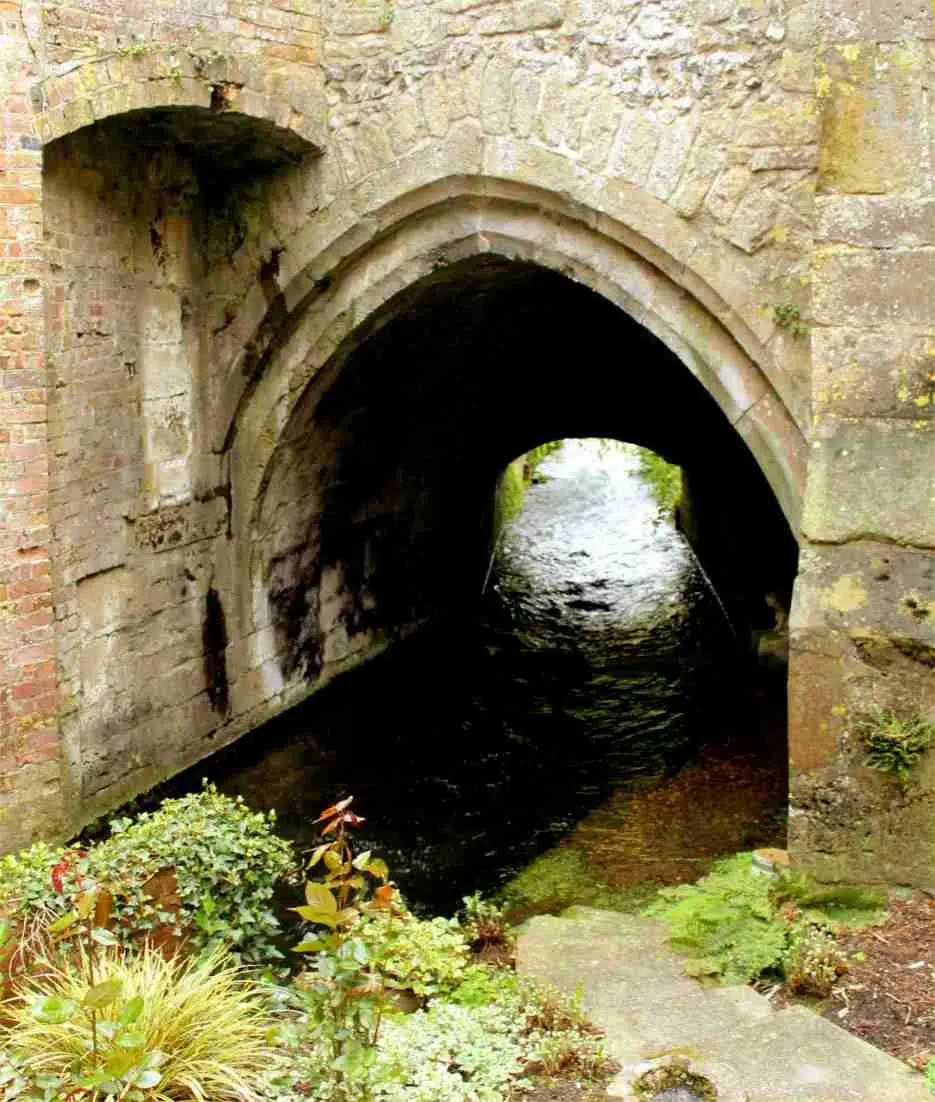
Holybourne derives from Old English Haligburna, “sacred stream” or “holy spring.” The spring almost certainly shaped selection of the site: springs were understood as thresholds where earth yielded something hidden, and the Normans, like their predecessors, founded sacred structures beside them. It still runs near the church and a pond central to the village's visual identity.
The church layers a 12th-century Norman nave and west-tower base, a thirteenth-century Early English chancel, a fifteenth-century arcade and raised floor responding to spring waterlogging, Victorian restoration preserving the medieval roof framework, and Whitechapel bells added in 2009. It also stands on the ancient Pilgrim's Way from Winchester to Canterbury.
Walkers can collect a passport stamp, rest in the churchyard, and continue toward Farnham; for those whose walk is more than exercise, nine centuries of prayer on a route shaped by sacred travel offer a different quality of rest.
Why this place is sacred
The thin-place reading of Holy Rood Holybourne begins before the Norman church was built, in the spring itself. The Old English Haligburna — sacred stream — suggests that the water at this site was considered spiritually significant before the Conquest.
Springs occupy a distinctive category in sacred geography: they emerge from underground, they are cold in summer and relatively warm in winter, they are reliable in a way that surface water is not, and they were associated in many pre-Christian European traditions with the numinous, with healing, and with access to what lies beneath the surface of the world.
The Normans, practical builders of empire and church alike, tended to site their parish churches at or near existing sacred places, absorbing rather than suppressing local veneration. The spring at Holybourne was likely one such site.
The dedication to the Holy Rood adds a second layer. The True Cross — the rood — was the central object of medieval Christian devotion, the instrument of salvation made tangible and physically present. Pilgrimages were undertaken to venerate fragments of it at major sites across Europe. A church named for the Holy Rood was not simply a local parish institution; it announced itself as a place where the meaning of Christian salvation was actively commemorated.
Walkers on the road to Canterbury, making their own journey of atonement and petition to the shrine of Thomas Becket, would have understood stopping at Holy Rood Holybourne as a small act of alignment with the central story of their faith.
The third layer is the accumulation itself. Nine centuries of regular prayer in a single building changes the quality of the space in ways that resist precise description but are commonly reported by visitors to long-used sacred sites. The stones have been polished by passing hands. The silence in the nave is a different silence from that of an empty room. Whether this is psychological, spiritual, or both, it is what pilgrims come seeking, and it is present here.
The waterlogging problem that forced the 15th-century floor raising is itself an oblique reminder of the springs' persistence — the sacred water does not stay neatly outside. The church had to accommodate it, literally raising itself above the level of the ground to remain usable, a structural consequence of its position beside the haligburna.
Built as a Norman parish church to serve the village of Holybourne after the Conquest, dedicated to the Holy Rood (True Cross) in the tradition of cross-dedication churches common in Norman England. The site was likely chosen in part because of an existing sacred spring, following the Norman practice of building on pre-existing sacred sites.
From Norman parish church to medieval pilgrimage waypoint to Victorian-restored active Anglican congregation, the church has absorbed several centuries of use without losing its core function as a place of Christian worship. The Pilgrim's Way passport scheme represents the newest formalization of the pilgrimage function, translating an ancient hospitality role into a contemporary walking-tourism context.
Experience and orientation
The church appears at the end of a short lane off the main road through Holybourne, where the village pond marks the presence of the bourne.
The churchyard surrounds the building on all sides and is worth time before entering: it holds the unusual brick barrel graves that have become one of the church's distinctive features, and somewhere within it is the memorial to Diana Rowden, an SOE agent who died in World War II — a reminder that sacred places accumulate all kinds of human story, not only the devotional.
The exterior announces its history clearly. The west tower base and nave walls carry Norman proportions; the chancel extends eastward in the narrower, more vertical Early English mode. The entrance retains its Norman arch, a rounded form that predates the pointed arches of Gothic construction. From the outside, the building reads as a genuine medieval structure that has been repaired and added to, not reconstructed.
Inside, the floor has been raised above the original ground level — the consequence of the springs that run below. This makes the space feel slightly compressed vertically in the nave, though the 15th-century roof framework preserved through the Victorian restoration opens upward in a way that corrects that impression. The arcade of the north aisle, also 15th-century, creates a secondary space alongside the nave.
The chancel, in Early English style, is architecturally the most resolved part of the interior: its proportions feel deliberate in a way the nave's several-phases-of-patching does not.
The church reads as actively loved rather than merely preserved. Evidence of current use — service schedules, community notices, flowers arranged for the Sunday Eucharist — sits alongside the medieval architecture without incongruity. This is not a museum church. For walkers arriving from several hours on the Pilgrim's Way, that quality of living occupation is itself a form of welcome.
The passport stamp is available, the visitor book invites a comment, and the chairs in the nave can be sat upon without ceremony.
The bells — eight of them, newly cast at Whitechapel Foundry in 2009, one of the last commissions before that historic foundry closed — are not a visual feature, but they are an auditory one if the visit happens to coincide with their ringing. Medieval and modern sound in a Norman tower.
Enter through the south door under the Norman arch. The nave and its arcade are to your left as you face east toward the chancel. The visitor book and donation box are typically near the entrance. The churchyard wraps the building — the brick barrel graves and war memorials are worth finding on a circuit of the exterior before or after visiting the interior.
Context and lineage
The village of Holybourne is recorded in the Domesday Book of 1086 as Haliborne, the same Old English root — Haligburna, meaning sacred stream — that became its current name. This suggests that the spring at this site was already understood as holy before the Norman church was built. The Norman builders, in the decades following the Conquest, constructed the original nave, west end, and lower tower in their characteristic Romanesque style: thick walls, rounded arches, small windows.
The dedication to the Holy Rood aligned this local church with the most powerful devotional symbol of medieval Christianity.
In the 13th century, the chancel was extended eastward in the Early English Gothic style, reflecting both the growing elaboration of liturgical space and the prosperity of the parish. By the 15th century, the springs beneath the site had become a structural problem: the floor of the entire church had to be raised to address waterlogging, a significant undertaking that also prompted the construction of the two-bay north aisle arcade.
The medieval roof framework, installed during this period or the earlier nave construction, survived into the 19th century and was retained through the Victorian restoration of 1870–1879, which rebuilt the north aisle but preserved the historic roof structure. Eight new bells were cast at the Whitechapel Bell Foundry and installed in October 2009.
The church passed from medieval Catholic use to Anglican at the English Reformation in the 16th century and has remained in Anglican hands since. It is currently part of the Parish of the Resurrection, Alton, within the Diocese of Winchester — the same diocese that holds Winchester Cathedral, the western terminus of the Pilgrim's Way. The continuity of the Diocese of Winchester provides an unbroken institutional thread from the Norman founding to the present day.
Diana Rowden
Special Operations Executive agent, World War II
Norman builders (unnamed)
Original constructors of the church
Victorian restorers (1870–1879)
19th-century restoration architects
Traditions and practice
The dedication to the Holy Rood places Holy Cross Day (14 September) as the church's patronal feast — the annual commemoration of the Exaltation of the Holy Cross, which commemorates both the finding of the True Cross by St Helena in Jerusalem and its recovery from Persian captivity. This feast was observed in the medieval Catholic calendar and continues in the Anglican lectionary.
Medieval pilgrims on the road to Canterbury would likely have stopped at a church of this dedication with particular devotion.
Sunday Eucharist services are held on the second and third Sundays of each month at 9:30am. The fourth Sunday hosts LeGo Church — a Lego-themed family worship service at 4pm. Through the week, Tuesday mornings offer a community coffee morning with prayer, and Wednesday mornings host Teddies, a toddler and carer group. The church is open daily from approximately 9:30am to at least 4pm for private prayer and reflection.
Pilgrim's Way passport stamps are available for walkers carrying a pilgrim passport on the Winchester-to-Canterbury route. This service, coordinated through the Holybourne Village Association and the Parish of the Resurrection, formalises a hospitality role that has existed at this site for centuries.
For those walking the Pilgrim's Way, entering the church before collecting the stamp — sitting in the nave for a few minutes, letting the walk quiet in the legs and the pace slow in the mind — repays the extra time. The visitor book is worth reading as well as signing: it holds a record of who has passed through, from where, and toward what.
The churchyard rewards a slow circuit, particularly to find the brick barrel graves and the Rowden memorial.
Anglican (Church of England)
ActiveThe church serves as an active parish church within the Parish of the Resurrection, Alton, Diocese of Winchester. It holds regular Eucharist services, community gatherings, and family worship events, and participates in the Pilgrim's Way passport scheme as a recognised stopping point for walkers on the Winchester-to-Canterbury route.
Sunday Eucharist on the second and third Sundays at 9:30am; LeGo (Lego-themed) family worship on the fourth Sunday at 4pm; Tuesday community coffee morning with prayer; Wednesday Teddies toddler group; Pilgrim's Way passport stamping; weddings and baptisms.
Medieval Catholic
HistoricalThe church was founded and used as a Catholic parish church from the Norman period through the English Reformation in the 16th century. Its dedication to the Holy Rood placed it within the medieval tradition of rood veneration, one of the most widespread devotional practices of the period. Its position on the Pilgrim's Way to Canterbury made it a natural stopping point for medieval pilgrims seeking hospitality and the blessing of a cross-dedicated church before continuing their journey.
Medieval Mass; pilgrimage hospitality; observance of the Feast of the Exaltation of the Holy Cross (14 September) as the patronal feast.
Perspectives and open questions
Holy Rood Holybourne sits at the intersection of several interpretive traditions — architectural, ecclesiastical, pilgrimage, and pre-Christian — each of which illuminates a different aspect of what makes the site significant. These perspectives are not in conflict; they layer onto one another in a way that reflects the genuine complexity of the site's history.
Scholarly perspective
Architectural and historical scholarship treats the church as a well-preserved example of Norman and Early English parish church development in Hampshire, notable for the clear legibility of its construction phases. The Corpus of Romanesque Sculpture in Britain and Ireland documents its Norman architectural elements, and its Grade II* listing by Historic England recognises its special architectural and historic interest above the standard Grade II threshold.
The village's Domesday Book entry as Haliborne (1086) provides documentary evidence for the pre-Conquest significance of the spring site, though the precise relationship between the spring's earlier sacred status and the Norman building programme remains inferential rather than documented.
Living and traditional perspectives
The Anglican tradition holds the church as a place of continuous Christian worship from the Norman period, dedicated to the Holy Rood in veneration of the True Cross — a devotion that the 19th-century Oxford Movement helped restore to prominence within Anglicanism after the Reformation's suppression of many devotional practices.
The Parish of the Resurrection, Alton, which now includes Holy Rood Holybourne within a group of four Anglican churches, understands the site as part of an ongoing mission of worship and community service, of which the Pilgrim's Way stamp scheme is one current expression.
Alternative interpretations
From a broader sacred geography perspective, the name Haligburna predating the Norman church is the most significant data point: it indicates that the spring at this site was considered holy before Christianity arrived in its Norman institutional form. Springs across Britain and Ireland were sites of pre-Christian veneration, often associated with healing, divination, and the offering of votive objects.
The Christianisation of such sites — by building a church beside or above the spring, by dedicating it to a saint or to a major Christian symbol, by establishing a feast day — was a standard Norman and earlier ecclesiastical strategy for redirecting rather than suppressing existing devotion. The Holy Rood dedication, one of the most powerful symbols in medieval Christianity, may have been specifically chosen to match the perceived power of the site.
Open questions
The full pre-Norman history of the spring site is not recoverable from available sources. The reason the entire church floor had to be raised in the 15th century — whether this was a gradual problem or a sudden one, whether it was related to increased spring activity or to subsidence — is not documented in detail. The original dedication ceremony and any specific founding legend attached to this church are not preserved in surviving sources.
Plan your visit
Access and arrival
Alton town centre, 1.3 miles away, has several hotels, B&Bs, and guesthouses. The town is well-served for an overnight stop on the Pilgrim's Way. No accommodation is available at the church itself. Check the British Pilgrimage Trust's Pilgrim's Way guidance for recommended overnight stops along the Hampshire section.
Respectful visit
Modest dress appropriate for a place of Christian worship. No specific dress code is enforced, but shoulders and knees covered is respectful.
Photography is generally permitted inside and outside the building. Discretion is appropriate during services or if the church is in use for a private occasion such as a baptism or wedding.
A donation box is available for contributions toward the upkeep of the building. There is no set amount; a contribution appropriate to a visit of this kind is welcome.
Silence or quiet conversation during services. If a service or community event is in progress, join quietly or allow it to conclude before exploring the building.
The church is an active place of worship. Visitors arriving during a Sunday Eucharist or a community event should either join quietly or return at another time. Services are not generally interrupted for passport stamping — check the service schedule before planning a stamp collection visit.
Location
Map loads as you approach this section.
Pilgrim reflections
A portrait of encounter, not a score
Pilgrims describe what they felt, how present they could become, and whether the place would shape a journey. There are no stars and no ranking of traditions.
No reviewed reflections yet
The first pilgrims can help describe the character of being here.
Share a reflection
Available after an account-backed “Been there.” Every reflection is reviewed before publication.
Nearby sacred places
Explore other sacred places in the region. Proximity does not establish access or travel time; check each place’s guidance.



References
Sources consulted for this page. Source categories describe the publication, not a guarantee that every claim is verified. Traditional accounts and outside interpretations may differ.
- 01Holybourne — Wikipedia — Wikipedia contributorsacademicConfirms 12th-century foundations, village name etymology from Old English Haligburna (sacred stream), and Domesday Book record as Haliborne (1086)
- 02Holy Rood Church — Holybourne Village Association — Holybourne Village AssociationofficialConfirms Pilgrim's Way passport stamp availability, church beside a bourne/pond, connection to village name, 8 new bells installed October 2009
- 03Holy Rood Church, Non Civil Parish — Historic England Listed Building 1351268 — Historic EnglandofficialConfirms Grade II* listed building status under Historic England
- 04Church of the Holy Rood, Holybourne — A Church Near You — Church of EnglandofficialCurrent parish information, services schedule, opening hours (open daily approx 9:30am–4pm), part of Parish of the Resurrection, Alton
- 05Church of the Holy Rood, Holybourne — Parish of the Resurrection — Parish of the Resurrection, AltonofficialOfficial parish website confirming the church's active worship status, Pilgrim's Way passport stamp, and community activities
- 06Holybourne (Holy Rood) Churchyard — Commonwealth War Graves Commission — Commonwealth War Graves CommissionofficialConfirms Commonwealth War Graves in the churchyard, including memorial to Diana Rowden (SOE agent)
- 07The Pilgrims' Way – Winchester to Canterbury — British Pilgrimage Trust — British Pilgrimage TrustofficialOverview of the Pilgrim's Way route from Winchester to Canterbury, confirming the Hampshire section through Alresford, Alton and Bentley
- 08Holy Rood, Holybourne, Hampshire — Corpus of Romanesque Sculpture in Britain and Ireland — CRSBIacademicAcademic Romanesque sculpture corpus entry confirming Norman-period architectural elements at the site
- 09Church of the Holy Rood, Holybourne — Resurrection Benefice — Resurrection BeneficeofficialBenefice-level description confirming active worship, community events, and position in the Parish of the Resurrection
- 10Holybourne, Church of the Holy Rood — Information — John Owen SmithSource contextDetailed architectural description: Norman arch entrance, Early English chancel, Perpendicular windows, 15th-century arcade, floor raising due to springs, 19th-century restoration
Share a photo
Help visitors recognize Church of the Holy Rood, Holybourne. Every submission is reviewed before publication.