Church of Sant Antoni de Portmany
A whitewashed fortress-church guarding Ibiza's harbor since the 1300s
Understand sacred places, explore living traditions, and learn how to engage respectfully with Pilgrim Map.
Access has not been verified. Check current local guidance before planning a visit.
Sant Antoni de Portmany, Balearic Islands, Spain
Read the sources
Visit essentials
A quick read before you go
- Duration
- 15–30 minutes for the interior and exterior; longer if attending Mass or visiting during the…
- Access
- Located at Plaça de s'Església, 1, in the pedestrian center of Sant Antoni de Portmany,…
Overview
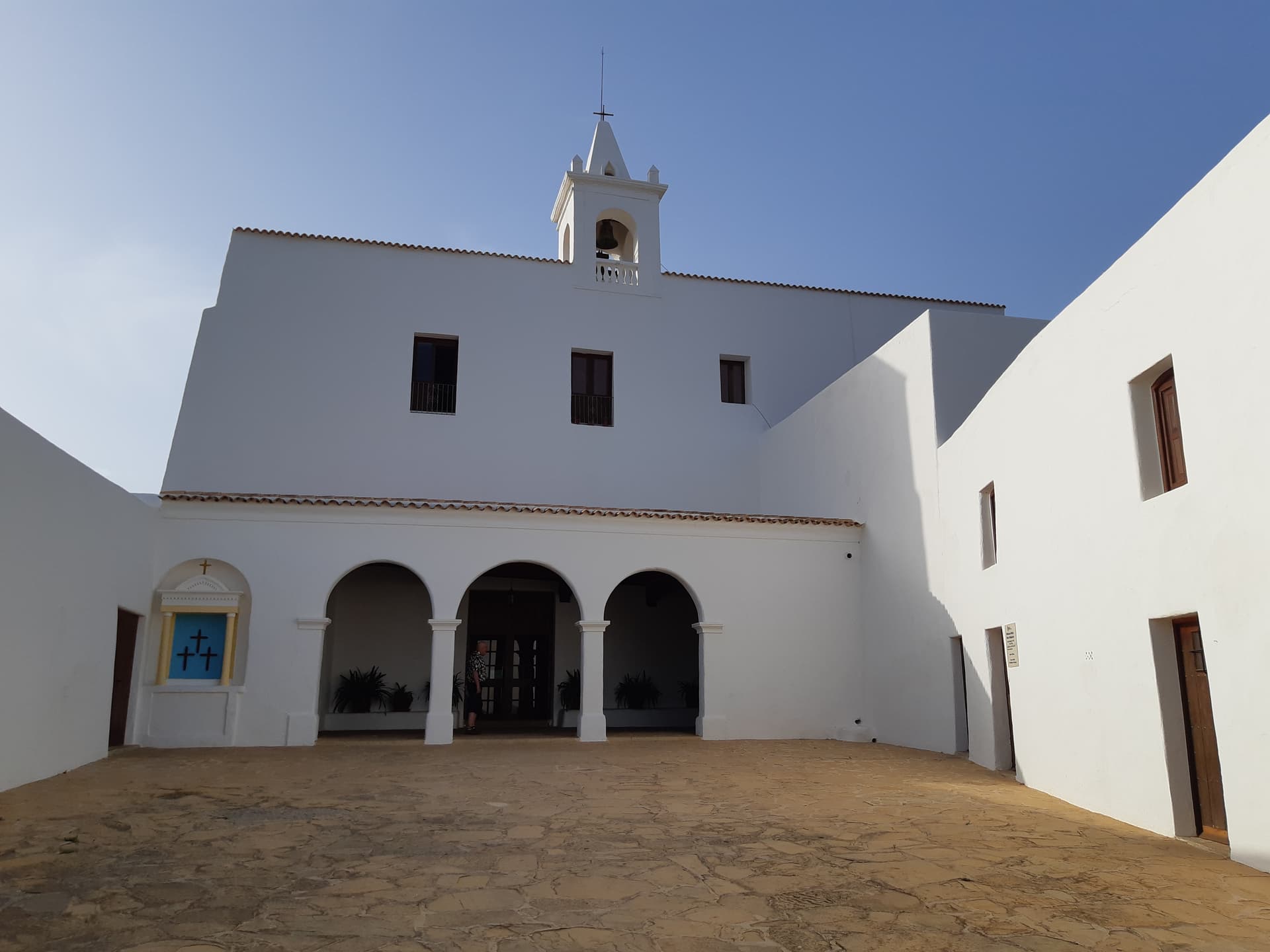
At the meeting of Sant Antoni de Portmany's pedestrian promenade and harbor, a squat white church and defensive tower face the water. Dedicated to Saint Anthony Abbot, it began with the Archbishop of Tarragona's 1305 permission for the Portmany quarter to build its own chapel and cemetery instead of traveling to Santa María in Ibiza Town.
Expansion through the 14th and 17th centuries produced a reinforced single nave of five arches; walls and tower were strengthened in the 1500s as pirate raids made the parish both sanctuary and stronghold.
Iron doors, small windows, a rooftop cannon covering the harbor, and an interior well sustained that defensive role, and weapons remained until 1869. Tourism and heritage sources repeatedly call it one of Ibiza's oldest surviving churches, second only to the cathedral, but that comparison is not independently verified and centuries of rebuilding complicate claims about the original 14th-century fabric.
Why this place is sacred
The church's significance is historical and communal rather than mystical. It does not sit on a dramatic natural feature or mark a reported vision or miracle; its power comes from having been, without interruption, the religious and defensive center of the Portmany quarter for more than seven hundred years.
Every generation that lived under threat of raid from the sea passed through this same nave, and the building's fortifications are a direct physical record of that anxiety — a rare case where a parish church's architecture tells you as much about the fear of its builders as about their faith.
What gives the site its particular resonance today is the layering: a 14th-century founding charter, 16th-century military engineering, and a living 21st-century parish occupying the same footprint. The harborfront square around it, now filled with cafés and hotel terraces, was for centuries the first line of the town's defense. Standing at the church's threshold, looking out toward the bay the tower's cannon once covered, is the clearest way to feel that history in the present townscape.
A parish chapel built to serve the Portmany quarter's population directly, without requiring travel to the cathedral parish in Ibiza Town; from the 16th century onward, fortified to double as a communal refuge against pirate and corsair attack.
Founded as a modest chapel following the 1305 authorization from the Archbishop of Tarragona; enlarged and altered through the 17th century; fortified in the 16th century with thick walls, a defensive tower, iron doors, and an interior well; retained weaponry in its tower until 1869; functions today as the town's active Catholic parish church.
Experience and orientation
Approaching from the pedestrian streets that fan out from the harbor, the church appears first as a mass of white wall and a squarish tower rising just above the surrounding rooftops. Up close, the whitewash gives way at the rear to an unpainted stretch of raw stone, a visible seam between the building's public face and its working, defensive one.
The main door is set into walls thick enough that the small windows above read less as decoration than as arrow slits reimagined for a later century — which, in effect, they were.
Inside, the single nave and its five arches create a compressed, unified space, plainer and darker than the ornate interiors found in many Mediterranean parish churches; the atrium and rooftop terrace referenced in historical accounts speak to a building designed for movement and defense, not just liturgy. Outside again, the harborfront plaza — Plaça de s'Església — surrounds the church with the ordinary business of a tourist town: shops, hotel entrances, people crossing to the water.
The contrast is part of the experience: a structure built to withstand siege, now standing quietly at the center of café tables and beach traffic.
The church sits at Plaça de s'Església, 1, in the pedestrian center of Sant Antoni de Portmany, immediately inland from the harbor. It is reachable on foot from anywhere in the town center; no vehicle access or parking is needed at the site itself.
Context and lineage
By the early 1300s, the Portmany quarter of Ibiza had grown populous enough that its residents petitioned for their own place of worship rather than continuing to travel to the parish of Santa María, the church that is now Ibiza's cathedral. In 1305, the Archbishop of Tarragona — under whose ecclesiastical authority Ibiza then fell — granted that petition, authorizing construction of a chapel and adjoining cemetery near the port.
The residents dedicated their new chapel to Saint Anthony, and the settlement that grew around it eventually took the same name.
1305 archiepiscopal authorization and founding chapel → early-to-mid 14th-century construction → 17th-century structural additions and enlargement → 16th-century fortification (walls, tower, well) in response to piracy → armed parish church through 1869 → continuously active Catholic parish to the present day.
Traditions and practice
For centuries, the church's defensive function was inseparable from its religious one: iron doors, thick walls, and an interior well meant that when pirate ships were sighted, the same building that held Mass on Sundays became the place villagers ran to for shelter. Cannon mounted in the tower defended the harbor approach directly.
This arrangement — church as fortress — was common to Ibizan coastal parishes of the period, a communal response to a shared threat rather than a practice unique to this one site.
The parish holds regular Mass on weekdays, Saturdays, and Sundays, with times shifting seasonally between spring–summer and autumn–winter schedules. The church anchors the town's most important yearly celebration: the Sant Antoni Abat festivity on January 17, when the harborfront square fills for traditional Ibizan country dancing (ball payès) and the blessing of pets and animals in the surrounding streets.
Visit during the church's public opening hours to see the interior's single-nave, five-arch structure and the visible transition between the whitewashed façade and the raw stone rear wall.
If your visit falls near January 17, the Sant Antoni Abat festival offers the fullest sense of the church's continuing role as the town's civic and religious center — arrive for the dancing and the blessing of animals in the square, and note how the same space that once sheltered residents from raiders now gathers them for celebration.
Roman Catholic Christianity
ActiveThe church has been the parish center of the Portmany quarter — now the town of Sant Antoni de Portmany — since its 1305 founding charter, serving continuously as the community's place of worship and, for several centuries, its principal defensive shelter against piracy.
Regular weekday, Saturday, and Sunday Mass with seasonal schedule changes; the annual Sant Antoni Abat patronal festival on January 17, featuring traditional Ibizan country dancing (ball payès) and the blessing of pets and animals in the streets around the church.
Perspectives and open questions
The church is understood primarily through local heritage scholarship and municipal cultural documentation, with tourism sources supplying most publicly available detail on its architecture and current use.
Scholarly perspective
Ibiza's island cultural heritage authority (Eivissa Cultural) catalogues the church as immovable cultural heritage, dating its origin to the 14th century and identifying it as among the oldest churches on the island after the cathedral of Santa María — a claim repeated across multiple tourism sources but without independent academic verification located in this research.
Living and traditional perspectives
Within the parish and town, the church's dual history as sanctuary and refuge is treated as founding local lore: the 1305 charter, the pirate-era fortification, and the retention of weapons until 1869 are commonly cited details in local and municipal accounts of the town's origins.
Open questions
Because of centuries of additions and possible partial demolitions, it is not established with certainty how much of the original 14th-century structure survives within the present building — a point the local heritage record itself acknowledges rather than resolves.
Plan your visit
Access and arrival
Located at Plaça de s'Església, 1, in the pedestrian center of Sant Antoni de Portmany, immediately behind the harbor. Fully walkable from anywhere in the town center; no vehicle access needed. Mobile phone signal is reliable throughout the town. Check obispadodeibiza.es for current contact details and Mass times, which vary seasonally.
Sant Antoni de Portmany is a major tourist town with abundant hotel and short-term accommodation options within walking distance of the church.
Respectful visit
No specific dress code is documented beyond general norms for visiting an active Catholic church: covered shoulders and no beach attire are advisable, particularly given the town's proximity to the seafront.
No specific restriction is documented; visitors should avoid photographing during active Mass or other services out of courtesy.
Visiting hours are limited to Tuesday–Saturday, 9:30 AM–1:30 PM per municipal tourism sources; Mass times vary seasonally and take priority over casual visits.
Respect Mass times and any services in progress; the church's opening hours for casual visits are limited (Tuesday–Saturday, 9:30 AM–1:30 PM, per municipal tourism sources), so plan around them rather than expecting all-day access.
Location
Map loads as you approach this section.
Pilgrim reflections
A portrait of encounter, not a score
Pilgrims describe what they felt, how present they could become, and whether the place would shape a journey. There are no stars and no ranking of traditions.
No reviewed reflections yet
The first pilgrims can help describe the character of being here.
Share a reflection
Available after an account-backed “Been there.” Every reflection is reviewed before publication.
Nearby sacred places
Explore other sacred places in the region. Proximity does not establish access or travel time; check each place’s guidance.

Sa Caleta Phoenician Settlement
Sant Josep de sa Talaia, Balearic Islands, Spain
12.8 km away

Puig des Molins Necropolis
Eivissa, Balearic Islands, Spain
13.6 km away

Cathedral of Santa Maria of Ibiza
Eivissa, Balearic Islands, Spain
14.1 km away
Church of Sant Miquel de Balansat
Sant Miquel de Balansat, Balearic Islands, Spain
14.3 km away
References
Sources consulted for this page. Source categories describe the publication, not a guarantee that every claim is verified. Traditional accounts and outside interpretations may differ.
- 01Església de Sant Antoni Abat — Eivissa Cultural (Consell Insular d'Eivissa heritage directory)officialOfficial island cultural heritage catalogue entry; confirms 14th-century date, dedication to Saint Anthony Abbot, status as second-oldest church on the island after the cathedral, and listing as immovable cultural heritage.
- 02Sant Antoni de Portmany church - Ibiza — Ibiza.travel (official tourism board)Source contextOfficial Ibiza tourism board entry; confirms 14th-century origin, fortification, mass schedule, contact details.
- 03Church of Sant Antoni - Visit Sant Antoni — Visit Sant Antoni (municipal tourism site)Source contextMunicipal tourism site; confirms address, opening hours, architectural description, fortification, whitewashed exterior.
- 04Iglesia de Sant Antoni de Portmany — DescubreIbiza.comSource contextConfirms 1305 authorization by the Archbishop of Tarragona for the inhabitants of the Portmany quarter to build a chapel and cemetery, dedicated to Saint Anthony; notes later structural additions obscure the original 14th-century fabric.
- 05Iglesia de Sant Antoni - Ibiza 5 Sentidos — Ibiza 5 SentidosSource contextDescribes the church-fortress typology common to Ibizan churches, built to shelter the population from pirate raids.
- 06Parish Church of St. Anthony the Great, Sant Antoni de Portmany, Spain — WanderlogSource contextConfirms dedication to Saint Anthony the Great (Saint Anthony Abbot) and location details.
- 07The San Antonio Abad festivity — Visit Sant Antoni (municipal tourism site)Source contextDescribes the annual January 17 patronal festival: traditional Ibizan country dancing (ball payès), blessing of pets, church-square celebrations.
- 08Església de Sant Antoni de Portmany Map — MapcartaSource contextGeographic/mapping reference confirming site location and coordinates in Sant Antoni de Portmany.
Share a photo
Help visitors recognize Church of Sant Antoni de Portmany. Every submission is reviewed before publication.