Church of Panagia Chrisopigi, Sifnos Island
A white church on a split rock where the Aegean meets centuries of answered prayer
Understand sacred places, explore living traditions, and learn how to engage respectfully with Pilgrim Map.
Access has not been verified. Check current local guidance before planning a visit.
Φάρος, South Aegean, Greece
Read the sources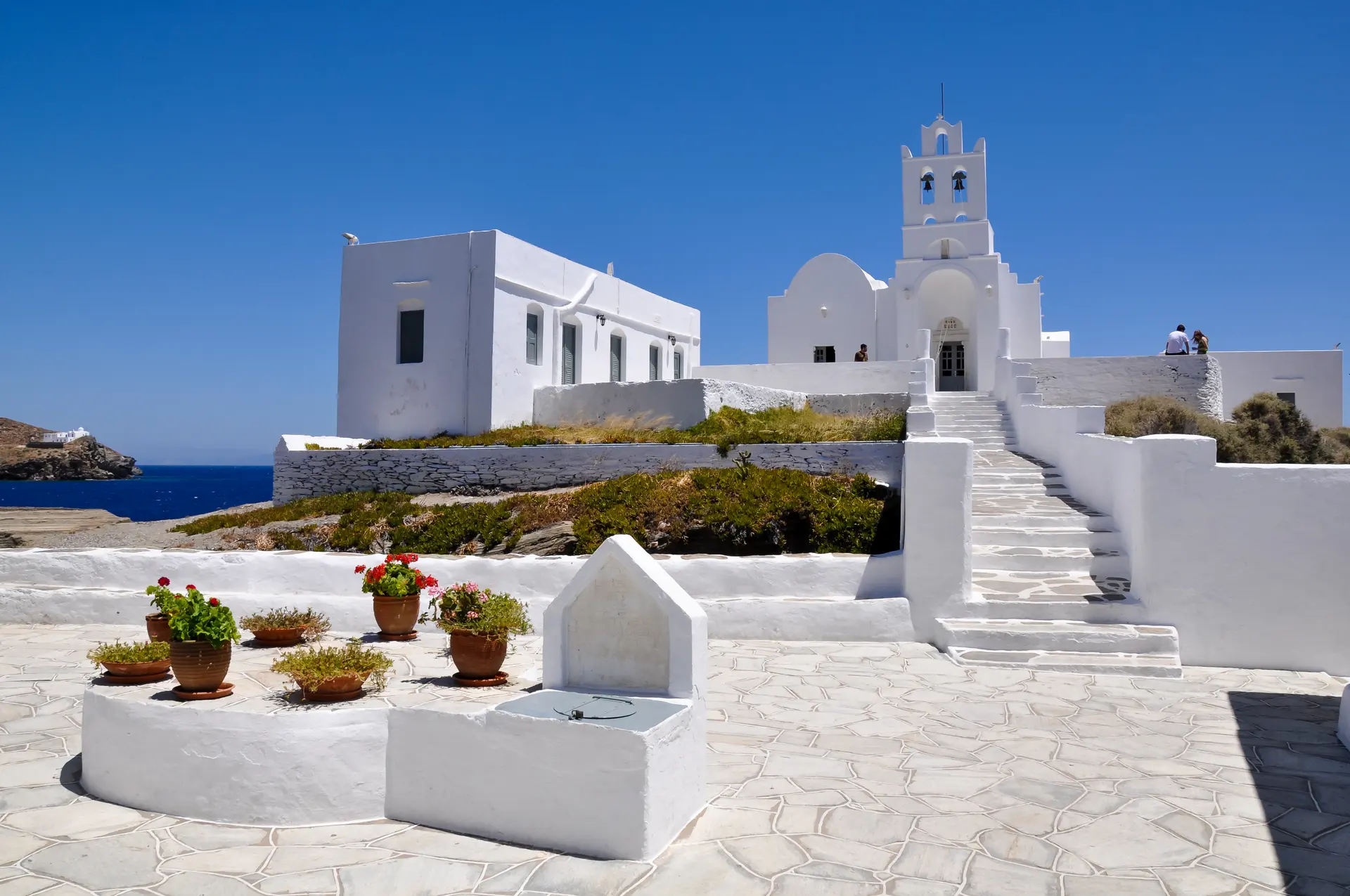
Image of Church of Panagia Chrisopigi, Sifnos Island. Image source · CC-BY-SA-4.0
Visit essentials
A quick read before you go
- Duration
- A visit of 30 minutes to one hour allows time to cross the bridge, explore the church interior,…
- Access
- Chrysopigi is located 10 km south of Apollonia, the capital of Sifnos, near the village of…
Overview
Panagia Chrysopigi stands where tradition says the Virgin chose to stay: a small white church with a vaulted roof and bell tower on a rocky islet off southern Sifnos. A narrow bridge, barely wide enough for two people to pass, crosses the fissure that tradition says miraculously opened to save women from pursuing pirates. During the Byzantine Iconoclasm, fishermen found an icon of the Virgin in the sea and brought it to this rock.
When worshippers tried to move it to a more accessible church, it became impossibly heavy, understood as her choice to remain. The church has been rebuilt and expanded across the centuries, but the icon and the island's devotion remain. Sifniots credit Chrysopigi with saving them from plague and locusts in 1676, 1811, and 1927.
Officially declared Sifnos's patron saint in 1964, her icon travels by boat across the harbor on Ascension Day, accompanied by a fleet of vessels and the prayers of the island.
Why this place is sacred
What makes a place sacred is sometimes a matter of geology and sometimes a matter of accumulated faith. At Chrysopigi, it is both. The islet's physical separation from the mainland creates an unmistakable threshold. Crossing the bridge, you leave the road, the parked cars, the beach umbrellas behind. The sound changes — waves replace traffic.
The light changes — reflected off sea on every side, it has a luminous, encompassing quality that softens shadows and seems to come from everywhere at once.
Then there is the split rock itself. The islet was not always an islet. The fissure that separates it from the coast is narrow enough to bridge but deep enough to fill with sea. Whether this was the work of an earthquake, erosion, or — as the tradition insists — divine intervention to protect the faithful from pirates, the result is a church that sits on a fragment of the earth, surrounded by water.
The symbolism writes itself, but visitors report that the experience goes beyond symbolism. Standing on the islet, with the Aegean pressing in from three sides and the cliffs of Sifnos behind you, the ordinary world recedes in a way that feels less like distance and more like permission.
Four centuries of continuous devotion have layered the site with the kind of presence that accumulates in places where prayer does not stop. The icon has been venerated here since the 17th century, and the miracles attributed to it are not ancient legends but events within the historical record of the island. The plague years are documented. The locust swarm of 1927 is within living memory of some islanders' grandparents.
For Sifniots, Chrysopigi is not a heritage site but an active relationship — the place where the Virgin listens, and where the island listens back.
The first church on this rock was built by Nikolaos Pitzini in 1650, on the ruins of an older, undated structure. It housed an icon of the Virgin Mary that fishermen had pulled from the sea during the period of Byzantine Iconoclasm — an icon that, according to tradition, refused to be moved from this spot.
The church served as a place of Marian devotion and, after the first recorded miracle in 1676, as the island's primary site of spiritual refuge in times of crisis.
The church has been rebuilt and expanded several times. Priest Hieronymos Zambelis-Rousso constructed a larger church in 1675. In 1677, a Cretan monk named Parthenios Hairetis documented the miracles and gave the church its current name, Chrysopigi — 'Golden Spring' or 'Golden Source' — after the Chrysopigi Monastery in Chania, Crete. A wall inscription records the construction of the current structure in 1757.
In 1760, the church was sold to the Monastery of Vrysiani, becoming a metohi — a dependent property — which it remains today. Through these transitions of ownership and structure, the core function has never changed: this is where the people of Sifnos come to be near their protector. The official declaration of Panagia Chrysopigi as patron saint of Sifnos in 1964 formalized what the island had known for centuries.
Experience and orientation
You see the church before you reach it. From the road above Chrysopigi beach, the white bell tower is visible against the deep blue, perched on its islet like something that grew from the rock rather than being placed there. The walk down takes a few minutes — past low scrub and wind-bent bushes, the dry aromatic landscape of the southern Cyclades giving way to the salt air of the coast.
The bridge is the threshold. It is narrow, stone, and the sea moves visibly beneath it — not a torrent but a steady pulse, turquoise shading to cobalt where the depth increases. Crossing it, even on a calm day, you feel the shift. The ground under your feet is no longer the island. It is a fragment — a piece that broke away, or was broken, depending on which story you carry.
The church itself is modest in scale and luminous in effect. White walls curve softly in the Cycladic manner, absorbing and radiating light. The bell tower rises tall and slender. Stone-built cells with vaulted ceilings cluster around the central church, remnants of the monastic function that persists through the church's connection to Vrysiani. Inside, the air is cooler, darker, scented with beeswax and incense.
The vaulted ceiling is low, reinforced by half-meter-wide stone slings that give the interior the feeling of a ship's hull inverted. The marble entrance frame carries carved waves, rosettes, and furousaki — ornamental details that show the Venetian influence that touched all the Cyclades.
The iconostasis is the heart of the interior: wood-carved, partially gilded, housing the miraculous icon behind its screen. The Virgin looks out from centuries of veneration. Candles burn steadily in their red glass holders. Whatever brought you here — curiosity, devotion, the recommendation of a guidebook — this room asks you to slow down. The waves are audible through the walls. The light through the small windows is soft and directional.
The room holds you the way cupped hands hold water.
Outside again, the islet offers a circumnavigation of a few dozen meters. The views are of open sea to the south and the coastline of Sifnos curving away to the north. On a bench or a warm rock, with the church at your back and the Aegean before you, the particular gift of this place becomes apparent. It is not grandeur. It is intimacy. A small church on a small rock, holding a very large devotion.
Chrysopigi is ten kilometers from Apollonia, the capital of Sifnos. Buses and cars reach the nearby road; from there, a short walk leads down to the bridge. Visit in the morning for the gentlest light and fewest visitors. Carry a light wrap for covering shoulders before entering the church. The adjacent Chrysopigi beach offers swimming afterward — a pairing of sacred and sensory that the Cyclades do naturally.
If visiting for Ascension Day, arrive the evening before to witness the full arc of the celebration, from vespers through the communal feast and overnight vigil.
Context and lineage
The story begins with destruction and rescue. During the Byzantine Iconoclasm, when imperial authorities ordered the systematic destruction of religious images, an icon of the Virgin Mary entered the sea. Whether it was deliberately set adrift by monks trying to save it or lost in the upheaval, the icon was found by fishermen in the waters near Sifnos.
They brought it to a rocky promontory on the island's southern coast, where a small temple — its origins now lost — already stood.
The icon, tradition holds, chose this place. When worshippers attempted to carry it to a larger, more established church, it became impossibly heavy. Multiple hands could not lift what one person had carried. The message was understood: the Virgin wished to remain here, on this rock above the sea. Nikolaos Pitzini built the first known church on the site in 1650, and the icon was installed.
Then the rock itself split. The story varies in its details — some accounts place this event before the church was built, others after — but the narrative is consistent in its meaning. Women were lighting candles at the church when pirates approached. The rock cracked, separating the church from the mainland and leaving the women safe on their new islet as the sea rushed in between. The pirates could not cross. The women survived.
The fissure remains, bridged now by human hands but never closed. It is the visible scar of a miracle, or the natural feature that generated one — and for those who come to pray here, the distinction does not matter.
The church belongs to the Eastern Orthodox tradition and functions as a metohi (dependent property) of the Monastery of Vrysiani on Sifnos, a relationship established in 1760 when the church was sold to the monastery. This monastic connection provides institutional continuity and liturgical oversight. The naming by the Cretan monk Parthenios Hairetis links Chrysopigi to the broader network of Marian devotion across the Greek world, particularly to the Chrysopigi Monastery in Chania.
The church's designation as patron of Sifnos in 1964 formalized its role as the island's spiritual center — a role it had held in practice since the first miracle of 1676.
Nikolaos Pitzini
Builder of the first documented church on the site in 1650, establishing the structure that would house the miraculous icon and anchor centuries of devotion.
Hieronymos Zambelis-Rousso
Priest who rebuilt and expanded the church in 1675, one year before the first recorded miracle of deliverance from plague. His construction gave the site its institutional permanence.
Parthenios Hairetis
Cretan monk who arrived in 1677, documented the miracles of the icon, and bestowed the name Chrysopigi — 'Golden Spring' — connecting this Sifniot church to the older Chrysopigi Monastery in Chania and to the symbolism of an inexhaustible sacred source.
The fishermen of the Iconoclasm
Unnamed fishermen who found the icon of the Virgin Mary in the sea and brought it to the rock. Their act of recovery — pulling the sacred from the waves — is the founding gesture that everything else follows from.
Traditions and practice
The liturgical year at Chrysopigi follows the rhythms of Orthodox worship, but one event stands above all others: the Ascension Day celebration, held forty days after Easter, typically falling in May or June. This is not merely a church service but a multi-day event that weaves together faith, food, community, and the sea itself.
The celebration begins in Kamares, Sifnos' port village. The miraculous icon is raised from the panigiras house — where it has been kept during its time away from the church — and processed through the streets to the Church of Agios Georgios. From there, the icon is placed aboard a vessel and carried by sea to Chrysopigi, accompanied by a fleet of boats.
Fishing boats, sailboats, and small craft fall into procession behind the icon, creating a floating pilgrimage that mirrors the icon's original arrival from the sea during the Iconoclasm. For the people of Sifnos, this is the moment when the annual cycle renews itself — their protector returns home across the water.
On the eve of the feast, Great Vespers begin at 6:30 in the evening. After the service, the Love Feast — a communal dinner — is served to all present. The menu follows tradition closely: revithada (slow-baked chickpeas, the signature dish of Sifnos), veal in tomato sauce, pasta, olives, and wine poured from terracotta jugs.
This is not a restaurant meal but a shared offering, prepared by the community and eaten together on the rocks and grounds around the church, with the sea dark and present on every side.
Through the night, a Holy Vigil is kept. Those who stay — and many do, sleeping on the rocks or sitting together in small groups — experience the church in its most elemental state: candlelight, incense, chanting voices, and the sound of the Aegean against the islet. At dawn, the polyarchieratic liturgy (a liturgy served by multiple priests) marks the feast proper.
Holy Friday and Easter observances are also held at the church, drawing islanders and visitors into the annual rhythm of death and resurrection that structures Orthodox life.
Beyond the great feast days, Chrysopigi serves as one of Sifnos' most beloved venues for weddings and baptisms. The intimate scale of the church, the setting on the islet with the sea as backdrop, and the association with the island's protector make it a place where personal milestones intertwine with communal faith. Year-round, visitors and locals enter the church to venerate the icon, light candles, and sit in the particular silence that the location affords.
The church is not a museum or an artifact but an active node in the daily spiritual life of the island.
Cross the bridge slowly. Notice the transition — from solid ground to the fragment of rock that holds the church. Inside, light a candle if the gesture speaks to you; the act of striking a match and watching the flame join the others is older than any specific creed. Spend time with the iconostasis. The partially gilded carvings reward close attention, and the icon at its center has been the focus of prayer for nearly four centuries.
Afterward, sit outside on the rocks facing the sea. Let the visit be unhurried. The monks of Vrysiani have maintained this place across centuries; fifteen minutes of stillness is a way of participating in that continuity. If you are on Sifnos during Ascension season, attending the Love Feast and vigil offers immersion in a living tradition that no guidebook can replicate.
Eastern Orthodox Christianity
ActiveChrysopigi is the patron church of Sifnos, officially designated in 1964 after centuries of de facto spiritual centrality. The miraculous icon is credited with three documented interventions — saving the island from plague twice and from locusts once. It is one of the most important Marian pilgrimage sites in the Cyclades and the focus of Sifnos' most significant annual celebration.
Perspectives and open questions
Chrysopigi can be read through several interpretive frames: as an example of Cycladic ecclesiastical architecture with Venetian influences, as a living center of Marian devotion with documented miraculous attributions, as a landscape phenomenon where the split between rock and sea mirrors the split between ordinary and sacred space.
Scholarly perspective
Architectural analysis places the current structure within the 18th-century tradition of Cycladic church building, with the wall inscription of 1757 providing a firm terminus. The marble entrance frame with its waves, rosettes, and furousaki shows Venetian decorative influence, consistent with the broader pattern of Western artistic contact across the Cyclades during the period of Venetian and Frankish rule. The church's status as a metohi of Vrysiani Monastery reflects the common practice of monastic property consolidation in the post-Byzantine Aegean.
The multiple construction dates reported by different sources (1523, 1650, 1675, 1757) likely refer to different structures on the same site, a not uncommon pattern where successive churches are built on earlier foundations. The pre-existing temple mentioned in founding accounts remains unidentified — whether it was an early Christian structure or something older is an open question that no available archaeological evidence resolves.
Living and traditional perspectives
For the people of Sifnos, Chrysopigi is not a historical curiosity but a living relationship. The icon in the church is the island's protector, and the three documented miracles — deliverance from plague in 1676 and 1811, and from locusts in 1927 — are not legends from a distant past but events within the community's remembered experience.
The Ascension Day celebration, with its boat procession that recreates the icon's original arrival from the sea, is the most important event in the island's cultural calendar. It is simultaneously a religious observance, a community gathering, and an affirmation of identity. To be Sifniot is, in a meaningful sense, to belong to Chrysopigi.
Alternative interpretations
The church's position on a split rock islet has drawn interpretation beyond the Orthodox framework. Some visitors and writers have noted the site's qualities as what Celtic spirituality would call a thin place — a location where the boundary between the material and the numinous seems permeable. The name Chrysopigi itself, meaning 'Golden Spring' or 'Golden Source,' carries resonances that extend beyond its immediate monastic reference.
Springs have been sacred across Mediterranean cultures since antiquity, and gold as a symbol of spiritual transformation has deep roots in alchemical and Hermetic traditions. Whether these associations are accidental or trace something older embedded in the site is a question the available evidence cannot answer.
Open questions
The nature of the pre-existing temple on which the first church was built remains one of Chrysopigi's genuine mysteries. No archaeological investigation has clarified whether this was an early Christian chapel, a Byzantine structure, or something older. The date of the rock split — if it was a single geological event rather than gradual erosion — is similarly unresolved, and its relationship to the founding narratives of the church is a matter of faith rather than evidence.
Some sources link the name Chrysopigi to the monastery in Chania, while others derive it independently from the meaning 'Golden Spring,' suggesting a sacred water source that has since been lost or forgotten. These ambiguities are not flaws in the historical record but part of what gives the site its depth — layers of meaning that resist being flattened into a single, definitive account.
Plan your visit
Access and arrival
Chrysopigi is located 10 km south of Apollonia, the capital of Sifnos, near the village of Chrysopigi. The church is reachable by car or local bus from Apollonia. From the road, a short walk leads down to the bridge connecting the mainland to the islet. The approach is on foot and accessible to most visitors; the terrain is uneven rock rather than steps.
Sifnos is reached by ferry from Piraeus (approximately 5 hours by high-speed ferry, longer by conventional), as well as from other Cycladic islands including Milos, Serifos, and Paros. Ferries dock at Kamares port. Mobile phone signal is generally available in the area.
Chrysopigi beach and the nearby village have a small number of guesthouses and rental properties. Apollonia, 10 km to the north, is the main accommodation center with a wider range of hotels and rooms. For the Ascension Day celebration, book well in advance — the island fills during the feast. Kamares port also offers lodging, with convenient access to the ferry.
Respectful visit
Modest dress: shoulders and knees covered for all visitors. Light, breathable fabrics that provide coverage are ideal for the Cycladic climate. A scarf or wrap carried in a bag serves well.
Photography is permitted and welcomed on the exterior of the church and the surrounding islet. Inside the church, photography is discouraged or restricted. Ask before photographing interior spaces. During services and ceremonies, cameras and phones should be put away entirely.
Candles are available for purchase inside the church. Lighting a candle is the customary offering and is open to all visitors. No other offerings are expected or solicited.
Standard church etiquette applies. No loud conversation inside. No entering during ceremonies unless you intend to stay. The church may have limited or irregular hours outside the summer season — check locally before visiting in spring or autumn.
The church is an active place of worship. Conversations should be quiet inside, and phones should be silenced. The Ascension Day celebration and other feast days are deeply meaningful to the people of Sifnos — attend as a participant, not a spectator. Taking photographs during services is discouraged. If a wedding or baptism is in progress when you arrive, wait outside until the ceremony concludes rather than entering.
Current practical details
Address
Chrisopigi 840 03, Greece
Hours
Hours, fees, and access can change — verify on the official source before you travel. Practical details last checked Jun 2026.
Location
Map loads as you approach this section.
Pilgrim reflections
A portrait of encounter, not a score
Pilgrims describe what they felt, how present they could become, and whether the place would shape a journey. There are no stars and no ranking of traditions.
No reviewed reflections yet
The first pilgrims can help describe the character of being here.
Share a reflection
Available after an account-backed “Been there.” Every reflection is reviewed before publication.
Nearby sacred places
Explore other sacred places in the region. Proximity does not establish access or travel time; check each place’s guidance.


References
Sources consulted for this page. Source categories describe the publication, not a guarantee that every claim is verified. Traditional accounts and outside interpretations may differ.
- 01Sifnos Chrysopigi — The Aegean Islands — Region of South AegeanofficialRegional authority with detailed architectural information
- 02Churches – Monasteries — Sifnos.gr — Municipality of SifnosofficialOfficial municipal tourism site
- 03Panagia Chrysopigi — Wikipedia — Wikipedia contributorsencyclopediaOverview of history and founding
- 04Synaxis of Panagia Chrisopigi of Sifnos — John SanidopoulosofficialDetailed miracle accounts and religious history
- 05Ascension Day in Sifnos and celebration of Panagia Chrysopigi — e-SifnosguideDetailed feast day celebrations and food traditions
- 06Chrissopigi Monastery in Sifnos — Greeka — Greeka.comguidePractical visitor information
- 07Sifnos Festival of the Panagia of Chrisopigi — Gastronomy Tours — Gastronomy ToursguideFocus on culinary traditions of the feast
Photo gallery
2 curated photos
Share a photo
Help visitors recognize Church of Panagia Chrisopigi, Sifnos Island. Every submission is reviewed before publication.