Monastery of Hozoviótissa, Amorgos Island
A white monastery pressed into a 300-meter cliff, suspended between rock and infinite blue
Understand sacred places, explore living traditions, and learn how to engage respectfully with Pilgrim Map.
Access has not been verified. Check current local guidance before planning a visit.
Amorgos, South Aegean, Greece
Read the sources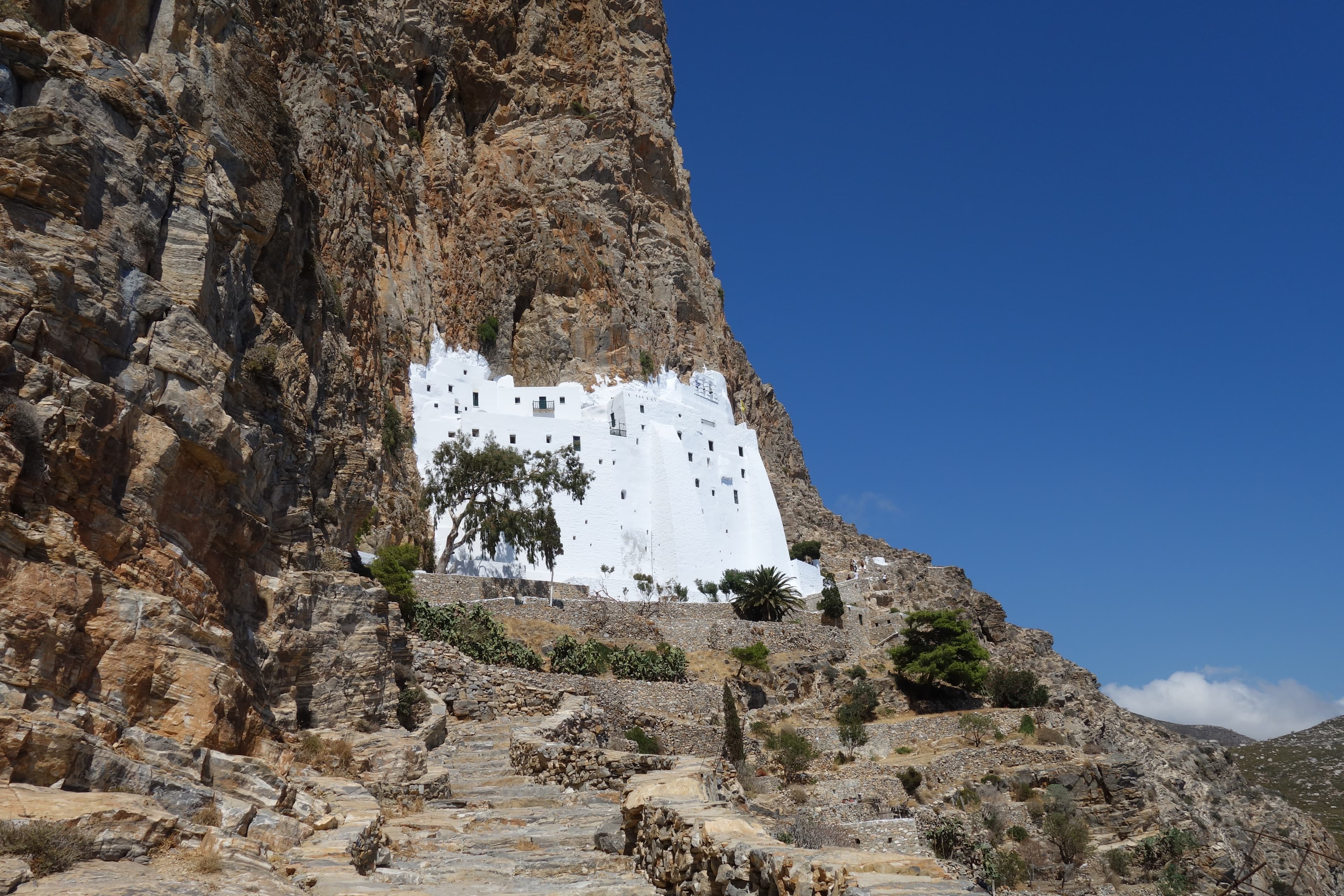
Image of Monastery of Hozoviótissa, Amorgos Island. Image source · CC-BY-SA-4.0
Visit essentials
A quick read before you go
- Duration
- Allow 1.5 to 2 hours for the complete visit: 30-45 minutes for the ascent, 30-45 minutes inside…
- Access
- The monastery sits 1 km from Amorgos Chora.
Overview
The Monastery of Hozoviótissa occupies a vertical plane on Amorgos's southern coast: eight stories of whitewashed stone pressed into a sheer cliff, barely five meters wide at its broadest. Limestone rises behind it; before it are three hundred meters of air and the Aegean stretching to the horizon.
For over a thousand years the monastery has held this position. Three monks still live here, maintaining a daily liturgical cycle uninterrupted across the centuries and keeping the miraculous Panagia Hozoviotissa icon—the Virgin who protects the island. They keep watch over the threshold between solid earth and open sky. Visitors climbing 300 steps receive a glass of raki, a piece of loukoumi, a cup of water, and freedom to sit in silence above the world.
Why this place is sacred
Certain places gather meaning the way valleys gather mist. The Monastery of Hozoviótissa is one of these. Its sacredness arises not from any single factor but from the convergence of several: the dramatic physical setting that places visitors at the edge between solid ground and vast emptiness; the miraculous icon whose arrival by sea during the Iconoclasm gives the site its founding narrative; and the unbroken chain of monastic prayer that has continued here since at least the ninth century.
The cliff itself is part of the experience. The monastery does not overlook the sea — it hangs above it, pressed into the rock face like a page pressed into a book. The building's extreme narrowness, its vertical layering, its staircases carved from living stone — all of these create an architecture of compression and release. Inside, the rooms are intimate, shadowed, dense with the smell of incense and old wood.
Step onto the balcony, and the Aegean opens without limit. This alternation between enclosure and infinity is the monastery's essential character.
For the people of Amorgos, the Panagia is not a historical figure but a living presence. The island's fishermen, farmers, and shopkeepers understand the icon in the cliff as their protector — the one who watches from the height when storms come, when illness comes, when the ferries stop running in winter. This is not metaphor. It is the lived relationship between a community and the sacred that has sustained both for a thousand years.
The monastery was founded to house a miraculous icon of the Virgin Mary that arrived by sea during the Byzantine Iconoclasm (8th-9th century). Monks fleeing the destruction of religious images placed the icon in a boat; it washed ashore at Agia Anna beach below the cliff. The monastery was built at the spot where the icon chose to reside — a location reportedly selected by divine sign when builders' tools were mysteriously transported to the cliff face overnight.
From its founding, the monastery served as both a place of monastic withdrawal and a center of Marian devotion for the surrounding island. Emperor Alexios I Komnenos formalized its status with a chrysobull in 1088, granting stauropigian rights that placed it under the direct authority of the Ecumenical Patriarch rather than the local bishop. Through centuries of Byzantine, Venetian, and Ottoman rule, the monastery maintained its role as the spiritual heart of Amorgos.
In 1988, Luc Besson's film The Big Blue brought international attention to Amorgos and the monastery, adding a secular dimension of pilgrimage to the island. Since 2012, a campaign has sought UNESCO World Heritage recognition.
Experience and orientation
Start from the road below. The monastery is visible from a distance — a white vertical mark on the brown cliff, so improbable that it looks painted rather than built. The path rises through sparse vegetation, and the steps begin. There are more than three hundred of them, uneven, sun-warmed, narrowing as they climb. The body works. The breath quickens. This is the old form of pilgrimage: you earn the arrival.
At the entrance, a monk or an attendant checks that visitors are appropriately dressed. Men must wear long trousers; women must wear long skirts, not trousers. Shoulders must be covered. Clothing is provided if needed — the monastery does not turn anyone away for arriving unprepared. This is worth noting: the strictness of the dress code is not exclusion but invitation. It says that you are about to enter a space that asks something of you.
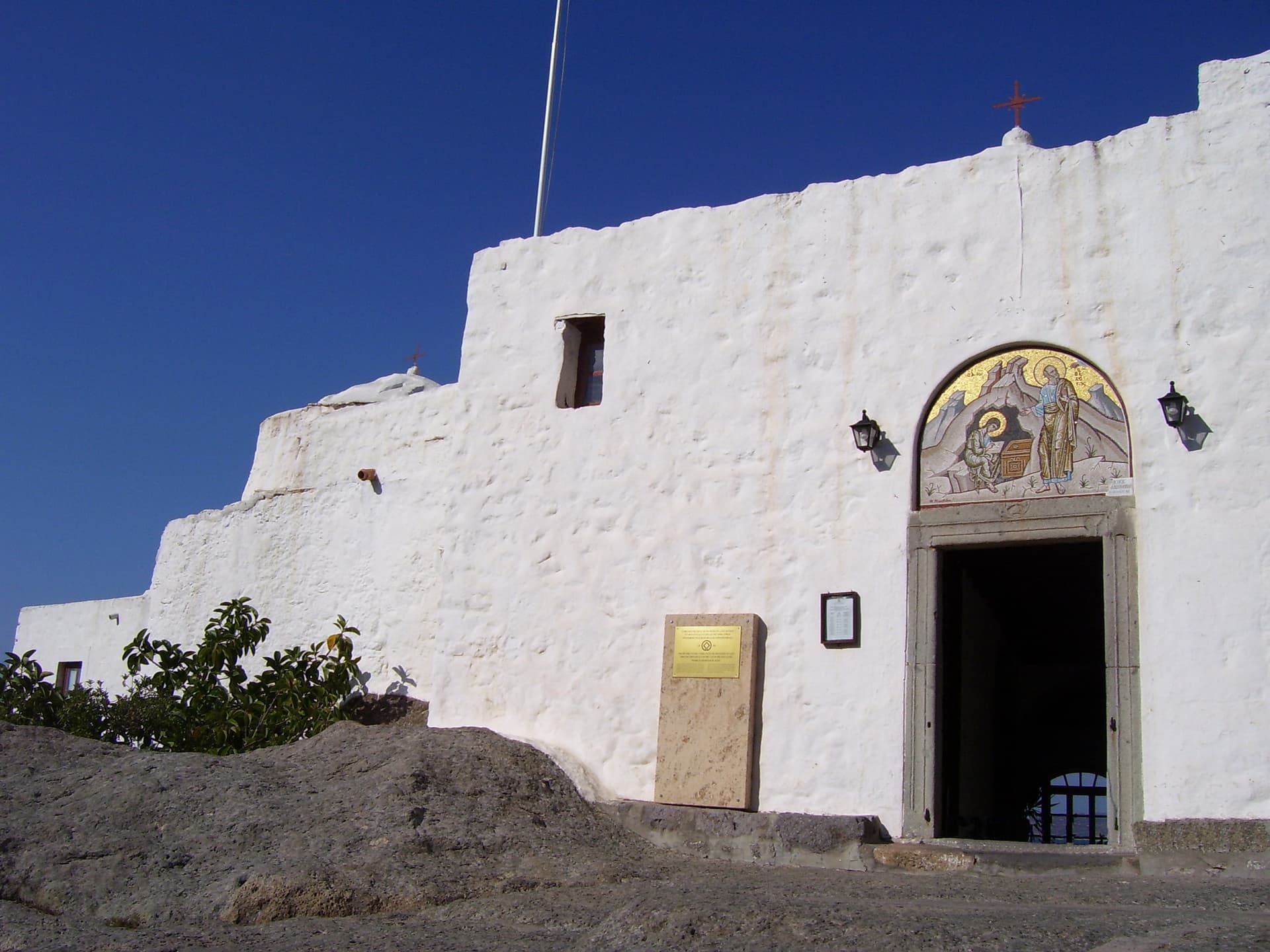
Inside, the rooms are low-ceilinged and connected by staircases that feel carved from the mountain itself, because many of them are. The walls are whitewashed, thick, cool to the touch. Byzantine and pointed arches frame doorways built of porous stone brought from Milos. The light is amber from oil lamps and filtered sunlight. The chapel holds the miraculous icon, visible behind glass, dark with age and devotion.
Then the monks' hospitality: a small glass of raki, a piece of loukoumi, a cup of cold water. This is offered to every visitor without exception — Orthodox, Catholic, Muslim, atheist, tourist, pilgrim. It is a gesture whose simplicity is its depth. In a world organized around transaction, these three monks give without counting.
The balcony is where the monastery's full meaning arrives. Step outside and the cliff drops vertically below. The Aegean stretches south and east without interruption. The blue is not a color but a condition — a depth that seems to have no bottom. If there is a moment that justifies the ascent, this is it.
Not because the view is beautiful, though it is, but because the arrangement of rock, air, light, and water creates a spatial experience that cannot be reproduced in photographs or described without remainder. You are held between the weight of the mountain and the weightlessness of the sea.
The monastery is best approached with patience. Arrive early in the morning session (8:00 AM opening) to avoid the midday closure and the heat of the ascent. Carry water. Wear sturdy shoes. Allow the physical effort of the climb to be part of the experience rather than an obstacle to it. Inside, move slowly. The rooms are small and the passages narrow. There is no need to rush. The monks have been here for a thousand years.
Context and lineage
The founding narratives of the monastery converge on a single act: the rescue of a sacred image during a time of destruction. During the Byzantine Iconoclasm of the 8th and 9th centuries, when the empire's authorities ordered the destruction of religious icons, monks placed an icon of the Virgin Mary in a small boat and set it adrift.
The icon traveled by sea — some traditions say from Cyprus, others from Palestine, others from Asia Minor — and came ashore at Agia Anna beach on the southern coast of Amorgos, directly below the cliff where the monastery now stands.
The builders who came to construct a shelter for the icon first chose a lower, more accessible location. Each morning, they found the previous day's work collapsed. This continued until their tools disappeared entirely and were found high on the cliff face, at the spot where the monastery stands today. The builders understood this as the Virgin's instruction: she had chosen her dwelling, and it was to be here, at this impossible height, pressed against the rock above the sea.
The name Hozoviotissa derives from Hozeva — today's Wadi Qelt in Palestine — where the Orthodox Monastery of Saint George clings to a similar cliff above a desert gorge. Whether the icon originated there or the name was carried by monks who had lived in both places, the connection links this Aegean monastery to the monastic traditions of the Holy Land.
The monastery belongs to the Eastern Orthodox tradition and holds stauropigian status under the Ecumenical Patriarchate of Constantinople. It is one of the most important monasteries in the Cyclades and is considered the second oldest in Greece. Its manuscript collection includes Byzantine and post-Byzantine texts of significant scholarly value. The monastic community has been continuous since at least the 9th century, though the number of monks has varied — from dozens in prosperous periods to the current three.
Emperor Alexios I Komnenos
Imperial patron who granted the monastery stauropigian rights via chrysobull in 1088, placing it under the direct authority of the Ecumenical Patriarch and ensuring its institutional survival across centuries of political change.
Monks of the Iconoclasm period
The unnamed monks who saved the icon of the Panagia from destruction by setting it adrift at sea. Their act of faith and desperation is the monastery's founding narrative.
Luc Besson
French filmmaker whose 1988 film The Big Blue, filmed partly on Amorgos with views of the monastery, brought international visibility to the island and added a contemporary dimension to its cultural significance.
The three resident monks
The current monastic community — three monks who maintain the daily liturgical cycle, preserve the manuscript collection, and offer hospitality to every visitor.
Traditions and practice
The liturgical life of the monastery follows the daily cycle of Orthodox worship: matins in the early morning, the Divine Liturgy, vespers in the evening, and compline at night. Three monks sustain this rhythm throughout the year, their voices filling the narrow chapel that holds the miraculous icon.
The two most significant celebrations are the Feast of the Presentation of the Virgin Mary on November 21 and the Holy Week observances. For the November feast, the icon is carried in procession from the monastery down to Chora, the island's main town. The night before, pilgrims climb to the monastery and keep vigil, sleeping on the steps and rocks outside.
After the morning liturgy, a communal meal of fasting dishes — cod with potatoes, cod with garlic sauce — is shared by monks and pilgrims together. During Holy Week, the icon travels through the streets of Chora in a procession that traces the same routes it has followed for centuries.
In August, the Dormition of the Virgin Mary (August 15) brings over 600 visitors per day to the island, many of them making the pilgrimage ascent to the monastery.
The monastery's daily practice of hospitality is perhaps its most distinctive contemporary expression. Every visitor — regardless of faith, nationality, or reason for coming — is offered raki (the local spirit), loukoumi (Turkish delight), and a glass of water by the monks. This hospitality is not a tourism service but a monastic discipline, rooted in the Orthodox understanding that every stranger may be Christ.
The monks also maintain the monastery's collection of Byzantine manuscripts and operate a small exhibition of relics in the sacristy.
Visitors who wish to engage more deeply with the monastery's spiritual life can attend the morning liturgy (arrive at 8:00 AM). The ascent itself can be treated as a walking meditation — three hundred steps taken slowly, with attention to breath and the changing perspective of sea and cliff. On the balcony, simply sitting in silence for ten or fifteen minutes allows the spatial experience of the place to work on its own terms.
Accepting the monks' hospitality with genuine gratitude — making eye contact, taking time with the raki and loukoumi rather than rushing through — honors the tradition that offers it.
Eastern Orthodox Christianity
ActiveThe monastery is one of the most important in the Cyclades and the second oldest in Greece. Stauropigian since 1088, it falls under the direct authority of the Ecumenical Patriarchate. The miraculous icon of Panagia Hozoviotissa is venerated as the protector of Amorgos, and the monastery maintains a continuous liturgical cycle sustained by three resident monks.
Perspectives and open questions
The Monastery of Hozoviótissa can be understood through multiple lenses — as a masterpiece of Byzantine engineering, as a living center of Orthodox devotion, as a landscape that challenges the boundary between the possible and the impossible.
Scholarly perspective
Architectural and historical analysis confirms the monastery as one of the most important Byzantine monuments in the Aegean. The 1088 chrysobull of Alexios I Komnenos is well-documented, and architectural study reveals multiple construction phases from the 9th through 11th centuries and later. The manuscript collection, though not fully catalogued in English-language scholarship, is recognized as one of the most significant in the Cyclades.
The monastery's engineering — eight levels pressed into a vertical cliff, connected by staircases carved from living rock — remains an object of study and admiration.
Living and traditional perspectives
For the people of Amorgos, the Panagia Hozoviotissa is the protector of their island. This is not heritage tourism language but lived conviction. The icon's arrival by sea, the divine selection of the building site, the centuries of answered prayers and averted disasters — these form the fabric of the island's identity.
When pilgrims climb the 300 steps on November 21 and sleep on the rocks through the night vigil, they are participating in a relationship between community and sacred presence that has sustained both for a millennium.
Alternative interpretations
The monastery's physical setting has led some visitors and writers to describe it as a 'thin place' — a term borrowed from Celtic spirituality for locations where the boundary between the material and the transcendent feels permeable. The cliff-face position, suspended between the weight of stone and the emptiness of sky, creates a spatial experience that transcends any single religious framework.
The connection to Luc Besson's The Big Blue, which used Amorgos as a location for its meditation on depth and surrender, has added a contemporary secular-spiritual association.
Open questions
The monastery's founding date remains genuinely uncertain, with traditions pointing to 813 AD, 1017 AD, and 1088 AD. The miraculous icon's provenance — Cyprus, Palestine, or elsewhere — is similarly unresolved. Perhaps most intriguing is the engineering question: how a community with 9th-century technology constructed an eight-level building on a sheer cliff face, carving staircases from the living rock and transporting building materials to a site accessible only on foot. The answer, like the icon's origin, may resist definitive resolution.
Plan your visit
Access and arrival
The monastery sits 1 km from Amorgos Chora. You can drive or walk to the trailhead, where the 300+ steps begin. The ascent is entirely on foot — no vehicle access to the monastery itself. Sturdy, closed-toe shoes are essential; the steps are uneven and can be slippery. There is no wheelchair access. Amorgos is reached by ferry from Piraeus (8-10 hours), Naxos (1.5-3 hours), or other Cycladic islands. The island has two ports: Katapola and Aegiali.
Mobile phone signal is generally available along the approach and at the monastery. In case of emergency, Chora is less than 1 km away with full services.
Amorgos Chora, less than 1 km from the monastery trailhead, has guesthouses and small hotels. Katapola port (7 km) and Aegiali (15 km) offer additional accommodation. Book well in advance for August and the November feast period.
Respectful visit
Men: long trousers required. Women: long skirts required (trousers not permitted). Both: shoulders must be covered, clothing loose-fitting. Wraps and coverings provided at the entrance for those who need them. Sturdy, closed-toe shoes recommended for the 300+ step ascent.
Photography is generally restricted inside the chapel and in the monks' quarters. Ask permission before photographing in any interior space. Exterior photography of the monastery is freely permitted and the views from the approach path are extraordinary.
No offerings are expected from visitors. The monks' hospitality — raki, loukoumi, water — is given freely. Small donations to the monastery are appreciated but never solicited.
Monks' cells are off-limits. Do not enter areas marked as restricted. The monastery closes from approximately 13:00 to 17:00 for midday rest and prayer. Visitors should plan to arrive during the morning session (8:00-13:00) or the late afternoon session (17:00-19:00).
The monastery is an active place of worship, not a museum. Visitors should maintain silence in the chapel areas, avoid photographing the monks without permission, and respect the midday closure (13:00-17:00) when the monks rest and pray. The November 21 feast and August 15 celebrations are deeply meaningful to the people of Amorgos; visitors during these times should participate respectfully rather than observe from a distance.
Current practical details
Address
Amorgos 840 08, Greece
Phone
Hours
Hours, fees, and access can change — verify on the official source before you travel. Practical details last checked Jun 2026.
Location
Map loads as you approach this section.
Pilgrim reflections
A portrait of encounter, not a score
Pilgrims describe what they felt, how present they could become, and whether the place would shape a journey. There are no stars and no ranking of traditions.
No reviewed reflections yet
The first pilgrims can help describe the character of being here.
Share a reflection
Available after an account-backed “Been there.” Every reflection is reviewed before publication.
Nearby sacred places
Explore other sacred places in the region. Proximity does not establish access or travel time; check each place’s guidance.



References
Sources consulted for this page. Source categories describe the publication, not a guarantee that every claim is verified. Traditional accounts and outside interpretations may differ.
- 01Monastery of the Virgin Mary (Panagia) Hozoviotissa — Visit Greece — Greek National Tourism OrganisationofficialOfficial Greek tourism authority
- 02Amorgos Hozoviotissa — The Aegean Islands — Region of South AegeanofficialRegional authority; detailed architectural and historical information
- 03Monastery of Panagia Hozoviotissa of Amorgos — Monasteries of Greece — Monastiria.grofficialDetailed religious and architectural information from monastery-focused source
- 04Panagia Hozoviotissa Monastery — Wikipedia — Wikipedia contributorsencyclopediaGood overview with citations; founding date and icon origin covered
- 05Hozoviotissa Monastery in Amorgos, Greece — Greeka — Greeka.comguideComprehensive visitor guide with practical details
- 06Amorgos Chozoviotissa Monastery — 7 important things to know — Greece MomentsguidePractical visiting information and dress code details
- 07The Monastery of Hozoviotissa — Amorgos.gr — Amorgos.grguideLocal Amorgos source; feast day and cultural details
- 08A guide to Hozoviotissa Monastery, Amorgos — Unfolding Greece — Unfolding GreeceguideVisitor guide with practical access information
Photo gallery
3 curated photos
Share a photo
Help visitors recognize Monastery of Hozoviótissa, Amorgos Island. Every submission is reviewed before publication.