Chun Quoit
A Neolithic portal standing intact after five millennia on Cornwall's windswept moors
Understand sacred places, explore living traditions, and learn how to engage respectfully with Pilgrim Map.
Access has not been verified. Check current local guidance before planning a visit.
Bojewyan, England, United Kingdom
Read the sources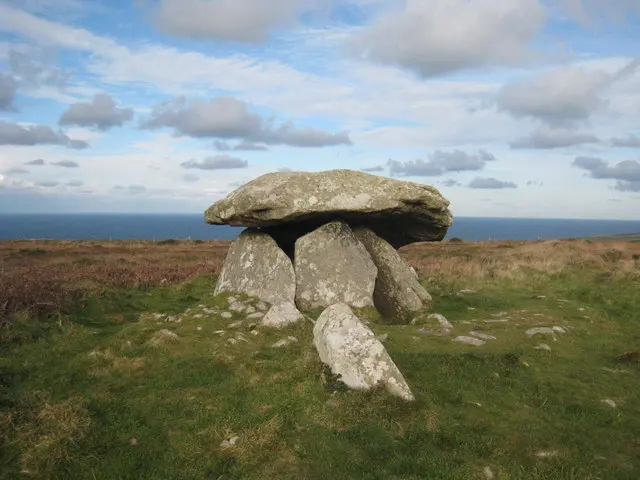
Image of Chun Quoit. Image source · CC-BY-SA-2.0
Visit essentials
A quick read before you go
- Duration
- Two to three hours to fully appreciate the quoit and walk to nearby Chun Castle
- Etiquette
- Chun Quoit asks for respect appropriate to both an archaeological treasure and a site that has…
Overview
Chun Quoit is an intact Neolithic burial chamber on West Penwith's high moorland. Its mushroom-shaped capstone weighs nearly nine tonnes and remains where builders placed it between 3500 and 2500 BCE, more than five thousand years ago. It is Cornwall's only ancient dolmen surviving in its original form; others fell, were restored, or crumbled.
A fifteen-minute walk across open heath, with Atlantic views and constant wind, leads to an intimate, almost enterable chamber rather than a monument on the scale of Stonehenge or Avebury. Its builders left no writing or explanation, only this precise stone arrangement.
At winter solstice, the sun sets directly behind Carn Kenidjack, a sacred cairn one mile away. Deliberate alignment cannot be established with certainty, but seasonal visitors watch the dying year through architecture that has witnessed five millennia of returns. The builders and their ceremonies are gone, yet visitors still report a sense that the membrane between worlds grows thin.
Why this place is sacred
Chun Quoit survives as its builders arranged it, without Victorian restoration or a reset capstone, offering direct contact with unmediated Neolithic stonework. Its exposed ridge overlooks moor, farmland, and sea; wind, weather, and horizon make it liminal.
At winter solstice, the sun sets behind Carn Kenidjack, a rocky cairn linked in local legend with the dead. Intent cannot be proved, though archaeoastronomers consider coincidence unlikely; viewed from an ancestral burial chamber, the alignment carries evident symbolism.
Dowsers and earth-energy practitioners describe a telluric vortex and radial lines, sometimes interpreting the capstone as redirecting subterranean force to fertilize the land. These claims lack scientific verification but express reported visitor experiences.
Nearby standing stones, circles, another quoit, healing-associated Men-an-Tol, and Chun Castle form a dense sacred landscape. The Iron Age hillfort's entrance aligns directly with the much older quoit, suggesting continued veneration after its builders were forgotten. Cornish stories of returning stones, curses, and a guardian giant made the quoits sacred and untouchable, protecting them from dismantling. Survival, position, alignment, reported energies, neighboring monuments, and protective folklore accumulate into the site's felt significance.
Archaeological consensus classifies Chun Quoit as a portal dolmen or chambered tomb from the Early to Middle Neolithic period. The structure likely served for communal burial, with excarnated remains deposited in the chamber over extended periods. Evidence suggests bones may have been periodically removed and replaced, indicating the quoit functioned not as a sealed grave but as a site for ongoing relationship with the dead.
Beyond the purely funerary, archaeologist Peter Herring proposes that quoits served multiple functions: territorial markers establishing hereditary ownership, communal gathering places, and focal points for ancestor cult ceremonies. Francis Pryor suggests they represented attempts to develop tribal identity through connection to place and lineage. The Cornish name Chy-an-Woone, the House on the Downs, preserves this understanding of the quoit as a dwelling place for ancestors.
For perhaps a millennium after construction, Chun Quoit likely served its intended purpose. Then the Bronze Age brought new burial practices and new monuments. But the quoit was not forgotten. Chun Castle, an Iron Age hillfort built thousands of years after the quoit, has its main entrance aligned directly toward the ancient structure. This remarkable detail suggests that even when the original builders and their practices had passed from memory, reverence for the site persisted.
Through the medieval period and beyond, Cornish folklore wrapped the quoits in protective taboo. They were sacred, untouchable, guarded by supernatural forces. When antiquarians arrived in the 19th century, they found a monument that local custom had preserved intact.
William Copeland Borlase excavated the site in 1871, documenting the surrounding mound, kerb stones, and evidence of an entrance passage. His work found no artifacts or human remains, a common situation in Cornwall where acidic moorland soils destroy organic material. What was left was the architecture itself.
Today, Chun Quoit draws a new generation of pilgrims. Contemporary Pagans, dowsers, secular seekers, and the simply curious walk the moorland path their Neolithic predecessors walked. The ceremonies have changed. The sense that this place matters has not.
Experience and orientation
From a small lay-by, walk fifteen or twenty minutes across uneven, exposed moorland; there is no car park at the monument, café, or shop. The inconvenient, often wild approach makes arrival meaningful.
The quoit emerges gradually against the sky: intimate and human-scaled rather than Stonehenge-like. Visitors often become still as travel's mental noise gives way to attention. Some experience the granite as a presence and describe touching an upright as connection beyond the physical; whether projection, suggestion, or something understood by the builders, such reports recur.
Visitors also report dawn lights along the stone, metallic or magnetic sunrise sounds, and what dowsers call phenomenal radial energy. Whether measurable, beyond measurement, or otherwise explained, these accounts remain part of the pattern. Responses range from profound peace and unexpected emotion to spontaneous clarity.
At winter solstice, sunset behind Carn Kenidjack joins present observers to a view witnessed for five millennia, producing a vertiginous sense of continuity.
Approach Chun Quoit as the culmination of a walk rather than a destination to reach. The moorland crossing is not obstacle but threshold. Let the anticipation build. Let the weather be whatever it is.
When you arrive, resist the impulse to immediately photograph. Stand at a distance first. Take in the structure's relationship to the land, the way it sits both in and against the landscape. Notice your body's response.
If you wish to touch the stones, do so slowly and with attention. Many find placing a palm against the cool granite opens something. Others prefer to sit nearby, letting the structure enter peripheral vision rather than demanding direct attention.
Consider coming with a question. Something genuinely unsettled. The quoit will not answer in words. But visitors often report that clarity arrives unbidden, as though the act of being present in this particular place allows patterns to emerge that were obscured elsewhere.
Leave time. The minimum visit takes an hour including the walk. A meaningful encounter asks for longer. Those who can stay through changing light, through shifting weather, through the fading of initial impressions into something subtler, often describe the deepest experiences.
Context and lineage
The name tells part of the story. Chun derives from the Cornish Chy-an-Woone or Chy Woon, meaning the House on the Downs. The Neolithic people who raised this structure understood it as a dwelling place, a home for the ancestors who remained present in the land.
Who were these builders? We know them only through what they left behind. Farming communities had arrived in Cornwall perhaps a millennium earlier, bringing with them practices and beliefs from continental Europe. They cleared forest, cultivated the land, raised livestock. And they built monuments.
The quoits of Cornwall represent some of the earliest monumental architecture in Britain. Chun Quoit dates to the Early or Middle Neolithic, perhaps 3500-2500 BCE. Its construction required sophisticated engineering and organized communal effort. The capstone alone weighs nearly nine tonnes. Moving it, positioning it precisely atop four upright slabs, demanded knowledge we can appreciate even if we cannot fully reconstruct.
Cornish folklore offers another origin. The word quoit comes from legends that giants enjoyed a game of quoits, hurling massive capstones across the landscape. The giant of Chun Quoit was said to guard the surrounding moor, ensuring no one disturbed the sacred ground. These stories emerged long after the Neolithic, but they preserved a truth: this place demanded respect.
The lineage of Chun Quoit is both continuous and interrupted. For perhaps a millennium, Neolithic communities used the structure for its intended purposes, whatever those fully were. Then practices changed, but reverence persisted.
The Iron Age hillfort of Chun Castle, built thousands of years after the quoit, has its main entrance aligned directly to the ancient monument. This alignment cannot be coincidental. It speaks to millennia of unbroken awareness, if not understanding, of the quoit's significance.
Cornish folklore preserved the site through centuries when so many ancient monuments were dismantled. The taboos against disturbance were effective conservation.
Modern engagement began with antiquarian interest in the 18th and 19th centuries, formalized through Borlase's excavation and subsequent listing as a Scheduled Ancient Monument. Today, the Cornish Ancient Sites Protection Network (CASPN) works to protect and promote respectful visitation.
Contemporary seekers continue arriving, adding their presence to five millennia of human attention. The lineage continues.
William Copeland Borlase
historical
Cornish antiquarian who excavated Chun Quoit in 1871. His work documented the surrounding mound, kerb stones, and possible cist within the barrow, providing the first systematic study of the site. His excavation found no artifacts or human remains due to the acidic soil conditions.
John Lloyd Warden Page
historical
Writer who in 1897 described Chun Quoit as 'the most perfect of the cromlechs,' recognizing its exceptional preservation among Cornwall's ancient monuments.
Peter Herring
scholarly
Contemporary landscape historian and archaeologist with Cornwall Council who has proposed broader interpretations of quoit function beyond purely funerary use, seeing them as territorial markers, communal gathering places, and centers for ancestor cult ceremonies.
Traditions and practice
Original Neolithic practices are entirely unknown. The structure suggests excarnation, the exposure of bodies to the elements and scavengers until only bones remained, followed by communal deposition of remains in the chamber. Evidence from comparable sites indicates bones may have been periodically removed and replaced, suggesting the quoit served not as a sealed grave but as a site for ongoing dialogue with ancestors.
The astronomical alignment to the winter solstice sunset over Carn Kenidjack indicates ceremonies may have marked this cosmic hinge point, when the dying sun began its return. But what form such ceremonies took, what words were spoken, what offerings made, cannot be reconstructed. The builders left only architecture.
No regular organized ceremonies are held specifically at Chun Quoit. What takes place here is more personal. Contemporary practitioners visit for meditation and silent contemplation, dowsing and earth energy work, and observation of solstices and equinoxes.
Some come as part of larger pilgrimages through the sacred Penwith landscape, walking from site to site as their Neolithic predecessors may have done. Others arrive for a single focused encounter.
The Cornish Ancient Sites Protection Network conducts conservation work and promotes respectful visitation. Their motto captures the appropriate orientation: don't change the site, let the site change you.
If you come seeking more than scenery, consider these approaches:
Arrive in silence. The walk across the moorland offers transition time. Use it. Let conversation fall away. Let the land enter.
When you reach the quoit, stand at a distance first. Take in the relationship between structure and landscape. Notice how the capstone sits, how the uprights lean inward, how the whole arrangement both belongs to and rises from the ground.
If you wish to touch the stones, do so with intention. Palm against granite, feel the temperature, the texture, the weight of time. Some visitors report a sense of contact, of relationship. Others simply feel stone. Both responses are valid.
Sit nearby and let time pass. The quoit will not perform for you. Its gift requires patience. Those who can wait, who can let initial impressions settle, often describe something emerging that haste would have foreclosed.
If you come at winter solstice, position yourself to watch the sunset over Carn Kenidjack. You will see what Neolithic eyes saw. Let that continuity work on you.
Neolithic Funerary and Ceremonial Practice
HistoricalChun Quoit was constructed during the Neolithic period as a chambered burial tomb and ceremonial center. It likely functioned as more than just a burial site, serving as a communal gathering place, territorial marker, and focal point for ancestor veneration. Francis Pryor proposes quoits featured in ancestor cult ceremonies, representing attempts to establish hereditary ownership of territory and develop tribal identity through connection to lineage and land.
Original practices are entirely unknown. The structure suggests excarnation followed by communal deposition of remains. Evidence from comparable sites indicates bones may have been periodically removed and replaced, suggesting the quoit served as a consultation site for ongoing dialogue with ancestors. The astronomical alignment to the winter solstice sunset indicates seasonal ceremonies may have been significant.
Contemporary Paganism and Earth Energy Practice
ActiveModern practitioners view Chun Quoit as a site of powerful earth energy, a vortex where telluric forces focus and radiate outward. The site is valued for its astronomical alignment to the winter solstice sunset over Carn Kenidjack, connecting solar cycles to the landscape. As Cornwall's best-preserved dolmen, it offers an authentic encounter with Neolithic sacred architecture.
Contemporary practice includes personal meditation and spiritual contemplation, dowsing and earth energy work, observation of solstices and astronomical events, and pilgrimage walking through the sacred Penwith landscape. Visitors engage in their own ways rather than following prescribed ritual. Some touch the stones seeking connection or healing. Others sit in silence, allowing the site to work on its own terms.
Cornish Folklore Tradition
HistoricalDeep-rooted Cornish folklore surrounding quoits reflects centuries of popular veneration and taboo. The monuments were considered sacred, protected by supernatural forces that would punish any who disturbed them. This folklore effectively preserved Chun Quoit through periods when other ancient monuments were dismantled.
Traditional belief held that stones removed from quoits would magically return at night. Those who tampered with them would be cursed. A giant was said to guard the moor around Chun Quoit. These taboos created behavioral norms protecting the sites without requiring formal explanation.
Perspectives and open questions
Chun Quoit invites multiple interpretations. Archaeologists, folklorists, earth energy practitioners, and contemporary seekers each bring their own frameworks to the site. These perspectives need not compete. The quoit has stood long enough to hold many meanings.
Scholarly perspective
Archaeological consensus classifies Chun Quoit as a portal dolmen or chambered tomb dating to the Neolithic period, circa 3500-2500 BCE. It is the best-preserved example of its type in Cornwall, the only one to retain its capstone in original position.
Borlase's 1871 excavation found no artifacts or human remains, a common situation in Cornwall where acidic moorland soils destroy organic material. The monument was likely used for communal burial with ongoing ancestor veneration. The bones of the dead were not simply deposited and sealed away but remained accessible, perhaps periodically removed and replaced as new generations joined them.
Modern archaeology increasingly emphasizes multiple functions beyond the purely funerary. Peter Herring proposes that quoits served as territorial markers, communal gathering places, and centers for ancestor cult ceremonies. The site's astronomical alignment to the winter solstice sunset is accepted by archaeoastronomers as likely intentional.
The relationship between Chun Quoit and nearby Chun Castle remains significant. The Iron Age hillfort, built millennia after the quoit, has its main entrance aligned directly to the ancient monument. This suggests continuous veneration even after the original builders and their practices had been forgotten.
Living and traditional perspectives
No indigenous tradition survives from the Neolithic builders. What remains is Cornish folklore that developed over subsequent millennia, creating protective taboos around the quoits.
Local belief held the stones sacred and untouchable. Those who tampered with them would be cursed. Stones removed would magically return at night. A giant was said to guard the moor around Chun Quoit. The name itself, Chy-an-Woone or the House on the Downs, acknowledged the monument as an ancestral dwelling.
These folk beliefs, however they originated, effectively preserved the monuments through centuries when so many others were dismantled. The taboos were a form of conservation, protecting what the community recognized as sacred even without understanding why.
Carn Kenidjack, visible from the quoit and framing the winter solstice sunset, carries its own traditions. Called the hooting cairn for the sounds the wind makes racing through its rocks, it is associated with the dead. The surrounding Gump moorland is said to be haunted by the ghost of a witch called Old Moll, fairies playing tiny pipes, and spirits that tempt travelers from the path.
Alternative interpretations
Earth energy practitioners and dowsers view Chun Quoit as a device for capping and redirecting telluric energy. The theory holds that quoits were positioned over blind springs, underground water sources creating subtle energy vortices. The capstone caps this upwelling force, bending it horizontally to radiate across the landscape.
Dowsers report phenomenal radial energy emanating from Chun Quoit. Some describe the experience as overwhelming, requiring gradual approach. Ley line researchers have mapped alignments connecting the quoit to other Penwith monuments, suggesting an intentional sacred geography.
Strange light phenomena reported at the site are interpreted within this framework as manifestations of telluric energy. The astronomical alignment is seen as connecting earth and cosmic energies at the winter solstice, a moment when forces converge.
These interpretations lack scientific verification. However, they often emerge from genuine experiences visitors report. The language of energy may be an attempt to describe something real that resists conventional vocabulary.
Open questions
Genuine mysteries remain. The specific beliefs and practices of the Neolithic builders are entirely unknown. We cannot reconstruct their ceremonies, their cosmology, their understanding of death and ancestors. We know only what they built.
Why this precise location was chosen for the monument remains unclear. The winter solstice alignment suggests astronomical awareness, but was it the primary consideration? What other factors influenced the site selection?
The original appearance and full extent of the surrounding barrow and ritual landscape cannot be recovered. What ceremonies or astronomical observations took place at winter solstice can only be imagined.
The cup mark visible on the capstone raises questions. Was it functional, decorative, or symbolic? Did additional marks exist that weathering has erased?
The nature of reported light and sound phenomena at the site remains unexplained. Whether these reflect atmospheric effects, suggestion, or something that eludes current understanding, the reports persist across visitors who arrive without expectation of them.
Plan your visit
Access and arrival
Limited accommodation is available in Pendeen, St Just, or Morvah. More options exist in Penzance or St Ives. Several bed-and-breakfasts and self-catering cottages serve visitors to the West Penwith sacred landscape.
Respectful visit
No specific requirements. Practicality governs. Sturdy walking boots with ankle support are essential for the uneven moorland terrain. Waterproof layers are advisable given Cornwall's weather. The site is exposed to Atlantic winds. Dress for conditions.
Photography is permitted and the site offers remarkable opportunities, particularly at golden hour and during atmospheric weather. However, consider whether the camera creates distance. Many visitors find that the first hour without a lens allows an encounter that photography would have prevented. The site will be here after your phone dies.
Traditional Cornish belief held the quoits sacred and untouchable. Modern visitors honor this by leaving nothing behind. CASPN's motto captures it: don't change the site, let the site change you. If offering is important to your practice, make it internal.
Do not climb on the monument. Do not disturb the stones or surrounding archaeology. Leave no litter. Dogs should be kept under control due to grazing livestock. There are no time restrictions. The site is freely accessible at all times via public footpaths and permissive paths across open moorland.
Do not climb on the monument. The stones have survived five millennia; they deserve continued protection. Do not leave offerings or objects. Traditional Cornish belief held the quoits sacred and untouchable, and modern visitors honor this by leaving no trace.
The walk across the moorland can be challenging in poor weather. Sturdy footwear is essential. The exposed location can be harsh in strong winds or storms.
Respect any grazing livestock. Keep dogs under control.
If you discover damage or vandalism, report it to CASPN at 01736-787186 or 787522.
Current practical details
Address
St Just, Penzance TR19 7TT, UK
Hours
Hours, fees, and access can change — verify on the official source before you travel. Practical details last checked Jun 2026.
Location
Map loads as you approach this section.
Pilgrim reflections
A portrait of encounter, not a score
Pilgrims describe what they felt, how present they could become, and whether the place would shape a journey. There are no stars and no ranking of traditions.
No reviewed reflections yet
The first pilgrims can help describe the character of being here.
Share a reflection
Available after an account-backed “Been there.” Every reflection is reviewed before publication.
Nearby sacred places
Explore other sacred places in the region. Proximity does not establish access or travel time; check each place’s guidance.


References
Sources consulted for this page. Source categories describe the publication, not a guarantee that every claim is verified. Traditional accounts and outside interpretations may differ.
- 01Chun Quoit — Historic CornwallofficialOfficial Cornwall archaeological records
- 02Chun Quoit — Cornish Ancient Sites Protection Network (CASPN)officialCharitable trust dedicated to protecting Cornwall's ancient sites
- 03Chun Quoit Chambered Cairn — The Megalithic PortalSource contextComprehensive megalithic monuments database with GPS coordinates
- 04Winter Solstice Alignments — Archaeoastronomy CornwallSource contextSpecialist archaeoastronomy research
- 05Chun Downs prehistoric landscape complex — Historic EnglandofficialOfficial scheduled monument listing
- 06Chun Quoit — WikipediaencyclopediaWikipedia article with architectural details
- 07Chun Quoit — Cornwall GuideSource contextTourism website with visitor information
- 08Cornwall's Quoits — Dark CornwallacademicDetailed folklore and legends of Cornish quoits
- 09The Modern Antiquarian - Chun Quoit — The Modern AntiquarianacademicDetailed visitor accounts and photographs
- 10Quoits - Ancient Penwith — Ancient PenwithacademicEarth energy and dowsing perspectives
- 11Chun Quoit — The Cornish BirdblogLocal perspective with folklore and visitor experience
- 12Chun Quoit & Carn Kenidjack Walk — Walking BritainguideWalking directions and access information
Share a photo
Help visitors recognize Chun Quoit. Every submission is reviewed before publication.