Christ Church Gate
Part ofCanterbury Cathedral
The threshold where eight centuries of pilgrimage ends and the sacred begins
Understand sacred places, explore living traditions, and learn how to engage respectfully with Pilgrim Map.
Access has not been verified. Check current local guidance before planning a visit.
Canterbury, England, United Kingdom
Read the sources
Visit essentials
A quick read before you go
- Duration
- The gate itself warrants 15–30 minutes of contemplative attention — longer for pilgrims…
- Access
- Located in the Buttermarket, Canterbury city centre, accessed via Mercery Lane or Sun Street.
Overview
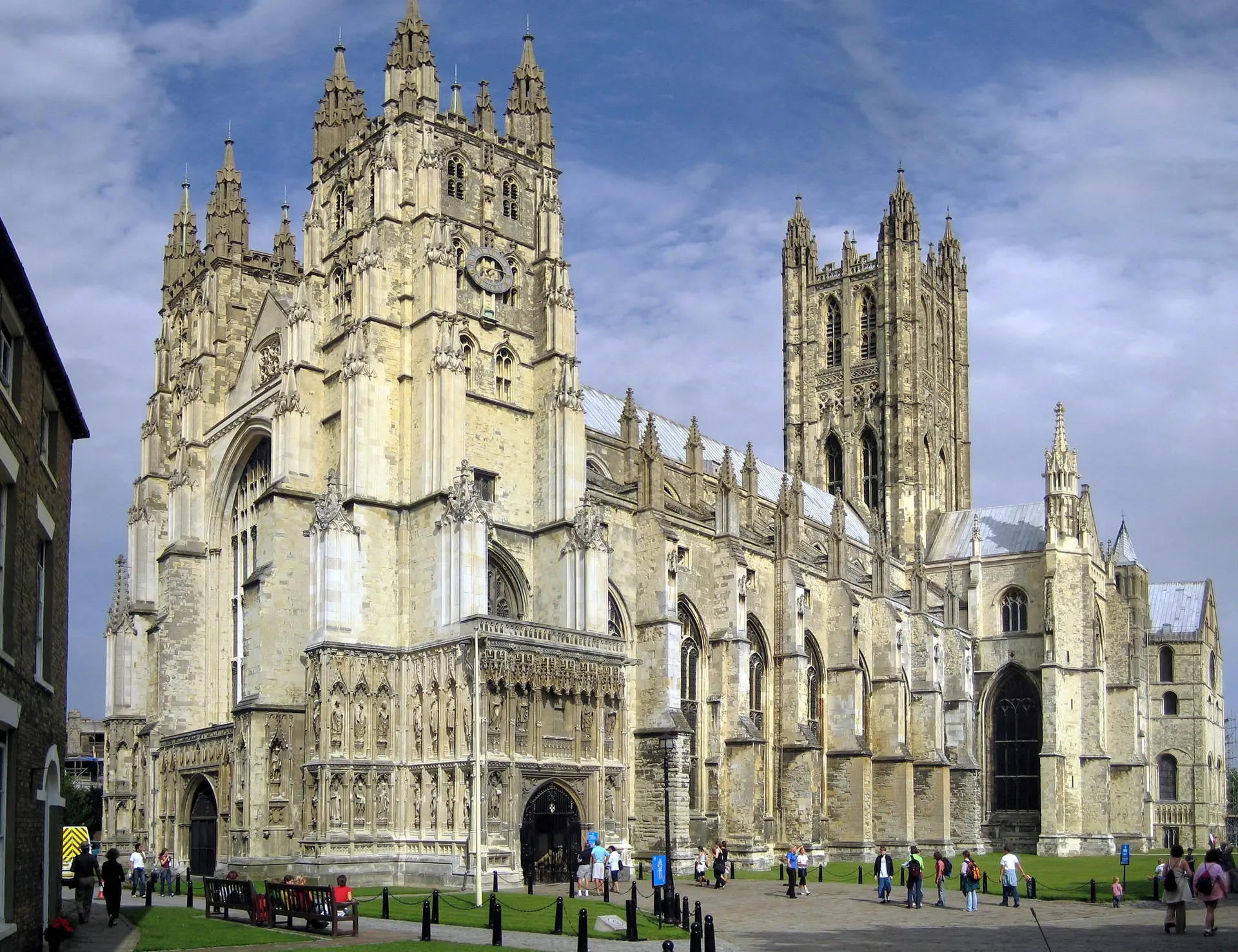
Christ Church Gate turns Canterbury's narrow Buttermarket approach into a threshold of carved stone and gilded heraldry, with cathedral towers rising beyond. Probably completed between 1504 and 1521 in the final years of the great medieval pilgrimage to Becket's shrine, it carries Saint Thomas Becket's arms on the vault bosses, Tudor royal heraldry, and early Renaissance pilasters that hint at the new Europe reshaping England.
Pilgrims still pass through after the 120-mile Pilgrim's Way from Winchester, the narrowing Mercery Lane and sudden gatehouse compressing the final approach. Beyond lie the cathedral nave and Becket's memory: martyred in 1170 and venerated here for three and a half centuries before Henry VIII destroyed his shrine.
The 2018–2022 restoration recovered polychromy largely lost since the seventeenth century. A Christ statue destroyed by Puritans in 1643 and absent for 347 years was replaced in 1990. The gate again approaches its original visual intention: a devotional statement in stone, paint, and gilding at the boundary between city and sacred ground.
Why this place is sacred
Thin places are typically associated with landscape — hilltops, cliff edges, island shores. Christ Church Gate achieves something rarer: a thinness that is entirely architectural, constructed and deliberate rather than found. The Priory commissioned the gate knowing it would be the point at which pilgrims crossed from the world into the precincts of Becket's shrine, and everything about the design reinforces that function. The vault bosses carry Becket's own arms.
The scallop shells carved into the wooden gate frame — symbol of the pilgrim on the Way of St James, and of Becket himself, who received his pallium in Rome — mark the threshold as pilgrim space.
Mercery Lane contributes to the thinness. The medieval street is narrow even now, compressing the approach, and the stalls that once lined it sold the tangible tokens of the encounter ahead: Becket's holy water in lead ampullae, pilgrim badges stamped with the saint's image.
Pilgrims arrived already primed — weeks of walking, the accumulated expectation of the route — and this lane, this gate, and the view through the arch to the cathedral towers formed a single spatial sequence designed to culminate in a threshold experience.
The gate's own history adds layers. It was built at the end of an era. Within a generation of its completion, Henry VIII would dissolve the monasteries, destroy Becket's shrine, and prohibit the pilgrimage. The gate outlasted the practice it was built to serve, standing through four centuries in which the shrine it opened onto no longer existed.
That absence — the gate still framing the walk to a place where something is no longer — gives it a particular quality that purely functional architecture does not possess.
To serve as the ceremonial entrance to the Cathedral precincts for pilgrims arriving at the shrine of Saint Thomas Becket, and as a dynastic memorial to Prince Arthur, eldest son of Henry VII, and the Tudor–Aragon union.
Completed in the last decades of active medieval pilgrimage (shrine destroyed 1538, just years after construction), the gate has since served as the Cathedral's public face — a ceremonial entrance for ecclesiastical processions and the effective terminus of the modern Pilgrim's Way revival. The 2018–2022 restoration returned it closest to its original polychrome state in centuries.
Experience and orientation
The gate does not announce itself from a distance. Canterbury's medieval street plan narrows the final approach — Mercery Lane is barely wide enough for two people to pass — so the gatehouse arrives suddenly, filling the view.
The carved stonework is dense with heraldic detail that rewards sustained attention: the royal arms of Henry VII and Prince Arthur, the arms of Catherine of Aragon, the combined heraldry of the Tudor and Aragon houses, and, in the vault bosses overhead, the arms of Thomas Becket himself alongside those of Cardinal Wolsey and Archbishop Warham.
Following the 2022 restoration, the stonework carries renewed polychromy — painted and gilded details that flatten-grey photographs do not capture. Stand directly beneath the arch and look up at the vault: the bosses read as an abbreviated hall of honour for the late medieval English Church, the saint's arms inscribed at the entrance to his own precincts.
For pilgrims completing the Pilgrim's Way, this arch is the resolution of every mile since Winchester. Many pause here before crossing — photographing the gate, sitting on the Buttermarket steps, absorbing the completion. Others cross without stopping, drawn by the cathedral towers visible on the far side. Both responses are entirely comprehensible. The gate is built for both the pause and the threshold crossing; it functions equally as destination and as passage.
Approach from Mercery Lane to the south for the intended medieval pilgrim experience. The gate faces south onto the Buttermarket square. The exterior can be viewed and photographed freely without Cathedral admission. To pass through requires a Cathedral entry ticket, purchased at the gate itself or online. Morning light falls on the south-facing facade; early arrival before tour groups is recommended for unhurried contemplation.
Pilgrims completing the Pilgrim's Way on foot are encouraged to inform the Cathedral welcome team on arrival.
Context and lineage
Construction of Christ Church Gate was commissioned by Priors Thomas Goldstone II and Thomas Goldwell of Christ Church Priory in Canterbury. Work began around 1504 and the gate was substantially complete by approximately 1521, though an inscription on the stonework is dated 1507 and dendrochronological analysis of the roof timbers suggests construction spanned roughly 1507 to 1521. The scholarly record does not resolve this gap with certainty.
The heraldic programme that covers the gate's surfaces points to its deeper occasion. Prominent among the carved devices are the arms of Prince Arthur, eldest son of Henry VII, who married Catherine of Aragon in 1501 and died the following year aged fifteen.
The pairing of Arthur's arms with those of Catherine, and with the Tudor royal arms, strongly suggests the gate was partly conceived as a memorial to the prince and a permanent record of the dynastic union that his brief life represented. Whether the commission was driven specifically by Arthur's death — as some sources argue — or was primarily a prestige project for the Priory, celebrating the royal marriage, remains debated among historians.
The vault bosses introduce a second commemorative register: the arms of Archbishop Thomas Becket, Cardinal Wolsey, and Archbishop Warham appear overhead, situating the gate in the ecclesiastical hierarchy of the early Tudor Church. Becket's arms above the entrance to his own shrine precinct are both heraldic statement and devotional act — the saint invoked at his own threshold.
The construction incorporated unusually early Renaissance details, including pilasters and capitals that represent some of the earliest Renaissance architectural elements documented in England, suggesting exposure to Flemish or Italian workshop influence, though the identity of the master mason remains unknown.
Christ Church Gate stands within the Canterbury World Heritage Site, inscribed in 1988 as part of 'Canterbury Cathedral, St Augustine's Abbey, and St Martin's Church.' The Cathedral precinct it guards has been the seat of the Archbishop of Canterbury — the senior bishop of the Church of England — since St Augustine's mission in 597 AD.
The medieval pilgrimage to Becket's shrine, which the gate was built to commemorate and receive, operated from the establishment of the shrine in 1220 until Henry VIII's Dissolution of the Monasteries in 1538. The modern revival of the Pilgrim's Way as a walking pilgrimage route, notably championed by the British Pilgrimage Trust, has restored the gate's function as a pilgrim terminus.
Prior Thomas Goldstone II
Patron/Commissioner
Prior Thomas Goldwell
Patron/Commissioner
W.D. Caröe
Restoration Architect
Purcell Architecture
Conservation Architects
Thomas Becket (Saint Thomas of Canterbury)
Saint / Dedicatee
Traditions and practice
Medieval pilgrims arrived at Christ Church Gate after approaching through Mercery Lane, where stalls sold Becket badges and lead ampullae containing water from Becket's Well. The approach was itself ritualized: pilgrims had already been handling the material tokens of the saint's presence before reaching the gate. Crossing the threshold was understood as entering sacred ground and represented the culminating act of a journey that could have lasted weeks or months.
Pilgrims proceeded directly through the precincts to the Martyrdom — the site of Becket's murder in 1170 — and then to the Trinity Chapel and the shrine itself. The crossing of the gate was not the end of the pilgrimage but its threshold: the moment when the journey became arrival.
Contemporary pilgrims completing the Pilgrim's Way reach the gate as the route's official terminus. Canterbury Cathedral offers a Pilgrim's Welcome at designated times; pilgrims arriving on foot are encouraged to identify themselves to the Cathedral welcome team. Services of pilgrimage thanksgiving are held in the Cathedral. Many walkers pause at the gate before passing through — some for prayer, some for photographs, some simply to register the completion.
The Buttermarket square in front of the gate has become the informal gathering point for arriving pilgrims. Cathedral admission is required to cross through the gate into the precincts.
Stand in Mercery Lane before the gate comes into view and walk the final approach slowly, as the medieval pilgrims would have. Let the compression of the lane and the sudden opening of the gatehouse be experienced sequentially rather than anticipated. Under the arch, look up at the vault bosses: locate Becket's arms among the heraldic devices.
If time allows, pass through and sit in the Cathedral precincts before entering the building itself — the transition from city to precinct to nave is its own spatial progression worth inhabiting unhurriedly.
Christian (Anglican)
ActiveThe gate marks the entrance to the seat of the Archbishop of Canterbury, the senior bishop of the Church of England. It has served as the ceremonial threshold to the Cathedral since c.1520 and bears the arms of successive archbishops in its vault. Cathedral chapter processions pass through the gate on major feast days.
Modern pilgrims pause at the gate before entering the precincts. Cathedral chapter processions use the gate on major feast days. The gate is the formal entrance to an active Anglican Cathedral receiving hundreds of thousands of visitors and worshippers annually.
Medieval Catholic Pilgrimage
HistoricalThe gate was completed in the final active decades of the great medieval pilgrimage to the shrine of Thomas Becket (martyred 1170, shrine established 1220, shrine destroyed 1538). Pilgrims from across England and Europe walked Mercery Lane — where stalls sold holy water and Becket badges — to reach this gate and enter the Cathedral precincts. The shrine was within sight of the gate on the far side of the nave.
Medieval pilgrims crossed this threshold as the culminating act of their journey, proceeding first to the Martyrdom and then to Becket's shrine in the Trinity Chapel. The crossing of the gate was understood as the moment of entering sacred ground.
Ecumenical Pilgrimage
ActiveThe Pilgrim's Way from Winchester to Canterbury is actively walked by pilgrims of many Christian denominations and by non-religious seekers. At approximately 120 miles, it is the principal English pilgrimage route, and Christ Church Gate is its terminus — the threshold moment after weeks of walking.
Modern pilgrims end the Pilgrim's Way at the gate. Canterbury Cathedral offers a Pilgrim's Welcome at designated times. The Buttermarket plaza has become the informal gathering point for arriving groups. Services of pilgrimage thanksgiving are held in the Cathedral.
Perspectives and open questions
Christ Church Gate draws multiple interpretive frameworks: an art historian reads the heraldry as a precise Tudor political document; a theologian reads the same vault bosses as a devotional programme; a pilgrim reads the arch itself as the resolution of a journey. These readings are not competing — each illuminates a dimension the others cannot fully see.
Scholarly perspective
Architectural historians identify Christ Church Gate as a significant late example of the Perpendicular Gothic style, notable for the unusually early Renaissance details — pilasters, capitals — incorporated into an otherwise medieval vocabulary. The Canterbury Archaeological Trust's dendrochronological analysis of the roof timbers has contributed to ongoing debate about the precise construction chronology (inscription date 1507; timber analysis spanning c.1507–1521).
The heraldic programme is read as a reliable primary source for the ecclesiastical and dynastic relationships of the early Tudor court: the pairing of Arthur's arms with Catherine of Aragon's, the presence of Wolsey's and Warham's devices in the vault, the prominence of Becket's own arms. The memorial hypothesis — that the gate was built at least partly to commemorate Prince Arthur, who died aged 15 in 1502 — is widely accepted but not conclusively proven.
Living and traditional perspectives
Within the Anglican and Catholic traditions, the gate is understood as a sacred threshold — the entrance to ground made holy by Becket's martyrdom and centuries of pilgrimage devotion. The presence of Becket's arms in the vault bosses is theologically legible: the saint greets pilgrims at his own threshold, his intercession invoked at the moment of crossing.
For Catholic pilgrims, the destruction of Becket's shrine by Henry VIII in 1538 — within living memory of the gate's completion — gives the site a quality of witness. The gate saw the end of the pilgrimage it was built to serve; it has outlasted both the shrine and the Church that built it, now serving as the entrance to an Anglican Cathedral.
Alternative interpretations
The scallop shell motifs carved into the gate's wooden frame carry meaning that exceeds any single tradition. The scallop is the badge of St James of Compostela, the emblem most associated with pilgrimage in the medieval West; it also appears on Becket's own heraldic devices. In pre-Christian symbolic registers, the shell is associated with water, fertility, and rebirth — the threshold as passage into a different mode of being.
The gate's function as a liminal threshold — the crossing-over from secular to sacred — resonates with universal symbolic structures found across cultures and periods. Those drawn to the Pilgrim's Way as a secular or interfaith practice rather than a specifically Christian one often describe the gate as a place of arrival rather than a specifically religious monument.
Open questions
The identity of the master mason or principal architect responsible for the gate's design is not recorded. The significance of the gap between the 1507 inscription date and the dendrochronological evidence for construction spanning into the 1520s remains an unresolved scholarly question — whether this reflects phased construction, a record of a specific element's completion, or something else is uncertain. Whether the original gate incorporated sculptural elements beyond those currently documented has not been fully established.
The specific ceremonies, if any, that medieval pilgrims were expected to perform at or near the gate itself are not recorded in surviving sources.
Plan your visit
Access and arrival
Located in the Buttermarket, Canterbury city centre, accessed via Mercery Lane or Sun Street. Canterbury East station is approximately 10 minutes' walk; Canterbury West station approximately 15 minutes. The Buttermarket is pedestrianised — no vehicle access. The archway passage is level and fully accessible on foot. Mobile phone signal is generally reliable in central Canterbury. No booking required for the gate exterior; Cathedral tickets can be purchased on arrival or online in advance.
Canterbury city centre has a full range of accommodation from independent hotels to B&Bs and hostels within walking distance of the gate. Pilgrims completing the Pilgrim's Way are advised to book ahead, particularly in summer. The Cathedral Precincts contain no visitor accommodation; the nearest pilgrim-focused options are in the city centre. No specific information was available at time of writing on dedicated pilgrim accommodation schemes — check Canterbury Cathedral's website or the British Pilgrimage Trust for current recommendations.
Respectful visit
Respectful dress is expected inside the Cathedral precincts. No specific dress requirements apply to viewing the gate exterior from the Buttermarket.
Photography of the gate exterior is freely permitted from the public Buttermarket square. Inside the Cathedral precincts, photography is generally permitted for personal use; restrictions apply during services. Check current Cathedral guidance on arrival.
Do not climb on or touch the carved stonework of the gate. Respect services taking place within the precincts. The gate itself may not be climbed or otherwise physically engaged with beyond walking through the archway passage.
The Cathedral precincts require paid admission (free for worship services). Photography of the exterior from the Buttermarket is unrestricted. Cathedral photography follows standard Cathedral guidelines — generally permitted for personal use, with restrictions during services. Climbing on or touching the gate's carved stonework is not permitted.
Location
Map loads as you approach this section.
Pilgrim reflections
A portrait of encounter, not a score
Pilgrims describe what they felt, how present they could become, and whether the place would shape a journey. There are no stars and no ranking of traditions.
No reviewed reflections yet
The first pilgrims can help describe the character of being here.
Share a reflection
Available after an account-backed “Been there.” Every reflection is reviewed before publication.
Nearby sacred places
Explore other sacred places in the region. Proximity does not establish access or travel time; check each place’s guidance.


References
Sources consulted for this page. Source categories describe the publication, not a guarantee that every claim is verified. Traditional accounts and outside interpretations may differ.
- 01Christchurch Gate — Canterbury Historical and Archaeological Society — Canterbury Archaeological TrustacademicDetailed archaeological and architectural analysis including dendrochronological dating, heraldry identification, and restoration watching-brief findings. Primary scholarly source for construction dates and fabric analysis.
- 02Christ Church Gate Revealed — Canterbury Cathedral — Canterbury CathedralofficialOfficial cathedral announcement on the 2018–2022 restoration completion, describing conservation techniques, polychromy revival, and structural repairs.
- 03Christ Church Gate, Canterbury Cathedral — Canterbury Trust — Canterbury Cathedral TrustofficialCovers vault decoration details including heraldic bosses (Archbishop Becket arms, Cardinal Wolsey, Archbishop Warham), roof timber analysis, and multi-phase restoration history from 1930s to 2022.
- 04Canterbury Cathedral, St Augustine's Abbey, and three city churches — British Pilgrimage Trust — British Pilgrimage TrustofficialSituates Christ Church Gate within the broader pilgrimage context of the Pilgrim's Way terminus at Canterbury Cathedral. Discusses the role of the cathedral precinct entrance in contemporary pilgrimage.
- 05Christ Church Gateway, Canterbury, Kent — Britain Express — Britain ExpressSource contextOverview of construction history, Tudor heraldry, and architectural description including early Renaissance pilaster details. Good general reference.
- 06Christ Church Gate, Canterbury — Exploring Great Britain — Exploring Great BritainSource contextVisitor-oriented description of the gate with historical context on the Puritan destruction of the Christ statue and subsequent restorations.
- 07Mercery Lane, Canterbury: A Narrow Medieval Street — Exploring Great Britain — Exploring Great BritainSource contextDocuments the medieval streetscape of Mercery Lane leading to Christ Church Gate, including the pilgrim souvenir trade and Becket's Well stalls that lined the route to the gate.
- 08Pilgrims' Way — Wikipedia — Wikipedia contributorsacademicBackground on the Pilgrim's Way route from Winchester to Canterbury, including the pre-Christian origins of the trackway and the medieval pilgrimage context culminating at Canterbury.
Share a photo
Help visitors recognize Christ Church Gate. Every submission is reviewed before publication.