Chak Chak
Zoroastrianism's holiest mountain shrine, where a cliff opened to shelter a princess and water has dripped ever since
Understand sacred places, explore living traditions, and learn how to engage respectfully with Pilgrim Map.
Access has not been verified. Check current local guidance before planning a visit.
دهستان رباطات, Yazd, Iran
Read the sources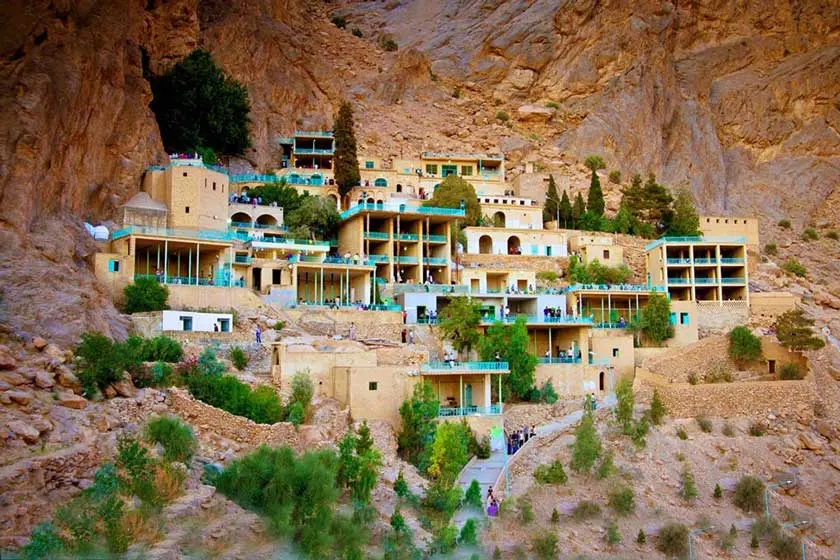
Image of Chak Chak. Image source · CC-BY-SA-4.0
Visit essentials
A quick read before you go
- Duration
- 2–3 hours including the climb
- Access
- About 70 km northeast of Yazd near Ardakan in central Iran; reached by car or tour, then a long…
Overview
Chak Chak — the name means 'drip drip' — clings to a cliff face in the desert mountains northeast of Yazd, reached only by a long flight of steps up the rock. Inside the man-made grotto, guarded by great bronze doors embossed with the image of Zoroaster, a spring drips ceaselessly from the stone while an eternal fire burns, its smoke darkening the cavern walls. An ancient plane tree grows improbably from the cliff beside the water.
Zoroastrian tradition holds that this is where Nikbanou, a daughter of Yazdegerd III, the last Sassanian king, fled the Arab conquest of Persia around 640 CE. Cornered against the mountain, she prayed to Ahura Mazda, and the rock opened to hide her; the perpetual dripping spring is said to be the tears shed in that moment. The ancient tree, tradition says, grew from her staff struck into the ground.
For Zoroastrians in Iran, India, and the wider diaspora, Chak Chak is the holiest of the mountain shrines. Each year from 14 to 18 June a major pilgrimage gathers thousands here for prayer, recitation of the Avesta, the lighting of sacred fires and candles, the baking and sharing of bread, and the singing of hymns.
The meeting of living fire, perpetual water, and a tree rooted in bare rock makes the grotto a vivid emblem of Zoroastrian reverence for purity and light.
Why this place is sacred
Several things gather here at once. There is the legend — a fugitive princess, a mountain that opened, tears that became a spring — which lends the place a sense of refuge and answered prayer. There is the sheer physical drama: a cliffside grotto reached only by hundreds of steps, the constant gentle sound of dripping water in the dark, the warmth and smoke of a fire kept burning for centuries, and a single old tree clinging to the rock.
And there is the weight of survival: Chak Chak is the foremost shrine of a faith that endured persecution and dispersal, drawing its scattered community back to one cliff each June. The elements Zoroastrians hold sacred — fire and pure water especially — are present together in a single small space.
A mountain refuge and shrine commemorating the flight of the princess Nikbanou and the compassion of Ahura Mazda, centered on a sacred dripping spring and an eternal fire.
Tradition dates the shrine's origin to the Arab conquest of Persia around 640 CE; the grotto was cut into the cliff and fitted with bronze doors, and it has been maintained and developed by the Zoroastrian community as their holiest mountain shrine and the focus of an annual June pilgrimage. Precise archaeological dating of the built structures is not documented.
Experience and orientation
The ascent is part of the experience. Visitors climb a long stairway up the mountainside (sources cite anywhere from around 230 to 360 steps) before reaching the grotto, where the change is immediate: the open desert glare gives way to a cool, smoke-scented cave, the constant sound of water dripping from the rock, and the glow of the eternal fire.
Many describe a strong sense of sanctity here, heightened during the June pilgrimage when the cliffside fills with Zoroastrian families praying, reciting, and singing. Outside the festival the grotto can be quiet and contemplative, the dripping water and the old plane tree the only company. The cliff offers wide views over the desert; the whole site rewards arriving with time to rest at the top and simply listen.
From Yazd, travel by car or tour to the foot of the mountain near Ardakan, then climb the long stairway to the cliff grotto. Cover your head, and be ready to remove your shoes before entering the grotto. During the 14–18 June pilgrimage expect crowds and reserve quiet behaviour; certain ceremonies are for the Zoroastrian community only.
Context and lineage
Zoroastrian tradition holds that Nikbanou, daughter of the last Sassanian king Yazdegerd III, fled the advancing Rashidun army to this cliff around 640 CE. Trapped against the mountain, she prayed to Ahura Mazda, who opened the rock to shelter her and shed tears that became the year-round dripping spring — hence the name Chak Chak. An ancient tree beside the spring is said to have grown from her wooden staff struck into the ground.
The grotto, cut into the cliff and sheltered by two large bronze doors embossed with the image of Zoroaster, has been developed and maintained by the Zoroastrian community ever since. The historical kernel behind the Nikbanou legend, and the precise age of the shrine and its eternal fire, remain uncertain.
Zoroastrianism — the ancient pre-Islamic faith of Persia, centered on Ahura Mazda and the reverence of fire, water, and the elements as expressions of purity and light.
Nikbanou
Venerated princess of the legend
Yazdegerd III
Last Sassanian king
Ahura Mazda
The divine focus of veneration
The Zoroastrian community of Yazd and the diaspora
Custodians and pilgrims
Traditions and practice
Lighting and tending the eternal fire, collecting and venerating the dripping spring water, recitation of the Avesta, and the singing of hymns.
Year-round visitation and prayer, with the major annual pilgrimage from 14 to 18 June drawing thousands of Zoroastrians for communal prayer, the lighting of sacred fires and candles, the baking and sharing of traditional bread, and hymns. The gathering is sometimes likened in its importance to the Hajj for Muslims.
Whether or not you share the tradition, the grotto invites a slowing of attention. Sit with the sound of the dripping water and the smoke of the fire; notice how fire and water, usually opposed, are held together here. The climb itself can be approached as part of the visit rather than an obstacle to it.
Zoroastrianism
ActiveChak Chak (Pir-e Sabz) is the holiest of the Zoroastrian mountain shrines. Tradition holds that Nikbanou, daughter of Yazdegerd III, fled the Arab conquest in 640 CE and prayed to Ahura Mazda, who opened the mountain to shelter her; the perpetual dripping spring is said to be the tears of that moment. The eternal fire and ancient tree, said to be Nikbanou's cane, make it a focal point of Zoroastrian devotion worldwide.
Annual June 14–18 pilgrimage with prayer, recitation of the Avesta, lighting of sacred fires and candles, baking and sharing of traditional bread, and hymns; year-round veneration of the dripping spring and eternal flame.
Perspectives and open questions
Chak Chak is understood as the foremost living Zoroastrian mountain shrine, its meaning carried by legend, by the elements gathered in the grotto, and by an annual gathering of the global community.
Scholarly perspective
Chak Chak is the foremost living Zoroastrian mountain shrine in Iran, centered on a cliffside grotto with a natural dripping spring and an eternal fire, and the focus of an annual June pilgrimage drawing the global Zoroastrian community.
Living and traditional perspectives
Zoroastrians revere the site as the refuge of Nikbanou, where Ahura Mazda's compassion produced the eternal spring; the ancient tree and dripping water are held as sacred relics of that miracle.
Alternative interpretations
Some read the grotto as a meeting of the elements — fire, water, earth, and air — embodying the Zoroastrian cosmology of purity and light.
Open questions
The historical kernel behind the Nikbanou legend and the precise age of the shrine and its eternal fire remain uncertain.
Plan your visit
Access and arrival
About 70 km northeast of Yazd near Ardakan in central Iran; reached by car or tour, then a long flight of steps (cited as anywhere from ~230 to ~360) up the mountainside to the cliff grotto.
Yazd, about 70 km away, offers the fullest range of guesthouses and hotels, many in restored traditional houses; smaller options exist near Ardakan.
Respectful visit
Modest clothing; the head must be covered. Comfortable shoes for the steep climb, removed before entering the grotto.
Generally permitted outside ceremonies; be discreet and respectful during prayer and the June pilgrimage.
Lighting candles and small fires, and respectful veneration of the spring water.
Remove shoes to enter the grotto; ritual cleanliness is expected. Non-Zoroastrians may be excluded from certain festival ceremonies and invitation-only events.
This is a living, deeply revered shrine. Outside the grotto's restricted ceremonies, non-Zoroastrian visitors are generally welcome if respectful, but certain June rituals are reserved for the Zoroastrian community and some events are invitation-only.
Location
Map loads as you approach this section.
Pilgrim reflections
A portrait of encounter, not a score
Pilgrims describe what they felt, how present they could become, and whether the place would shape a journey. There are no stars and no ranking of traditions.
No reviewed reflections yet
The first pilgrims can help describe the character of being here.
Share a reflection
Available after an account-backed “Been there.” Every reflection is reviewed before publication.
Nearby sacred places
Explore other sacred places in the region. Proximity does not establish access or travel time; check each place’s guidance.


References
Sources consulted for this page. Source categories describe the publication, not a guarantee that every claim is verified. Traditional accounts and outside interpretations may differ.
- 01Chak Chak, Yazd — Wikipedia — Wikipedia contributorsacademicConfirms coordinates (32.3480944N, 54.4086222E), Nikbanou legend, eternal fire, ancient tree said to be her cane, bronze doors, June 14–18 pilgrimage.
- 02Pir-e-Sabz Fire Temple (Chak Chak) in Yazd Province — Atlas Obscura — Atlas ObscuraSource contextDescribes the most sacred mountain shrine of Zoroastrianism, cliffside grotto, dripping spring.
- 03Chak Chak: A Zoroastrian Shrine — SURFIRAN — SURFIRANSource contextDetails legend, dripping-water symbolism, June festival rituals, and pilgrimage importance.
- 04Chak Chak in Yazd: A Zoroastrian Shrine — IranAmaze — IranAmazeSource contextJune 14–18 rituals: prayer, baking and sharing bread, Avesta recitation, lighting fires/candles, hymns; likened to Hajj.
- 05Temple of Chak Chak; The Sacred Zoroastrian Shrine in Iran — Saadatrent — SaadatrentSource contextEtiquette: cover head, remove shoes, ritual cleanliness; modest dress; bronze doors embossed with Zoroaster.
- 06Zoroastrian Temple of Chak Chak — Iran Paradise — Iran ParadiseSource contextSteep cliff climb, ancient plane tree recognized as natural heritage, smoke-stained walls from perpetual fire.
Share a photo
Help visitors recognize Chak Chak. Every submission is reviewed before publication.