Callanish Standing Stone Circle
Where three-billion-year-old stone meets a five-thousand-year-old alignment with the wandering moon
Understand sacred places, explore living traditions, and learn how to engage respectfully with Pilgrim Map.
Access has not been verified. Check current local guidance before planning a visit.
Callanish, Scotland, United Kingdom
Read the sources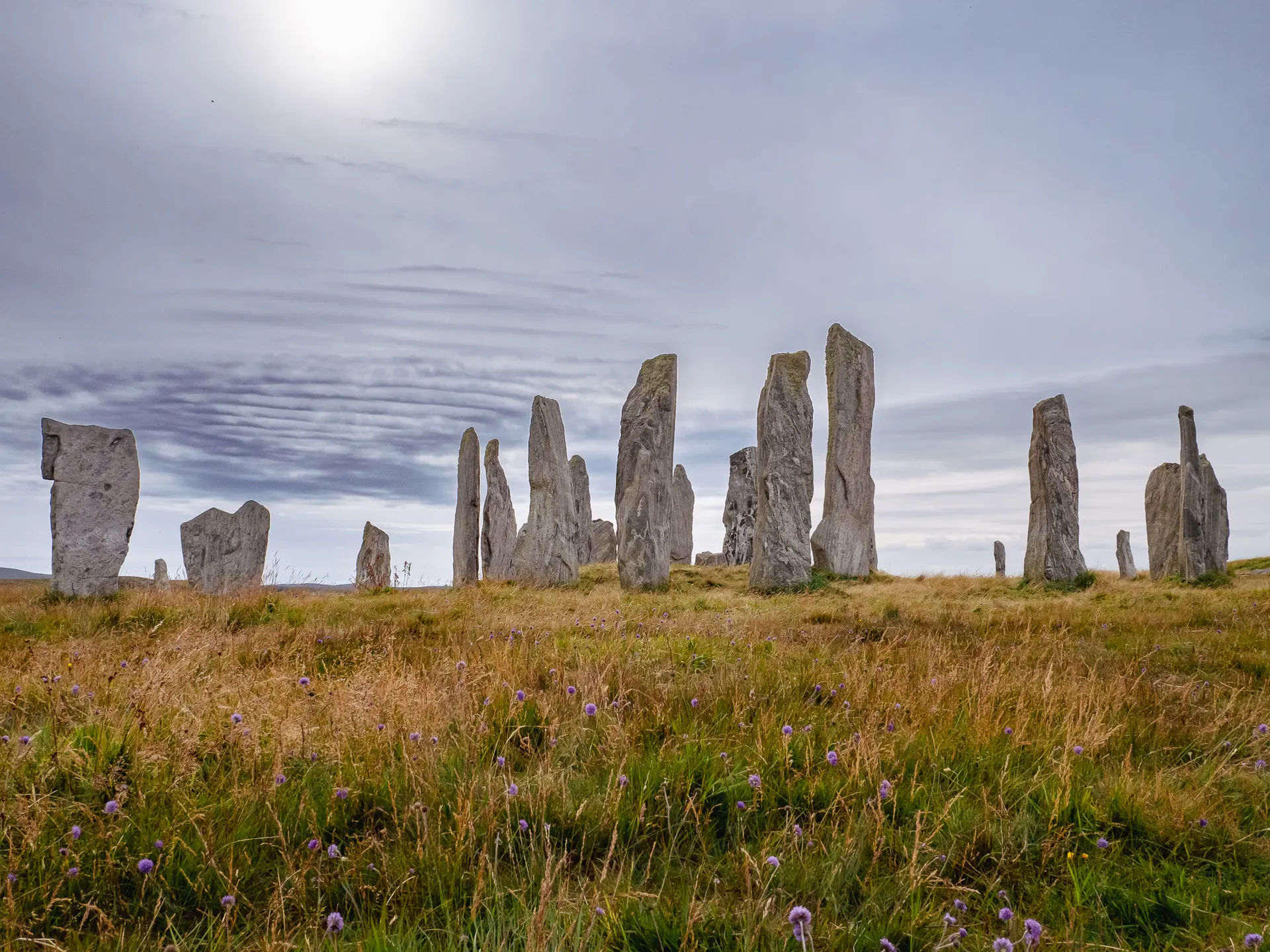
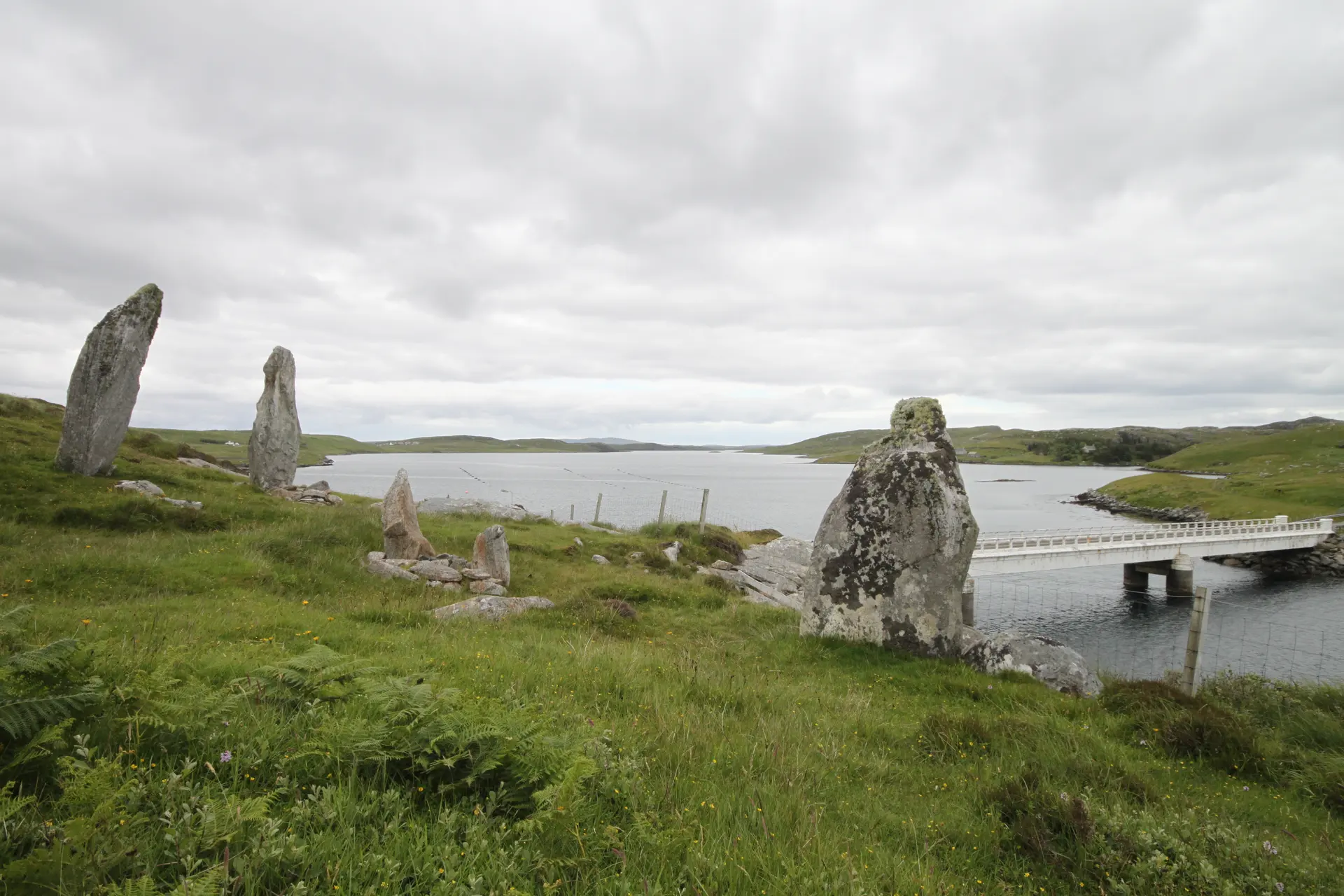
Image of Callanish Standing Stone Circle. Image source · CC-BY-SA-4.0
Visit essentials
A quick read before you go
- Duration
- 2 to 3 hours to walk the avenue, explore all stone rows, and absorb the atmosphere
- Etiquette
- Walk freely among the stones.
Overview
The Callanish Standing Stone Circle occupies a low ridge above Loch Roag on the western coast of Lewis, the largest island in the Outer Hebrides. It is one of the most remarkable surviving achievements of Neolithic Britain. Thirteen stones form the central circle, arranged in a slightly flattened ring roughly 13 metres across. From this circle, stone rows extend to the east, west, and south, while a double avenue of nineteen stones stretches 82 metres to the north.
At the centre stands the tallest monolith on the site, 4.75 metres high, flanked by the remains of a small chambered cairn inserted some five centuries after the original construction.
The monument was erected between approximately 2900 and 2600 BC. Around 2450 BC it was reorientated to track the major lunar standstill, an 18.6-year cycle during which the full moon follows an exceptionally low path across the southern horizon, its arc tracing the silhouette of a mountain range the Gaelic tradition calls Cailleach na Mointeach, the Old Woman of the Moors. The moon briefly disappears behind the hills and then rises again, its light entering the stone circle.
This integration of stone, sky, and mountain constitutes one of the most sophisticated astronomical alignments in prehistoric Europe.
The stones themselves are Lewisian gneiss, among the oldest rock on Earth. Their banded surfaces shift in colour with the weather and the hour, grey and silver in rain, warm gold in low Atlantic light. Unlike Stonehenge, visitors walk freely among the stones, touching surfaces that connect deep geological time to the relatively recent human past.
The site is open at all hours, every day of the year, and it rewards those who come at dawn, at dusk, or under stars.
Why this place is sacred
The thinness of Callanish operates on several scales simultaneously, and each reinforces the others.
The first is geological. The standing stones are Lewisian gneiss, formed approximately three billion years ago in the deep crust of the Earth. This is among the oldest exposed rock in the British Isles, older than complex life itself. To place your hand against these stones is to touch a material that existed for two and a half billion years before the first multicellular organisms appeared.
The Neolithic builders could not have known this in our terms, but they knew the rock. They quarried it, shaped it, carried it, and raised it. They chose this particular stone for this particular purpose. The gneiss carries its age in its surface: banded, folded, veined with quartz and feldspar, each stone different from its neighbours. In rain, the bands darken and the veins gleam. In low sun, the stones warm to gold and amber. The material insists on attention.
The second scale is astronomical. Around 2450 BC the monument was deliberately orientated to frame a celestial event that occurs only once every 18.6 years. During the major lunar standstill, the full moon's declination reaches its maximum southern extent. Viewed from the Callanish avenue, the moon appears to skim the southern horizon, following the profile of the mountain range whose silhouette resembles a woman lying on her back.
The Gaelic tradition names this figure Cailleach na Mointeach, the Old Woman of the Moors, and in the wider Gaelic mythological tradition the Cailleach is the divine ancestral grandmother, the embodiment of winter, land, and the ancient forces that predate human memory. The moon traces her body and then briefly disappears behind the hills before re-emerging and sending its light into the centre of the stone circle.
To witness this is to see sky, mountain, and stone functioning as a single instrument, built to mark a rhythm that spans human generations.
The third scale is cultural. For nearly five millennia, people have recognised this place as set apart. Neolithic communities gathered here for ceremonies aligned with the lunar cycle. Bronze Age people added a chambered cairn and continued depositing ritual pottery for centuries.
Gaelic-speaking communities preserved the stones' significance through folklore: Fir Bhreig, the False Men, giants petrified for refusing baptism; the Shining One, a radiant figure who walks the avenue at midsummer dawn, heralded by the cuckoo of Tir-nan-Og, the Celtic Otherworld; the white cow who appeared from the sea to nourish the people at the stones until human greed drove her away. These are not decorations applied to an archaeological site.
They are successive generations recognising that something about this place demands a story, demands an explanation, demands acknowledgement.
The fourth scale is spatial. The site sits on the Atlantic margin of Europe. To the west, there is nothing but ocean until Newfoundland. The Hebridean sky is enormous. Weather moves across Lewis with a speed and drama that the mainland rarely sees. Light changes within minutes. Wind is constant. The stones stand in this exposed position as they have for five thousand years, neither sheltered nor diminished. They do not compete with the landscape. They participate in it.
The monument's original purpose remains the subject of scholarly discussion, but the leading interpretation identifies it as a ceremonial and astronomical complex designed to track the major lunar standstill. The cruciform layout with radiating stone rows from four directions and the 82-metre northern avenue suggest processional approaches. The addition of a chambered cairn within the circle approximately five centuries later introduced funerary and ancestral associations, linking observation of the sky to commemoration of the dead.
Ritual activity at the site spanned approximately 2,000 years, from the initial construction around 2900 BC through continued pottery deposition until about 1500 BC. Around 900 BC blanket peat began to encroach on the stones, eventually reaching nearly two metres in depth and burying the lower portions of the monoliths. The site remained visible but diminished for centuries.
In 1857, Sir James Matheson, owner of the Isle of Lewis, ordered the peat removed, revealing the true height of the stones and uncovering the chambered cairn for the first time in perhaps two thousand years. Patrick Ashmore's excavation programme from 1979 to 1988 established the construction sequence and proposed the lunar standstill alignment theory. The site was scheduled as an Ancient Monument in 1882 and is managed today by Historic Environment Scotland as a Property In Care.
The visitor centre is undergoing a major redevelopment expected to reopen in spring 2026.
Experience and orientation
The approach from the north matters. The 82-metre avenue of standing stones channels your movement into a single line, two rows of monoliths flanking your path, each stone distinct in shape and grain. This is how the Neolithic builders designed the encounter: a controlled, processional approach that narrows the world to the line between you and the circle ahead. The stones on either side are taller than you.
They do not lean inward or press upon you, but they define the space. You are not wandering. You are arriving.
The circle opens before you. Thirteen stones arranged in a slightly flattened ring, irregularly spaced, each one different. The central monolith rises 4.75 metres, the tallest on the site, its surface folded and banded with the deep geological history of the Lewisian gneiss. To its east, the low remains of a chambered cairn occupy part of the circle's interior, added some five centuries after the original construction.
Stand here and you are at the intersection of the four stone rows: avenue to the north, shorter rows extending east, west, and south. The cruciform layout places you at a crossing point, a place where directions meet.
Turn south. Beyond the southern stone row, the land falls away toward the loch and the distant hills. If you know what to look for, you will see the profile of Cailleach na Mointeach on the horizon, the recumbent figure whose body the moon traces during the major lunar standstill. The builders aligned the monument to this view. The mountain profile is not incidental. It is the reason the stones stand where they do.
Touch the stones. This is permitted and it matters. The surface of Lewisian gneiss is not smooth. It carries the texture of three billion years: ridges and hollows, veins of quartz, bands of darker mineral. Each stone has a different character. Some are rough and pitted. Others have been polished by wind and rain into something almost soft. The temperature of the stone changes with the weather. In sun, the south-facing surfaces warm.
In rain, the gneiss darkens and the mineral veins catch the light.
The shorter stone rows to east, west, and south are worth walking. They are less dramatic than the avenue but they complete the design. The western row is the shortest, four stones extending 13 metres. The eastern row, five stones over 23 metres. The southern row, five stones over 27 metres. Each offers a different perspective on the circle and the landscape. The eastern row frames views toward the interior of Lewis.
The southern row leads the eye to the Cailleach.
If you can, return at a different hour. Dawn at Callanish, when the low Atlantic light catches the stones from the east and the gneiss flares with colour, is a different experience from midday. Dusk, when the stones darken against the western sky and the circle fills with shadow, is different again. At night, under clear skies, the stones become silhouettes against stars, and the silence of the Hebridean dark is absolute. The 24-hour access exists for a reason.
The monument was not built for a single hour.
The Callanish Standing Stone Circle occupies a low ridge above East Loch Roag on the western coast of Lewis. The northern avenue extends northward from the circle for 82 metres. Shorter stone rows radiate to the east, west, and south. The central monolith and chambered cairn are within the circle. The profile of Cailleach na Mointeach is visible to the south on the horizon. The village of Callanish lies nearby.
During the visitor centre redevelopment, access is via the top road, which involves a walk along the shore and up the hill.
Context and lineage
Between approximately 2900 and 2600 BC, Neolithic communities on the Isle of Lewis undertook one of the most ambitious construction projects in Atlantic Britain. They quarried monoliths of Lewisian gneiss, some weighing several tonnes, and transported them to a low ridge above Loch Roag. There they erected a circle of thirteen stones with a tall central monolith, and from this circle they extended stone rows in four directions.
The northern avenue, 82 metres long, was lined with two roughly parallel rows of stones, nine on the eastern side and ten on the western. Shorter rows reached east, west, and south, creating a cruciform layout unique among British Neolithic monuments.
Around 2450 BC, the monument was reorientated. Whether this involved restructuring the avenue or refining the sight lines, the result was an alignment with the major lunar standstill, the 18.6-year cycle in which the full moon reaches its most extreme southern declination. Viewed from the avenue, the moon traces the profile of the southern mountain range and then enters the circle.
Patrick Ashmore, who led the major excavation from 1979 to 1988, proposed that major ceremonies were held at the stones every 18.6 years to mark this event.
Approximately five centuries after the original construction, a small chambered cairn was built within the eastern part of the circle, introducing funerary associations to the astronomical complex. At least one burial was placed just outside the circle between 2150 and 1750 BC. Grooved Ware and Beaker pottery, deposited as offerings over many centuries, demonstrates connections with Orkney and wider Atlantic seaboard cultural networks.
Ritual activity continued for approximately 2,000 years before declining around 1500 to 1000 BC. Then the peat came. From around 900 BC, blanket bog began to encroach, slowly burying the lower portions of the stones. By the time the first written descriptions appeared in the 17th century, nearly two metres of peat concealed the stones' true height and entirely covered the chambered cairn. The monument was diminished but never forgotten.
Gaelic-speaking communities maintained rich traditions about the stones: they were giants petrified by a saint, or the setting for a luminous being's midsummer procession, or the place where a miraculous white cow appeared from the sea.
In 1857, Sir James Matheson ordered the peat stripped away. The stones emerged at their full height. The cairn was revealed. The modern encounter with Callanish began.
The Callanish Standing Stone Circle belongs to the Neolithic megalithic tradition of Atlantic Europe, with particularly strong connections to the ceremonial complexes of Orkney. Grooved Ware pottery found at the site is similar to that from the Stones of Stenness and the Ring of Brodgar, indicating shared cultural networks along the Atlantic seaboard. The cruciform layout with radiating stone rows is, however, unique to Callanish.
The monument stands at the centre of a wider ceremonial landscape of at least eleven satellite stone circles, designated Callanish II through Callanish XIII, whose precise relationship to the main complex remains incompletely understood. This concentration of megalithic monuments across a few square miles of Lewis suggests Callanish was the focal point of a ceremonial landscape of extraordinary scale.
Patrick Ashmore
Sir James Matheson
Martin Martin
Traditions and practice
The original Neolithic ceremonies cannot be fully reconstructed, but the evidence suggests processional movement along the northern avenue toward the central circle, observation of celestial events coordinated with the 18.6-year lunar standstill cycle, and rituals connecting the living with the ancestral dead in the chambered cairn. Grooved Ware and Beaker pottery fragments found at the site indicate food and drink offerings spanning centuries. Gaelic tradition maintained midsummer morning visits to the stones and Beltane observances.
The Shining One legend describes a radiant figure walking the avenue at midsummer dawn, heralded by the cuckoo, the bird of Tir-nan-Og. This may preserve folk memory of the processional use of the avenue during Neolithic ceremonies.
Contemporary visitors come to the stones throughout the year for purposes ranging from archaeological interest to personal contemplation, seasonal observance, and spiritual practice. Many time their visits to astronomical events, Celtic calendar festivals, or lunar cycles. The major lunar standstill of 2025 attracted international gatherings. Practitioners of earth-based spiritual traditions, druidry, and various forms of paganism recognise Callanish as one of the most significant megalithic sites in Europe.
The 24-hour access enables encounters at dawn, dusk, midnight, and under stars, maintaining a relationship with the stones that extends well beyond daytime tourism.
Begin at the northern end of the avenue. Before you walk, pause. The avenue was designed to structure your approach, and the structure is part of the meaning. Notice the stones on either side, their height, their spacing, the way they channel your movement southward toward the circle.
Walk slowly. The avenue is 82 metres long. At an unhurried pace, the walk takes two or three minutes. Let it take longer. The Neolithic builders did not design this approach for efficiency. They designed it for transformation, for the gradual narrowing of attention from the open landscape to the enclosed circle ahead.
When you enter the circle, do not rush to the centre. Stand at the edge first. Let your eyes move around the ring of stones. Notice how each one differs from its neighbours in height, width, and surface texture. The circle is not perfectly round. The stones are not evenly spaced. This irregularity is not a failure of precision. It is the character of a monument built by hand from natural stone.
Approach the central monolith. At 4.75 metres, it is the tallest stone on the site. Place your hand against it if you wish. Feel the texture of the gneiss, the ridges and hollows, the veins of quartz. This stone was old when it was quarried. It was old when the Earth first developed an oxygen atmosphere. Your hand on its surface is one of the most recent events in its history.
Look south. Beyond the southern stone row, the horizon is defined by the mountain range whose profile resembles a reclining figure. This is Cailleach na Mointeach, the Old Woman of the Moors. The builders aligned the monument to this view. During the major lunar standstill, the full moon traces her body before entering the circle. Even when the standstill is years away, the alignment is present. The stones point to it. The landscape holds it.
If time allows, walk the shorter stone rows to east, west, and south. Each offers a different relationship with the landscape. Return to the circle. Sit if the ground permits. Wait for the light to change. Callanish reveals itself gradually, and patience is part of the practice.
Neolithic Ceremonial and Astronomical Practice
HistoricalThe Callanish Standing Stone Circle was erected between approximately 2900 and 2600 BC, predating the main phase of Stonehenge. The cruciform layout with radiating stone rows and 82-metre avenue is unique among British Neolithic monuments. Around 2450 BC the monument was reorientated to focus on the major lunar standstill, an 18.6-year astronomical cycle. The massive labour investment in quarrying, transporting, and erecting the Lewisian gneiss monoliths indicates the site held profound communal and cosmological significance.
Processional movement along the northern avenue toward the central circle. Observation of the lunar standstill and other celestial events. Ceremonies within the stone circle coordinated with astronomical phenomena. The addition of a chambered cairn linked the living to their ancestors within the astronomical framework. Grooved Ware and Beaker pottery fragments indicate food and drink offerings spanning centuries.
Bronze Age Funerary and Ritual Use
HistoricalA small chambered cairn was constructed within the stone circle approximately five centuries after the original construction. At least one burial was placed near the circle between 2150 and 1750 BC. Beaker pottery found at the site indicates connections with wider Bronze Age cultural networks extending across Britain and to continental Europe.
Burial of the dead within and around the chambered cairn. Deposition of pottery vessels as grave goods or ritual offerings. The transition from communal ceremonial use to funerary practice reflects broader Bronze Age cultural changes across the British Isles.
Gaelic Folklore Traditions
ActiveThe Gaelic-speaking communities of Lewis developed rich folklore around the stones over centuries. The name Fir Bhreig (False Men) reflects the visual impression of the stones as petrified human figures. The legends of St Kieran, the Shining One, and the white cow represent successive cultural layers of interpretation applied to an already ancient monument. These traditions maintained community connection to the site's sacred character long after the original rituals ceased.
Traditional visits to the stones on midsummer morning and at Beltane. The Shining One tradition describes a radiant entity walking the avenue at midsummer dawn, heralded by the cry of the cuckoo. The white cow legend connects the stones to themes of sustenance, generosity, and the consequences of greed.
Lunar Standstill Observation
ActiveEvery 18.6 years, during the major lunar standstill, the full moon's setting path traces a unique trajectory when viewed from the Callanish avenue. The moon appears to skim the southern horizon, following the profile of Cailleach na Mointeach, then briefly disappears and re-emerges, its light entering the stone circle. The 2025 major lunar standstill attracted international attention and gatherings.
Gatherings at the stones to observe the lunar standstill phenomenon. Patrick Ashmore proposed that major ceremonies were held every 18.6 years around 2450 BC. Contemporary observers gather to witness the moon tracking along the Cailleach profile. The phenomenon connects sky, mountain, and monument into a single integrated experience.
Contemporary Spiritual Practice
ActiveModern practitioners of earth-based spirituality, druidry, and various contemplative traditions recognise Callanish as one of Europe's most significant megalithic sites. The combination of astronomical alignment, dramatic Atlantic setting, Gaelic cultural depth, and unrestricted access creates a powerful destination for contemplation and seasonal observance.
Visits for meditation, personal ceremony, and seasonal observances aligned with the Celtic calendar. Walking the avenue as a processional practice. Dawn, dusk, and night visits for contemplation. Gatherings during full moon and lunar standstill events. Solstice and equinox observances.
Perspectives and open questions
The Callanish Standing Stone Circle is understood through overlapping frameworks: the archaeological record, the Gaelic folklore tradition, astronomical analysis, and contemporary spiritual engagement. No single perspective exhausts the site's meaning. Each illuminates something the others leave in shadow.
Scholarly perspective
The archaeological consensus, shaped primarily by Patrick Ashmore's excavations of 1979 to 1988, dates the main stone circle to approximately 2900 to 2600 BC, with the chambered cairn added around five centuries later. The construction sequence proceeded from circle and stone rows to lunar standstill reorientation to cairn insertion to continued pottery deposition over many centuries. High-quality Grooved Ware pottery demonstrates cultural connections with Orkney and the wider Atlantic seaboard Neolithic networks.
The cruciform layout with radiating stone rows is unique among British Neolithic monuments. The leading interpretation identifies the monument's primary function as a ceremonial observatory for the major lunar standstill, the 18.6-year cycle in which the full moon traces an exceptionally low path along the southern horizon. At least eleven satellite stone circles in the surrounding landscape indicate Callanish was the focal point of a major ceremonial complex.
New Neolithic structures discovered in the wider landscape in 2024 continue to expand scholarly understanding of the site's context. Some archaeologists question aspects of the lunar standstill theory, and the precise dating of the initial construction phase varies between sources.
Living and traditional perspectives
The Gaelic-speaking communities of Lewis developed layered traditions around the stones. The name Fir Bhreig, the False Men, was recorded by Martin Martin around 1695 and reflects the visual impression of the tall stones as human figures. The legend of giants petrified by St Kieran represents a Christian interpretive layer applied to an older sacred site.
The Shining One tradition describes a luminous being who walks the avenue at midsummer dawn, heralded by the cry of the cuckoo, the bird of Tir-nan-Og, the Celtic Otherworld. This tradition may preserve genuine folk memory of processional ceremonies.
The white cow who appeared from the sea during a famine, providing miraculous sustenance at the stones until a witch's greed drove her away, connects to wider Gaelic traditions of supernatural bovines and the consequences of exceeding the generosity of the land.
The association of the southern mountain profile with Cailleach na Mointeach, the divine ancestral grandmother of Gaelic mythology, represents perhaps the deepest indigenous understanding: the monument connected to the goddess of land, winter, and the forces older than human memory. Midsummer and Beltane visits to the stones were maintained into the modern period.
Alternative interpretations
Contemporary spiritual practitioners recognise Callanish as one of Europe's most significant megalithic sites. The astronomical alignment, lunar symbolism, and integration with the Cailleach's landscape profile support interpretations centred on goddess worship, earth energies, and celestial spirituality. Some practitioners identify the site as a node in ley line or earth energy networks. The cruciform layout has been interpreted as representing the four directions, the four elements, or the intersection of earthly and cosmic planes.
The avenue has been understood as a birth canal or passage leading to spiritual rebirth within the circle. The Cailleach association resonates strongly with goddess-oriented spiritual traditions, and the 2025 lunar standstill drew international gatherings of practitioners from many traditions.
Open questions
Fundamental questions remain unanswered. The precise meaning behind the unique cruciform layout, shared by no other British monument, is not understood. Whether the Shining One legend preserves genuine memory of Neolithic processional rituals or is a later cultural creation cannot be determined. The full extent and function of the ceremonial landscape, the relationship between the main circle and its eleven or more satellite stone settings, remains incompletely mapped.
What specific ceremonies took place during the lunar standstill observations every 18.6 years is unknown. How astronomical knowledge was accumulated and transmitted across the generations required to build and refine the monument is a matter of conjecture. The reason for the decline in ritual use around 1500 to 1000 BC, and whether climatic deterioration drove the abandonment, is debated. Whether the site incorporated solstice or equinox alignments in addition to the documented lunar standstill orientation has not been conclusively established.
Plan your visit
Access and arrival
Limited accommodation in Callanish village, including self-catering cottages and bed-and-breakfasts. Stornoway, 13 miles east, offers hotels, guest houses, and hostels. Advance booking is strongly recommended for summer visits, as the Outer Hebrides are increasingly popular. Note that many services on Lewis observe the Sabbath: Sunday closures of shops, restaurants, and limited public transport are customary.
Respectful visit
Dress for exposed Hebridean weather. The Isle of Lewis is at latitude 58 degrees north on the Atlantic coast. Wind, rain, mist, and brilliant sun can occur within the same hour. Warm waterproof layers are essential even in summer. Sturdy footwear is recommended as the ground around the stones can be wet, peaty, and uneven.
Photography is permitted and the stones photograph exceptionally well in varied conditions. The Lewisian gneiss reveals different colours and textures depending on the light: silver-grey in overcast, warm gold in low sun, deep charcoal in rain. Dawn, dusk, and stormy skies offer the most dramatic possibilities. Be mindful of other visitors when setting up equipment. Tripods and long exposures at dawn or dusk, when the site is quiet, produce some of the finest results.
The Neolithic builders deposited pottery at the site. Contemporary visitors should leave nothing behind. Do not place crystals, ribbons, coins, or other objects at the stones. The most meaningful offering is presence: unhurried attention, respectful silence, willingness to encounter the stones on their own terms.
Do not climb on the stones. Do not damage or mark the monument in any way. Do not disturb the ground or dig. Leave no trace. Dogs should be kept on leads. Camping and fires are not permitted at the site.
The site is fully exposed to Atlantic weather. Wind, rain, and sudden changes in conditions are normal on Lewis even in summer. Dress in warm waterproof layers and wear sturdy footwear. The ground around the stones can be wet and uneven. During the visitor centre redevelopment, facilities are unavailable and the access route involves walking along the shore and up a hill. No shelter exists at the stones themselves.
Current practical details
Address
Callanish, Isle of Lewis HS2 9DY, UK
Hours, fees, and access can change — verify on the official source before you travel. Practical details last checked Jun 2026.
Location
Map loads as you approach this section.
Pilgrim reflections
A portrait of encounter, not a score
Pilgrims describe what they felt, how present they could become, and whether the place would shape a journey. There are no stars and no ranking of traditions.
No reviewed reflections yet
The first pilgrims can help describe the character of being here.
Share a reflection
Available after an account-backed “Been there.” Every reflection is reviewed before publication.
Nearby sacred places
Explore other sacred places in the region. Proximity does not establish access or travel time; check each place’s guidance.
References
Sources consulted for this page. Source categories describe the publication, not a guarantee that every claim is verified. Traditional accounts and outside interpretations may differ.
- 01Calanais Standing Stones & Visitor Centre — Calanais Visitor CentreofficialOfficial visitor centre website with history, legends, and visitor information
- 02Calanais Standing Stones — Historic Environment ScotlandofficialOfficial heritage body managing the site as a Property In Care
- 03Calanais Standing Stones: History — Historic Environment ScotlandofficialDetailed history and archaeology from official heritage body
- 04Facts, Legend & History — Calanais.orgacademicOfficial interpretation including folklore, archaeology, and visitor guidance
- 05Calanais or Callanish Standing Stones (SM90054) — Historic Environment Scotland PortalofficialOfficial scheduled monument listing, designation date 18 August 1882
- 06Remembering Calanais: Guest blog by Patrick Ashmore — Calanais.orgacademicFirst-hand account by lead excavator
- 07The Major Lunar Standstill, 2025, and preparations for it in 2024 — Calanais.orgacademicOfficial information on the 2025 lunar standstill event
- 08Callanish I Stone Circle — The Megalithic PortalSource contextSpecialist megalithic sites database with precise measurements and coordinates
- 09New discoveries in the Neolithic landscape of the Callanish Stones — Current ArchaeologyacademicSpecialist archaeology publication covering new research
- 10Callanish Stones — WikipediaencyclopediaWell-referenced encyclopedia article with detailed archaeological and dimensional data
- 11Calanais Standing Stones — Visit Outer HebridesguideTourism authority for the Outer Hebrides
- 12Callanish Standing Stones — British FolkloreSource contextCompilation of folklore and legend traditions
Photo gallery
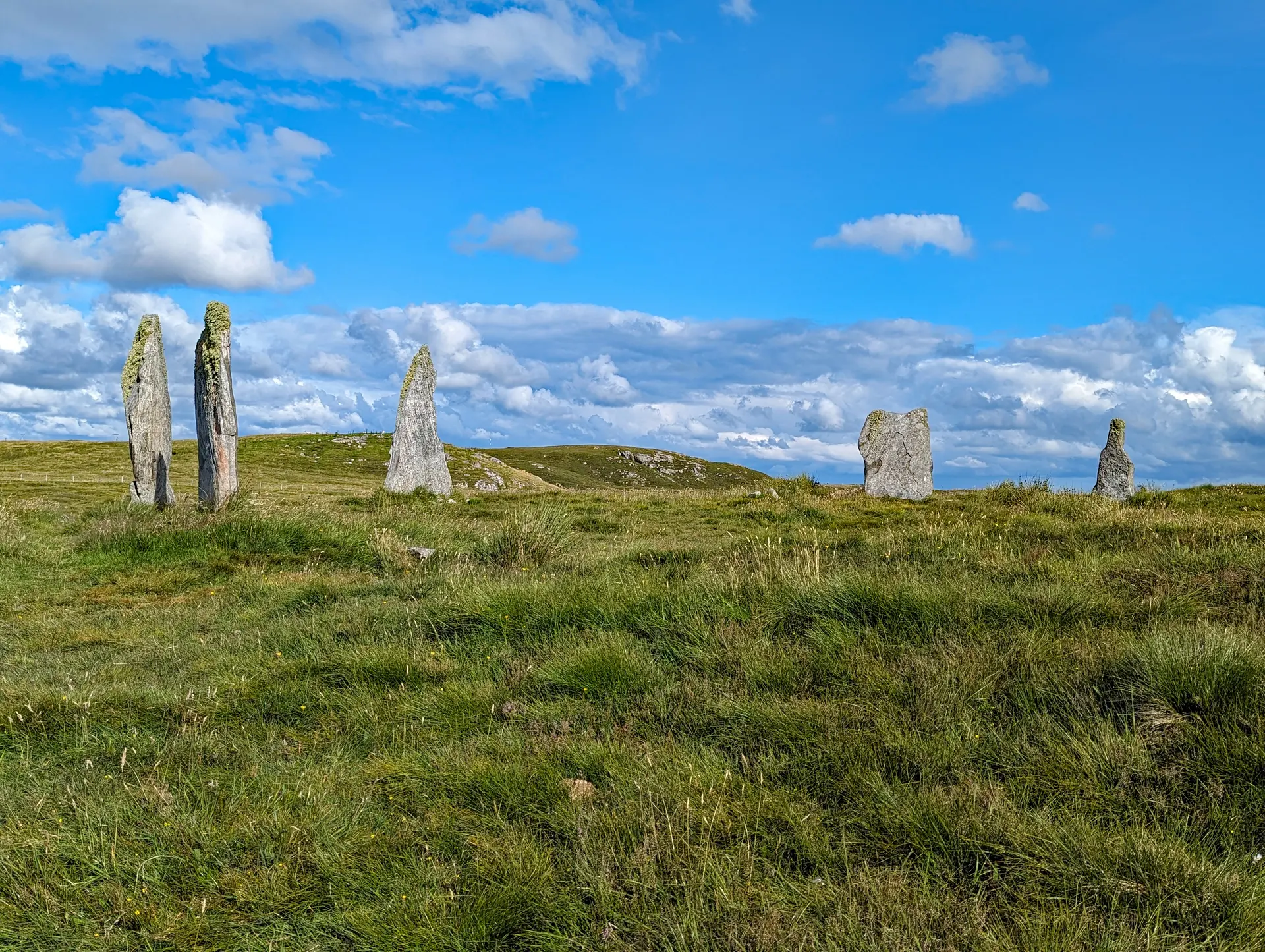
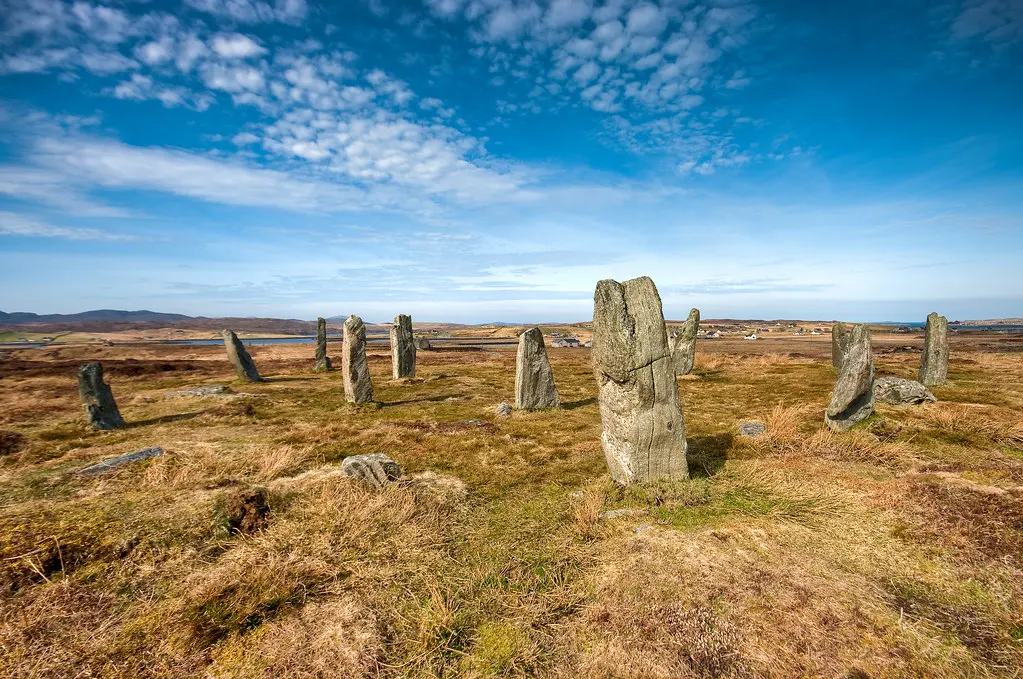
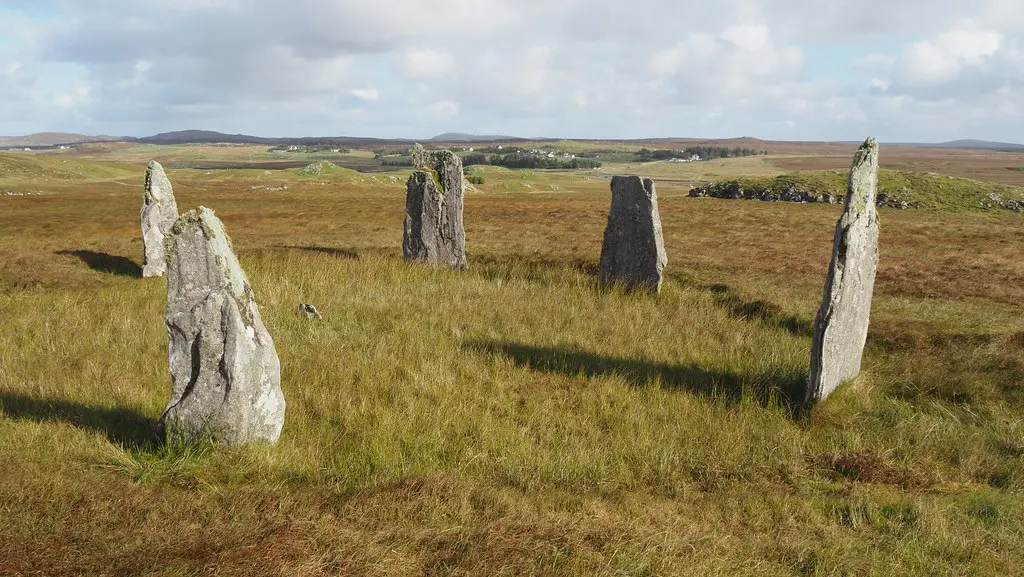
3 curated photos
Share a photo
Help visitors recognize Callanish Standing Stone Circle. Every submission is reviewed before publication.