Brihadeeswarar Temple
A thousand-year Chola temple conceived as the southern Mount Meru, still alive with daily worship
Thanjavur, Tamil Nadu, India

Plan this visit
Practical context before you go
1.5 to 3 hours.
On the south bank of the Cauvery in Thanjavur, Tamil Nadu; well connected by rail and road, with free entry. Open about 6:00 AM to 12:30 PM and 4:00 to 8:30 PM.
A living temple and World Heritage monument; all are welcome in the complex, though the inner sanctum may be restricted to Hindus.
At a glance
- Coordinates
- 10.7828, 79.1318
- Type
- Hindu Temple
- Suggested duration
- 1.5 to 3 hours.
- Access
- On the south bank of the Cauvery in Thanjavur, Tamil Nadu; well connected by rail and road, with free entry. Open about 6:00 AM to 12:30 PM and 4:00 to 8:30 PM.
Pilgrim tips
- Modest traditional attire; avoid shorts, mini-skirts, and sleeveless tops; remove footwear before entering the premises.
- Permitted for the exterior and architecture; prohibited inside the sanctum sanctorum and inner buildings.
- Photography is prohibited inside the sanctum, and inner-shrine access may be limited to Hindus. Footwear must be removed at the temple premises, and the granite grows very hot underfoot at midday.
Overview
The Brihadeeswarar Temple in Thanjavur, completed in 1010 CE under Rajaraja Chola I, is one of India's grandest Shiva temples and a UNESCO Great Living Chola Temple. Its ~60 m granite tower, colossal lingam, and monolithic Nandi still anchor daily Agamic worship and great festivals.
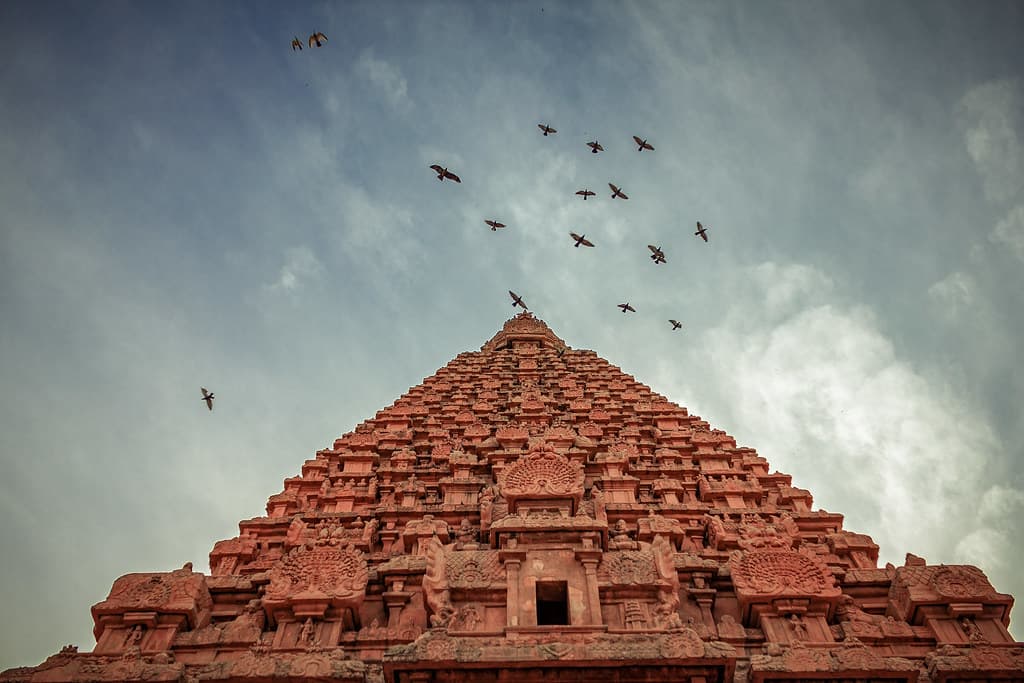
The Brihadeeswarar Temple, known in Tamil as Peruvudaiyar Kovil and historically as Rajarajeswaram, was the supreme architectural statement of the Chola empire at its height. Begun around 1003 and consecrated in 1010 CE under the emperor Rajaraja I, it was conceived as Dakshina Meru, the southern Mount Meru, a cosmic mountain-axis dedicated to Shiva. A granite vimana rising about sixty metres carries a capstone weighing roughly eighty tons, raised without mortar; a thirteen-foot monolithic Nandi faces the sanctum down a vast processional axis; and inside stands one of India's largest lingams, close to four metres tall.
What makes the temple remarkable is not only its scale but its continuity. For over a millennium it has remained a living seat of Shaiva worship, sustained by six daily Agamic services, the singing of Tamil Tevaram hymns, and a tradition of temple dance. UNESCO inscribed it in 1987, extending the property in 2004 to the Great Living Chola Temples alongside Gangaikondacholisvaram and Airavatesvara.
Visitors describe being overwhelmed by the scale of the vimana and gopuras, by golden-hour light on the granite, and by the depth of living ritual within a World Heritage monument. The temple's inscriptions name it the Mount Meru of the south, and the form of the tower still carries that cosmological claim. Popular accounts dwell on the engineering mystery of the capstone and on a no-shadow-at-noon legend that is largely folklore rather than established fact.
Context and lineage
Rajaraja Chola I endowed the temple in 1003 and completed it in 1010, installing a gold-plated kalasam atop the vimana to consecrate it. The towering vimana was designed to embody Mount Meru, the cosmic axis, and the temple's own inscriptions name it the Mount Meru of the south. The chief architect is named in tradition as Kunjara Mallan Raja Rama Perunthachan. The exact methods used to raise the massive granite blocks and the eighty-ton capstone remain debated.
Tamil Shaivism within the Chola Agamic temple tradition, sustained by Tevaram hymnody and temple dance for over a thousand years.
Rajaraja Chola I (Arulmozhi Varman)
Founder and patron
Kunjara Mallan Raja Rama Perunthachan
Chief architect
Tevaram hymnists (Nayanars)
Tamil Shaiva poet-saints
Vijayanagara-era patrons
Later custodians
UNESCO World Heritage Committee
Heritage authority
Why this place is sacred
The threshold quality of Brihadeeswarar is bound up with scale and with continuity. The vimana embodies Mount Meru, the axis of the cosmos, and standing at the base of its sixty-metre granite mass, with the eighty-ton capstone raised somehow without mortar, produces the awe the builders intended. Along the processional axis the thirteen-foot Nandi faces the great lingam, and the whole arrangement reads as an ordered cosmos in stone. Yet the temple is not a museum: six daily services, the singing of Tevaram hymns, and night-long Maha Shivaratri vigils with classical dance offered to Shiva as Nataraja sustain a line of worship over a thousand years long. Many visitors report a profound sense of cosmic order embodied in the Meru-form tower.
Traditions and practice
Worship includes abhishekam of the lingam with milk, honey, rose water, and sacred water; offerings of bilva leaves and oil lamps; and the recitation of Tevaram hymns.
Six daily Agamic services continue. The Maha Shivaratri night vigils are accompanied by an international classical dance festival, and Panguni Uthiram and the Aipasi Brahmotsavam bring major processions.
Walk the processional axis slowly and let the proportions register before moving close to the sanctum; if a festival coincides with your visit, the dance offerings give a vivid sense of how the temple has held art and worship together for a millennium.
Hinduism (Shaivism)
ActiveOne of the grandest Shiva temples in India, conceived by Rajaraja Chola I as Dakshina Meru, the southern Mount Meru, and enshrining a colossal lingam; it has been a continuous center of Shaiva worship, Tamil hymn (Tevaram) tradition, and temple dance for over a millennium.
Six daily Agamic worship services with abhishekam and Tamil and Sanskrit chanting; festivals including the Maha Shivaratri dance festival, Panguni Uthiram, and Aipasi Brahmotsavam.
Experience and perspectives
Visitors arrive and are first struck by sheer scale: the granite vimana, the great gopuras, and the play of golden-hour light across the stone. The monolithic Nandi and the colossal lingam set the proportions of the place, and the vast courtyard invites slow circumambulation. Beneath the architecture runs the depth of living worship, six daily Agamic services with abhishekam and chanting, that gives a World Heritage monument the charge of an active temple.
The cooler months of October to March are most comfortable. Golden hour, roughly half past five to half past six in the evening, is prized for photography of the granite. Festival times intensify everything: Maha Shivaratri brings night vigils and an international classical dance festival, while Panguni Uthiram and the Aipasi Brahmotsavam bring major processions. The temple opens about 6:00 AM to 12:30 PM and again 4:00 to 8:30 PM, closing for the midday break.
Remove footwear at the entrance, walk the processional axis past the Nandi toward the sanctum, then circle the courtyard to take in the vimana from each side; time the visit for late afternoon to catch golden light on the granite.
Brihadeeswarar is read at once as the supreme achievement of Chola architecture and as a living abode of Shiva.
Art and architectural historians regard the Brihadisvara as the supreme achievement of Chola temple architecture, precisely dated by extensive inscriptions and recognized by UNESCO as the centerpiece of the Great Living Chola Temples.
For Tamil Shaivas it is a living abode of Shiva as Dakshina Meru, sustained by Agamic ritual, Tevaram hymnody, and temple dance for over a thousand years.
Popular accounts dwell on the 'mystery' of how the eighty-ton capstone was raised and on the cosmological symbolism of the Meru-form vimana.
The exact engineering methods used to raise the massive granite blocks and capstone remain debated; the long-claimed no-shadow-at-noon legend is largely folklore rather than established fact, and the vimana's quoted height varies by source depending on the point measured.
Visit planning
On the south bank of the Cauvery in Thanjavur, Tamil Nadu; well connected by rail and road, with free entry. Open about 6:00 AM to 12:30 PM and 4:00 to 8:30 PM.
Thanjavur offers a wide range of hotels and guesthouses within easy reach of the temple; book ahead around Maha Shivaratri and the dance festival.
A living temple and World Heritage monument; all are welcome in the complex, though the inner sanctum may be restricted to Hindus.
Modest traditional attire; avoid shorts, mini-skirts, and sleeveless tops; remove footwear before entering the premises.
Permitted for the exterior and architecture; prohibited inside the sanctum sanctorum and inner buildings.
Bilva leaves, milk and ghee for abhishekam, flowers, and oil lamps are customary.
Silence and decorum in the sanctum; non-Hindus may be restricted from the innermost shrine; do not touch carvings or inscriptions.
Plan your visit
Address
Balaganapathy Nagar, Thanjavur, Tamil Nadu 613001, India
Phone
Hours
Hours, fees, and access can change — verify on the official source before you travel. Practical details last checked Jun 2026.
Nearby sacred places
Sacred places within a half-day’s reach. Pilgrims often visit them together: walk one, stay for the other.
Brihadeeswara Temple, Thanjavur, Tamil Nadu
Thanjavur, Tamil Nadu, India
0.0 km away
Adi Kumbeswarar Temple, Kumbakonam, Tamil Nadu
Kumbakonam, Tamil Nadu, India
32.6 km away

Kalahasteeswarar Temple, Kumbakonam, Tamil Nadu
Kumbakonam, Tamil Nadu, India
33.7 km away
Sri Mahalingaswamy Temple
Priranavidagam, Tamil Nadu, India
42.2 km away
References
Sources consulted when researching this page. Independent verification by readers is welcome.
- 01Brihadisvara Temple — Wikipedia — Wikipedia contributorshigh-reliability
- 02Great Living Chola Temples — UNESCO World Heritage Centre — UNESCOhigh-reliability
- 03Brihadishvara temple — Encyclopaedia Britannica — Encyclopaedia Britannicahigh-reliability
- 04Brihadeeswarar Temple: Timeless Majesty — Incredible India — Ministry of Tourism, Government of Indiahigh-reliability
- 05Brihadeeswara Temple, Thanjavur — Tamil Nadu Tourism (UNESCO WHS) — Government of Tamil Nadu, Department of Tourismhigh-reliability
- 06Brihadeeswarar Temple Tanjore — Timings, History & Darshan Guide — Tamil Nadu Tourism — Government of Tamil Nadu, Department of Tourismhigh-reliability
- 07The Brihadeshwara Temple, Thanjavur — Gods' Collections — Gods' Collections (research project)high-reliability
- 08Brihadeeswarar Temple — Timings, Dress Code & Photography Guide — Tamil Nadu Tourism (visitor guide)
Key questions
What pilgrims usually ask
- Why is Brihadeeswarar Temple considered sacred?
- Brihadeeswarar Temple in Thanjavur is a 1010 CE Chola masterpiece and UNESCO site, with a ~60 m granite tower, colossal lingam, and living Shaiva worship.
- What should I wear at Brihadeeswarar Temple?
- Modest traditional attire; avoid shorts, mini-skirts, and sleeveless tops; remove footwear before entering the premises.
- Can I take photos at Brihadeeswarar Temple?
- Permitted for the exterior and architecture; prohibited inside the sanctum sanctorum and inner buildings.
- How long should I spend at Brihadeeswarar Temple?
- 1.5 to 3 hours.
- How do you visit Brihadeeswarar Temple?
- On the south bank of the Cauvery in Thanjavur, Tamil Nadu; well connected by rail and road, with free entry. Open about 6:00 AM to 12:30 PM and 4:00 to 8:30 PM.
- What offerings are appropriate at Brihadeeswarar Temple?
- Bilva leaves, milk and ghee for abhishekam, flowers, and oil lamps are customary.
- What etiquette should visitors follow at Brihadeeswarar Temple?
- A living temple and World Heritage monument; all are welcome in the complex, though the inner sanctum may be restricted to Hindus.
- What is the history of Brihadeeswarar Temple?
- Rajaraja Chola I endowed the temple in 1003 and completed it in 1010, installing a gold-plated kalasam atop the vimana to consecrate it. The towering vimana was designed to embody Mount Meru, the cosmic axis, and the temple's own inscriptions name it the Mount Meru of the south. The chief architect is named in tradition as Kunjara Mallan Raja Rama Perunthachan. The exact methods used to raise the massive granite blocks and the eighty-ton capstone remain debated.