Belur Chennakeshava Temple, Karnataka
A nine-century-old Hoysala soapstone masterpiece on the Yagachi, still alive with daily Vaishnava worship
Understand sacred places, explore living traditions, and learn how to engage respectfully with Pilgrim Map.
Access has not been verified. Check current local guidance before planning a visit.
Bellotte, Karnataka, India
Read the sources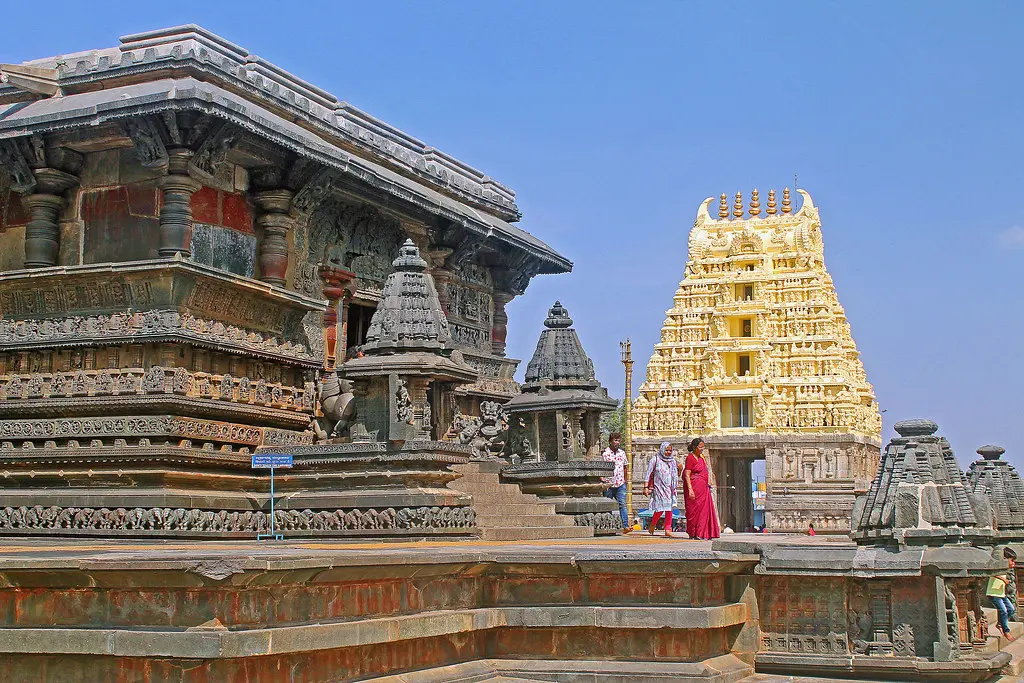
Image of Belur Chennakeshava Temple, Karnataka. Image source
Visit essentials
A quick read before you go
- Duration
- 2–3 hours to take darshan and study the sculpture; longer for those combining Halebidu.
- Access
- In Belur town, Hassan district, Karnataka, on the banks of the Yagachi River, about 35 km from…
Overview
On the Yagachi River at Belur, Chennakeshava Temple has remained a living place of worship for over nine centuries. Hoysala king Vishnuvardhana commissioned and consecrated it in 1117 CE; roughly a century of carving followed. Dedicated to Vishnu as Chennakeshava, 'handsome Keshava,' it remains a Sri Vaishnava centre. Its soft soapstone carries minute bracket figures, narrative friezes, lathe-turned pillars, and the celebrated Darpana Sundari, the 'lady with the mirror,' around a star-shaped jagati made for ritual circumambulation.
Successive wars damaged the temple and repairs reshaped it, but daily pooja never ceased. UNESCO inscribed it in 2023 within the 'Sacred Ensembles of the Hoysalas.' Daily abhishekam and archana meet devotional art here, producing what many describe as a meditative, time-collapsing experience of worship and wonder.
Why this place is sacred
Chennakeshava's depth comes from the meeting of continuity and craft. Daily pooja has been offered at the same sanctum for nine hundred years — an unbroken thread of devotion that survived wars, damage and repeated repair — so the temple is not a ruin to be admired but a living shrine still receiving its god. Around that living centre lies an almost unaccountable density of soapstone carving: the bracket figures, the narrative friezes, the Darpana Sundari, each demanding close attention.
The star-shaped jagati platform invites you to walk the building slowly, clockwise, the way ritual circumambulation intends. The combination — active darshan and the contemplation of the carvings — tends to draw visitors into both devotional and aesthetic absorption at once.
A Vaishnava temple commissioned by King Vishnuvardhana in 1117 CE to honour Vishnu as Chennakeshava and, by tradition, to commemorate his victory over the Cholas at Talakad.
Built and carved over roughly a century in the Hoysala Karnata Dravida tradition, damaged in successive wars and repaired across the Hoysala and Vijayanagara eras while remaining an active temple; inscribed by UNESCO in 2023 as part of the Sacred Ensembles of the Hoysalas.
Experience and orientation
Visitors are awed by the minutely detailed soapstone sculpture and by the sense of a still-living temple within a masterpiece monument. You may take darshan and join pooja, or simply explore the carvings (photography is restricted inside the sanctum). The star-shaped jagati platform invites a slow clockwise walk around the building, taking in the friezes at eye level. Many describe a meditative, time-collapsing experience: the active worship and the contemplation of nine-century-old carving fold into one another.
Good daylight matters here — the detail rewards careful looking — and the calmest hours are early morning and evening.
The temple stands on a star-shaped jagati platform on the banks of the Yagachi at Belur, the sanctum holding Vishnu as Chennakeshava and the exterior surfaces carrying the carving. Photography is restricted inside the sanctum; for darshan hours see the practices below.
Context and lineage
King Vishnuvardhana commissioned the temple in 1117 CE, traditionally linked to his military victory over the Cholas at Talakad in 1116 and counted among the 'five foundations' of his reign. Hoysala tradition attributes much of the carving genius to legendary master sculptors. The temple was built, damaged in successive wars, and repeatedly repaired across the Hoysala and Vijayanagara eras. The deity Chennakeshava — 'handsome' or 'lovely' Keshava — gives the temple its name.
Sri Vaishnavism (Hinduism) in the lineage of Ramanujacharya, under Hoysala royal patronage and later Vijayanagara-era patronage and additions.
Vishnuvardhana
Founder-king
Jakanachari (tradition)
Master sculptor
Ramanujacharya
Sri Vaishnava teacher
Vijayanagara patrons
Later patrons and restorers
Traditions and practice
Vaishnava abhishekam, archana, aarti and seasonal utsavas; processional and car-festival traditions.
Daily darshan and poojas (typically around 7 AM–1 PM and afternoon to about 8 PM), with festival peaks such as Makar Sankranti in January and the local Kambala season; an ASI-protected monument under active worship.
Take darshan if you wish, then give the carvings the slow looking they were made for — walk the jagati platform clockwise and let the friezes and bracket figures reveal their detail. Come in good daylight, and consider the early-morning or evening hours when the temple is calmest, so that worship and contemplation can sit together.
Sri Vaishnavism (Hinduism)
ActiveDedicated to Vishnu as Chennakeshava ('handsome Keshava'), the temple has been a centre of Vaishnava worship since 1117 CE and reflects the Hoysala rulers' devotion to Sri Vaishnavism in the lineage of Ramanujacharya.
Daily darshan, abhishekam, archana and pooja; festival observances including Makar Sankranti and car festivals.
Perspectives and open questions
Chennakeshava is read as a foundational Hoysala monument, a living abode of Vishnu, and a sculptural expression of worldly beauty within sacred space.
Scholarly perspective
A foundational monument of the Hoysala Karnata Dravida architectural tradition (1117 CE, Vishnuvardhana), celebrated for its soapstone sculpture; UNESCO-inscribed in 2023, repeatedly damaged and restored, and continuously an active Vaishnava temple.
Living and traditional perspectives
For devotees it is the living abode of Chennakeshava (Vishnu), a centre of Sri Vaishnava worship in the line of Ramanujacharya, where daily pooja has continued for nine centuries.
Alternative interpretations
The madanika bracket figures and auspicious motifs are read in some interpretations as expressions of fertility, auspiciousness and the integration of worldly beauty within sacred space.
Open questions
Debates persist over the identities and methods of the master artisans, the original polychromy or finishing of the soapstone, and the full extent of any pre-Hoysala sanctity at the site; the number of madanika figures is cited variously as 38 or 42, with consensus at 38 on the exterior.
Plan your visit
Access and arrival
In Belur town, Hassan district, Karnataka, on the banks of the Yagachi River, about 35 km from Hassan and about 16 km from Halebidu. Reached by road from Hassan, Mysuru and Bengaluru; nearest railhead Hassan.
Respectful visit
Modest, traditional dress for men and women; footwear removed before entering the temple.
Permitted in the premises and of the exterior sculpture; restricted or prohibited inside the sanctum sanctorum.
Flowers, fruit and traditional pooja offerings made through the temple priests.
Maintain silence and reverence during rituals; do not touch or lean on the carvings; follow ASI and temple-authority guidelines.
Observe the temple decorum noted under etiquette — in particular, the soft soapstone carvings must not be touched. During Makar Sankranti and festival peaks the crowds are heavy.
Current practical details
Address
5V76+54P, Belur, Karnataka 573115, India
Hours
Hours, fees, and access can change — verify on the official source before you travel. Practical details last checked Jun 2026.
Location
Map loads as you approach this section.
Pilgrim reflections
A portrait of encounter, not a score
Pilgrims describe what they felt, how present they could become, and whether the place would shape a journey. There are no stars and no ranking of traditions.
No reviewed reflections yet
The first pilgrims can help describe the character of being here.
Share a reflection
Available after an account-backed “Been there.” Every reflection is reviewed before publication.
Nearby sacred places
Explore other sacred places in the region. Proximity does not establish access or travel time; check each place’s guidance.



References
Sources consulted for this page. Source categories describe the publication, not a guarantee that every claim is verified. Traditional accounts and outside interpretations may differ.
- 01Chennakeshava Temple, Belur — Wikipedia — Wikipedia contributorsacademicConfirms 1117 CE commissioning by Vishnuvardhana on the Yagachi, Karnata Dravida Hoysala style, 2023 UNESCO inscription as Sacred Ensembles of the Hoysalas, repeated damage and restoration.
- 02Chennakeshava Temple, Belur — Hassan District, Government of Karnataka — Hassan District AdministrationofficialOfficial district source on the temple's history, bracket figures and significance.
- 03Noteworthy Bracket Figures — Chennakeshava Temple Beluru (Exhibits@Jio Institute) — Jio InstituteacademicScholarly exhibit on the madanika/shilabalika bracket figures and temple plan.
- 04The Chennakeshava Temple – the Marvel of Belur — CIS Indus (Indic Varta)academicDetailed account of Hoysala architecture, jagati platform and Sri Vaishnava context.
- 05Chennakesava Temple, Belur – A Hoysala Marvel — Karnataka.comSource contextConstruction over generations, Talakad victory context, Darpana Sundari and madanika sculptures.
- 06Chennakeshava Temple, Belur — Timings, History & Darshan Guide — IndianpanoramaSource contextDarshan timings, active Vaishnava worship, dress and photography guidance.
- 07Chennakeshava Temple, Belur (Sri Channa Keshava Swamy) — Pooja Timings, Rituals, Significance & History — OneindiaSource contextVaishnava rituals, Ramanujacharya/Sri Vaishnavism link, festival information.
Photo gallery
3 curated photos
Share a photo
Help visitors recognize Belur Chennakeshava Temple, Karnataka. Every submission is reviewed before publication.