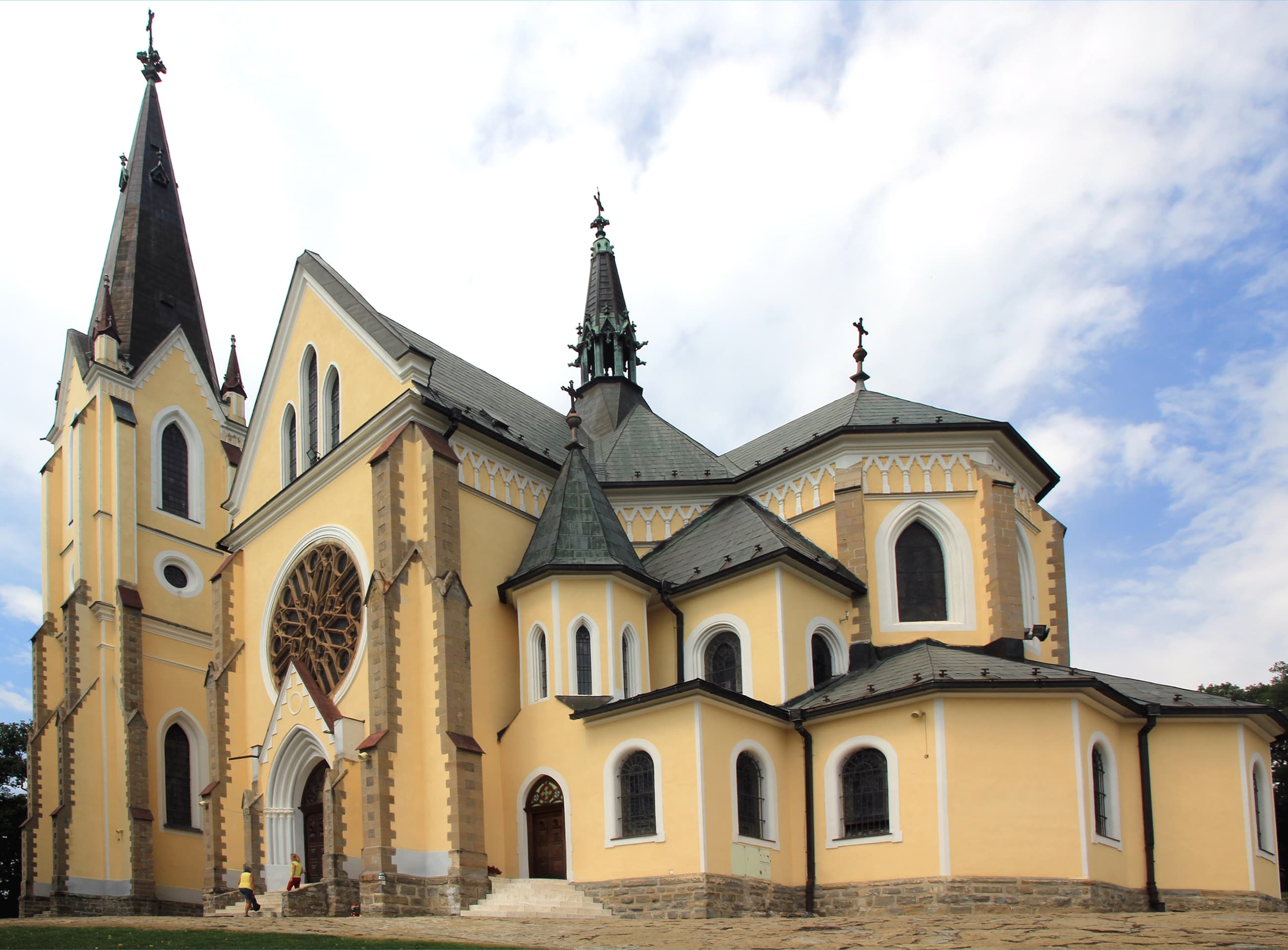
Basilica of the Visitation of the Blessed Virgin Mary, Marian Hill in Levoča, Slovakia
Slovakia's greatest pilgrimage, where 500,000 climb a hill their ancestors climbed for 800 years
Understand sacred places, explore living traditions, and learn how to engage respectfully with Pilgrim Map.
Access has not been verified. Check current local guidance before planning a visit.
Levoča, Prešov, Slovakia
Visit essentials
A quick read before you go
- Duration
- 1-2 hours for a basic visit including the climb and basilica.
- Etiquette
- Standard Catholic etiquette applies: modest dress, quiet during Mass, respectful behavior in the…
Overview
Each July, 500,000 to 600,000 pilgrims gather on an eastern Slovakian hillside, continuing a tradition born under invasion. In 1241-1242, Tartar forces swept the region; people from Levoca and nearby villages survived by fleeing to the fortified hill behind today's Marianska Hora—Marian Hill. In thanksgiving they built a chapel below and began an annual procession.
Nearly 800 years later, over 10% of Slovakia's population attends the main pilgrimage weekend around July 2, the Feast of the Visitation. At night, pilgrims climb by candlelight, the hillside flames showing a nation at prayer. The present basilica, completed in 1914 after the original chapel became too small, was later raised to minor-basilica rank by Pope John Paul II, who visited in person.
The procession endured the medieval world's decline, the Austro-Hungarian Empire's dissolution, and decades of Communist suppression of religion. Emperor Joseph II banned pilgrimages throughout his empire in 1787, and Communists promoted atheism; Levoca's people kept coming. Today Slovaks and international visitors—especially from neighboring Poland, with its intense Marian devotion—make the climb. The Alley of John Paul II leads to the basilica through five chapels commemorating his visit and offering reflection stations.
Why this place is sacred
The thinness of Marianska Hora builds through repetition. One year of pilgrimage is meaningful. Eight hundred years of pilgrimage creates something that exceeds the sum of individual visits. Each pilgrim who climbs the hill walks where countless others have walked, prays where countless others have prayed, adds their intention to an accumulation that stretches back to those medieval survivors giving thanks for deliverance.
The night procession makes this thinness visible: each candle a person, each person a prayer, all moving toward the same goal. The visual is not staged for effect but emerges naturally from the pilgrimage structure. This is what devotion looks like when it gathers in numbers.
The origin in thanksgiving shapes what the site holds. This was not a place where miracle appeared or vision descended. This was a place where people survived and gave thanks. The gratitude of those survivors became the first deposit in an account that has been added to ever since. Every pilgrimage since has been, in some sense, thanksgiving—for deliverance, for answered prayer, for the simple fact that the tradition continues.
Pope John Paul II's visit in 1995 added its own layer. Here was a Polish pope—the first non-Italian pope in centuries—coming to a Slovak shrine that shared Poland's Marian intensity. The 650,000 who gathered were not simply attending a papal event; they were witnessing the intersection of their tradition with universal Catholicism. The pope blessed what they had maintained through Communist decades when blessing was unwelcome.
For pilgrims who climb today, the thinness operates through participation. You are not observing a tradition but joining it. Your candle is one of thousands. Your steps follow millions. Whatever you carry up the hill—intention, gratitude, grief, hope—you add to what the hill already holds.
The original purpose was thanksgiving. The villagers who survived the Tartar invasion built a chapel to express gratitude for their deliverance. The annual procession that developed maintained this thanksgiving across generations. The site's purpose has never fundamentally changed: this is where people come to thank Mary for protection and to seek her intercession.
The chapel that Tartar survivors built was first mentioned in documents from 1247. It was enlarged in 1470 as pilgrimage numbers grew. By the early 20th century, the medieval structure could no longer accommodate the crowds, and construction began on the present church in 1903.
The building process faced setbacks—the tower collapsed in 1908, delaying completion until 1914. Bishop John Vojtassak consecrated the new church on July 2, 1922, establishing the date that remains the center of the pilgrimage calendar.
Communist rule (1948-1989) brought pressure against religious observance, but the pilgrimage persisted. The state could not entirely suppress something so deeply embedded in Slovak identity. When Communism fell, the pilgrimage emerged from suppression larger than before.
Pope John Paul II's elevation of the church to minor basilica in 1984 and his personal visit in 1995 marked international recognition of what Slovaks had always known: this was one of the great Marian pilgrimages of Central Europe, a tradition that had outlasted empires.
Experience and orientation
Approaching Marianska Hora, you first see the basilica on the hillside above Levoca, the town spires below and the Spis countryside spreading toward the High Tatras on the horizon. The setting is not dramatic in the manner of Alpine peaks but carries the gentler beauty of Central European hill country—a landscape shaped by centuries of human habitation.
The climb to the basilica can follow the Alley of John Paul II, a path marked by five chapels that offer stations for reflection. Walking this alley, you join your steps to those of the millions who have made this climb since the 13th century. The path is not steep but requires effort—enough to feel that you are making a pilgrimage, not simply visiting.
The basilica itself holds approximately 2,000 people but overflows during the July pilgrimage, when crowds gather on the hillside and in the surrounding grounds. Inside, the altar focuses devotion on Mary—the Visitation that gives the basilica its name, the moment when Mary visited Elizabeth and the unborn John the Baptist leaped in recognition.
Outside of the main pilgrimage, the basilica is quieter—open daily from spring through autumn for visitors and smaller-scale devotion. The view from the hilltop rewards the climb: Levoca below with its medieval center (the Church of St. James houses the world's tallest Gothic wooden altar), the fields and forests of Spis extending toward the mountains.
The night procession during the July pilgrimage is the experience that defines Marianska Hora. As darkness falls, pilgrims light candles and begin the climb. Thousands of flames move through the night, a river of light flowing uphill. There is singing, prayer, the steady movement of a crowd united in purpose. By the time you reach the basilica, you have participated in something that statistics cannot convey.
For visitors who cannot attend the July pilgrimage, any visit offers a smaller-scale encounter with the tradition. You can walk the Alley of John Paul II, enter the basilica, pray or reflect, and carry away something of what the hill holds.
Marianska Hora is located outside Levoca in eastern Slovakia (Spis region). Levoca is accessible by road from Poprad (25 km, with rail and air connections) or Presov. The basilica is open daily from spring through autumn. The main pilgrimage takes place around July 2 (Feast of the Visitation). If visiting during the pilgrimage, expect very large crowds and plan accommodation well in advance.
Context and lineage
In 1241, Tartar armies swept through Central Europe, devastating everything in their path. The people of the Levoca region fled to the fortified hill behind what is now Marianska Hora. There, protected by the hill's defenses, they waited as the invasion passed. When the danger ended and they emerged alive, they built a chapel on the slopes below in thanksgiving for their deliverance.
This is not a legend of miraculous intervention but a story of survival and gratitude. The chapel was not built because Mary appeared or spoke. It was built because people lived through something terrible and wanted to give thanks. That impulse—thanksgiving for survival—became the foundation for nearly eight centuries of pilgrimage.
The pilgrimage to Marianska Hora belongs to the broader tradition of Central European Marian devotion, particularly strong in Slovakia, Poland, and neighboring countries. The intensity of Marian pilgrimage in this region—the crowds, the processions, the persistence through oppressive regimes—distinguishes it from the more individualized piety of Western Europe. The Levoca pilgrimage stands among the largest expressions of this regional tradition.
Bishop John Vojtassak
Consecrated the new church on July 2, 1922, establishing the date that remains central to the pilgrimage calendar. Later served during Communist persecution and was beatified in 2025.
Pope John Paul II
Elevated the church to minor basilica in 1984 and visited in person on July 3, 1995, when approximately 650,000 pilgrims gathered—the largest gathering in Slovak history at that time.
Traditions and practice
The traditional practice at Marianska Hora is pilgrimage itself—the physical act of climbing the hill to the basilica. The night procession during the July pilgrimage continues what medieval pilgrims began: approaching the sacred site on foot, by candlelight, as an act of devotion.
Mass and confession anchor the pilgrimage in sacramental practice. Pilgrims often prepare through confession before the main feast day, approaching the basilica in a state of grace. The rosary is prayed, both privately and in organized groups.
The thanksgiving established by the Tartar survivors continues. Pilgrims bring intentions—petitions and gratitude—to offer at the basilica. What began as thanksgiving for deliverance has expanded to encompass the full range of human need and gratitude.
Contemporary practice maintains the traditional forms while accommodating modern scale. The July pilgrimage attracts international visitors alongside Slovaks, particularly from Poland, Austria, and Hungary. Special Masses during the pilgrimage weekend accommodate different language groups.
The Alley of John Paul II, added after the 1995 papal visit, provides structured devotion for the climb—five chapels with occasions for reflection. This path has become integral to the pilgrimage experience.
The night procession remains the central practice. Contemporary pilgrims carry candles as their predecessors did, creating the river of light that defines Marianska Hora in the collective imagination. Photographs and videos of the procession circulate widely, drawing attention to a tradition that might otherwise be known only locally.
If you visit during the July pilgrimage, participate fully: climb the hill, join the night procession, attend Mass, let yourself be part of the crowd. The experience is communal; individual piety merges into collective devotion.
If you visit outside the main pilgrimage, walk the Alley of John Paul II, pausing at each chapel. Enter the basilica, sit in silence, offer whatever you carry. Climb back down slowly, letting the experience settle.
Whether or not you share the Catholic faith that animates the pilgrimage, you can approach with respect for what generations of prayer have created here. You can recognize that without claiming it.
Pilgrimage to Marianska Hora
ActiveThe most important pilgrimage in Slovakia, drawing 500,000-600,000 pilgrims annually for the July 2 feast—over 10% of the national population. The tradition dates to the 13th century, beginning as thanksgiving for deliverance from Tartar invasion.
Annual pilgrimage around July 2. Night procession with candles from the town to the basilica. Mass and confession. Walking the Alley of John Paul II. Thanksgiving and petition.
Thanksgiving for Deliverance from the Tartars
ActiveThe pilgrimage originated in thanksgiving for survival during the Tartar invasion of 1241-1242. The villagers who survived built a chapel below the hill where they had sheltered. The annual procession continues this thanksgiving.
Annual procession maintaining the tradition of thanksgiving. The structure of the pilgrimage—climbing the hill to give thanks—replicates the original descent from refuge and the subsequent offering of gratitude.
Perspectives and open questions
Marianska Hora is understood as Slovakia's most important pilgrimage site—a place where national identity, Catholic faith, and eight centuries of tradition converge. The scale of the July pilgrimage (10%+ of the national population) makes it a social phenomenon as well as a religious one.
Scholarly perspective
The Levoca pilgrimage has been studied as an example of persistent popular religion—a tradition that survived imperial prohibition (Joseph II's 1787 ban on pilgrimages) and Communist suppression to emerge stronger than before. Sociologists note the pilgrimage's role in Slovak national identity, particularly during periods of political oppression when religion provided an alternative source of meaning.
The pilgrimage's scale is remarkable even in a European context. Drawing 10-12% of the national population to a single event exceeds most comparable gatherings, religious or secular.
Living and traditional perspectives
From the Catholic perspective, Marianska Hora is a privileged place of Marian devotion where prayers are offered and received, where the faithful encounter Mary's intercession, where thanksgiving for past protection and petitions for future help converge. The papal visit and basilica elevation confirm the site's significance within universal Catholic tradition.
From the Slovak perspective, the pilgrimage represents continuity. To climb Marianska Hora is to walk where ancestors walked, to join a procession that binds generations together.
Plan your visit
Access and arrival
Hotels and pensions in Levoca. More options in Poprad (25 km). During the July pilgrimage, accommodation books months in advance—plan early.
Respectful visit
Modest dress appropriate for Catholic church. Shoulders covered. No shorts or revealing clothing. Comfortable footwear for the climb.
Photography is generally permitted but should not disrupt worship or the night procession. Be sensitive to fellow pilgrims.
Votive candles are available. Donations support the shrine. Candles for the night procession may be purchased locally.
{"Maintain reverence during Mass and processions","Non-Catholics should not receive Communion","Dress modestly","Photography should not disrupt devotion","Parking restrictions during July pilgrimage—follow local direction"}
The July pilgrimage draws very large crowds. Logistics can be challenging—parking, accommodation, food service. Plan in advance. The night procession involves walking in darkness with thousands of others; watch your footing.
Current practical details
Address
Námestie Majstra Pavla 52, 054 01 Levoča, Slovakia
Phone
Hours
Hours, fees, and access can change — verify on the official source before you travel. Practical details last checked Jun 2026.
Location
Map loads as you approach this section.
Pilgrim reflections
A portrait of encounter, not a score
Pilgrims describe what they felt, how present they could become, and whether the place would shape a journey. There are no stars and no ranking of traditions.
No reviewed reflections yet
The first pilgrims can help describe the character of being here.
Share a reflection
Available after an account-backed “Been there.” Every reflection is reviewed before publication.
Nearby sacred places
Explore other sacred places in the region. Proximity does not establish access or travel time; check each place’s guidance.

St Martin's Cathedral at Spišská Kapitula
Spišské Podhradie, Spišské Podhradie, Prešov Region, Slovakia
11.2 km away

Church of the Holy Spirit at Žehra
Žehra, Žehra, Košice Region, Slovakia
15.6 km away

Wooden Articular Church at Kežmarok
Kežmarok, Kežmarok, Prešov Region, Slovakia
17.3 km away

Zvir Mountain Pilgrimage Site
Litmanová, Litmanová, Prešov Region, Slovakia
39.3 km away
Photo gallery
3 curated photos
Share a photo
Help visitors recognize Basilica of the Visitation of the Blessed Virgin Mary, Marian Hill in Levoča, Slovakia. Every submission is reviewed before publication.